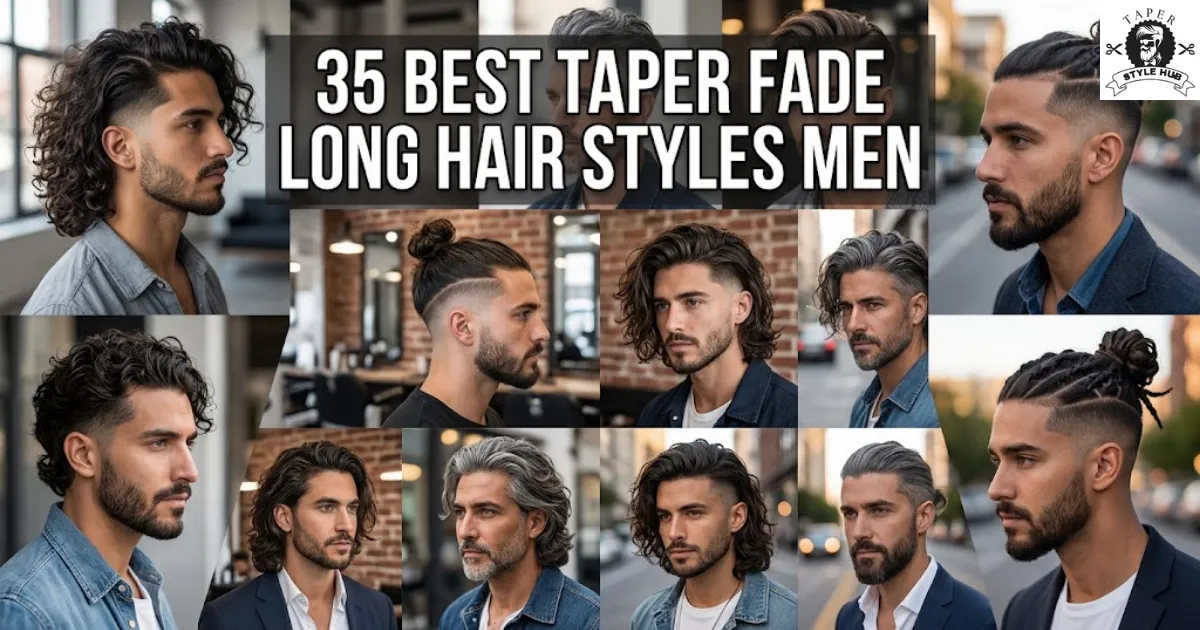
35 Best Taper Fade Long Hair Styles Men
Taper fade long hair is one of the most balanced looks a man can wear right now. The sides and neckline get gradually shorter, while the top keeps the length, texture and movement most guys refuse to give up. It looks sharp at the office and just as good on a lazy weekend.
Plenty of men grow their hair out and then watch it turn shapeless around the ears and neck. A taper fade long hair cut solves that problem without a major chop. It adds structure to the outline, so the length on top looks intentional instead of simply grown out.
This guide explains what the cut really is, how low, mid and high tapers behave on longer hair, and 35 styles worth saving to your phone. You will also find barber wording, a home tutorial, face shape advice, product picks and a realistic upkeep plan.
👉 Also Read: Taper Fade Mid
Taper Fade Long Hair Guide: Everything to Know Before Your Next Haircut
Before choosing a taper fade long hair style, it helps to understand the building blocks. Once you know how fade height, top length and hair texture work together, every photo online makes more sense. Conversations with your barber also get much easier.
👉 Also Read: Taper Fade Buzz Cut
What Is a Taper Fade Long Hair Cut?
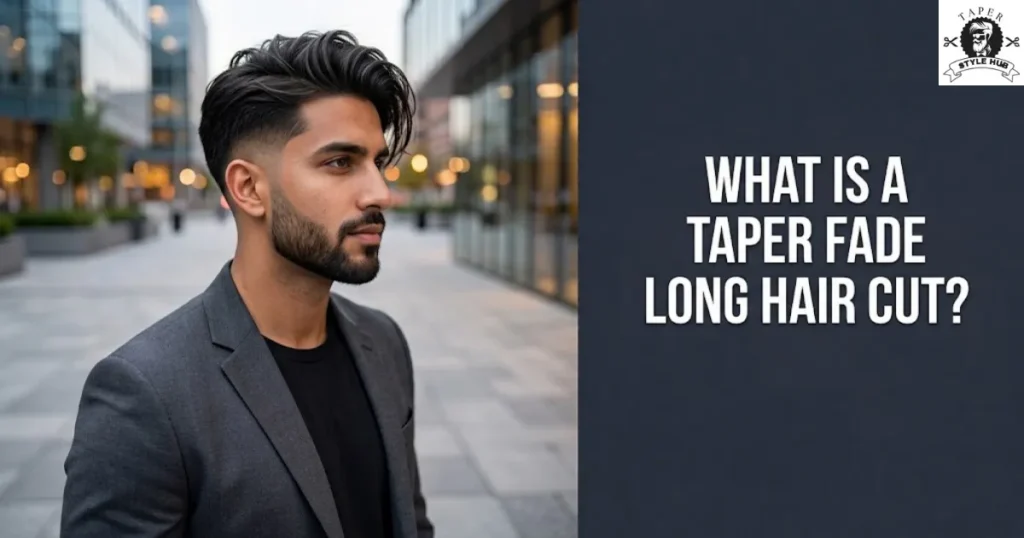
A taper fade long hair cut shortens the sides and back in gradual steps, starting at the sideburns and neckline and moving upward. The hair on top stays long, usually three inches or more. The result is a smooth outline with plenty of length left to style.
The word taper describes the slow change in length, while fade describes how softly the sections blend together. Barbers often use both terms loosely, so a reference photo always helps your barber picture the exact finish you want.
👉 Also Read: Taper Fade Long on Top
How the Taper and the Length Work Together
In a taper fade long hair cut, the taper handles the edges and the long top handles the personality. Short, tidy sides next to flowing hair create a strong visual contrast. That contrast makes the cut look polished from the front, the side and the back.
👉 Also Read: Buzz Cut Taper Fade
Taper Fade vs Full Fade on Long Hair
A taper changes length gently and usually leaves more hair around the ears and neck. A full fade drops faster and often goes close to the skin. On long hair, a taper fade long hair cut reads as the softer, more conservative choice.
👉 Also Read: Hispanic Long Hair Taper Fade
Why Taper Fade Long Hair Is So Popular Right Now
Men who grow their hair out often miss the clean, structured look of shorter cuts. A taper fade long hair cut delivers both at once. The sides keep the look groomed, and the top gives you styling options that short cuts simply cannot offer.
It also photographs well. The contrast between tight sides and flowing length looks sharp on screen, which is a big reason this cut keeps showing up on social media and in barbershops everywhere.
Who Should Get a Taper Fade Long Hair Cut?
Almost anyone with enough length on top can wear this cut, but it rewards certain habits. If you like variety in styling, you will enjoy it. The top lets you switch between loose, tied back and swept, while the outline always stays neat.
It also suits men who want to look professional without cutting everything short. A taper fade long hair look passes in most offices, and it still feels creative. Your hair type and routine matter more than your age or job.
It is a weaker fit if you dislike regular barber visits. The sides need attention more often than the top, and a neglected taper loses its crispness quickly. Be honest about how much upkeep you will actually do.
Taper Fade Long Hair Heights: Low vs Mid vs High
Fade height changes the whole feel of the haircut. The table below shows how each height behaves when the hair on top stays long. Use it as a quick reference before you book your appointment.
| Feature | Low Taper | Mid Taper | High Taper |
|---|---|---|---|
| Contrast | Subtle | Moderate | Strong |
| Side length kept | Most | Balanced | Least |
| Visible with hair down | Barely | Clearly | Prominently |
| Upkeep | Longest gaps | Moderate | Shortest gaps |
| Best for | First timers | Most men | Bold looks |
No height is objectively best for taper fade long hair. Lower tapers keep more side coverage and are safer if you dislike scalp showing, while higher tapers create more contrast. Contrast makes a fresh cut look sharp, but it also makes regrowth obvious sooner.
Taper Fade Long Hair vs Undercut and Skin Fade
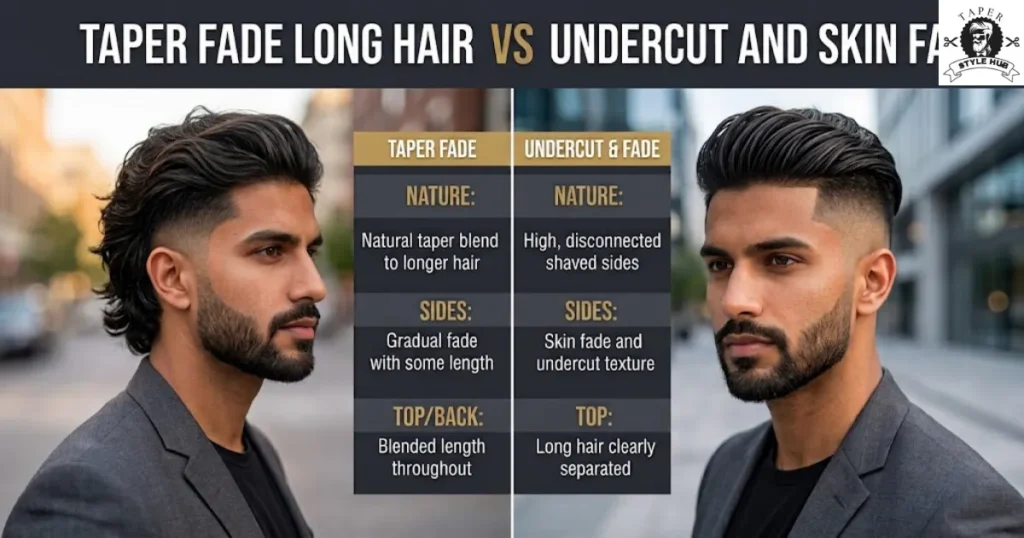
These three cuts get mixed up all the time, especially in online searches. They share short sides and a long top, yet the transition and the finish are different. Knowing the difference helps you ask for the right one.
Taper Fade vs Undercut
An undercut removes the sides at one length with a sharp break from the top. A taper fade long hair cut shortens the sides gradually and blends everything together. The undercut is bolder, while the taper looks smoother and grows out better.
Taper Fade vs Skin Fade
A skin fade goes down to bare skin across a wider area, which creates stronger contrast. A taper usually stops short of the skin and keeps more hair around the ears. Choose the taper if you want a softer outline.
Taper Fade Long Hair Types by Fade Height
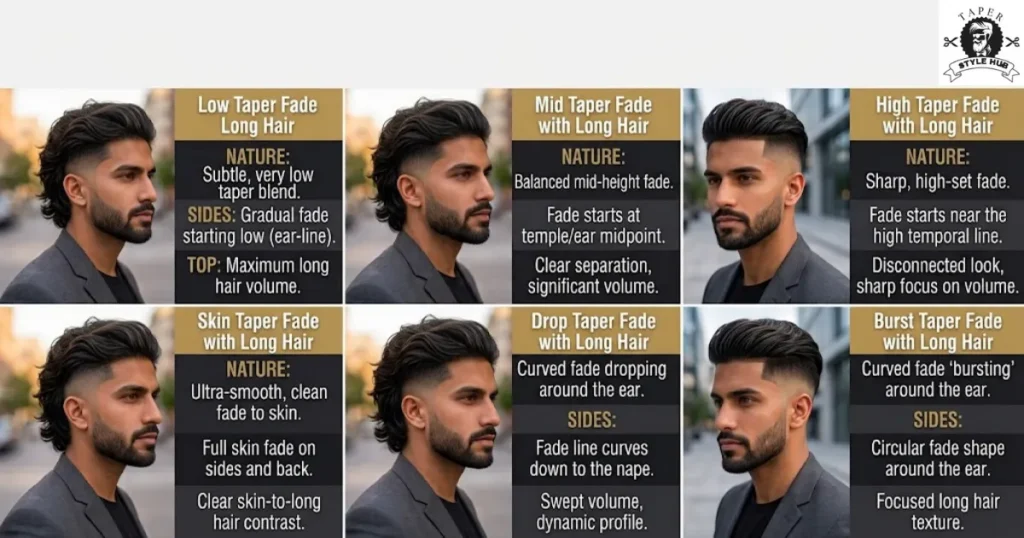
Fade height decides how much contrast your haircut shows. For taper fade long hair, that choice matters even more, because the top draws attention while the sides frame it. Here are six height-based versions to discuss with your barber.
“All The Types Shown Below Are Displayed In The Single Image Above☝️”
Low Taper Fade Long Hair
The low taper starts just above the ears and follows the neckline, so the sides stay full. It is the gentlest option for long hair and grows out without an awkward phase. Choose it if you want a subtle cleanup rather than strong contrast.
Mid Taper Fade with Long Hair
A mid taper begins around the temples, roughly halfway up the sides. It creates clearer definition than a low taper while keeping some weight at the sides. Most men with long hair on top find this height the easiest balance between structure and flow.
High Taper Fade Long Hair
The high taper starts near the upper head, leaving only the top section long. The contrast is bold, which makes thick or textured hair look even fuller. It needs more frequent visits, because regrowth shows quickly at this height.
Skin Taper Fade with Long Hair on Top
A skin taper takes the bottom of the fade down to bare skin. Paired with long hair on top, it gives the sharpest and most modern contrast. Expect shorter gaps between appointments, since any regrowth stands out against the skin.
Drop Taper Fade with Long Hair
The drop taper follows a curved line that arcs down behind the ear instead of running straight across. This shape follows the natural curve of the skull and feels softer than a flat fade. It suits long hair that is worn loose or tucked back.
Burst Taper Fade with Long Hair
A burst taper curves around the ear in a half circle, leaving more length at the back of the head. It works well with mullets and longer layered cuts. The shape adds personality without cutting into the length you are growing out.
Classic Taper Fade Long Hair Styles for Work and Formal Events
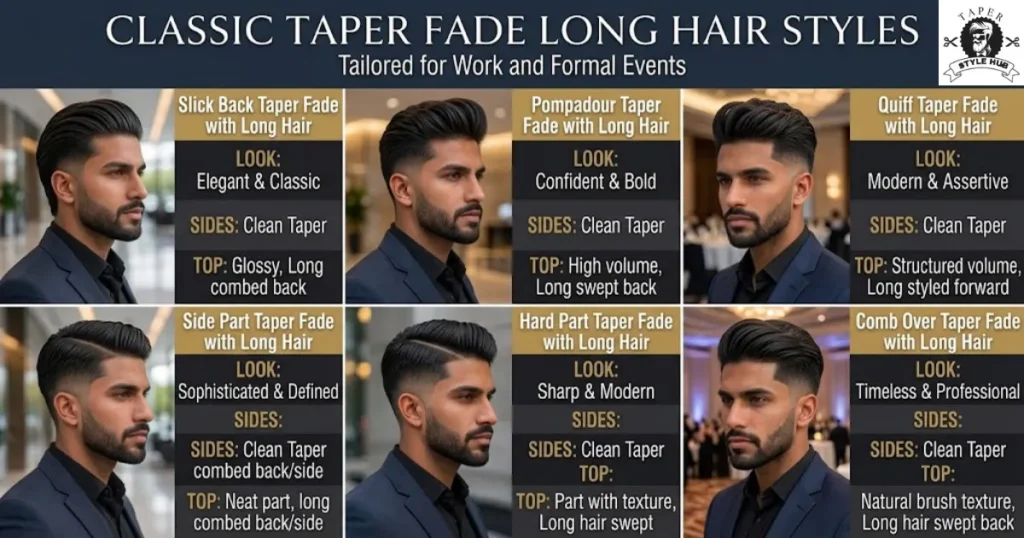
These polished taper fade long hair styles use the taper to keep the outline tight while the long top is combed, parted or swept. They suit offices, interviews and formal events, and most of them work with a medium-hold product.
“All The Types Shown Below Are Displayed In The Single Image Above☝️”
Slick Back Taper Fade with Long Hair
Long hair is combed straight back from the forehead, and the tapered sides keep everything neat. It looks refined with straight or slightly wavy hair. A medium-hold pomade and a quick blow-dry give a smooth finish that lasts through the day.
Pompadour Taper Fade with Long Hair
The pompadour lifts the front upward and back, creating height and volume. A taper on the sides makes that height look deliberate and clean. It takes more time and product each morning, but the result is always eye-catching.
Quiff Taper Fade with Long Hair
The quiff pushes volume forward at the hairline and sweeps it up and back. It is softer than a pompadour and easier to wear on casual days. A light mousse or clay and some blow-drying are usually all you need.
Side Part Taper Fade with Long Hair
A side part sweeps long hair across the head from a natural parting line. The taper keeps the sides crisp, so the part stands out. It is the safest choice for interviews and works with most face shapes.
Hard Part Taper Fade with Long Hair
A hard part adds a thin shaved line where the part sits, creating strong definition between the top and the sides. Combined with a taper, it gives a sharp and structured look. Keep the line fresh with regular touch-ups.
Comb Over Taper Fade with Long Hair
The comb over sweeps long hair to one side from a deep part. With a low or mid taper, it looks polished and professional. A little pomade keeps the shape in place without making the hair look stiff.
Brushed Back Taper Fade with Long Hair
Brushed back hair is combed away from the face without the high shine of a slick back. It feels relaxed but tidy, and very easy to wear. This style shows off the taper around the temples, so ask your barber to keep that area clean.
Trending Taper Fade Long Hair Styles for Men

These are the looks showing up most often in barbershops and on social media. They lean on texture, movement and bolder shapes, and each one pairs naturally with a tapered outline.
“All The Types Shown Below Are Displayed In The Single Image Above☝️”
Flow Haircut with Taper Fade
The flow is all about natural movement. The hair falls over the ears and is pushed back or to the sides, while the taper keeps the neckline neat. It has a relaxed, athletic feel and suits wavy or straight hair.
Wolf Cut Taper Fade
The wolf cut mixes shaggy layers on top with a slightly longer back. Adding a taper to the sides makes those messy layers look intentional. It is one of the most popular long hair trends of the last few years.
Mullet Taper Fade
The modern mullet is far more refined than the old version. The top and sides stay neat, and the length flows down the back. A tapered outline keeps it clean and gives the whole cut a sharper edge.
Curtain Bangs Taper Fade
Curtain bangs part in the middle and fall softly on both sides of the face. With a tapered outline, the center part frames the face while the sides stay tidy. They suit oval, round and heart-shaped faces.
Textured Fringe Taper Fade
A textured fringe uses choppy, layered bangs that fall forward over the forehead. The taper adds contrast and keeps the fringe from overwhelming the face. A bit of sea salt spray gives it a lived-in finish.
Long Edgar Cut Taper Fade
The long Edgar keeps the blunt, straight-across fringe but allows more length overall. Tapered sides make the fringe stand out as the focal point. This style is popular on social media and takes confident styling.
Korean Two-Block Taper Fade
The two-block keeps a longer top separate from shorter sides, and the contrast is deliberate. A taper can soften the lower edge so the transition feels less abrupt. It gives hair a soft, shaped look with very little product.
Disconnected Undercut with Long Hair
A disconnected undercut leaves a visible line between the long top and the short sides. There is no gradual blend, which makes it bolder than a standard taper. Choose it if you want your haircut to make a statement.
Messy Textured Taper Fade
This relaxed style leaves the top tousled and slightly uneven, with a tapered outline to keep things tidy. Texturizing spray or a light paste adds grip and volume. It looks best on hair with natural movement.
Faux Hawk Taper Fade
A faux hawk pushes the hair toward the center to form a soft ridge without shaving the sides completely. A high or mid taper makes the ridge stand out. It is a lively option for men who like a little edge.
Mohawk Taper Fade
The mohawk keeps a strip of length down the center while the sides are faded short. On long hair, the strip can be styled upward or left to fall loose. It is bold, so a clean taper helps keep it polished.
Tied-Back Taper Fade Long Hair Styles
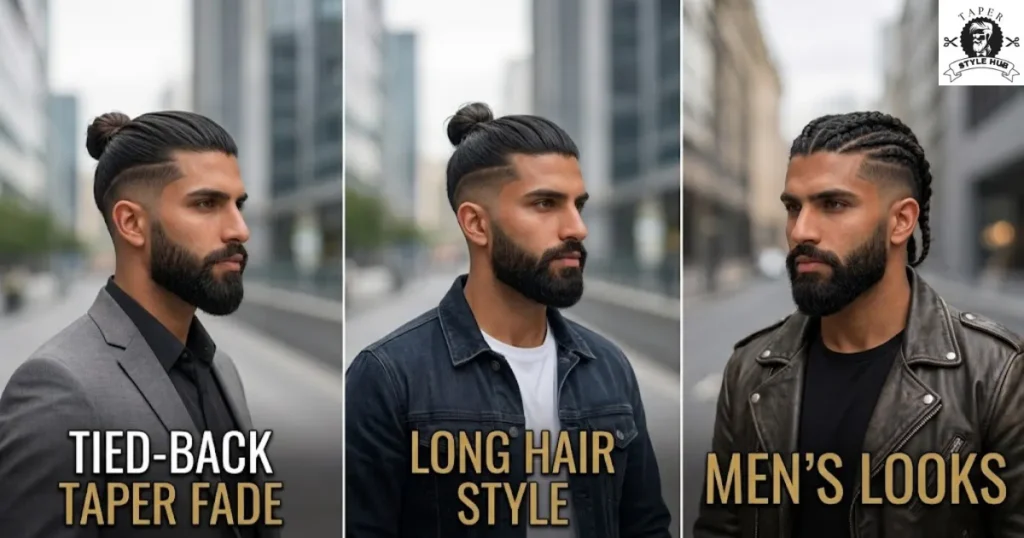
Tying hair back shows off the taper more than any other way of wearing it. That means the blend has to be clean around the temples, sideburns and nape. Here are three tied-back versions.
“All The Types Shown Below Are Displayed In The Single Image Above☝️”
Man Bun Taper Fade
The man bun gathers long hair at the crown or lower on the head. The tapered sides give it a finished, groomed look that a plain bun lacks. Tell your barber where you usually tie your hair before the cut.
Top Knot Taper Fade
A top knot sits high on the head and adds height to the silhouette. Combined with a mid or high taper, the sides look sharp and the knot becomes the focus. It is practical for gym days and warm weather.
Braids and Twists with Taper Fade
Braids and twists look great above a tapered outline, because the taper frames them instead of fighting them. Discuss where the braiding starts, so clipper work does not cut into the first row. Keep the style comfortably loose.
Taper Fade Long Hair by Hair Type
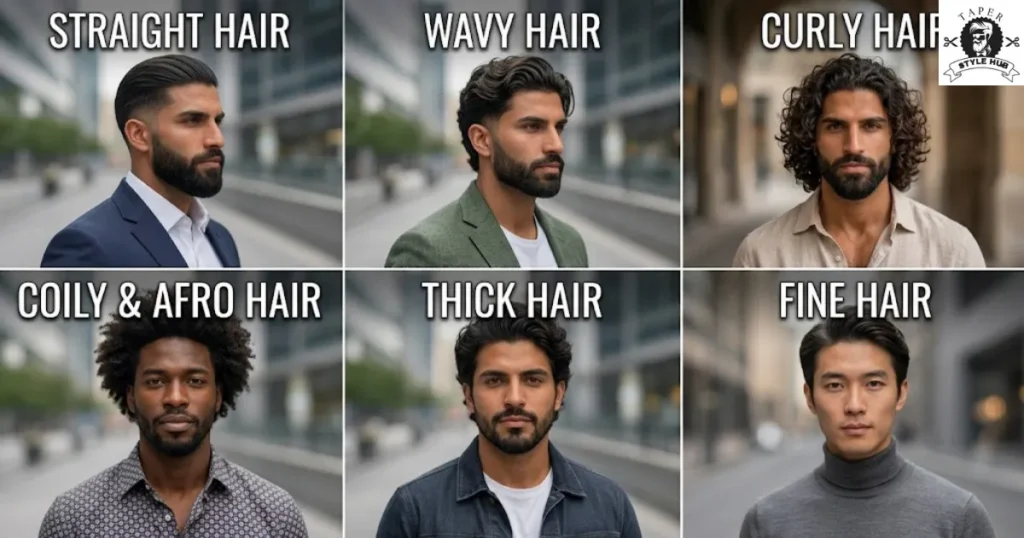
Texture changes how a taper behaves, how visible the blend is and how the top should be cut. A good barber adjusts the technique to your hair instead of using one method on everyone.
“All The Types Shown Below Are Displayed In The Single Image Above☝️”
Taper Fade on Long Straight Hair
Straight hair shows every line, so the blend and the layering need to be precise. The top can look flat without enough lift. A volumizing spray at the roots keeps the length looking full.
Taper Fade on Long Wavy Hair
Wavy hair is one of the easiest textures to work with. It holds shape, has natural volume and blends smoothly on the sides. Salt spray or a light cream is usually enough to bring out the wave pattern.
Taper Fade on Long Curly Hair
Curly hair needs a barber who understands shrinkage, since the top looks shorter once it dries. A mid or high taper keeps the sides tight, so the curls can sit at full volume. Curl cream keeps definition and cuts frizz.
Taper Fade on Long Coily and Afro Hair
Coily hair gives a rounded shape and plenty of volume. A taper around the temples and neckline gives that shape a clear edge. Moisture matters here, so use a leave-in conditioner and avoid over-brushing.
Taper Fade on Long Thick Hair
Thick hair carries a lot of bulk at the sides, which can make blending harder. A barber may remove some weight before fading so the transition looks smooth. Thinning shears or texturizing techniques help.
Taper Fade on Long Fine Hair
Fine hair can fall flat when left long. The taper helps by removing bulk from the sides, so the top looks fuller by comparison. Avoid cutting the top too short, since less hair means less volume.
Taper Fade Long Hair with Beards and Color
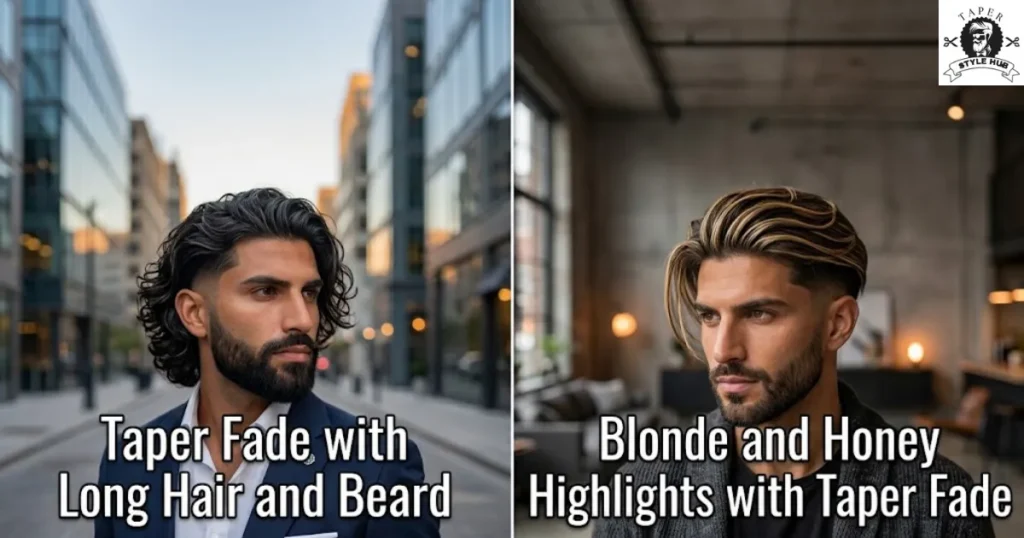
A few add-ons change the look of the whole cut. Facial hair and color both interact with the taper, so plan them together with your barber rather than as separate choices.
“All The Types Shown Below Are Displayed In The Single Image Above☝️”
Taper Fade with Long Hair and Beard
A beard can flow straight out of the taper, creating one connected shape from hairline to jaw. Ask your barber to blend the fade into the beard in the same session. Beard oil keeps the whole look soft and groomed.
Blonde and Honey Highlights with Taper Fade
Lighter tones add depth and make the layers on top easier to see. The taper provides contrast so the color reads clearly. Color needs extra conditioning, because lightened long hair dries out faster.
Best Taper Fade Long Hair Styles for Your Face Shape

Face shape does not limit you, but it can guide the details. The right fade height and top style can balance your features. Use these quick pointers as a starting point.
“All The Types Shown Below Are Displayed In The Single Image Above☝️”
Oval Face
Oval faces suit almost every version of this cut. You can push the top to the side, slick it back or leave it natural. Any fade height works, so choose based on how much upkeep you want.
Round Face
Round faces benefit from height on top. A mid or high taper with the hair styled upward, like a pompadour or a voluminous slick back, adds length to the face. Avoid wide, spread-out sides that emphasize roundness.
Square Face
A strong jawline pairs well with bolder fade heights. A high taper with the hair pulled back or swept to one side looks great. Softer options such as a flow or curtain bangs can also balance sharp angles.
Oblong Face
Longer faces look better with width than height. A low or mid taper with hair worn loose or parted to the side adds visual width across the temples. Skip tall, upright styles that lengthen the face further.
Taper Fade Long Hair for Every Occasion
One of the best things about this cut is how easily it moves between settings. A few small styling changes can take you from a meeting to a night out. Here is how to adapt it.
Office and Interviews
Choose a low or mid taper and keep the top neat with a side part, comb over or slick back. A matte or medium-hold finish looks professional without too much shine. Keep the neckline fresh before any big meeting.
Gym and Active Days
Tie the hair into a bun or top knot so it stays out of your face. The taper keeps the sides tidy even when you sweat. Use a soft elastic to avoid pulling on the hairline.
Weddings and Formal Events
A pompadour, quiff or sleek slick back looks elegant in formal photos. Book a fresh taper a few days before the event, so the edges look crisp but natural. Bring a small pomade for touch-ups.
Casual Weekends
Let the hair fall naturally for a flow look, or add sea salt spray for texture. Relaxed styles show the taper softly and need almost no effort. This is where long hair really gets to shine.
Taper Fade Long Hair and Your Hairline
Your hairline affects how clean the taper looks, especially around the temples. Cowlicks, a widow’s peak or a receding hairline do not rule out a taper fade long hair style. They simply change where the blend should start and how the top should fall.
Cowlicks and Uneven Growth
A strong cowlick near the temple can push the blend off course. Tell your barber about it, so they can cut with the direction of growth instead of against it. A slightly longer taper often hides the problem.
Receding Hairlines and Widow’s Peaks
A mid or low taper keeps the outline soft and avoids drawing attention to the temples. Sweeping the long top back or to the side helps frame the hairline naturally. Avoid very high fades that expose the area.
Barber Terms to Know Before Booking Taper Fade Long Hair
A little vocabulary goes a long way in the chair. These terms come up often, and knowing them lets you describe the cut clearly without guessing.
- Taper: a gradual reduction in length, usually around the sideburns and neckline.
- Fade: a smooth blend from longer hair into very short hair or skin.
- Guard: the clipper attachment that sets the cutting length.
- Line up: a sharp edge along the hairline, temples and sideburns.
- Shape up: a quick edge cleanup that leaves the top untouched.
- Weight line: the point where short sides meet long hair on top.
How to Ask Your Barber for a Taper Fade Long Hair Cut
A vague taper fade long hair request is the fastest way to lose length you wanted to keep. The word mid does not tell a barber how much hair should come off. Be specific about placement, length and finish, and always bring a photo.
- Show a photo of the whole silhouette, not just a close-up of the fade.
- Point to where the taper should start and end on your head.
- Say the minimum length that must stay on top and at the sides.
- Explain how you normally wear it: down, tied back or parted.
- Choose the finish at the temples and neckline: natural, short or close to the skin.
- Let your barber pick the guard sequence and blending technique.
Guard numbers do not translate reliably from shop to shop, so describe the result instead of the tool. A good barber will also ask about your hair texture and daily routine. Answer honestly, because that shapes how the cut behaves at home.
Taper Fade Long Hair Haircut Tutorial: Tools and Steps
Most men should book a barber for a taper fade long hair cut, especially the first time. If you want to understand the process or tidy things up between visits, here is how the haircut is built. Work slowly and check both sides often.
Tools You Need
- Clippers with guards from 1 to 4
- A T-outliner for the neckline and edges
- Barber shears for the long top
- A wide-tooth comb and a fine-tooth comb
- A handheld mirror for the back
- A cape or towel and a spray bottle
Good lighting matters as much as the tools. Stand near a window or under a strong overhead light, so every angle is clearly visible while you work.
Step-by-Step Process
- Decide the fade height and mark an imaginary guide line around the head.
- Trim the long top first, so you can see the final shape before touching the sides.
- Start with the longest guard just below the guide line, using upward strokes.
- Move down through shorter guards, working a little lower with each one.
- Blend each transition with small upward flicks of the wrist.
- Remove the guard at the very bottom and keep the blade light against the hairline.
- Shape the neckline and clean the edges around the ears and temples.
- Style the top with product that suits your texture.
Blending is the heart of the whole technique. If you see a harsh line, go back over it with the next guard size up. Patience here separates an average cut from a great one.
Common Cutting Problems and Fixes
Uneven sides are the most common issue, so compare both ears in the mirror after every pass. If one side sits higher, blend the lower side up rather than cutting the higher one down. Harsh lines usually need a lighter touch and a longer guard.
Best Products and Daily Styling for Taper Fade Long Hair
Long hair needs more care than short hair, and the taper needs a clean surface to look sharp. Choose products by the finish you want, not by trend. Start light, because it is always easier to add more than to wash out a heavy product.
- Sea salt spray: adds grip and natural texture, ideal for waves and flow styles.
- Matte clay: gives flexible hold and volume for textured and messy looks.
- Medium-hold pomade: keeps slick back and side part styles smooth.
- Curl cream: defines curls and reduces frizz on curly and coily hair.
- Leave-in conditioner: adds moisture and tames dryness on the long top.
- Heat protectant: shields hair when you blow-dry for lift and shape.
Apply product to damp hair for most taper fade long hair styles. For slick styles, comb it through and blow-dry backward for lift. Keep heat on a low or medium setting, because high heat dries out long hair over time.
Choosing Products by Hair Type
Straight hair usually needs a volumizing spray or light mousse to avoid looking flat. Wavy hair responds well to salt spray and a flexible cream. Curly and coily hair needs moisture first, so reach for leave-in conditioner and curl cream. Thick hair can handle stronger holds, while fine hair does better with lightweight formulas.
Taper Fade Long Hair Through the Seasons
Weather changes how long hair behaves, so your routine should shift with it. A few seasonal tweaks keep the taper looking sharp and the top healthy all year.
Summer Care
Heat and sweat make long hair heavy, so tie it back for comfort and rinse it often. Use a light leave-in conditioner and sun protection for your scalp. Book your taper a little earlier, because humid weather makes regrowth look fuzzy faster.
Winter Care
Cold air and hats dry out the lengths and create static. Add a richer conditioner or a drop of hair oil, and avoid very hot showers. Choose a soft hat to prevent breakage along the hairline.
How to Maintain Taper Fade Long Hair Between Visits
This cut runs on two clocks. The tapered sides need attention every few weeks, while the long top can go much longer between trims. Treating both parts the same way means one of them always suffers.
| Area | Typical interval | What gets done |
|---|---|---|
| Tapered sides | Every 2 to 4 weeks | Re-blend temples, sideburns and nape |
| Edges only | Every 2 to 3 weeks | Clean up hairline and neckline |
| Long top | Every 6 to 10 weeks | Trim ends and refresh layers |
Trim Schedule
Higher tapers need visits at the shorter end of that range, because contrast shows regrowth faster. If you are growing the sides out on purpose, ignore the schedule and book only for the neckline and edges.
Washing and Conditioning
Wash with shampoo on the scalp and let it rinse through the lengths. Condition the ends, or the full length if your hair is dry or curly. Detangle gently from the ends upward with a wide-tooth comb.
Heat and Brushing
Limit blow-drying and flat irons, and keep heat on a low or medium setting. Brush only when dry hair is tangled, and start from the ends. Wet hair stretches and breaks more easily than dry hair.
Scalp and Neckline Health
Keep the scalp clean so the tapered area stays free of buildup and itch. Use a trimmer for the neckline between visits, and avoid repeated passes over one patch. Coarse or curly hair can get irritated if shaved too close.
How to Grow Out Taper Fade Long Hair the Right Way
Many men start with shorter hair and grow into this style. The tricky part is the in-between stage, when the top is long enough to flop but not long enough to style. A plan makes that phase much easier.
Keep the Sides Tidy While the Top Grows
Visit your barber every few weeks for a low taper and edge cleanup while the top keeps growing. This stops the cut from looking messy and gives you a clean base to build on. Ask for trims only on the sides.
Manage the Awkward Stage
Use a light cream or sea salt spray to control flyaways. Try pushing the hair back or using a headband or small clip for a few weeks. Avoid cutting the top out of frustration.
Common Mistakes to Avoid with Taper Fade Long Hair
Most disappointing results come from small mistakes rather than a bad haircut. Knowing them in advance saves you money and length. Watch for these before and after your appointment.
- Going into the chair without a reference photo.
- Choosing a fade height that clashes with how you style your hair.
- Skipping regular touch-ups until the blend turns fuzzy.
- Tying the hair too tightly, which can pull on the hairline.
- Using heavy products that weigh down fine or straight hair.
- Forgetting to condition the long top.
Tight styles deserve extra care. Constant pulling from a tight bun or braids can stress the hairline over time. Loosen the tie, vary the style and stop if you feel pain.
Taper Fade Long Hair Trends Worth Watching
Men’s hair keeps moving toward softer, more natural shapes. Texture, movement and personal expression matter more than rigid perfection. Expect these ideas to keep growing in popularity.
- Layered flow with a lightly tapered neckline
- Wolf cuts and shaggy tops with clean sides
- Curtain-style middle parts on straight and wavy hair
- Soft burst and drop tapers behind the ears
- Natural color and subtle honey highlights
Final Thoughts on Taper Fade Long Hair
A taper fade long hair cut gives you the freedom of length with the discipline of a clean outline. It works across textures, face shapes and styles, from a slick back to a wolf cut. The secret is choosing the right height and explaining it clearly.
Bring a photo, state the length you want to keep and plan your upkeep before the clippers come out. Do that, and your long hair will look deliberate every single day. Pick a style from this list and book your next appointment.
Taper Fade Long Hair FAQs
Can you get a taper fade long hair cut?
Yes. The cut works with any top length, and long hair makes the contrast with the tapered sides even stronger.
How long should hair be for a taper fade long hair look?
Three inches or more on top usually counts as long. Many popular versions keep four to six inches or longer.
What is the best taper fade long hair style?
The mid taper is the most popular because it balances contrast and length. Go lower for subtle, higher for bold.
How often should I touch up taper fade long hair?
Refresh the tapered sides every two to four weeks. The long top usually needs a trim every six to ten weeks.
Does taper fade long hair suit curly or thick hair?
Yes, with adjustments. Curly hair needs shrinkage planned in, and thick hair may need weight removed on the sides.

I’m M Ahmad Ansari, founder and content creator at Taper Style Hub. With 3+ years of experience researching taper haircuts, hairstyles, grooming, and men’s style, I create practical, accurate, and easy-to-understand content. My goal is to provide readers with trustworthy information, useful tips, and inspiring ideas for choosing and styling the perfect taper haircut.



2 Comments