
Burst Fade Straight Hair: 20 Trendy Styles
Burst fade straight hair is one of the cleanest combinations in modern barbering, because the curved fade around the ear stands out sharply against smooth, flat strands. If you want a haircut that looks planned, this is a strong place to start.
Straight hair keeps every line visible, so the details matter more than they would on curls or waves. Height, finish, top length and back shape all change the final result. This guide walks you through each decision in plain language.
You will find twenty style ideas grouped by category, a barber script you can copy, a simple styling routine, upkeep advice and the mistakes that ruin good cuts. Read it before your appointment and the chair conversation gets easier.
👉 Also Read: Burst Fade Design
What Is Burst Fade Straight Hair and How Does It Work?
A burst fade is a fade that curves in a semicircle around the ear instead of running as a straight band around the head. The hair is taken very short around the ear, then it stays longer above the arc and across the back.
Straight hair changes how this cut looks. Each strand falls in one direction and holds its outline, so the blend, the arc and the crown connection are all easy to see. That is why a good barber matters so much here.
Think of the burst as a side treatment rather than a full haircut. The top can be a buzz, a crop, a quiff, a mullet or even a mohawk, which is why burst fade straight hair works for so many different personalities.
👉 Also Read: Burst Fade Mullet Curly Hair
Key Features of Burst Fade Straight Hair
Before you pick a style, it helps to know what makes this cut recognizable. A few features show up in almost every good version, no matter how long the top is or how high the arc sits.
- A curved burst fade around the ear that ends behind it
- A smooth blend behind the ear with no hard shelf
- Clear contrast between the faded sides and the texture on top
- A back that keeps its length unless you ask for a fade there
- A clean neckline that finishes the shape from behind
These features give burst fade straight hair a balanced, intentional look. They also explain why the burst suits men who want contrast on the sides without committing to a full high fade or a disconnected undercut.
👉 Also Read: Burst Fade Mullet
Why Burst Fade Straight Hair Is So Popular
The popularity of burst fade straight hair comes from its balance. It looks fashionable without being fussy, and it adapts to office dress codes, creative jobs and weekend plans with only a small change in top length.
Social media also helped. Mullets and mohawks with curved fades went viral, and people with straight hair noticed how clean the shape looked on their own heads. Barbers now get requests for it every single day.
Another reason is flexibility. You can keep it subtle with a low arc and a short guard, or push it harder with a high arc and a longer top. Either way, burst fade straight hair feels current.
👉 Also Read: Taper Mullet 40 Modern Types For Men
Why Burst Fade Straight Hair Shows Every Transition
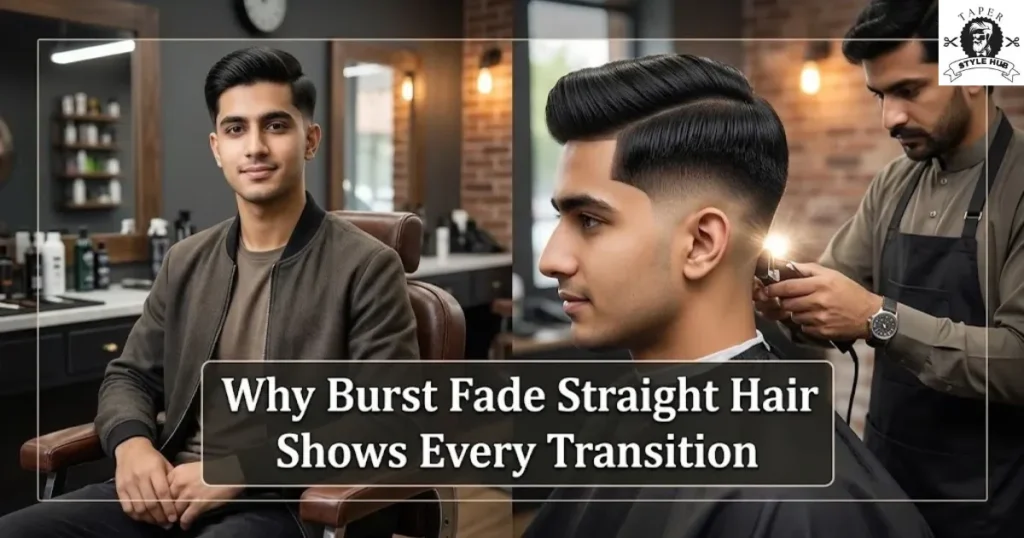
Waves and curls blur the edges of a fade. Straight hair does the opposite. A sudden jump in length above the arc turns into a visible shelf, and a patchy blend looks like a mistake instead of a style.
Texture also plays a role. Dense, coarse straight hair can stand away from the head when it is cut very short, so a slightly longer transition lies down more neatly. Fine hair needs a careful hand so the sides do not look thin.
Growth direction matters too. A cowlick at the crown or front hairline will push straight hair its own way, so mention it before the clippers start. Your barber can then plan the part and the fringe around it.
👉 Also Read: Low Burst Fade Mullet
Low vs Mid vs High Burst Fade Straight Hair
Height describes how far the fade climbs from the ear, not how short it finishes. Labels differ slightly between shops, so a side-view photo is the safest way to confirm exactly what you want.
| Height | Where it starts | Contrast | Best for |
|---|---|---|---|
| Low | Just above the ear | Subtle | Office looks, first fades, longer tops |
| Mid | Around temple level | Clear | Crops, fringes, quiffs, everyday wear |
| High | Near the parietal ridge | Strong | Faux hawks, mohawks, short bold cuts |
A low burst keeps more hair on the sides and grows out quietly. It suits professional settings, school and anyone still testing the shape. The softer contrast also keeps a longer side-swept top looking tidy.
A mid burst is the most flexible choice. It gives a visible curve without exposing too much of the side, so it works with short crops and longer tops alike. Most barbers suggest it for a first burst.
A high burst pushes the arc toward the temple and shows off the ear curve more than any other height. It looks bold and modern, but it grows out faster and needs touch-ups more often.
👉 Also Read: Straight Hair Taper Mullet Fade
Skin, Shadow and Zero Finishes
The finish is how short the lowest point of the arc gets. It is a separate decision from height, so a low skin burst and a high shadow burst are both normal requests.
| Finish | Shortest point | Best for |
|---|---|---|
| Skin | Bare skin | Maximum contrast |
| Shadow | Very short but still visibly dark | A clean look with less exposure |
| Short guard | Low clipper guard, no bare skin | Sensitive skin and subtle results |
Skin gives the sharpest contrast but shows regrowth first. Shadow keeps some hair for a softer edge, and a short guard is the gentlest option if your skin gets irritated by close cutting.
If your hair is on the thinner side, a shadow finish is usually the smarter pick. It keeps the scalp less visible and makes the grow-out stage far less dramatic.
Who Should Choose Burst Fade Straight Hair?
Burst fade straight hair suits most men, but a few quick checks can steer you toward the right version. Look at your hair in daylight and think about how much time you want to spend styling it each morning.
Density is the number of hairs in a patch of scalp, while strand thickness is the width of each hair. They are different things. Dense hair hides skin through a short fade for longer than sparse hair does.
If you are unsure, start with a low burst and a shadow finish. You can always go higher at your next visit, but you cannot add the hair back once it is gone.
Hair Type Guide for Burst Fade Straight Hair
Straight hair is not one single texture. Fine, medium and coarse strands behave differently once a burst is cut around them, so the best version depends on what actually grows from your scalp.
| Hair type | Best arc and finish | Styling tip |
|---|---|---|
| Fine and thin | Low arc, shadow finish | Use powder or light cream for lift |
| Medium density | Mid arc, shadow or zero | Matte paste for easy separation |
| Thick and coarse | Mid or high arc, any finish | Ask for light thinning on top |
| Receding hairline | Low arc, short guard | Choose a cropped fringe like a Caesar cut |
Fine hair benefits from contrast, because short sides make the top look thicker. Coarse hair benefits from a smooth transition, because stiff strands can stick out when they are cut very short.
20 Burst Fade Straight Hair Styles by Category
Every style below uses the same burst fade on the sides. What changes is the top length, the shape of the fringe or crown, and what happens at the back. Five categories help you jump to what fits your routine.
Short and Low-Maintenance Burst Fade Straight Hair Styles

Short tops need almost no styling, but they put your head shape and hairline on full display. These five options are ideal if you want a sharp result with the least effort each morning.
1. Buzz Cut Burst Fade
The buzz cut keeps the top at one even short length, so the fade carries the whole look. A skin finish gives maximum contrast, while a shadow finish keeps the edge softer and friendlier to thinner hair.
Because there is nowhere to hide, uneven density and head shape show clearly. Ask for a slightly longer guard on top and refresh the arc often, since the curve is the only feature in this look.
2. French Crop Burst Fade
A French crop is a short, textured top brushed forward into a fringe that is usually cut fairly straight across. Straight hair suits it naturally, because the fringe lies neatly without much persuasion or product.
Ask your barber to blend the crown into the arc so the back does not look boxy. A pinch of matte paste is enough, and most mornings you can simply use your fingers.
3. Textured Crop Burst Fade
This version has short, choppy layers on top that add movement without adding length. The burst fade straight hair combination looks soft and controlled, which makes it a safe pick for work, school or weekends.
Blow-dry the top forward, then work a little matte clay through the ends with your fingertips. Point-cutting the layers helps straight hair separate instead of lying in one flat sheet.
4. Caesar Cut Burst Fade
The Caesar cut brings a short, forward-combed fringe that sits neatly across the forehead. Paired with the curved arc, it feels disciplined and modern at once, and it is easy to keep tidy.
It is also a smart option if your hairline is receding, because the cropped fringe creates a fuller look. Keep the tips textured, and use a light cream or paste to hold the direction.
5. Short Spiky Texture Burst Fade
Short spikes add energy to straight hair without needing real length. The arc around the ear keeps the sides neat, so the texture on top looks lively instead of messy.
Blow-dry upward, then use matte clay for hold and a touch of light pomade for subtle shine. Wash the product out at night so your scalp stays healthy.
Fringe-Focused Burst Fade Straight Hair Styles

A fringe gives straight hair its personality, and the burst keeps the sides tidy underneath. These four ideas change mostly in how heavy, how choppy and how long the front is allowed to be.
6. Textured Fringe Burst Fade
A slightly longer, point-cut fringe moves more than a French crop does. It only looks intentional when you work a little light product through it, so skip this one if you never touch your hair.
A mid burst works especially well here. The sharper contrast on the sides makes the fringe look softer and more relaxed, which is exactly the balance most men want.
7. Messy Fringe Burst Fade
A messy fringe falls unevenly over the forehead and gives the cut a youthful, relaxed feel. The faded sides keep it from looking careless, so the contrast between carefree and clean does the work.
Ask your barber to cut the front slightly choppy so it separates naturally. A little sea salt spray adds definition without the stiff finish that heavy gel creates.
8. Edgar Burst Fade
The Edgar cut uses a blunt, boxy fringe that sits straight across the forehead. Combined with a tight burst, it delivers strong contrast and a bold attitude that stands out in any crowd.
Burst fade straight hair is ideal for this look because the fringe lies flat and crisp. Keep the line even, and book regular visits so the edge never softens or drifts.
9. Side-Swept Fringe Burst Fade
A side-swept fringe pushes the front across the forehead at a gentle angle. It softens a strong forehead, suits oval and square faces, and gives straight hair a calm, natural direction.
Tell your barber which way you part and whether the part should be cut in. Check the opposite side in the mirror too, because that is where a shelf above the fade shows most.
Classic and Professional Burst Fade Straight Hair Styles

Not every haircut needs to shout. These three styles pair the burst with traditional tops, which makes them comfortable choices for offices, interviews and formal events.
10. Side Part Burst Fade
The side part gives the haircut structure and a timeless shape. A low burst keeps the contrast subtle, so the whole look stays polished and professional without feeling old-fashioned.
Use a fine-tooth comb and a light pomade to create a crisp parting line. For extra definition, ask your barber to add a faint shaved line along the part.
11. Comb Over Burst Fade
A comb over with a clean burst feels sharp and modern. The sides stay tight and neat, while the top is combed across with a clear part that makes the cut look refined.
Medium-hold pomade works best, and a blow-dryer helps set the shape in the morning. Burst fade straight hair usually behaves well here, which makes this a very low-risk style.
12. Slick Back Burst Fade
Slicking the top straight back creates a smooth, confident silhouette. The arc around the ear adds a modern edge, so the look works for weddings, business events and nights out.
Blow-dry the hair backward, apply a medium-hold pomade, then comb it through once. Ask your barber to blend the fade neatly into the nape so the back view stays clean.
Volume and Lift Burst Fade Straight Hair Styles

Straight hair can fall flat by lunchtime, so these styles rely on the blow-dryer and the right product to build height. The burst sits underneath and makes the volume look even bigger by contrast.
13. Quiff Burst Fade
The quiff lifts the front up and slightly back, adding height and movement. It needs enough length to stand, a blow-dryer and a product with real hold, otherwise straight hair simply sits flat.
Shape it with your fingers instead of a comb for a relaxed finish. A mid or high arc pairs best, because the stronger contrast makes the lifted front stand out.
14. Pompadour Burst Fade
The pompadour borrows from vintage barbershop fashion, yet the curved fade keeps it fresh. A tall, swept-up front sits above tight sides, which makes the volume look deliberate and polished.
Blow-dry upward with a round brush and lock the shape with strong-hold pomade. This style suits medium to thick straight hair best, and touch-ups every two to three weeks keep it neat.
15. Brush Up Burst Fade
A short brush up lifts the front without needing the length of a pompadour. Combined with a high arc, it gives maximum contrast and shows off both the height and the ear curve.
Blow-dry the front upward and set it with matte paste. It is a practical choice for men who want height but prefer a shorter, easier cut overall.
16. Blowout Burst Fade
A blowout builds a soft, full shape by drying the hair upward and back with a round brush. The clean sides make the fluffy top look intentional and quietly dramatic.
Start with slightly damp hair and dry it in sections. A light volumizing mousse or texture powder keeps the volume up all day without the hair feeling stiff.
Bold and Long Burst Fade Straight Hair Styles

Longer and bolder styles keep length at the crown or back, so your instructions about the nape matter as much as the fade itself. These four are the most expressive options on the list.
17. Mullet Burst Fade
The mullet is where the burst earns its place. It clears the sides around the ears but leaves the back untouched, so the longer hair at the nape looks planned rather than neglected.
Tell your barber plainly that the back stays long. Without that instruction, the fade can creep behind the ear and remove the length you have been growing for months.
18. Faux Hawk Burst Fade
A faux hawk pushes the top toward a raised center but keeps more length on the sides than a true mohawk. It is easier to wear daily and easier to grow out later.
Use a strong-hold paste and shape the ridge with your fingers, pushing upward and inward. Say how wide the center section should be before the cut begins.
19. Mohawk Burst Fade
The mohawk is the boldest option here, with a strip of length running from front to back. The burst curves the sides down around the ears and makes the strip look taller.
Expect daily styling and more frequent trims to keep the edges clean. A cowlick at the crown can split the strip, so mention it before the barber starts.
20. Long Layered Flow Burst Fade
Men growing their hair out can keep real length on top and still look neat. Layers add movement, and the burst keeps the sides clean so the length looks styled, not unkempt.
Wear it loose, tucked behind the ears or swept back. Condition regularly, trim the ends every couple of months and refresh the arc every three weeks.
Best Burst Fade Straight Hair Styles for Different Face Shapes
Face shape does not decide whether you can wear burst fade straight hair, but it helps you choose the height and the top. The table below gives you a quick starting point.
| Face shape | Recommended setup | Why it works |
|---|---|---|
| Oval | Any height with any top | Balanced proportions suit every version |
| Round | Mid or high burst with lifted top | Added height lengthens the face |
| Square | Low or mid burst with soft fringe | The curve softens a strong jaw |
| Heart | Mid burst with side-swept fringe | A fringe balances a wider forehead |
| Long | Low burst with textured crop | Less height keeps proportions even |
| Diamond | Mid burst with textured fringe | The arc highlights the cheekbones |
Treat these as starting points, not rules. Bring a photo of someone with a similar face shape and hair density, and your barber can adapt the idea to your head.
Choosing Burst Fade Straight Hair for Your Lifestyle
Your daily routine should shape the decision as much as your hair type. A cut that needs twenty minutes of styling will not survive a busy week, no matter how good it looks in a photo.
If you want minimal effort, choose a buzz cut, French crop or short textured crop. If you enjoy styling, a quiff, pompadour or slick back rewards the extra time with more visible shape.
If you travel often or train regularly, favor shorter tops that dry quickly and recover well after the gym. Burst fade straight hair is forgiving when the top stays simple.
Choosing Height and Finish Together for Burst Fade Straight Hair
Height and finish work as a pair, and the combination decides how bold the result looks. A low arc with a shadow finish is the quietest option, while a high arc with a skin finish is the loudest.
Most men land somewhere in the middle. A mid arc with a shadow or zero finish gives clear contrast, grows out gracefully and suits nearly every top style on this list.
When you are comparing photos, check both details separately. Ask yourself how high the curve climbs and how short it gets at the bottom, then tell your barber both answers.
How to Ask Your Barber for Burst Fade Straight Hair
Saying burst fade straight hair is a good start, but it is not a complete request. It tells your barber nothing about height, finish, top length or the back, so the result usually depends on guesswork.
Settle six details before you sit down. Work through the list below, and write the answers in your phone if that helps.
- Height: low, mid or high around the ear
- Finish: skin, shadow or a short guard at the lowest point
- Top: how much length stays and which way it sits
- Crown: blended into the fade or deliberately disconnected
- Back: regular neckline, extended nape, mullet or mohawk strip
- Edges: hairline, sideburns and beard connection
Bring photos that show the side and the back, on hair with similar density and length to yours. Front-only pictures hide the crown and nape, which is where most burst fades go wrong.
Then try a simple script such as this one: “I would like a mid burst fade around the ear, taken down to a shadow, with a textured top left long enough to style forward and a longer back.”
Burst Fade Straight Hair with a Beard
A beard works well with this haircut when the sideburns connect naturally to the curved arc. The blend should flow from the fade into the facial hair without a visible gap or sudden jump.
Ask your barber to match the fade length with the beard length so the transition looks natural from every angle. Keep the neckline clean and use a little beard oil to keep the hair soft.
Burst fade straight hair with a short stubble beard suits every height, while a full beard looks best with a mid or high arc that gives the face enough definition.
Burst Fade Straight Hair for Teens and Kids
Younger clients can wear this cut too, and many parents like it because it keeps hair tidy at school. A low arc with a short guard is the most practical choice.
Bring a photo to the appointment, keep the top easy to style, and avoid very high arcs that need constant visits. Kids grow out fades quickly, so a softer finish saves time and effort.
Tools Barbers Use to Cut Burst Fade Straight Hair
A good burst fade straight hair cut depends on a handful of tools and a patient hand. Clippers set the guideline around the ear, and different guard sizes control how short each section becomes.
Trimmers and a razor refine the neckline and the arc, while a comb controls the hair as it is cut. A foil shaver gives the cleanest finish if you chose a skin result.
How a Barber Creates Burst Fade Straight Hair Step by Step
Knowing the process helps you spot problems early. A skilled barber will usually follow a similar order, even if the exact tools change from shop to shop.
- Set a guideline around the ear with clippers.
- Build the arc upward, blending each guard length into the next.
- Refine the curve behind the ear so it ends cleanly.
- Blend the hair above the arc into the top to avoid a shelf.
- Detail the neckline, sideburns and hairline with a trimmer or razor.
- Texturize the top and style it to show the final shape.
If you notice a hard line forming above the ear, speak up politely before the barber moves on. It is much easier to soften a blend early than to repair it at the end.
Burst Fade vs Drop Fade vs Taper vs Temple Fade
These four cuts are often confused because they all involve fading. The real difference is where the short area sits, and a quick comparison clears up most of the confusion.
| Fade | Where the short area sits | Back of the head | Best for |
|---|---|---|---|
| Burst fade | Arc around the ear | Stays longer | Mullets, crops, faux hawks |
| Drop fade | Dips behind the ear and across the back | Faded | Fuller tops and everyday cuts |
| Taper fade | Sideburns and nape only | Neckline shortened | Classic, conservative looks |
| Temple fade | Temples and front of the sides | Untouched | Sharp line-ups |
Choose burst fade straight hair if you want contrast on the sides and length kept at the back. Choose a drop fade for a rounded fade that travels all the way around the head.
A taper is the quietest option, and a temple fade only sharpens the front. Some shops use burst and drop interchangeably, so a photo always settles the question faster than a label.
How to Style Burst Fade Straight Hair at Home
The fade needs nothing day to day, but the top does. Straight hair sets in whatever direction it dries, so shape it with the dryer first and use product only to hold and finish.
- Start with towel-dried, damp hair rather than dripping wet hair.
- Push the hair in your chosen direction with your fingers or a brush.
- Blow-dry on a warm setting while holding that direction.
- Rub a small amount of product between your palms until it spreads thin.
- Work it from the back of the top toward the front, then adjust the fringe.
Fine hair wants a lighter product in a smaller amount, while dense or coarse hair can handle more grip. Overloading is the fastest way to flatten straight hair.
Best Products for Burst Fade Straight Hair
| Product | Best for | Hold |
|---|---|---|
| Lightweight cream | Fine or soft hair | Light |
| Matte paste | Medium to thick hair, crops | Medium |
| Matte clay | Thick or coarse hair | Firm |
| Texture powder | Fine hair, quiffs, root lift | Light |
| Light pomade | Side parts, comb overs, slick backs | Medium |
Pick one product and learn how it behaves before adding a second. Most men get great results with just a cream or paste plus a blow-dryer.
Maintenance and Grow-Out for Burst Fade Straight Hair
There is no single schedule for every burst fade straight hair cut. Skin finishes lose contrast first, while shadow and guard finishes grow out more gradually. Go by what you see in the mirror.
- The arc around the ear has lost its clean edge
- The sideburns and hairline look fuzzy
- Dark regrowth has filled in the shortest area
- The contrast between the sides and the top has faded
Most men book a refresh every two to three weeks, and a high burst may need a visit sooner. Trim the top every four to six weeks, or sooner if the fringe starts to fall into your eyes.
Between visits, wash out product regularly and keep styling the top in the same direction. Avoid trying to re-fade the arc yourself, because small mistakes around the ear are hard to hide.
Scalp and Hair Care for Burst Fade Straight Hair
Short sides expose more scalp, so skin care matters more than people expect. Moisturize lightly after washing and apply sunscreen in summer if the fade sits very close to the skin.
Use a gentle shampoo and a clarifying wash every week or two to remove product buildup. Clean hair holds style better, and a healthy scalp keeps the faded area looking smooth.
Condition the top regularly, especially if you blow-dry often. Straight hair can look dull when it dries out, and shiny, healthy strands make the whole burst fade straight hair look sharper.
Common Burst Fade Straight Hair Mistakes and Quick Fixes
Most disappointing burst fade straight hair cuts come from a missed instruction rather than poor clipper work. These are the problems clients report most often, along with simple ways to avoid them.
- Fade too high: ask for a lower starting point next visit.
- No smooth blend behind the ear: request a refined taper through the ear curve.
- Flat top: improve your blow-dry technique and add a little texture powder.
- Overloaded product: use smaller amounts of matte clay or paste.
- Uneven neckline: tidy it every two weeks between full cuts.
- Over-thinning: avoid aggressive thinning on fine straight hair, because it looks stringy.
Skip a skin finish if you have tender bumps or ongoing irritation where the fade sits. A shadow or short guard keeps the blade off the skin while it settles.
Is Burst Fade Straight Hair Professional?
Burst fade straight hair can be professional, depending on how you style it. A low burst with a shadow finish and a side part or comb over looks perfectly suitable for offices, interviews and formal events.
Bolder versions, such as a mullet or mohawk, belong in casual settings. If your workplace is conservative, keep the arc low and the top classic, and save the edgier styles for weekends.
Quick Checklist Before You Book Burst Fade Straight Hair
Run through these questions before you sit in the chair. If you can answer all of them without hesitating, your barber will know exactly what to do.
- How high should the arc go: low, mid or high?
- How short should it get at the lowest point?
- How much length stays on top, and which way does it sit?
- Does the crown blend into the fade or stay separate?
- How should the back be finished?
- Do you have a side photo and a back photo ready?
Mention any cowlick, thin spot or sensitive skin early in the appointment. That two-minute conversation does more for the result than any single reference photo.
Final Thoughts on Burst Fade Straight Hair
Burst fade straight hair works because it pairs a precise curve with the clean lines of straight strands. The result looks sharp, modern and easy to adapt, whether you want a quiet office cut or a bold mullet.
The secret is communication. Decide on the height, the finish, the top and the back, bring side and rear photos, and your barber will have everything needed to deliver the cut you pictured.
Start lower than you think you want, refresh the arc before it fades out, and style the top with a light hand. Do that consistently and burst fade straight hair will keep looking intentional from the first day to the last.
Burst Fade Straight Hair FAQs
Does a burst fade work on pin-straight hair?
Yes. Straight strands show the blend clearly, so it looks very clean as long as the barber softens the transition above the arc.
Is a low or mid burst fade better for straight hair?
A low burst is subtler and easier to grow out. A mid burst gives clearer contrast and works with more top styles.
How long should the top be for burst fade straight hair?
Keep at least one to two inches for a fringe or quiff. Shorter tops like crops and buzz cuts need less.
Can fine or thinning straight hair wear a burst fade?
Yes. Choose a low arc with a shadow finish and avoid heavy products that flatten the top.
How often should I refresh my burst fade?
Most people refresh every two to three weeks. A skin finish or high arc usually needs a visit sooner.

I’m M Ahmad Ansari, founder and content creator at Taper Style Hub. With 3+ years of experience researching taper haircuts, hairstyles, grooming, and men’s style, I create practical, accurate, and easy-to-understand content. My goal is to provide readers with trustworthy information, useful tips, and inspiring ideas for choosing and styling the perfect taper haircut.


5 Comments