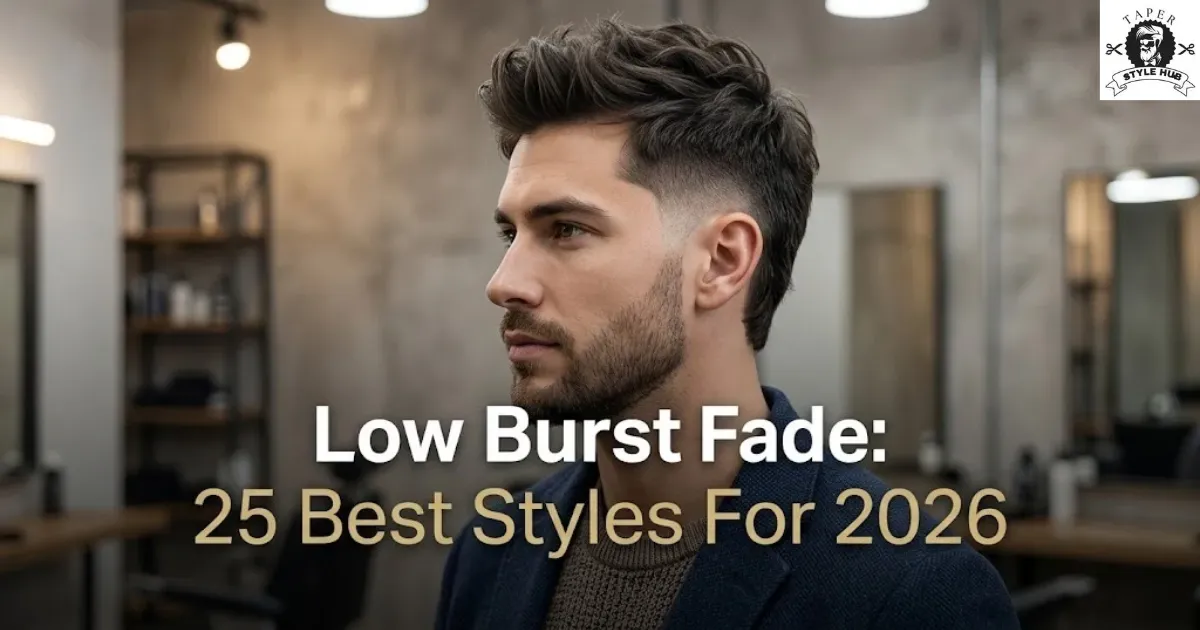
Low Burst Fade: 25 Best Styles For 2026
A low burst fade curves a short, clean blend around the ear and leaves more length on top and through the back. It looks sharp without feeling severe, which is why so many men keep asking for it.
Most guides stop at a few photos. This one covers how the cut works, how it compares with similar fades, 25 styles grouped by category, the exact words to use in the chair, and how to keep it fresh.
Whether your hair is straight, wavy, curly or coily, there is a version here that fits your texture, face shape and routine. Pick a favorite and walk into the barbershop with a clear plan.
👉 Also Read: Burst Fade Straight Hair
What Is a Low Burst Fade Haircut?
This haircut starts its blend low, near the top of the ear, and arcs backward in a half circle toward the nape. Instead of climbing straight up the side, the fade bursts outward like a small sunburst.
Because the blend sits low, more hair stays at the temples. That softens the contrast between the short sides and the longer top, and it gives the whole haircut a polished, wearable feel.
Some people call this shape a radial fade or a halo taper. Whatever the name, the key idea is the same: a compact, curved blend around the ear instead of a flat, level strip across the head.
- The fade starts low, around the ear, not high on the side of the head.
- The blend follows a curved arc instead of a straight taper line.
- More hair is kept at the temples than in a mid or high fade.
- It meets a beard cleanly because the low line sits near the sideburns.
- It works on most hair types with very little daily styling.
👉 Also Read: Burst Fade Design
Low Burst Fade vs Mid and High Burst Fade
All three share the same curved shape around the ear. The only real difference is where the fade begins, and that single choice changes how bold the haircut looks and how often you need a trim.
👉 Also Read: Burst Fade Mullet Curly Hair
| Feature | Low Burst Fade | Mid Burst Fade | High Burst Fade |
|---|---|---|---|
| Fade starts | Around the ear | Midway up the side | High on the side |
| Contrast | Soft and gradual | Moderate | Sharp and dramatic |
| Best for | Work and first fades | Everyday balance | Bold statements |
| Trim every | Three to four weeks | Two to three weeks | About two weeks |
| Grow-out | Softest regrowth | Moderate | Least forgiving |
If you are unsure, start low. It is the most forgiving height, easy to raise at your next visit, and it never leaves you with a fade that feels too high.
Low Burst Fade vs Low Taper, Drop Fade and Skin Fade

Shop language overlaps, so names get mixed up fast. A low taper puts its shortest work around the sideburns and neckline, while a burst adds a clearly curved area around the ear.
A drop fade follows a descending path behind the ear toward the back of the head. A burst curves around the ear instead. Showing your barber a side view and a rear view settles any confusion.
A skin fade describes the finish, not the shape. You can have this cut with visible stubble or taken to bare skin, so always say which finish you want before the clippers come out.
👉 Also Read: Burst Fade Mullet
Why the Low Burst Fade Keeps Trending in 2026
This fade has stayed popular because it photographs well and grows out well. A high fade can look tired within two weeks, while a lower blend can stretch to three or four before it needs attention.
It has also become the default recommendation for men getting their first fade, men in client-facing jobs, and men with thick or curly hair who want controlled sides without losing volume on top.
Social media helped too. The curved blend looks great from every angle, and it pairs with mullets, fringes, crops and curls, so there is always a fresh way to wear it.
👉 Also Read: Taper Mullet 40 Modern Types For Men
Who Should Get a Low Burst Fade Haircut?
This cut suits most men, but it is an especially strong choice in a few situations. Check whether any of these sound like you before you book.
- You want a fade that reads as professional rather than edgy.
- You have curly, coily or thick hair and want the sides controlled.
- You wear a beard and want a seamless blend into the sideburns.
- You would rather not be in the barber chair every two weeks.
- You are getting your first fade and want the easiest one to grow out.
It is a weaker fit if you want maximum contrast between the sides and the top. In that case, a mid or high burst fade will give you the sharper look you are after.
👉 Also Read: Low Burst Fade Mullet
How to Choose Fade Height, Finish and Back Shape
Three separate decisions shape the final result: where the blend sits, how short it gets at its tightest point, and what happens at the back. Treat them one at a time instead of relying on the name alone.
| Decision | What to agree on | What to check |
|---|---|---|
| Placement | A compact curve close to the ear | How much side hair remains above it |
| Shortest finish | Visible stubble or a skin finish | Whether the reference shows bare skin |
| Back shape | Tidy nape, fuller back or mullet | Where the short area ends behind the ear |
A low placement can still end in visible stubble or bare skin. A small skin-faded area against dark hair creates strong contrast, so choose stubble when you want a softer effect.
Ask your barber to show the planned back outline in a mirror before cutting. A fuller back, a tidy natural nape and a deliberate mullet each look quite different from behind.
👉 Also Read: Straight Hair Taper Mullet Fade
Best Face Shapes for a Low Burst Fade
The fade itself stays fairly consistent, so the top length and finish do most of the shaping work. Use this table as a starting point and adjust with your barber.
| Face shape | Top to try | Why it works |
|---|---|---|
| Oval | Classic or comb over | Balanced proportions suit almost anything |
| Round | Pompadour or faux hawk | Added height lengthens the face |
| Square | Textured crop or slick back | Softens a strong jawline without adding side width |
| Diamond | Textured or wavy top | Balances wide cheekbones |
| Heart | Short or messy top | Moderate volume keeps the jaw in proportion |
How the 25 Styles Are Grouped
Instead of one long list, the styles below are split into five categories. Each category shares a mood or purpose, so you can jump straight to the group that matches your life and then compare the five options inside it.
Classic and Professional Low Burst Fade Styles
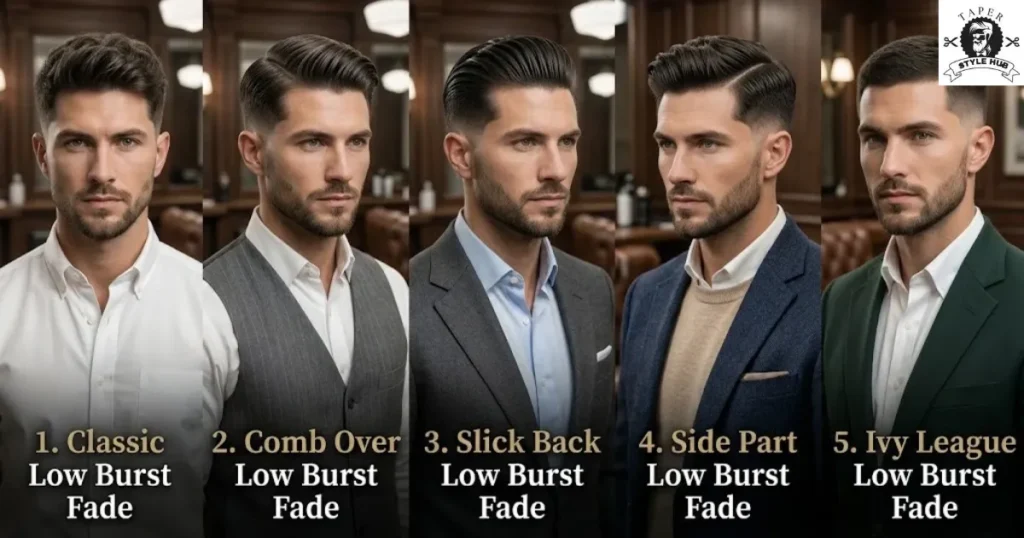
These five looks suit the office, interviews, school and formal events. They keep the top neat and let the low blend do its quiet work around the ear.
“All The Types Shown Below Are Displayed In The Single Image Above☝️”
1. Classic Low Burst Fade
The base version. Sides blend low and clean, while the top stays an even, slightly longer length with light texture. Ask for this if you are unsure what you want, since every other style here builds on it.
2. Comb Over Low Burst Fade
A defined side part with the top brushed across, sitting on a clean low blend. It reads polished and confident, which is why it stays popular in client-facing jobs. Medium-hold pomade gives a smooth finish.
3. Slick Back Low Burst Fade
Hair brushed straight back keeps attention on the smooth top while the low blend keeps the sides quiet. It is a dependable formal choice. Apply pomade evenly with a comb for lasting hold.
4. Side Part Low Burst Fade
A pronounced part gives this cut classic elegance with a modern edge. The compact curve around the ear adds structure without distracting from the part. Style it with a light product and a comb.
5. Ivy League Low Burst Fade
The Ivy League cut has a slightly longer top that can be slicked back, combed aside or tousled. Adding a low blend tidies the ears and nape and gives the classic shape a fresher outline.
Textured and Casual Low Burst Fade Styles

If you like a relaxed finish that takes minutes to style, start here. Texture on top contrasts nicely with the controlled curve at the sides.
“All The Types Shown Below Are Displayed In The Single Image Above☝️”
6. Textured Crop Low Burst Fade
A short, broken-up fringe keeps attention on the small curve around the ear. Ask for texture you can recreate with your fingers, and a little matte clay will hold it all day.
7. Messy Low Burst Fade
The point of this cut is contrast: deliberately undone texture on top against clean, controlled sides. Keep up with trims, because an overgrown fade weakens the effect. Use light clay to avoid stiffness.
8. French Crop Low Burst Fade
A short top with a fringe sitting forward pairs well with a compact fade. The shape is tidy, modern and easy to maintain. Blow-dry the front forward, then press it into place with your fingers.
9. Forward Fringe Low Burst Fade
Hair left longer at the front and swept across the forehead looks younger and softer than a comb over. Trim the fringe regularly so the length stays intentional instead of shaggy.
10. Edgar Low Burst Fade
The blunt, straight-across fringe of the Edgar cut stands out against a mini side fade. It is bold yet simple to maintain. Ask your barber to keep the fringe line even and the fade compact.
Low Burst Fade Styles for Every Hair Type

Texture changes how a fade behaves, so these five styles are matched to specific hair types. Pick the one closest to your natural pattern and describe your dry shape to the barber.
“All The Types Shown Below Are Displayed In The Single Image Above☝️”
11. Curly Low Burst Fade
Curls keep their volume on top while the low fade gives them a defined edge to grow from. Choose a reference with a similar curl size, and ask the barber to check the shape once the curls settle.
12. Wavy Low Burst Fade
Natural waves need very little help. Keep enough upper length for the wave to bend, and let the fade add definition at the sides. A moisturizing cream keeps the pattern soft without weighing it down.
13. Straight Hair Low Burst Fade
Straight hair shows every line, so precision matters more than product here. Ask your barber to spend extra time on the blend zone. A textured top stops straight hair from falling flat.
14. Coily Low Burst Fade for Black Men
A compact curve beneath a fuller coily shape keeps height and width where you want them. The low placement also leaves less exposed skin to grow out unevenly. Moisturize regularly to keep coils defined.
15. Thick Hair Low Burst Fade
Thick hair can blur the clean lines of a fade and add unwanted volume. Show pictures and ask your barber to thin the top properly. Done well, the blend keeps its crispness for longer.
Bold and Statement Low Burst Fade Styles

Want people to notice your haircut? These five styles add length, height or detail above the compact fade, and the low placement keeps them wearable.
“All The Types Shown Below Are Displayed In The Single Image Above☝️”
16. Low Burst Fade Mullet
Short, faded sides meet longer hair at the back. Because the low fade keeps the front and sides restrained, the length behind reads as intentional rather than grown out. Point to where the tail should end.
17. Low Burst Fade Mohawk
A strip of longer hair runs down the center while the sides blend low and tight. It is a bigger commitment, so agree on the strip width before cutting. A strong-hold gel keeps the shape standing.
18. Low Burst Fade Faux Hawk
Extra height builds through the center without shaving the sides down to a true mohawk. The low fade keeps the sides quiet so the raised top reads clearly. Texture paste adds grip and shape.
19. Low Burst Fade Pompadour
Height and volume at the front, built by blow-drying, sit above neat, structured sides. The low fade keeps the focus on the top. It also lengthens rounder faces and works formally or casually.
20. Low Burst Fade With Design
A shaved line, V-cut nape or small pattern can sit inside the faded zone. Because the fade is low and compact, keep the design simple and refresh it often so the edges stay sharp.
Short and Low-Maintenance Low Burst Fade Styles

These five looks suit men who want less effort, or who like to pair the fade with a beard, a crisp line or a gentle taper.
“All The Types Shown Below Are Displayed In The Single Image Above☝️”
21. Buzz Cut Low Burst Fade
A uniform short top meets the low blend with minimal contrast. It is about as low-maintenance as a fade gets while still looking like a real haircut. Visit your barber every few weeks to keep it fresh.
22. Skin Low Burst Fade
Here the fade drops to bare skin at its lowest point, giving the highest contrast. It needs the most upkeep because stubble shows quickly. Use sunscreen on exposed scalp areas to protect the skin.
23. Low Burst Fade With Beard
The low fade line meets a short or full beard without a visible seam, which is why this pairing is so requested. Ask your barber to blend the beard and haircut in the same session.
24. Low Burst Fade With Line Up
A crisp, straight hairline added over a soft curved fade creates a deliberate contrast. It looks sharp, but the line needs regular touch-ups. Book a quick edge-up between full haircuts to keep it clean.
25. Low Burst Fade With Taper
Pairing a low taper along the sideburns and neckline with the curve around the ear is a natural combination. It follows the shape of your head and adapts easily from casual to formal settings.
How to Ask Your Barber for a Low Burst Fade
Vague instructions produce a different haircut from the one in your head. Barbers work quickly, so being specific saves an awkward conversation at the end of the appointment.
Try this script: “I’d like a low burst fade. Start the fade around the top of my ear, curve it back instead of straight up, and keep this much on top. I want stubble at the shortest point.”
Then add the details that change the result. Mention each of these before the barber picks up the clippers, and bring a photo that clearly shows the side and the back.
- Your preferred top length, or the clipper guard you want on top.
- Whether you want a soft blend or a sharper, more defined line.
- Whether the finish should be visible stubble or bare skin.
- Beard blending, if you wear a beard, done in the same session.
- Any line up or design request, and how crisp the hairline should be.
If you like clipper language, the lower blend usually passes through a short guard on its way to stubble or skin, with a longer guard on top. Clipper brands vary, so confirm the numbers with your barber.
Before you leave the chair, run through a quick check. If something looks off, point to the exact area while the barber can still adjust it.
- Side: can you still see longer hair above a compact curve?
- Rear: has the center back kept the shape you agreed on?
- Balance: do both sides look even against your ears?
- Top: does the front fall where you expected when dry?
How a Barber Cuts a Low Burst Fade, Step by Step
Knowing the process helps you spot problems early and explain what you want. Here is how most barbers build the cut from start to finish.
- Check the natural growth pattern, cowlicks and the way your hair falls when dry.
- Set the curved guideline low around the ear instead of a straight taper line.
- Blend with several clipper guards in sequence, moving from shortest to longest.
- Cut the top with scissors or clippers over comb to match your chosen style.
- Clean the neckline, hairline and beard edges with a trimmer or straight razor.
- Apply a little product so you can confirm the finished look before leaving.
How to Style a Low Burst Fade at Home
The side shape comes from the cut, so your daily routine mostly concerns the top. A short routine is enough, and two minutes is usually all it takes once you know your hair.
Start with clean, towel-dried hair. Warm a small amount of product between your fingers, work it through by hand, then lift at the roots for height or press down for a sleeker shape.
Most barbers like this cut slightly dry and textured rather than glossy. Heavy, high-shine products can make the cut look stiff and overdone, so start small and build up.
For waves and curls, arrange the damp shape gently and let it settle before deciding whether you need more product. Take a quick photo after your first wash to see how the cut behaves.
Best Hair Products for This Fade
The right product depends on your hair type and the finish you want. These six cover almost every style in this guide.
- Matte clay: strong hold and a natural finish for textured and messy tops.
- Pomade: shine and control for slick backs, pompadours and comb overs.
- Texture powder: instant lift and grip for fine or flat hair.
- Sea salt spray: relaxed volume for wavy and textured styles.
- Curl cream: soft definition and less frizz for curly and coily hair.
- Styling cream: light hold with a smooth, touchable finish.
How to Maintain a Low Burst Fade
A low burst fade is one of the easier fades to live with. Because the blend sits low, the grow-out is gentle and the cut keeps looking good for longer than a high fade.
Plan a barber visit every three to four weeks as a starting point, then adjust to your own growth. A skin finish loses its crisp contrast sooner, while visible stubble softens more gracefully.
Avoid carving higher around the ears at home to chase the original outline. For the next appointment, bring your first-wash photo and explain what became difficult between visits.
- Wash two to three times a week with a gentle, sulfate-free shampoo.
- Condition the lengths, especially if your hair is curly or longer on top.
- Trim the beard on the same schedule so the blend stays aligned.
- Ask for a perimeter refresh when you only need the edges tidied.
Common Low Burst Fade Mistakes to Avoid
Most disappointing results come from a communication gap rather than a bad barber. These five mistakes cause the majority of them.
- Not saying low: some barbers default to a mid or high placement, so confirm where the blend starts.
- Skipping the reference photo: low and soft blend mean different things to different people.
- Waiting too long between trims: after five or six weeks the blend grows out unevenly.
- Overloading product on fine hair: it weighs the top down and makes it look thinner.
- Forgetting the beard: mention it before the cut so both blends match.
Pros and Cons of a Low Burst Fade
No haircut is perfect for everyone. This quick comparison shows where this cut shines and where you might want a different height instead.
| Pros | Cons |
|---|---|
| Softest, most forgiving regrowth | Less dramatic than a mid or high fade |
| Looks professional and polished | Can feel safe if you want a bold statement |
| Works with most hair types | Barbers may default to it, so be specific |
| Blends cleanly into a beard | Intricate designs have less room to show |
| Longer gaps between trims | Needs care around the ear for balance |
Where This Fade Comes From
The burst fade has roots in classic barbering and Black hair culture, and it reached mainstream attention over the last decade. Many barbers credit Usher and his longtime barber with pushing the curved shape into the spotlight.
You may also hear it called the South of France cut. The lower version grew popular because it brought that curved detail to people who wanted a quieter, more professional result.
Choosing the Right Top Length and Texture
The fade stays the same while the top changes everything. Length, texture and direction decide whether the cut feels formal, relaxed or bold, so spend more time discussing the top than the sides.
Short tops suit busy mornings and hot weather. Medium lengths give you the most styling options, from a quiff to a side part. Longer tops need more product and patience, but they reward you with movement.
| Top length | Style options | Daily effort |
|---|---|---|
| Short | Buzz cut, crop | Very low |
| Medium | Quiff, comb over, side part | Moderate |
| Long | Mullet, fringe, slick back | Higher |
Bring a photo of the top you like, then ask where it will fall when dry. Wet hair hides real length, and curls shrink as they dry, so judge the shape dry whenever possible.
If you are torn between two lengths, choose the longer one. Hair can always be cut shorter at your next visit, but nobody can add length back once it is gone.
Hair Type Quick Reference
Each texture responds differently to products and styling. This table gives you a fast starting point before you experiment with your own routine.
| Hair type | Best product | Styling tip |
|---|---|---|
| Straight | Texture powder | Add grip at the roots |
| Wavy | Sea salt spray | Scrunch and air dry |
| Curly | Curl cream | Style while damp |
| Coily | Rich moisturizer | Keep coils hydrated |
| Thick | Matte clay | Ask for thinning |
Hairline and Neckline Details Worth Discussing
Small edges make a big difference. Before the cut begins, decide how the hairline and neckline should look, because these details frame the entire haircut.
A natural neckline follows your own growth and softens as it grows out. A squared or rounded neckline looks sharper on day one but shows regrowth faster. Neither is wrong; they suit different routines.
At the front, ask whether you want a crisp edge or a softer, natural hairline. A hard line up pairs well with short tops, while a softer edge flatters textured and curly styles.
Sideburns deserve a mention too. Their length and shape should echo the curve around the ear, so point to the exact spot where you want them to end.
Work, School and Special Occasions
A good haircut should fit the room it walks into. The low placement keeps the blend conservative, so the cut suits offices, interviews and classrooms without needing any special explanation.
For the most formal version, keep the top short or medium and the finish soft. A neat comb over or side part looks sharp in meetings and photographs.
For weekends and nights out, loosen things up. Add texture, push the fringe forward or let the top grow a little longer. The same fade supports both moods with only a change in styling.
Weddings and graduations deserve a fresh cut a few days beforehand, not the morning of. That gives the edges time to settle and gives you time to fix anything that feels off.
How to Grow Out a Low Burst Fade
Sometimes you want to switch styles or simply skip a few appointments. The good news is that a low blend is one of the most graceful fades to grow out, because the shortest area is small.
Let the sides fill in for the first few weeks. Ask your barber for a light clean-up around the neckline so the cut still looks intentional while the length builds.
Use a little product to guide the top while it grows, and trim only the edges. After a couple of months, you can decide whether to rebuild the blend or move to a longer, softer taper.
Patience matters most. Chasing the old outline with home clippers usually creates uneven patches that take longer to fix than they would have taken to grow out.
Can You Cut a Low Burst Fade at Home?
It is possible, but it is one of the harder fades to attempt without practice. The curve around the ear has to be symmetrical, and small mistakes show up immediately from the side.
If you still want to try, start with a longer guard than you think you need. You can always go shorter, but you cannot undo a cut that is too short.
Use a mirror for the back, work slowly, and keep the clippers moving in gentle sweeping motions. Blend upward in small steps instead of making one big pass.
Most men do better by leaving the blend to a barber and handling quick neckline tidy-ups at home. That compromise saves money between visits without risking the shape.
Safe and Unsafe At-Home Touch-Ups
A few small jobs are fine between appointments. Anything that changes the shape of the blend should wait for your barber.
- Lightly tidy the neckline with a trimmer.
- Remove stray hairs around the ears.
- Shape sideburns in very small steps.
Avoid these jobs, because mistakes are hard to correct and can ruin the curve.
- Re-cutting the curve around the ear.
- Shaving higher to chase the original outline.
- Thinning the top without guidance.
Questions to Ask Before You Book
A short consultation saves time and prevents surprises. These questions help you judge whether a barber understands the shape you want.
- Have you done this curved blend on my hair type before?
- Can you show me the planned boundary before cutting?
- How would you adapt my reference photo to my current length?
- Which finish do you recommend at the shortest point?
- How soon should I come back for a refresh?
A confident barber will welcome these questions and answer them clearly. If the answers feel vague, consider booking a consultation first or choosing a different shop.
How to Find a Barber Who Can Do It Well
Look at the portfolio, not just the reviews. Photos from the shop’s own feed show whether their blends are smooth and their curves are symmetrical.
Check that the examples include hair similar to yours. A barber who excels on straight hair may need extra care with tight coils, and the reverse is also true.
Book a trial appointment for a simple cut before trusting someone with a detailed style. How they listen and how they study your reference photo tells you almost everything.
Seasonal Tips for Summer and Winter
In summer, a shorter top and a softer finish keep you cool and make sweat less of a problem. Apply sunscreen to any exposed scalp, especially if your finish sits close to the skin.
In winter, a little extra length on top adds warmth and hides regrowth. Moisturize your scalp, since dry air can cause flaking that shows clearly against short, tight sides.
Hats and beanies flatten the top and can leave marks in the fade. Choose soft fabrics, and refresh your styling after wearing one.
Your Maintenance Schedule at a Glance
A simple timeline removes the guesswork. Use this as a rough guide and adjust it to your own hair growth.
| Timing | What to do |
|---|---|
| Day one | Take a reference photo after your first wash |
| Weeks one to two | Style daily and tidy the neckline lightly |
| Weeks three to four | Book your refresh appointment |
| Weeks five to six | Expect an uneven blend if you wait |
Choosing Between a Stubble Finish and a Skin Finish
This choice changes the personality of the cut more than most people expect. A stubble finish keeps a little visible hair at the tightest point, which looks softer and forgives regrowth.
A skin finish takes the blend all the way down, creating strong contrast, especially against dark hair. It looks crisp on day one but needs refreshing sooner.
If you are new to fades, begin with stubble. You can always ask for a closer finish next time, once you know how much upkeep you enjoy.
Reference Photo Tips That Help Your Barber
A good reference photo removes almost all guesswork. Choose one with clear lighting, a visible side profile and hair close to your own texture and length.
Add a rear view if the back shape matters to you. If your pictures show different cuts, tell the barber exactly which detail you want from each one.
Be realistic about hair color and density, too. A photo of someone with very different hair may not translate, and your barber can explain what to adjust.
Quick Checklist Before You Sit Down
Run through this short list in the waiting area. It takes thirty seconds and prevents most misunderstandings before the clippers ever touch your hair.
- Know your top length and preferred finish.
- Save a side photo and a rear photo.
- Say the word low and confirm where the blend starts.
- Mention your beard, glasses or daily part.
- Ask to see the planned boundary first.
Final Thoughts on the Low Burst Fade
This cut earns its place because it balances style and practicality. It frames the face, flatters most hair types and grows out gently, so you are never far from a good-looking haircut.
Pick a category that matches your lifestyle, choose a top you can style in two minutes, and bring a clear reference photo. Say low, say burst, and confirm the finish before the first pass.
With regular trims and a simple routine, your low burst fade will look considered every time you leave the chair. Save this guide, show your barber your favorite style, and enjoy the result.
Low Burst Fade FAQs
Is it suitable for all hair types?
Yes. It works on straight, wavy, curly, coily and thick hair, and the top can be adjusted to suit your length and texture.
How often should I trim it?
Most men visit every three to four weeks. A skin finish may need a touch-up sooner, while stubble softens more gracefully.
Does it look good with a beard?
Yes. The low line meets the sideburns naturally, so ask your barber to blend the beard and the fade in one session.
Is it the same as a skin fade?
Not necessarily. Low describes placement and burst describes the curve, so you can choose visible stubble or bare skin separately.
Is a low burst fade professional enough for work?
Yes. The low placement keeps it conservative, and a short or medium top makes it the most formal-friendly version.

I’m M Ahmad Ansari, founder and content creator at Taper Style Hub. With 3+ years of experience researching taper haircuts, hairstyles, grooming, and men’s style, I create practical, accurate, and easy-to-understand content. My goal is to provide readers with trustworthy information, useful tips, and inspiring ideas for choosing and styling the perfect taper haircut.


4 Comments