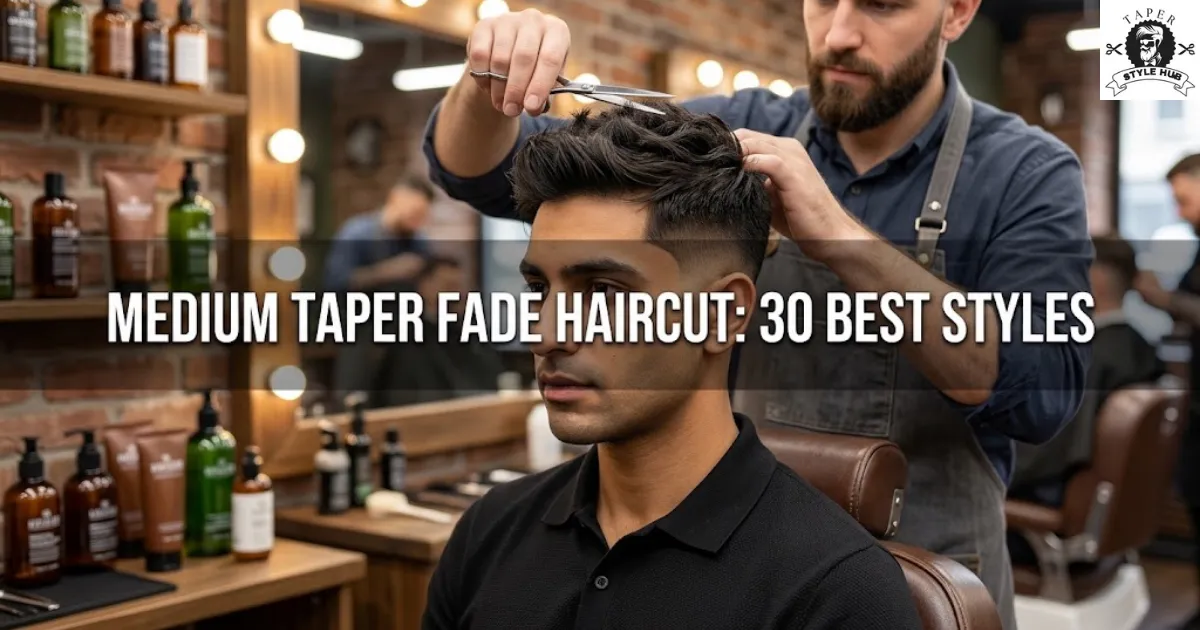
Medium Taper Fade Haircut: 30 Best Styles
A medium taper fade is the haircut you ask for when you want clean sides without going bold. It starts around the temples, blends down toward the ears and neckline, and leaves plenty of length on top.
That balance is exactly why this cut keeps showing up in barbershops, offices, classrooms and gyms. It looks tidy on a Monday morning, still works on a Saturday night, and asks for far less upkeep than a high skin fade.
This guide explains what the cut really is, how it compares with the low and high versions, and which of the 30 styles below suits your hair type and face shape.
You will also get a barber script, guard numbers, styling steps and a maintenance plan.
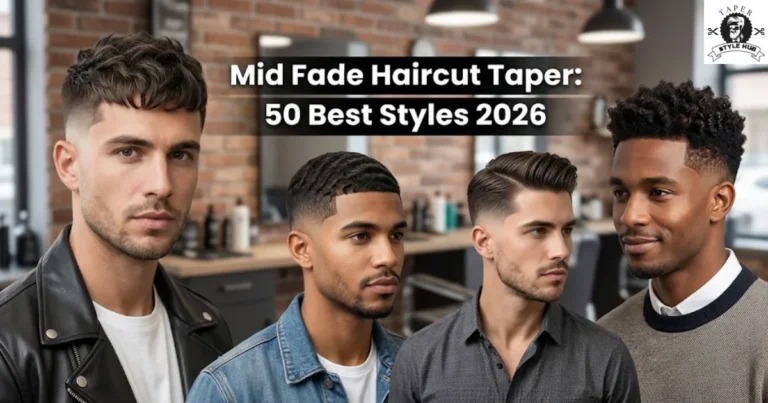
👉 Also Read: Mid Fade Haircut Taper
What Is a Medium Taper Fade Haircut?
A medium taper fade is a men’s haircut where the hair gradually shortens from the middle of the sides down to the neckline.
The change begins near the temples, roughly halfway between the ear and the top of the head, then moves toward the sideburns and nape.
Instead of a harsh step with a visible line, the length drops in tiny increments, so the sides look smooth rather than choppy.
The top stays longer, which gives you room for a quiff, a crop, curls, a fringe or a classic part.
The word medium describes where the blend begins. It sits between a low taper, which starts just above the ear, and a high taper, which starts closer to the crown. That middle position gives you visible contrast without drawing too much attention.
Most barbers build the gradient with clipper guards, then finish around the ears and neckline with a trimmer or a razor.
The shortest point usually lands somewhere between a number 0.5 and a number 2, depending on how close you want the finish.
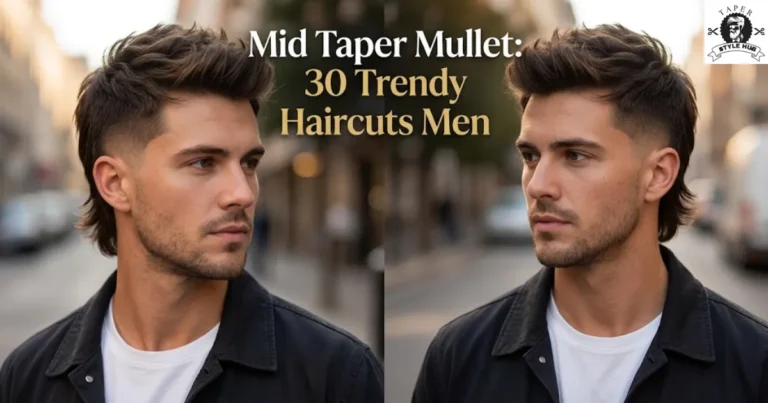
👉 Also Read: Mid Taper Mullet
Medium Taper Fade vs Mid Taper Fade: Are They the Same Thing?
In nearly every barbershop, yes. Barbers usually say mid taper, while clients often say medium taper, but both names describe the same placement around the temples. A medium taper fade and a mid taper fade will normally get you the same haircut.
The only real difference is how each barber reads the height. One barber may start the blend slightly higher than another, so a reference photo is always safer than relying on the name alone.
If you remember one thing from this section, make it this. Show a side photo and a back photo, then explain how short you want the bottom of the taper. That single step removes most of the guesswork.
👉 Also Read: Taper Mid
Key Characteristics of a Medium Taper Fade
You can recognize a well-cut medium taper fade by a handful of details. Check these the next time you look in the mirror after a haircut.
- The taper begins around the middle of the temple area, not near the ear or the crown
- Hair gets shorter in small steps toward the sideburns and neckline
- The sides keep more natural weight than they would with a skin fade
- The top stays long enough to style in several different ways
- The neckline is clean, whether tapered, rounded or squared
- The contrast is balanced, neither too soft nor too bold
- The cut works with straight, wavy, curly and coily hair
A medium taper fade does not have to reach bare skin. You can ask for a natural finish, a soft shadow or a closer skin-tight bottom, depending on how sharp you want the final result to look.
👉 Also Read: Mid Taper Fade Black Male Short Hair
How a Medium Taper Fade Looks From Every Angle
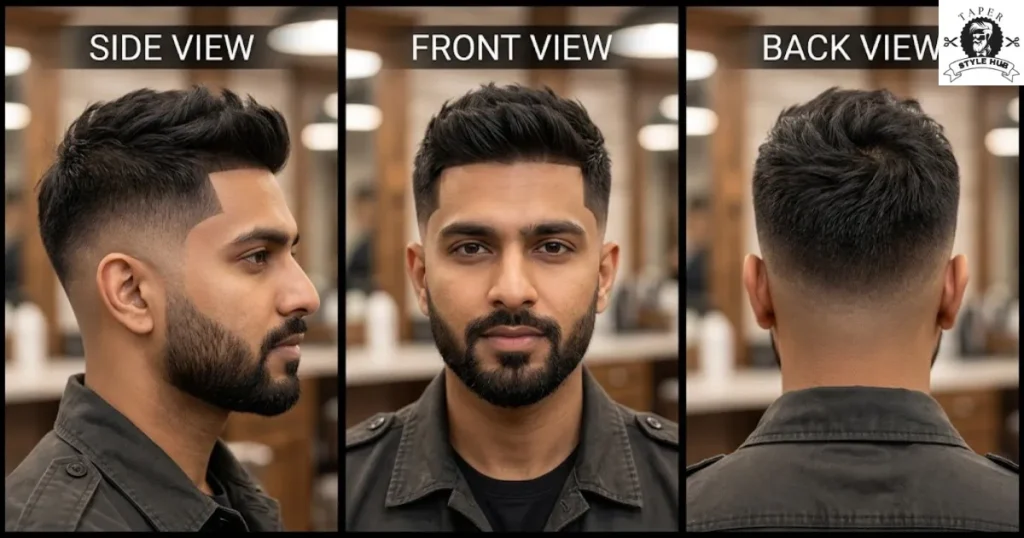
A good medium taper fade looks balanced from every side. Barbers judge the haircut by checking the front, the profile and the back separately, so it helps if you do the same in the mirror.
Front View
From the front, you notice a clean hairline and neat sideburns. The taper starts slightly out of sight, so it frames the face without pulling attention away from your top style.
Side Profile
The side view shows the real gradient. Hair moves from a visible length near the temple to very short hair around the ear, and the blend should look even, without stripes or hard lines.
Back View
At the back, the neckline decides how the haircut grows out. A tapered neckline fades naturally and grows out gently, while a squared neckline looks sharpest on day one but needs an earlier touch-up.
Medium Taper Fade vs Low Taper vs High Taper
The fastest way to choose your height is to compare all three side by side. The table below shows where each taper starts, how much contrast it creates and how often it usually needs a refresh.
| Feature | Low Taper | Medium Taper Fade | High Taper |
|---|---|---|---|
| Starting point | Just above the ear | Around the temples | Near the upper temple |
| Contrast | Soft and subtle | Balanced and modern | Bold and strong |
| Side weight kept | Most of it | A moderate amount | The least |
| Touch-up timing | Every 3 to 4 weeks | Every 2 to 3 weeks | Every 1 to 2 weeks |
| Best for | Conservative offices | Most people and styles | Edgy, high-contrast looks |
A low taper whispers. It stays close to the ear and neckline, leaves most of the side hair in place, and suits people who want a barely noticeable edge-up with a classic outline.
A high taper does the opposite. It begins higher, removes more hair from the sides, and pushes all the attention toward the top, which makes it a favorite for bold crops and spiky styles.
A medium taper fade talks at the right volume. You get a clear, defined transition and a modern outline, yet the cut still looks natural at work, at school and at family events.
Medium Taper Fade vs Mid Fade
People mix these two up all the time, but they are not identical. A mid fade usually removes more hair across the sides and often drops down to very short hair or bare skin.
The taper is softer. It concentrates the shortening around the temples, sideburns and neckline, so more natural length stays on the sides and the overall look feels less aggressive.
If you want a haircut that works in both professional and casual settings, the taper is usually the safer choice. If you want sharper contrast and more exposed skin, ask for the fade instead.
Medium Taper Fade vs Skin Fade, Drop Fade and Burst Fade
A skin fade can start low, medium or high, but it always ends at bare skin.
A medium taper fade can finish at skin, but it can also stop at a very short guard, which gives it a softer and less severe finish.
A drop fade curves down behind the ear and follows the shape of the skull. You can combine it with a medium taper fade when you want a more sculpted outline around the back of the head.
A burst fade curves around the ear in a semicircle and works especially well with curls, mullets and longer tops. It is a detail you add to the taper, not a replacement for it, so mention it clearly to your barber.
Who Should Get a Medium Taper Fade?
This haircut is flexible enough for almost anyone, but it fits certain people especially well. If any of these sound like you, it is probably a strong match.
- You want a modern look without extreme contrast
- You need a neat style for work, school or college
- You like changing your top style while keeping the same sides
- You have straight, wavy, curly or coily hair
- You prefer a cut that grows out gracefully
- You want moderate upkeep instead of weekly barber visits
It is also a smart pick if your hair is thick, because the taper removes bulk from the sides. If your hair is fine, a medium taper fade still works as long as you keep some density on top.
Is a Medium Taper Fade Good for Beginners?
Yes, and many barbers recommend it to first-time fade clients for exactly that reason. It is clearly visible, but it is not as dramatic as a high fade, so it feels comfortable on the first day.
It also forgives mistakes. If you decide next time that you want something bolder or softer, your barber can simply raise or lower the blend without starting from scratch.
That makes this cut a low-risk way to try a fade. You learn how your hair behaves, how fast it grows and how much styling you actually enjoy.
How to Choose Your Top Style Before You Sit in the Chair
Choosing the haircut is easier when you start with your life instead of a photo. Think about how much time you have in the morning, what your hair does naturally and where you spend most of your day.
| If You Want | Choose This Style |
|---|---|
| The easiest maintenance | Buzz cut or crew cut |
| A professional appearance | Side part, comb over or Ivy League |
| More volume | Quiff, pompadour or blowout |
| Natural texture | Curly top, wavy top or textured crop |
| A trendy look | Middle part, mullet or Edgar cut |
| Long hair flexibility | Taper with long hair on top |
Next, look at your hair density. Thick hair carries tall, structured styles, while fine hair does better with texture and moderate length. Curly and coily hair prefers enough length to form its natural pattern.
Then think about upkeep. Short styles and classic parts need more frequent edge cleanups, while longer textured tops can go a little longer between appointments because the movement hides regrowth.
Finally, be honest about your routine. If you will never pick up a blow-dryer, skip the pompadour, because even a perfect cut falls apart without the daily effort it needs.
If you are still unsure, ask your barber to talk through two or three options on your own hair type. A short consultation costs far less than a haircut you regret.
30 Best Medium Taper Fade Styles for Men in 2026
The medium taper fade is only half of the haircut. The other half is the top, and that is where the personality comes from.
Below, the 30 styles are grouped into six categories so you can jump to the one that matches your lifestyle.
Each style explains how it looks, who it suits and what to tell your barber. Read the category headings first, then pick the group that fits your hair length and your daily routine.
Classic and Professional Medium Taper Fade Styles
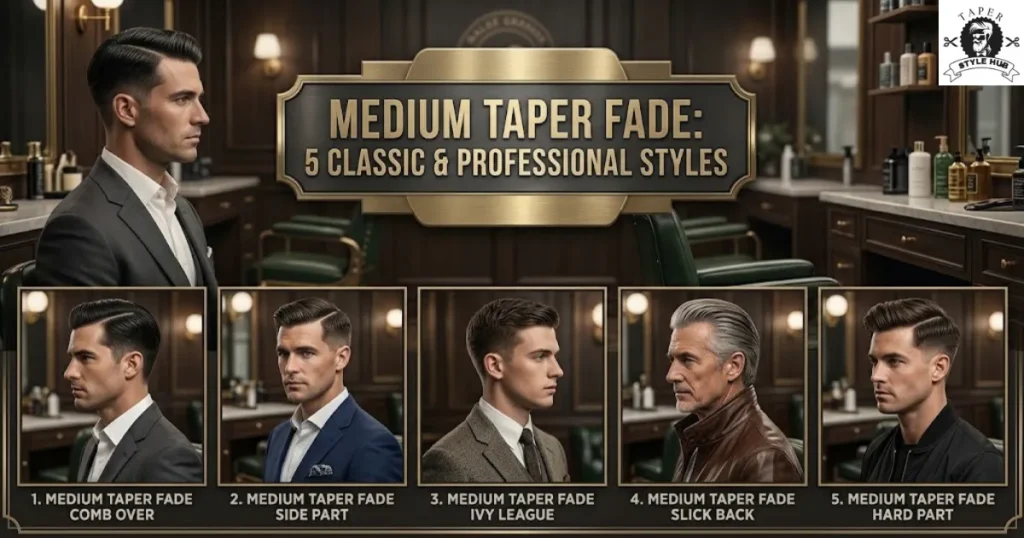
Classic styles lean on a clean part, smooth direction and neat edges. They work well in offices, interviews and formal events, and they rely on the medium taper fade to keep the sides sharp without looking trendy.
“All The Types Shown Below Are Displayed In The Single Image Above☝️”
1. Medium Taper Fade Comb Over
The comb over sweeps the top to one side while the medium taper fade keeps the temples and neckline tidy. It looks polished and confident, and it suits straight to slightly wavy hair with moderate length on top.
Style it on slightly damp hair. Blow-dry in the direction of the sweep, then comb it into place with a light pomade or cream for a clean finish with a little shine.
Ask your barber to leave three to four inches on top and keep the taper soft around the sideburns. Mention whether you want a natural separation or a visible part.
2. Medium Taper Fade Side Part
A side part gives structure to the top, and the medium taper fade stops it from looking old-fashioned. The sides stay neat, the part stays crisp, and the whole haircut feels deliberate without feeling stiff.
This style works best on oval and square faces with medium-density hair. Blow-dry the top along the part, then finish with a medium-hold pomade to smooth flyaways and add controlled shine.
Tell your barber which side you naturally part your hair on. Working with your growth pattern makes the style easier to maintain every morning.
3. Medium Taper Fade Ivy League
The Ivy League is a short, refined cut with just enough length at the front to sweep or part. Paired with a medium taper fade, it keeps its campus charm but gains a sharper, more modern outline.
It suits straight hair especially well and needs very little product. A small amount of styling cream is enough to keep the top neat from breakfast until the end of the workday.
Ask for a slightly longer front, a tidy neckline and a taper that starts at the temples. Avoid leaving too much bulk on the upper sides.
4. Medium Taper Fade Slick Back
The slick back pushes the hair straight off the forehead and toward the crown. The medium taper fade narrows the silhouette, so the style looks sleek and sophisticated rather than heavy or greasy.
Thicker hair holds this look best. Apply pomade to towel-dried hair, comb it back with a fine-tooth comb, and use a blow-dryer on low heat to set the direction before the product dries.
Request enough length to comb the top backward without it flopping forward. Four inches is a safe starting point for most hair types.
5. Medium Taper Fade Hard Part
A hard part is a thin line shaved into the hair to mark the separation. Combined with a medium taper fade, it creates a sharp, geometric detail that looks especially defined on straight hair.
Placement matters here. Ask your barber to check how your hair falls naturally before cutting the line, because a part that fights your growth pattern is hard to style.
Expect more frequent visits with this one. The shaved line softens quickly, so most people refresh it every two to three weeks along with the taper.
Short and Low-Maintenance Medium Taper Fade Styles
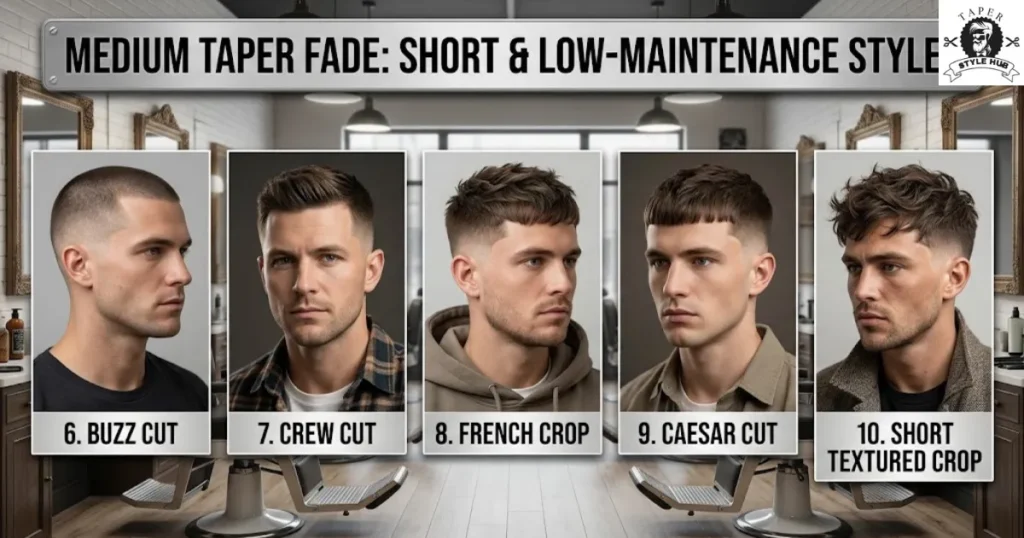
Short styles suit busy schedules, active lifestyles and hot climates. They keep the top compact and let the medium taper fade do most of the visual work, which means you can skip long styling routines.
“All The Types Shown Below Are Displayed In The Single Image Above☝️”
6. Medium Taper Fade Buzz Cut
A buzz cut with a medium taper fade is one of the easiest haircuts to live with. The top stays uniformly short, while the taper adds shape around the temples, ears and neckline so the cut never looks flat.
Most barbers use a number 3 to number 5 guard on top and blend down to a number 1 or number 0.5 at the bottom. Wash it, dry it and go.
Book a touch-up every two weeks if you want the taper to stay sharp. Short hair shows regrowth quickly, especially around the edges.
7. Medium Taper Fade Crew Cut
The crew cut keeps the top short and slightly longer at the front. With a medium taper fade underneath, it looks disciplined and practical without feeling military, which is why students and athletes love it.
Straight and thick hair works best. You can wear it with no product at all, or add a pea-sized amount of matte paste if you want light texture.
Ask for a gentle slope from the front to the crown and a clean taper around the ears. Trim the top whenever it starts feeling heavy.
8. Medium Taper Fade French Crop
The French crop pairs a short, textured top with a blunt forward fringe. The medium taper fade gives it cleaner lines, so the haircut looks modern and needs almost no daily effort.
It suits both fine and thick hair. Blow-dry the fringe forward with your fingers, then work a little matte clay through the ends to separate the pieces.
Tell your barber how long you want the fringe to sit. Ask for light texturizing so the front does not look like a solid helmet.
9. Medium Taper Fade Caesar Cut
The Caesar cut is a short, uniform fringe brushed forward over the forehead. Add a medium taper fade, and you get a compact, tidy style that is simple to manage and easy to repeat at every visit.
It is also a practical choice if your hairline is receding, because the forward fringe offers natural coverage. Keep the length even and use only a light cream if needed.
Ask for a short fringe with a clean edge and a taper that stays above the ears. Small trims every few weeks keep the outline neat.
10. Medium Taper Fade Short Textured Crop
The short textured crop uses scissors or point cutting to create movement on top without adding length. Paired with a medium taper fade, it looks relaxed, youthful and slightly messy in a controlled way.
Sea salt spray or matte clay on dry hair is all you need. Scrunch it with your fingers, push the fringe forward and leave it alone.
Tell your barber you want choppy texture rather than a smooth finish. The taper keeps the sides crisp while the top does the talking.
Volume and Lifted Medium Taper Fade Styles
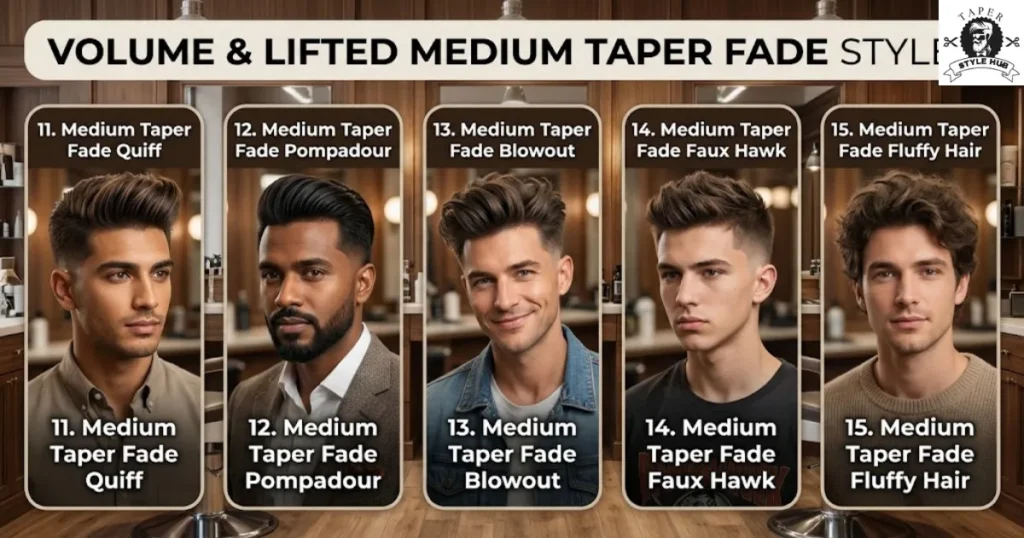
Volume styles add height and shape on top, then balance it with clean tapered sides. They need a little more styling time, but the contrast between the lifted top and the neat edges looks striking.
“All The Types Shown Below Are Displayed In The Single Image Above☝️”
11. Medium Taper Fade Quiff
The quiff lifts the front of the hair upward and slightly back. A medium taper fade controls the sides, so the height looks intentional instead of puffy, and it makes round faces appear a little longer.
Blow-dry the front upward with a round brush, then shape it with your fingers. Finish with a molding paste for flexible hold and light texture.
Ask for three to four inches at the front and tighter sides. Mention that you want the length to blend into the top without a visible step.
12. Medium Taper Fade Pompadour
The pompadour is the boldest lifted style on this list. Combined with a medium taper fade, the tall front looks balanced, because the tidy sides keep the whole shape organized.
It works best on thick or medium-density straight hair. Expect around ten minutes each morning with a blow-dryer and a strong-hold pomade.
Ask for four to five inches on top, longer at the front, with a clean taper that does not climb too high. A taper that rises too far can make the top look disconnected.
13. Medium Taper Fade Blowout
A blowout pushes the hair upward and outward for airy volume. The medium taper fade frames that fullness neatly, which is why the style looks so clean on thick, wavy and naturally textured hair.
Apply volumizing mousse to damp hair, then blow-dry upward from the roots with your fingers or a vent brush. Finish with a light spray if you need all-day hold.
Request three to four inches on top and enough layering to avoid heavy weight. Your barber can remove bulk from the sides to keep the shape light.
14. Medium Taper Fade Faux Hawk
The faux hawk raises a central strip of hair without shaving the sides into a full mohawk. With a medium taper fade, it feels bold but still wearable at work and on weekends.
Use a fiber paste and guide the center upward with your fingertips. Straight, thick hair holds the shape best, so fine hair may need a little texture powder at the roots.
Tell your barber to keep the longest section down the center and blend the surrounding hair gradually. The taper should narrow the sides without cutting too high.
15. Medium Taper Fade Fluffy Hair
Fluffy hair has a soft, bouncy look with natural volume. A medium taper fade keeps the sides neat, so the fluff looks stylish and cared for rather than messy or oversized.
It suits fine and wavy hair that needs body. Use a diffuser or let it air-dry after applying a light cream or a few sprays of sea salt.
Leave about three inches on top and ask your barber to thin it softly. Keep the sides short enough to highlight the volume above.
Fringe and Forward-Styled Medium Taper Fade Styles
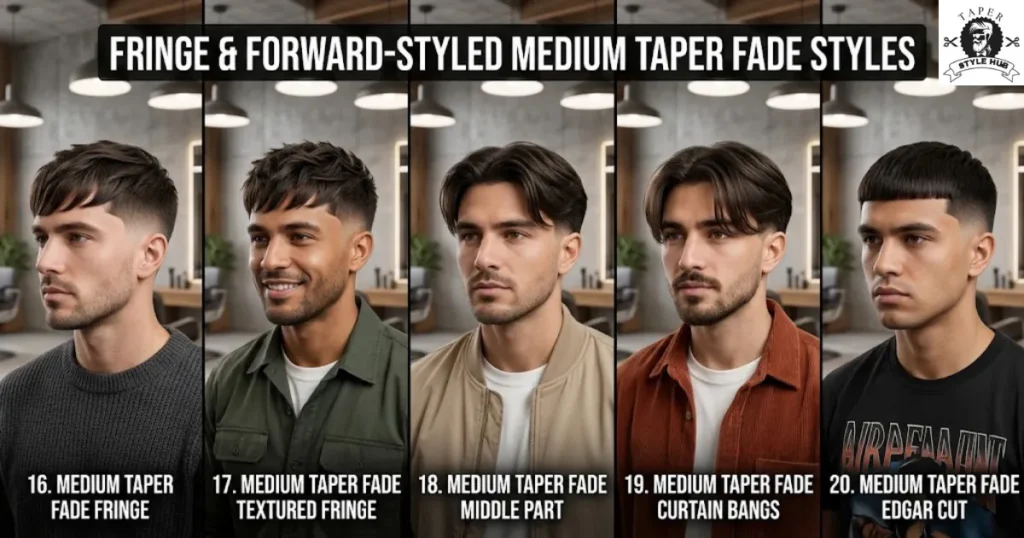
Forward styles bring the hair over the forehead and add a youthful, relaxed edge. They soften sharp features, work well for students and creatives, and look cleaner when the taper stays tight at the sides.
“All The Types Shown Below Are Displayed In The Single Image Above☝️”
16. Medium Taper Fade Fringe
A fringe brushes the front of the hair forward across the forehead. With a medium taper fade on the sides, it looks fresh and effortless, and it can soften a strong jaw or a high forehead.
Keep the fringe two to three inches long and style it with a pinch of matte clay. Blow-dry it forward so it sits naturally above the eyebrows.
Tell your barber to point cut the ends for a soft edge. Trim the front every three to four weeks so it never reaches your eyes.
17. Medium Taper Fade Textured Fringe
The textured fringe is the choppy, layered version of the classic forward cut. Scissors create uneven lengths, and the tapered sides keep the haircut tidy while the top shows plenty of movement.
It suits straight and wavy hair, and it is popular with younger guys who want a relaxed finish. Texture powder or matte clay separates the pieces without making them stiff.
Ask for point cutting through the front and a clean taper around the ears. Avoid heavy thinning, because it can leave the ends looking wispy.
18. Medium Taper Fade Middle Part
The middle part splits the hair down the center and lets it fall naturally to both sides. A medium taper fade keeps the sides narrow, so the longer top looks soft but still neat.
Straight and wavy hair work best, and you need at least four inches on top for the hair to fall properly. Dry it away from the face for natural movement.
Use a rat-tail comb to mark the part, then add a light cream to control flyaways. Ask your barber to leave extra length around the front.
19. Medium Taper Fade Curtain Bangs
Curtain bangs open at the center and sweep toward the sides of the face. Set against tapered sides, they create a nice contrast between a soft, longer front and a sharp outline.
This style loves medium-length straight hair. Blow-dry each side outward with a vent brush, then use a little styling cream on the ends for gentle separation.
Tell your barber you want face-framing length at the front and a taper that does not cut into the curtain shape. Soft layers help thick hair behave.
20. Medium Taper Fade Edgar Cut
The Edgar cut is known for its blunt, straight fringe cut across the forehead. When paired with a medium taper fade, the sides stay sharp and the fringe becomes the clear focal point of the haircut.
Thick, straight hair supports the blunt line best. Blow-dry the top forward, then tuck a touch of cream under the fringe to keep it flat and clean.
Agree on the fringe length before the barber starts cutting. A small change can alter the whole look, and the line needs regular trims.
Curly, Wavy and Coily Medium Taper Fade Styles
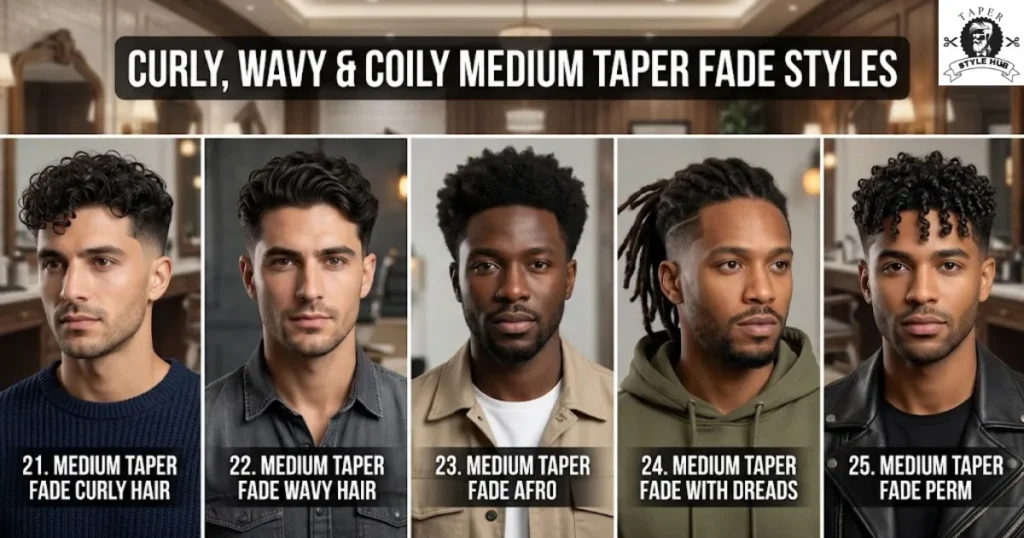
Textured hair and a medium taper fade are a natural match. The taper controls the sides and cleans the edges, while the curls, waves or coils on top remain the star of the haircut.
“All The Types Shown Below Are Displayed In The Single Image Above☝️”
21. Medium Taper Fade Curly Hair
Curls with a medium taper fade create a clear contrast between a full, bouncy top and neat, tapered sides. The cut removes extra bulk around the ears and neckline, so the curls look defined instead of oversized.
Apply a curl cream to damp hair, scrunch gently and let it air-dry or use a diffuser. Do not brush dry curls, because it breaks up the pattern.
Ask for at least three inches on top so the curls can form. Remember that curls shrink when dry, and tell your barber to cut with that in mind.
22. Medium Taper Fade Wavy Hair
Wavy hair has natural movement that looks great against clean sides. The taper removes bulk where waves can puff outward, so the shape stays balanced and the texture stays visible.
Sea salt spray on damp hair, a quick scrunch and a bit of air-drying will usually do the trick. Avoid heavy gel, which can weigh the waves down.
Leave three to four inches on top and ask your barber to texture the ends lightly. That keeps the movement soft and natural.
23. Medium Taper Fade Afro
An afro with a medium taper fade keeps height and volume on top while the sides stay crisp. The clean outline makes natural coils look intentional, sculpted and full of shape.
Use a wide-tooth comb or an afro pick to lift the hair, and apply a leave-in conditioner to keep it soft and moisturized. A light oil adds shine without heaviness.
Ask for a line-up along the forehead and temples, with the taper starting around the middle of the sides. Refresh the edges every two weeks.
24. Medium Taper Fade With Dreads
Dreadlocks on top and tapered sides look neat, modern and easy to manage. The taper keeps the area around the ears clean, so the locs have room to stand out.
Moisturize the scalp, retwist the roots on schedule and wrap the locs at night to reduce frizz. Match the taper height to the length of your locs.
Tell your barber to keep the fade subtle so it does not clash with the loc length. A fresh taper every two to three weeks keeps the contrast sharp.
25. Medium Taper Fade Perm
A perm adds permanent curls or waves to straight hair, and a medium taper fade keeps the sides from looking too wide. The result is a youthful, textured style with plenty of bounce.
Avoid washing your hair for forty-eight hours after the perm, then switch to a moisturizing shampoo and a curl cream. Skip the brush and use a wide-tooth comb instead.
Get the taper cut before the perm so the sides stay neat. Soft digital or Korean perms look the most natural.
Trending and Statement Medium Taper Fade Styles
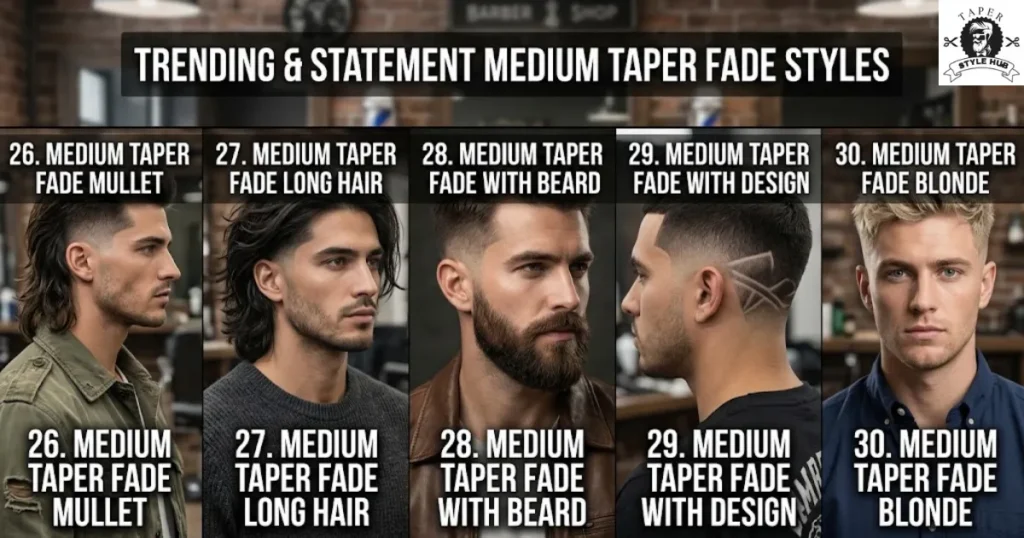
Trend-driven styles add personality through length, color or detail. They suit confident personalities, creative workplaces and social settings, and they need an experienced barber who understands how the taper supports the shape.
“All The Types Shown Below Are Displayed In The Single Image Above☝️”
26. Medium Taper Fade Mullet
The modern mullet keeps the top and back longer while the sides stay tidy. The taper gives it a polished finish around the temples and ears, which makes the style far more wearable than the old version.
Straight and wavy hair both work. Use matte clay on the top and a few sprays of sea salt through the back to keep it textured and natural.
Ask your barber to taper only the sides and keep the back length intact. Bring a photo showing how long you want it at the nape.
27. Medium Taper Fade Long Hair
You do not need short hair to wear a taper. A medium taper fade removes bulk from the sides and keeps the length on top, so long hair looks structured instead of triangular.
Wear it down, pull it into a ponytail or tie it into a small bun. Use a lightweight leave-in conditioner to control frizz and keep the ends healthy.
Keep at least four inches on top, and ask your barber to blend the taper smoothly into the longer hair so there is no visible line.
28. Medium Taper Fade With Beard
A beard gives the face a continuous frame, and a medium taper fade can blend straight into it. The sideburns flow into the beard, creating one smooth, connected transition instead of a harsh break.
Short stubble looks subtle, while a full beard creates stronger contrast. Use beard oil daily and trim the cheek line weekly to keep the shape clean.
Ask your barber to blend the fade and beard in the same visit. That keeps the proportions balanced and the edges consistent.
29. Medium Taper Fade With Design
A shaved line, curve or small pattern adds an artistic touch to the sides. The taper creates a clean canvas, and the design stands out sharply, especially on straight or tightly curled hair.
Keep the design simple if you work in a conservative office. A single curved line usually looks sharper and more wearable than a complicated pattern.
Bring a reference image and discuss the placement before the barber begins. Designs fade quickly, so plan a touch-up every two weeks.
30. Medium Taper Fade Blonde
A blonde top with a medium taper fade gives strong tonal contrast against darker natural sides. It looks bold and bright, and the tidy taper stops the color from overwhelming the whole haircut.
Use purple shampoo once a week to prevent brassiness and deep condition regularly. Bleached hair is more fragile, so avoid heavy heat styling.
Ask for a soft blend between the sides and top, and book a toner refresh every four to six weeks to keep the shade even.
Best Medium Taper Fade for Different Hair Types
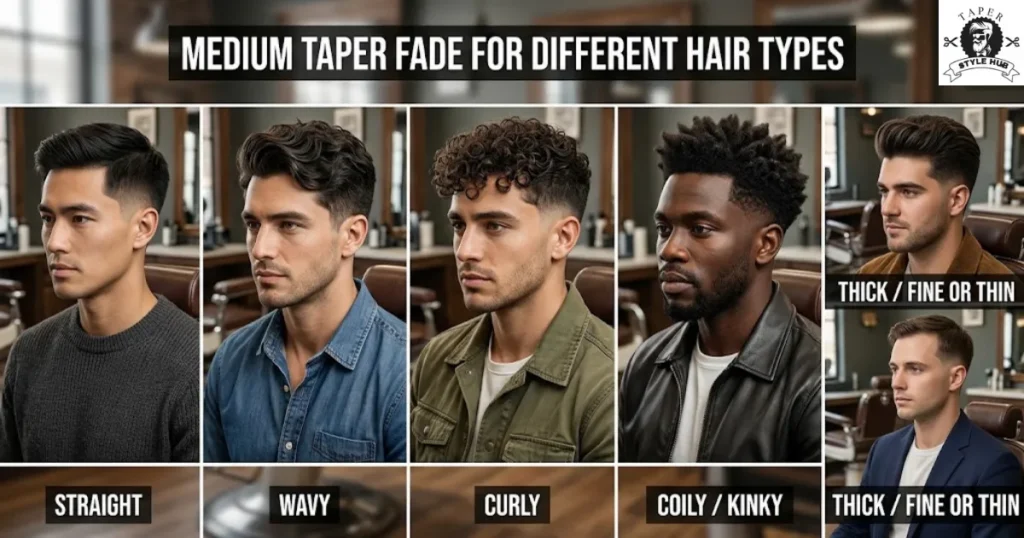
Hair texture changes how the same haircut behaves. A medium taper fade adapts to every type, but the top length, the guard choice and the styling products need small adjustments to get the best result.
“All The Types Shown Below Are Displayed In The Single Image Above☝️”
Straight Hair
Straight hair shows every blend line, so a clean transition matters. The taper looks sharp and architectural on straight strands, and the top can be styled as a part, a crop, a fringe or a slick back.
Fine straight hair can look flat, so keep a little extra density on top. A matte clay or texture powder adds grip and lift without weighing it down.
Wavy Hair
Wavy hair is the easiest match because the waves already bring movement. The taper removes side bulk that makes waves look uneven, and it leaves the top free to flow.
Sea salt spray on damp hair, a gentle scrunch and a short air-dry usually work best. Avoid brushing the waves once they are dry.
Curly Hair
Curls need length to form, so leave at least three inches on top. The taper cleans up the temples and neckline, and it keeps the curls from turning into a wide triangle.
Work a curl cream through damp hair and let it dry naturally or with a diffuser. Moisture matters, because dry curls lose definition quickly.
Coily Hair
Coily and Type 4 hair holds a crisp taper beautifully. The clean outline defines the natural density, and the style pairs well with short coils, twist sponge curls, waves or a sharp line-up.
Keep the top hydrated with a leave-in conditioner and a light oil. Refresh the taper every two weeks so the edges stay precise.
Thick Hair
Thick hair can get bulky around the sides quickly. A medium taper fade removes that extra weight while keeping enough fullness on top, so the overall shape looks sculpted instead of heavy.
Ask your barber to use point cutting or careful thinning on top. Textured styles are easier to manage because they hide the density.
Fine or Thin Hair
Fine hair can still carry this cut. The trick is avoiding too much contrast between the top and the sides, so keep the top slightly longer and the bottom of the taper from going completely to skin.
Use a volumizing mousse before blow-drying and a small amount of texture powder at the roots. Skip heavy pomades, because they separate thin strands.
Which Face Shape Suits a Medium Taper Fade Best?
This cut flatters every face shape, but the top style decides how balanced the final result looks. Use the table as a quick guide, then read the notes for your own shape.
| Face Shape | Best Top Styles | Why It Works |
|---|---|---|
| Round | Quiff, pompadour, textured crop | Adds height and lengthens the face |
| Oval | Almost anything | Balanced proportions suit every style |
| Square | Side part, crew cut, textured crop | Keeps the jaw strong without looking boxy |
| Heart | Fringe, curtains, middle part | Softens a wider forehead |
| Diamond | Fringe, curly top, layered styles | Adds width near the forehead and jaw |
| Oblong | Short crop, side fringe, medium top | Avoids extra height and adds width |
Round Face
Height is your friend. A quiff, pompadour or textured top lifts the eye upward, while the tight taper slims the sides and creates a longer, leaner outline.
Avoid flat tops with no direction, because they can make the face look rounder. Skip heavy fringes that sit straight across the forehead.
Oval Face
You can wear nearly anything. Oval faces are naturally balanced, so you can choose a style based on lifestyle, hair type and the amount of time you want to spend styling.
A side part, a slick back or a French crop all look good here. Let your hair texture guide the final decision.
Square Face
A strong jaw already gives you structure. A textured crop or a side part softens the angles a little, while the taper keeps the sides sharp and the overall look masculine.
Adding some texture on top helps stop the cut from looking too rigid or boxy. Avoid extremely geometric shapes.
Heart-Shaped Face
A wider forehead and a narrower chin respond well to fringes, curtains and medium-length tops. These styles add softness to the upper face and create better balance with the jawline.
Keep the volume near the crown rather than at the temples, and avoid tall styles that make the forehead look bigger.
Diamond Face
Prominent cheekbones need balance. A fringe or a curly top adds width near the forehead, while the taper stays tight enough to avoid making the face look narrower.
Do not remove too much fullness around the upper sides. A textured top with some movement works nicely.
Oblong Face
A longer face looks best with width rather than height. A short crop, a side-swept fringe or a medium-length top keeps the proportions comfortable and the haircut balanced.
Avoid tall quiffs and large pompadours, because extra vertical volume can make the face look even longer.
Medium Taper Fade Guard Numbers and Clipper Sizes
Guard numbers help you describe how short you want the hair, although every barber blends a little differently. Think of the table below as a starting point, not a strict formula.
| Guard | Approximate Length | Typical Use |
|---|---|---|
| #0.5 | About 1.5 mm | Neckline and tightest areas |
| #1 | About 3 mm | Bottom of the taper |
| #1.5 | About 4.5 mm | Blending zone |
| #2 | About 6 mm | Middle of the blend |
| #3 | About 10 mm | Upper part of the taper |
| #4 | About 13 mm | Longer sides and bulk control |
A common pattern starts with a number 1 or number 0.5 at the bottom, moves through a number 2 in the middle and finishes with a number 3 near the temple. Your barber then softens the steps with the clipper lever.
Hair density, growth direction and head shape all change the final result, so ask for a consultation. A good barber will adjust the guards instead of following a fixed formula.
How a Barber Builds a Taper Fade Step by Step
Understanding the process helps you judge the result and communicate better. Although every barber has a personal rhythm, most follow the same four stages when they build this kind of taper.
Step One: Consultation and Sectioning
A good barber starts by looking at your hair, not by picking up clippers. They check your growth pattern, your head shape and your reference photo, then section off the top so it stays out of the way.
Step Two: Setting the Guide Line
Next comes the guide line, which marks where the taper begins on the side of the head. For this cut, that line sits around the temples, and the barber checks it from every angle before continuing.
Step Three: Blending With Guards
The barber works upward from the neckline using several guard sizes, often with clipper over comb. Each pass softens the previous one, which is why a patient blend takes longer than a quick cut.
Step Four: Detailing and Finishing
Finally, the barber cleans the sideburns, ears and neckline with a trimmer or razor. They check the symmetry, texture the top if needed and show you the back with a mirror before you leave.
Tools Barbers Use to Create a Clean Taper
You do not need to own any of this equipment, but knowing the tools helps you understand what you are paying for. A precise taper depends on good clippers and a barber who knows how to use them.
Professional clippers handle the main blend, while a smaller trimmer cleans the sideburns, ears and neckline. Some barbers also use a foil shaver or a straight razor when they want a crisp, close finish.
Scissors and a fine-tooth comb build the transition on longer hair and shape the top. This technique, often called scissor over comb, creates a softer blend that suits wavy and curly textures.
Guards, brushes and a neck duster complete the setup. A clean, sharp set of tools makes the haircut faster, more comfortable and noticeably more even from the first pass to the last.
Top Length Guide: How Many Inches Do You Need?
The taper only controls the sides, so the length on top decides which styles are possible. Use the table below to see how much hair each look needs before you ask for a trim.
| Style | Approximate Top Length |
|---|---|
| Buzz cut | 3 to 6 mm |
| Crew cut | 1 to 2 inches |
| French crop or Caesar cut | 1 to 2 inches |
| Textured crop | 2 to 3 inches |
| Quiff or comb over | 3 to 4 inches |
| Pompadour or slick back | 4 to 5 inches |
| Middle part or curtains | 4 to 6 inches |
| Long hair styles | 5 inches or more |
Hair grows about half an inch every month, so growing from two inches to five inches takes around six months. Plan ahead if you want a style that needs more length than you currently have.
Curly and coily hair shrinks when it dries, so a few stretched inches can look much shorter in real life. Ask your barber to leave a little extra, and remember that you can always trim more later.
Growth Patterns, Cowlicks and Crown Whorls
Every head of hair grows in its own direction, and that direction affects how the taper looks. A swirl near the temple or a strong crown whorl can change where the blend should begin.
A cowlick right at the temple can make the transition look uneven if the barber ignores it. Mention it during the consultation, and ask whether adjusting the blend height would give a cleaner result.
Crown whorls matter for the top. Short styles can make a whorl stand up, while a little extra length helps the hair lie flat, so your barber may suggest keeping more weight in that area.
Growth patterns also explain why friends with the same haircut never look identical. Instead of copying a photo exactly, ask your barber to adapt the shape to the way your hair actually moves.
If the pattern is stubborn, a blow-dryer can train it. Dry the hair in the direction you want it to sit, and set it with a cool burst before applying any product.
Line-Ups and Edge-Ups: Choosing Your Hairline Finish
A taper looks even better when the hairline matches the sides. A line-up, sometimes called an edge-up, sharpens the front hairline, the temples and the sideburns with a trimmer or razor.
You can choose between three finishes. A natural edge keeps the hairline soft, a soft line-up cleans it lightly, and a sharp line-up creates a crisp, geometric outline that stands out immediately.
Sharp edges look fantastic on day one, but they soften quickly. If you prefer a lower-maintenance finish, ask for a natural edge and let the hairline grow out gently between visits.
Be careful about pushing the hairline too far back. An aggressive line-up can make the forehead look larger, especially if the hair is already thinning near the temples.
Whatever finish you choose, make sure the line-up connects smoothly with the taper. A mismatch between the two is one of the quickest ways to make a good haircut look unfinished.
How to Ask Your Barber for a Medium Taper Fade
Most bad haircuts begin with a vague request. Walking in with a clear plan helps your barber understand the height, the length and the finish you want from the very first minute.
The Exact Script to Use
Say it plainly: “I want a medium taper fade starting around my temples, with a number 1 at the bottom. Keep three inches on top, blend it smoothly and keep my neckline natural.”
If you want a closer finish, add: “Take the bottom of the taper close to the skin.” If you prefer something softer, say: “Keep a little shadow at the bottom.”
Details Worth Mentioning
A few extra details save a lot of confusion. Tell your barber about anything that affects the shape or the upkeep of the cut.
- How tall you want the taper to start on the sides
- Your preferred top length in inches
- Whether you want a natural, rounded or squared neckline
- How you plan to style the top each morning
- Any cowlicks, thinning areas or growth patterns near the temples
- Whether the taper should blend into a beard
Bring a Reference Photo
A photo removes almost all doubt. Show one image from the side and one from the back, so the barber can see the blend path and the neckline clearly.
Explain what you like about the picture, because your hair type may change the final result. A good barber will tell you honestly what is realistic.
Questions to Ask Your Barber Before the Cut
A short conversation before the first snip can save you weeks of regret. Barbers usually enjoy these questions, because they show you care about the result and want an honest answer.
- Have you cut this style on my hair type before?
- Which guard numbers will you use for the bottom and the top of the blend?
- How tall should the taper start for my head shape?
- Will my cowlick or crown change how the cut looks?
- Which product would you recommend for my hair texture?
- How soon should I come back for a touch-up?
A confident barber will answer calmly and explain the reasoning behind each choice. If the answers sound vague or rushed, consider booking a different appointment before the clippers come out.
Red Flags to Watch for When Choosing a Barber
Not every barber blends equally well, and a taper exposes weak technique quickly. Watching for a few warning signs can protect you from a bad haircut.
Be cautious if the barber skips the consultation and starts cutting straight away. A good professional asks about your preferred length, your styling habits and the finish you want before touching your hair.
Another warning sign is a rushed blend. A clean taper usually takes thirty to forty-five minutes, and a barber who finishes in ten minutes may leave visible lines or uneven patches.
Look at their portfolio as well. Photos of similar haircuts on similar hair types tell you far more than a general reputation, especially if you have curls, coils or very thick hair.
How to Style a Medium Taper Fade at Home
The haircut does about half of the work, and your morning routine does the rest. Because the sides are already tidy, styling is mostly about shaping the top and choosing a product that fits your hair type.
- Wash your hair and gently towel-dry it until it feels damp, not wet.
- Apply a pre-styler, such as sea salt spray for texture or mousse for volume.
- Blow-dry in the direction you want the style to fall, lifting the roots with your fingers or a brush.
- Work a pea-sized amount of clay, paste or pomade through the top while the hair is still warm.
- Shape the finished look with your fingers or a comb, then add a light mist of hairspray if you need hold.
Start with less product than you think you need. You can always add more, but a heavy hand makes hair look greasy and flat, especially if your hair is fine.
Keep the product on the top and avoid coating the tapered sides. Clean sides are what make the contrast look sharp, so a little discipline in the morning pays off all day.
Best Hair Products for a Medium Taper Fade
The right product depends on your hair type and the finish you want. You do not need all of them, but a couple of good basics will cover almost every style on this list.
Texture Clay
Clay gives strong hold with a matte finish. It works well for textured crops, quiffs and messy fringes, and it helps the top look thick without looking shiny.
Pomade
Pomade creates a smooth, polished finish. It suits slick backs, side parts and comb overs, and water-based versions wash out far more easily than heavy oil-based ones.
Molding Paste
Molding paste offers flexible hold and light texture. It is ideal when you want a style that stays neat but can be reshaped with your fingers during the day.
Texture Powder
Texture powder adds instant lift at the roots. It is a lifesaver for fine hair that goes flat quickly, and it adds grip before you apply any other product.
Sea Salt Spray
Sea salt spray gives grit and a natural, beachy movement. Use it on damp hair before blow-drying, then add clay or paste afterward if you need more control.
Styling Cream
Styling cream controls frizz and keeps the hair soft and natural. It suits side parts, curtains and everyday looks that need light hold without a stiff finish.
Curl Cream
Curl cream defines curls and waves while reducing dryness. Apply it to damp hair, scrunch it in and let the pattern form naturally without brushing.
Volumizing Mousse
Mousse builds body before blow-drying. It helps blowouts, quiffs and pompadours hold their height, and it works especially well on straight hair that tends to fall flat.
Hair Care Basics
A gentle shampoo, a hydrating conditioner and a few drops of argan oil keep the hair healthy. Use a clarifying shampoo once a week to remove product buildup.
How to Maintain a Medium Taper Fade Between Visits
A fresh taper looks sharp because the transition is clean. As the hair grows, the contrast softens, so a simple schedule keeps the cut looking intentional for longer.
| Time After Haircut | What to Expect | What to Do |
|---|---|---|
| Week 1 | Crisp, clean and well defined | Style as normal |
| Week 2 | Still sharp with slight growth | Keep the neckline tidy |
| Week 3 | The blend starts to soften | Book a touch-up |
| Week 4 | The contrast fades noticeably | Get a full trim |
Most people refresh the edges every two to three weeks and get a full reshape every four weeks. Fast-growing hair may need a visit slightly earlier, while slower hair can stretch it a little.
Between visits, you can tidy loose hairs around the neckline with a trimmer. Leave the blend itself to your barber, because a home attempt often creates uneven patches that are hard to fix.
Wash your hair as often as your scalp needs, and use less product on the sides. Buildup makes the taper look dull, and a clarifying shampoo once a week keeps everything fresh.
Haircut Aftercare in the First Forty-Eight Hours
The first two days after a haircut set the tone for how long it stays fresh. A few gentle habits protect the skin around the edges and keep the blend looking clean.
Avoid touching or scratching freshly clipped areas, because the skin near the neckline and ears can feel slightly sensitive. A cool rinse and a clean towel are usually all you need.
Skip heavy products on the first day if you notice any redness. Let the scalp settle, then return to your regular routine once it feels comfortable again.
If your barber used a razor, apply a light, fragrance-free moisturizer to the edges. This calms the skin and reduces the small bumps that sometimes appear after close shaving.
Scalp Care and Hair Health Under a Taper
Short sides expose more of the scalp, so skin health matters more than usual. A healthy scalp makes the haircut look cleaner and helps the hair on top grow thicker and stronger.
Wash with a gentle shampoo and rinse thoroughly, because leftover product can cause itching and flaking. If you sweat often, wash a little more frequently and finish with a cool rinse.
Sunscreen deserves a place in your routine. Tapered sides and thinner areas near the temples burn easily in summer, so use a light sunscreen or wear a hat when you spend long hours outdoors.
Massage the scalp for a minute while shampooing. It feels good, loosens dead skin and helps product spread evenly, which gives the top a healthier, fuller look over time.
Finally, trim split ends on longer tops every couple of months. Healthy ends reduce frizz, and they make every style on this list look sharper and more intentional.
How to Grow Out a Taper Without the Awkward Phase
A taper grows out better than almost any other short haircut. Because the transition is gradual, you never face a sudden step between short and long hair, and the shape stays neat for weeks.
If you are growing out the top, keep the sides tidy and skip top trims. Visit your barber only for edge cleanups, and let the length build until you reach the style you want.
Expect roughly half an inch of growth each month. That means a short top needs several months to reach a comfortable length for a quiff, a man bun or longer curtains.
Medium Taper Fade for Teens, Professionals and Receding Hairlines
The same haircut can serve very different people, but each situation has small details worth knowing. Here is how to adapt it to your own life.
Teens and Students
Teenagers usually prefer textured crops, fringes and curly tops because they are easy to style and look current. A medium taper fade keeps the sides tidy enough for school without feeling too strict.
Office and Professional Settings
For work, choose a side part, a slick back or an Ivy League cut. The soft contrast stays professional, and the clean neckline looks neat even after a long day.
Receding Hairlines
A taper can help if you are losing hair at the temples, as long as it is customized. Keep some texture on top, add moderate volume and avoid pushing the hairline back too far.
Active Lifestyles
If you train often or work outdoors, a short crop or a buzz cut with a taper is a smart pick. It dries quickly, stays tidy and needs almost no styling.
Barber Terms That Help You Explain Your Haircut
Knowing a few basic words makes your consultation faster and your result more accurate. You do not need to sound like a professional, but these terms help you get closer to the cut you imagine.
- Fade: a gradual change from longer hair to shorter hair, often down to skin
- Taper: a softer shortening that focuses on the sideburns, temples and neckline
- Blend: the smooth connection between two different hair lengths
- Guard number: the clipper attachment that sets the hair length
- Line-up: a sharp edge along the hairline around the forehead and temples
- Clipper over comb: a technique that removes bulk and smooths the blend
- Scissor over comb: a cutting method that creates a softer, more natural transition
- Point cutting: snipping into the ends with scissors to add texture
- Neck taper: shortening the hair around the neckline for a clean finish
Why This Haircut Keeps Trending in 2026
Haircuts rarely stay popular for years unless they solve real problems. This one does, because it looks sharp without demanding extreme upkeep, and it gives you an easy base for whatever top style you like.
It also fits the way people dress and work today. Many workplaces welcome a tidy, modern look, while social settings reward a little texture and personality, and a taper supports both without any change.
Another reason is flexibility. You can switch from a crop to a quiff, a fringe or curls without changing the sides, which makes it simple to experiment and keep your barber instructions consistent.
Quick Reference: Choosing the Right Taper Height
If you are still deciding between low, medium and high, this quick summary can help. Match the height to your hair, your workplace and the amount of attention you want the haircut to attract.
- Choose low if you want a barely noticeable edge and work in a conservative setting
- Choose medium if you want balance, flexibility and moderate contrast
- Choose high if you love bold contrast and do not mind frequent touch-ups
- Choose skin if you want the sharpest possible finish and accept higher upkeep
Your head shape also plays a role. A rounder head may look better with a slightly higher taper that slims the sides, while a flatter head often benefits from a lower blend that adds visual weight.
Remember that this decision is not permanent. Hair grows back, and barbers adjust the height at every visit, so you can experiment with a higher or lower blend until you find the exact placement that suits you.
Take a photo of the result in natural light after your first visit. Comparing it with later haircuts makes it easy to repeat what you loved and change what you did not.
Share that photo with your barber next time. A clear record of the height and finish you liked removes confusion and keeps every haircut consistent.
Small, consistent habits like these turn an ordinary haircut into one you can repeat with total confidence.
How Weather and Climate Affect Your Taper
The place you live changes how you care for your hair. Humidity, heat and cold all influence texture, scalp comfort and how long a fresh taper stays clean.
In hot weather, short sides keep your neck and ears cooler, and they dry quickly after a gym session. Choose lighter products so sweat does not turn your top into a greasy mess.
Humidity can make wavy and curly hair expand. A strong anti-frizz routine, with a leave-in conditioner and a curl cream, helps the pattern stay controlled even when the air feels heavy.
Cold, dry weather brings static and dryness. Use a hydrating conditioner, avoid very hot water and keep a small amount of oil on hand to smooth flyaways before you head outside.
Wearing hats or beanies can flatten the top. Give your hair a minute to recover after you take them off, then reshape it with your fingers and a small amount of product.
Beard and Sideburn Blending Explained
The sideburn is where the haircut meets the beard, so it needs special attention. A smooth connection makes both parts look planned, while a harsh break makes them look separate.
Ask your barber to start the taper from the temple, carry it down past the ear and blend it directly into the beard line. The beard should gradually thicken as it moves toward the jaw.
Beard length changes the effect. Light stubble gives a subtle transition, a short boxed beard adds definition and a full beard creates a stronger contrast with the shorter hair on the sides.
Keep the cheek line clean at home with a trimmer, and shape the neckline just above the Adam’s apple. A tidy neckline keeps the beard from looking larger than it really is.
Use a little beard oil each day to keep the hair soft and the skin comfortable. A healthy beard blends more easily and looks far better than one that feels dry or patchy.
Taper Fade Myths Worth Ignoring
A lot of barbershop advice gets repeated without much thought. Here are four common myths, along with what is actually true.
Myth: A Taper and a Fade Are Exactly the Same
They overlap, but they are not identical. A taper shortens the hair gradually and usually keeps more length, while a fade often blends down to very short hair or skin, which creates stronger contrast.
Myth: You Need Short Hair to Wear It
You only need short sides. Many people wear this cut with long hair on top, tied back or worn down, and the taper simply keeps the sides from looking bulky.
Myth: It Must Go Down to Skin
The bottom of a taper can stop at a short guard, a soft shadow or bare skin. Choose the finish that matches your comfort level, your hair type and your workplace.
Myth: Thin Hair Cannot Wear It
Fine hair can wear a taper with the right adjustments. Keep the top a little longer, avoid skin-tight sides and use lightweight products to make the hair look fuller.
Common Medium Taper Fade Mistakes to Avoid
Even a great haircut can lose its shape if you fall into a few common habits. Watch out for these, because most of them are easy to fix.
- Starting the taper too high, which turns it into a high fade
- Cutting the top too short, which removes your styling options
- Waiting more than four weeks between visits
- Using too much heavy product and weighing the hair down
- Skipping moisture, especially if your hair is curly or coily
- Choosing a style that fights your natural growth pattern
- Giving vague instructions such as “just clean it up”
The most common mistake is relying on the name alone. Two people can ask for the same haircut and leave with different results, so use a photo, mention the guard numbers and describe the finish you want.
How Much Does a Medium Taper Fade Cost?
Prices vary by city, barber experience and the amount of detail in the cut. A simple taper with a short top costs less than a longer style with beard work, a hard part or a design.
| Type of Shop | Typical Price | What Is Usually Included |
|---|---|---|
| Basic barbershop | $25 to $40 | Cut and taper |
| Mid-range barbershop | $40 to $60 | Cut, taper and styling |
| Premium barbershop | $60 and above | Consultation, cut and finishing |
Check the shop’s current menu before booking, and ask whether styling or a beard blend costs extra. Visiting every three weeks and tidying the neckline at home can reduce your yearly spending.
Is a Medium Taper Fade Worth It?
If you want a haircut that looks sharp, adapts to many styles and grows out gracefully, the answer is yes. It works in offices, schools, weddings and weekend plans without needing a new look.
The only people who may want something different are those who want zero upkeep or maximum contrast. For everyone else, this cut gives an easy balance between effort and appearance.
Final Thoughts on the Medium Taper Fade
The medium taper fade earns its popularity because it balances sharpness and comfort. It frames the face, controls bulk, grows out evenly and works with almost every top style, hair type and lifestyle.
Choose the style that matches your texture and routine, bring a clear reference photo and describe the finish you want. Book your next touch-up before the edges soften, and the cut will keep looking fresh from the first day to the last.
Medium Taper Fade FAQs
What is a medium taper fade?
It is a haircut where hair gradually shortens from the temples down to the neckline. The top stays longer, and the contrast looks clean without being too bold.
How often does it need a touch-up?
Most people refresh the edges every two to three weeks. Slower-growing hair can often stretch that to four weeks if a softer look is acceptable.
What is the difference between a medium taper and a mid fade?
A medium taper keeps more hair near the sideburns and neckline, so it looks softer. A mid fade usually cuts shorter and shows stronger contrast.
Is it good for curly hair?
Yes. It removes bulk from the sides while leaving the curls full and defined on top. Keep at least three inches so the pattern can form.
What guard number should I ask for?
Most barbers start with a number 1 or number 0.5 at the bottom and blend up to a number 3. Your hair density may change that slightly.

I’m M Ahmad Ansari, founder and content creator at Taper Style Hub. With 3+ years of experience researching taper haircuts, hairstyles, grooming, and men’s style, I create practical, accurate, and easy-to-understand content. My goal is to provide readers with trustworthy information, useful tips, and inspiring ideas for choosing and styling the perfect taper haircut.
4 Comments