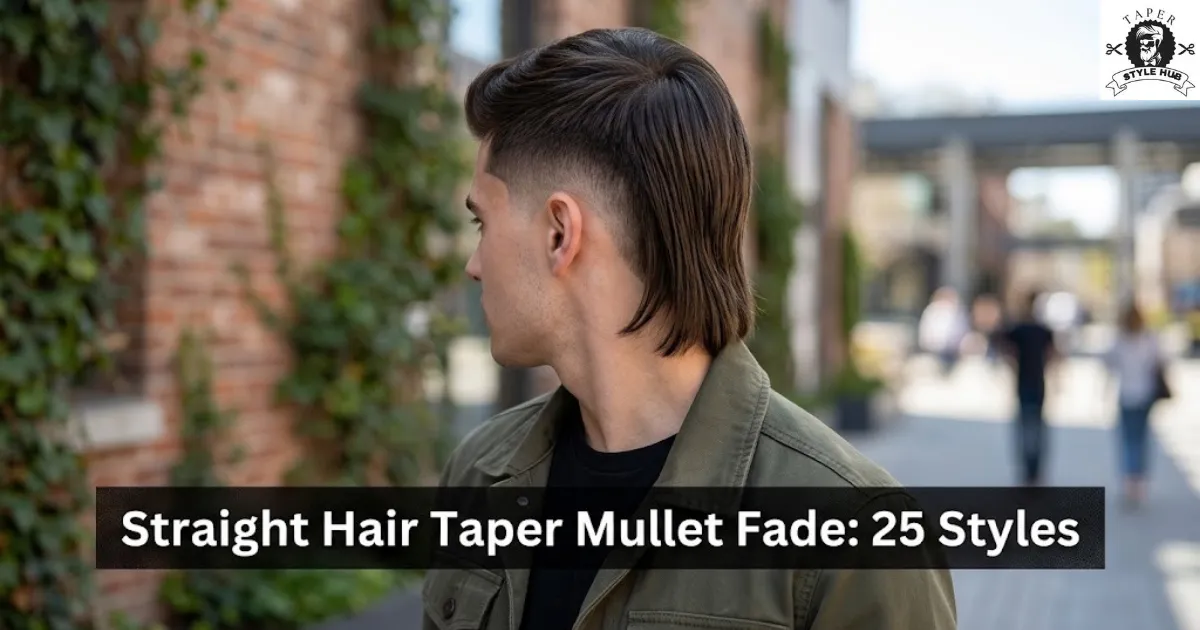
Straight Hair Taper Mullet Fade: 25 Styles
A straight hair taper mullet fade gives you clean, sharp sides and a longer back without the harsh, blunt look of the old 1980s cut. Straight strands show every line, so the shape looks deliberate, polished, and surprisingly easy to wear every day.
This guide covers 25 styles, exact barber wording, face shape advice, styling steps, and upkeep. Whether you want a subtle low taper for the office or a bold burst fade for the weekend, there is a version that fits your hair and routine.
👉 Also Read: Taper Mid Fade
What Is a Straight Hair Taper Mullet Fade?
A straight hair taper mullet fade is a modern mullet where the sides and neckline get shorter in gradual steps while the back stays longer. The taper blends both lengths together, so the haircut reads as one connected shape instead of two separate cuts.
Three parts define the look, and each one can be adjusted to suit you:
- Straight hair: the smooth texture keeps every line crisp and easy to read.
- Taper and fade: the sides shorten gradually around the ears, sideburns, and nape.
- Mullet length: the back stays noticeably longer than the front and sides.
Unlike the traditional mullet, the modern version relies on precise barbering. Clean sides, controlled volume, and a softly layered back create a style that feels bold without looking like a costume. That balance is why barbers often recommend it as a first mullet.
👉 Also Read: Mid Taper Fade Black Male
Why the Straight Hair Taper Mullet Fade Works So Well
Straight hair falls into place on its own, which makes the contrast between short sides and a longer back easy to see. A straight hair taper mullet fade also grows out cleanly because the hair does not puff or spring up unevenly.
There is a catch, though. Straight hair shows every mistake, so a rushed cut can look flat or stringy within days. Texture, point cutting, and light layers keep the shape full and add movement through the crown and back.
The taper also solves practical problems. It cleans up the ears and neckline, keeps the back of your head cooler, and lets the longer hair frame your face in a relaxed, intentional way.
👉 Also Read: Mid Taper Textured Fringe
Straight Hair Taper Mullet Fade vs Skin Fade vs Burst Fade
Many people mix up these terms at the barbershop, so a quick comparison helps. A taper keeps some length at the edges, while a fade drops much shorter, often down to bare skin. Here is how the common options compare.
| Style | Side Finish | Contrast | Barber Visit |
|---|---|---|---|
| Taper | Gradual, keeps some length | Subtle | Every 3 to 5 weeks |
| Skin fade | Drops down to bare skin | High | Every 2 to 3 weeks |
| Burst fade | Curves around the ear | High and curved | Every 3 to 4 weeks |
| Low taper | Starts near ears and nape | Low | Every 4 to 5 weeks |
| Mid taper | Starts around the temples | Moderate | Every 3 to 4 weeks |
Choose a taper if you want a softer, more natural finish that grows out gracefully. Choose a skin fade or burst fade when maximum contrast matters more than low upkeep. A straight hair taper mullet fade can use any of these finishes.
If you are unsure, start with a low or mid taper. You can always ask your barber to take the sides shorter at the next visit, but you cannot add hair back.
👉 Also Read: Medium Taper Fade Haircut
Why the Straight Hair Taper Mullet Fade Is Trending in 2026
The modern mullet sits between a bold statement cut and a sharp skin fade, giving you attitude without harsh contrast. That middle ground explains why the straight hair taper mullet fade keeps showing up in barbershops and on social feeds.
Barbers love its clean outline and styling flexibility. Men love that it looks planned, stays neat around the ears, and still leaves room to grow the back as long as they like.
Short videos and barber content have also helped. They show how tiny changes in length, texture, and taper height can create completely different looks, which inspires people to experiment.
It also suits many lifestyles. Streetwear, vintage clothing, and relaxed tailoring all pair well with it, and the softer transition makes regrowth less noticeable between touch-ups.
👉 Also Read: Mid Fade Haircut Taper
Straight Hair Taper Mullet Fade vs Traditional Mullet
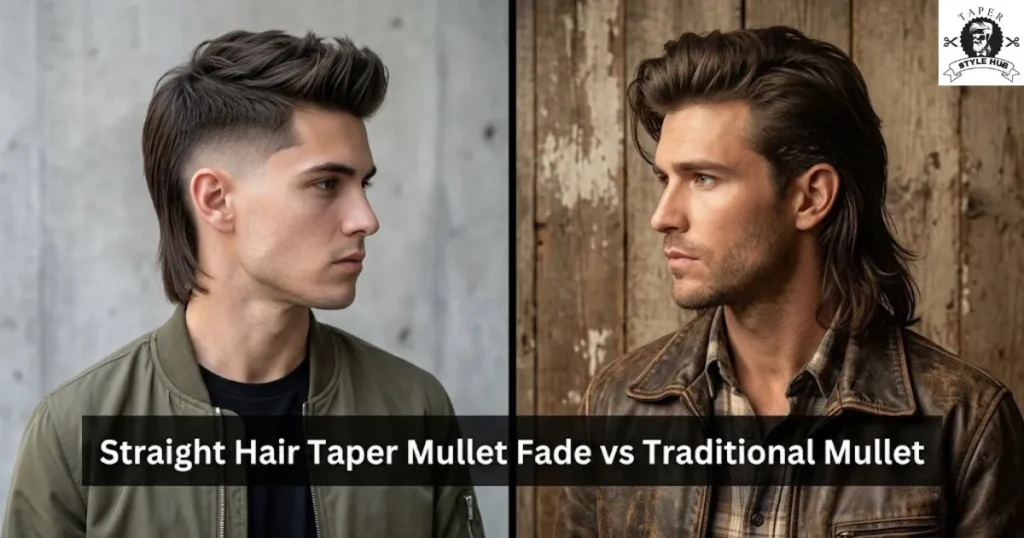
A traditional mullet has a blunt step between the short sides and the long back. A straight hair taper mullet fade softens that step with gradual shortening, so the cut looks cleaner, less bulky, and far more current.
The traditional version also tends to look heavy around the ears. The taper removes that bulk, which is especially helpful on straight hair that tends to hang flat against the head.
👉 Also Read: Mid Taper Mullet
25 Best Straight Hair Taper Mullet Fade Ideas
The 25 styles below are grouped into five categories so you can compare similar cuts side by side. Each idea explains who it suits, what to ask for, and how to style it. Treat them as starting points, because a good barber will adjust the details to your hair density.
👉 Also Read: Taper Mid
Classic and Everyday Straight Hair Taper Mullet Fade Styles
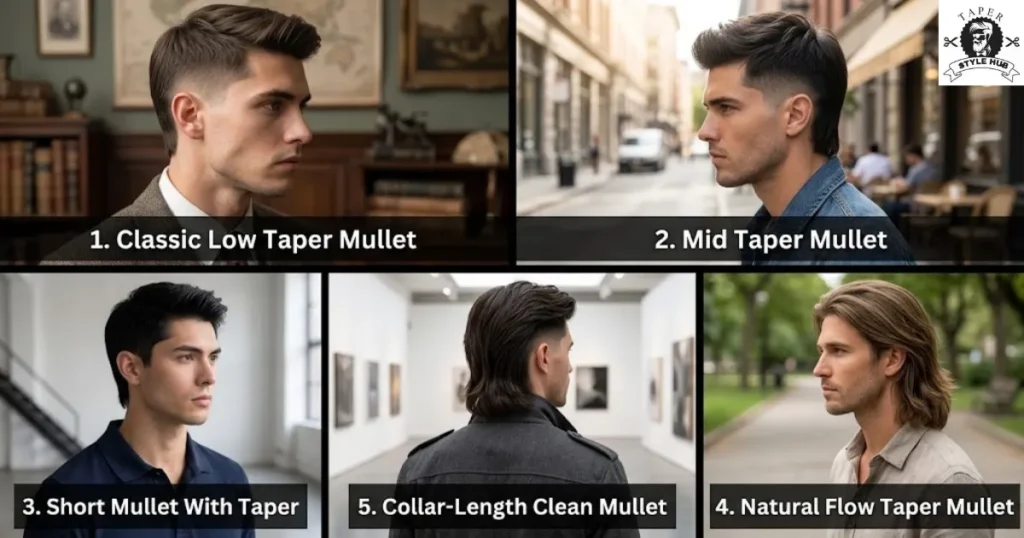
These five cuts are the safest place to begin. They are balanced, easy to style, and work in most settings, from school to the office. Every classic straight hair taper mullet fade shares one thing: a gentle blend between the sides and the longer back.
“All The Types Shown Below Are Displayed In The Single Image Above☝️”
1. Classic Low Taper Mullet
The low taper begins near the ears and nape, so the transition stays soft and subtle. The back sits at the collar while the top keeps two to three inches of usable length. It is the most natural way to try the cut.
- Best for: first-timers and conservative settings.
- Ask for: a low taper with a collar-length back.
- Style it: light matte clay on dry hair.
👉 Also Read: Mid Taper Fade Black Male Short Hair
2. Mid Taper Mullet
A mid taper starts around the temples and creates clearer contrast without feeling extreme. The sides look sharper, and the longer back stands out more. This option suits anyone who wants a visible shape that still looks tidy.
- Best for: medium-density hair and oval faces.
- Ask for: a mid taper blended into a mid-neck back.
- Style it: sea salt spray at the roots.
3. Short Mullet With Taper
Often called a baby mullet, this version keeps the length difference small. The back only just touches the collar, which makes it easy to wear at work or school. You can always grow the back longer later.
- Best for: office settings and beginners.
- Ask for: a short mullet with a clean taper.
- Style it: matte paste for a tidy finish.
4. Natural Flow Taper Mullet
This cut follows the way your hair already falls instead of fighting it. The taper stays light, and the top moves freely with minimal product. It is perfect when you want a low-effort routine.
- Best for: easygoing styling and fine straight hair.
- Ask for: soft scissor work over the ears.
- Style it: air drying with a drop of leave-in cream.
5. Collar-Length Clean Mullet
Here the back ends right at the collar, creating a neat and polished outline. The taper keeps the neckline sharp, so the cut looks fresh for weeks. It pairs well with shirts, jackets, and casual outfits alike.
- Best for: professional dress codes.
- Ask for: a squared neckline with tapered edges.
- Style it: light pomade combed through the top.
Textured and Layered Straight Hair Taper Mullet Fade Styles
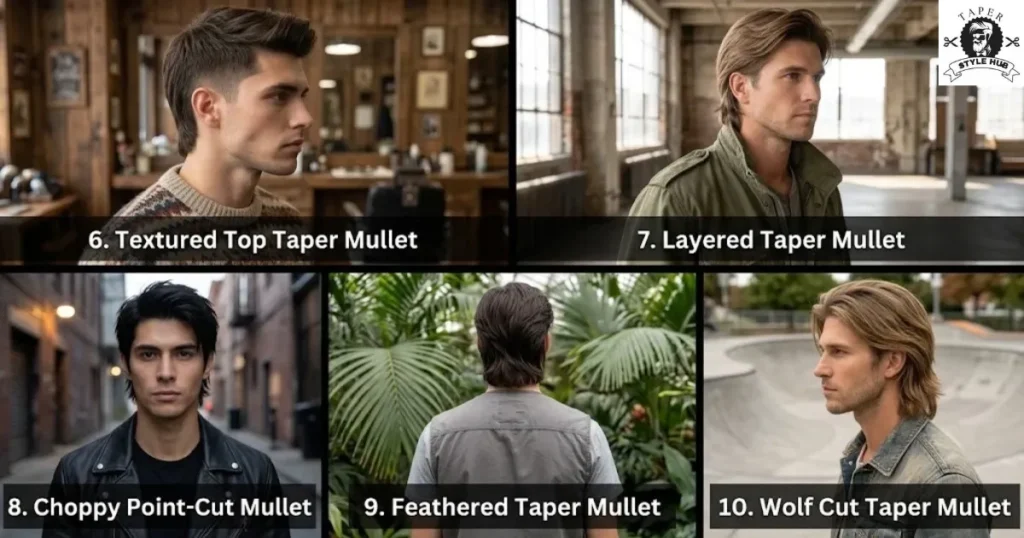
Straight hair can look flat, so texture is what makes a mullet feel modern. These layered cuts add movement and volume while the taper controls the outline. Ask your barber for point cutting if you want a straight hair taper mullet fade with a lived-in finish.
“All The Types Shown Below Are Displayed In The Single Image Above☝️”
6. Textured Top Taper Mullet
Point cutting breaks up the top so straight strands stop lying flat. The movement catches light and gives the look of extra density. A lightweight product finishes the job without making the hair greasy.
- Best for: medium-density straight hair.
- Ask for: point-cut texture through the top.
- Style it: texture spray, then your fingers.
7. Layered Taper Mullet
Long layers run from the crown to the back so the length moves in soft steps. The tapered sides stop the shape from widening around the ears. It works especially well when your hair feels heavy.
- Best for: thick straight hair.
- Ask for: long layers connecting the top and back.
- Style it: a blow dry that lifts the roots upward.
8. Choppy Point-Cut Mullet
Short, uneven layers create a jagged edge with plenty of attitude. The taper keeps the sides clean, so the choppy texture becomes the focal point. Expect to trim every five to six weeks to keep it sharp.
- Best for: confident, bold dressers.
- Ask for: choppy layers with a clean nape.
- Style it: strong matte clay.
9. Feathered Taper Mullet
Feathered layers sweep away from the face and thin toward the ends, borrowing a little from 1970s rock styling. The taper gives it a current finish. Straight hair makes the feathering look smooth and deliberate.
- Best for: fine to medium straight hair.
- Ask for: soft, graduated layers.
- Style it: a round brush and light hairspray.
10. Wolf Cut Taper Mullet
This hybrid mixes shaggy layers with a mullet outline. Heavy texture through the crown stops straight hair from sitting like a helmet, while the taper keeps the sides cleaner than a full wolf cut. It also grows out well.
- Best for: men who want extra volume.
- Ask for: crown texture with point-cut ends.
- Style it: sea salt spray and a quick scrunch.
Fringe and Part Straight Hair Taper Mullet Fade Styles
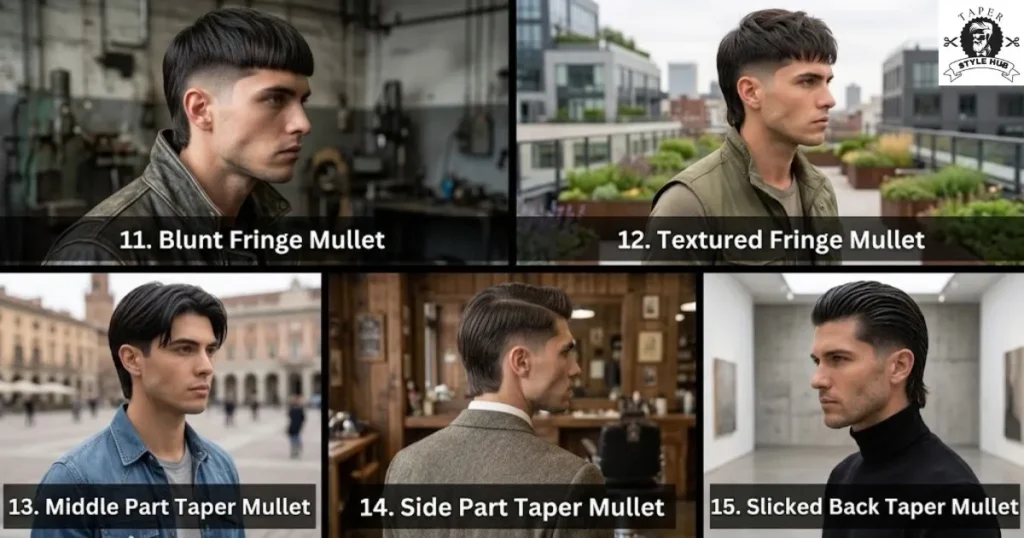
The front of the cut changes the mood of a straight hair taper mullet fade completely. Fringes and parts frame your face, soften strong features, and give the style a different personality. Each option below sits on the same tapered, longer-back foundation.
“All The Types Shown Below Are Displayed In The Single Image Above☝️”
11. Blunt Fringe Mullet
A blunt fringe cuts straight across the forehead for a sharp, architectural look. Straight hair holds that line beautifully. Frequent trims keep it crisp and well proportioned.
- Best for: oval and triangle faces.
- Ask for: a blunt, eyebrow-length fringe.
- Style it: an evening blow dry to keep the line.
12. Textured Fringe Mullet
A softer, choppier fringe falls naturally across the forehead and looks youthful and relaxed. Point cutting prevents the front from feeling heavy. It pairs nicely with a mid taper.
- Best for: long and oval faces.
- Ask for: a textured fringe with a low taper.
- Style it: a light paste.
13. Middle Part Taper Mullet
A center part brings a relaxed 1990s mood, and straight hair splits cleanly down the middle. The taper keeps the sides slim so the shape never looks bulky. Layers around the face add softness.
- Best for: even-density straight hair.
- Ask for: a clean center part with face-framing layers.
- Style it: cream to tame flyaways.
14. Side Part Taper Mullet
A side part adds order and makes the mullet look tailored. It suits smart casual settings, and the tidy line draws attention to strong features. Keep the back shorter if you need a more professional finish.
- Best for: rectangle and square faces.
- Ask for: a low taper with a defined side part.
- Style it: light pomade or wax.
15. Slicked Back Taper Mullet
Brushing the top back connects it directly to the longer back and creates a glossy, polished shape. Straight hair slicks back easily and stays disciplined. It moves smoothly from formal events to late nights.
- Best for: oval and oblong faces.
- Ask for: enough top length to comb back.
- Style it: a medium-hold, water-based pomade.
Bold and High-Contrast Straight Hair Taper Mullet Fade Styles
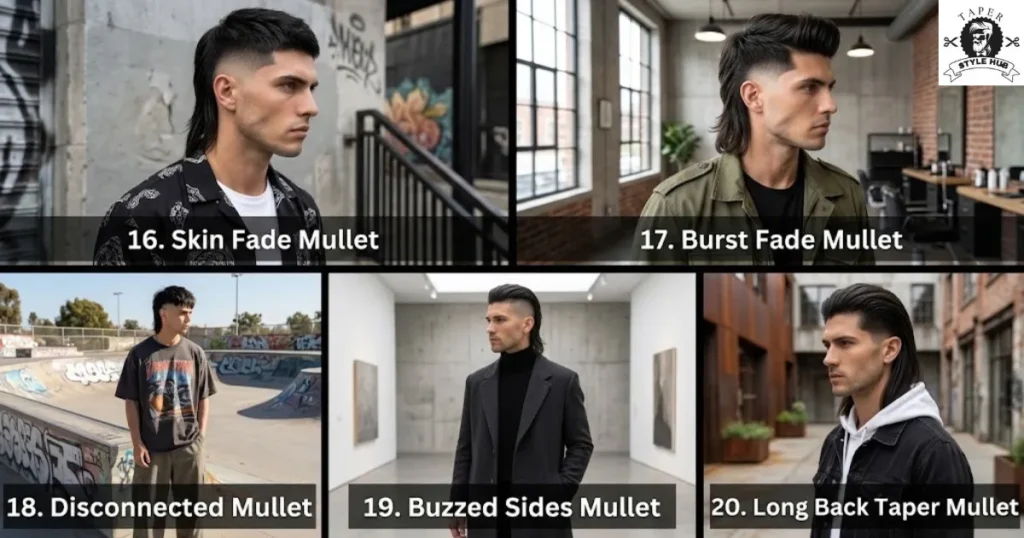
If you want maximum impact, these cuts push the contrast between short sides and a long back. They need more upkeep, but the sharp edges look fantastic on straight hair. Choose one when you want people to notice your straight hair taper mullet fade from across the room.
“All The Types Shown Below Are Displayed In The Single Image Above☝️”
16. Skin Fade Mullet
The sides drop all the way to bare skin and blend into the longer back. It is one of the sharpest versions available. Expect to visit your barber every two to three weeks.
- Best for: oval and heart-shaped faces.
- Ask for: a mid skin fade with length kept at the back.
- Style it: a shine-free gel on top.
17. Burst Fade Mullet
The fade curves around the ear in a half circle and leaves weight behind it. That curved line stays crisp on straight hair, which is why it is so popular right now. It adds drama without losing the mullet shape.
- Best for: oval and round faces.
- Ask for: a burst fade around the ears.
- Style it: matte clay for the top.
18. Disconnected Mullet
Here the top and sides are separated by a hard line instead of a blend. Straight hair makes that edge read cleanly instead of looking blurry. It delivers high impact and needs regular cleanups.
- Best for: strong jawlines.
- Ask for: a sharp disconnection line.
- Style it: texture powder for lift.
19. Buzzed Sides Mullet
The sides are clipped almost to nothing, which pushes all attention to the length on top and at the back. Nothing softens the edges, so the contrast feels raw and deliberate. Keep the back long enough to balance it.
- Best for: square and angular faces.
- Ask for: closely shaved sides with no blend.
- Style it: light cream through the back.
20. Long Back Taper Mullet
The back reaches the shoulders or beyond while the taper keeps the sides tight. Thick straight hair carries this length best. Trim the ends every six to eight weeks to avoid thin, stringy tips.
- Best for: thick straight hair.
- Ask for: a tightly tapered neckline with a long back.
- Style it: conditioner focused on the ends.
Color, Beard, and Statement Straight Hair Taper Mullet Fade Styles
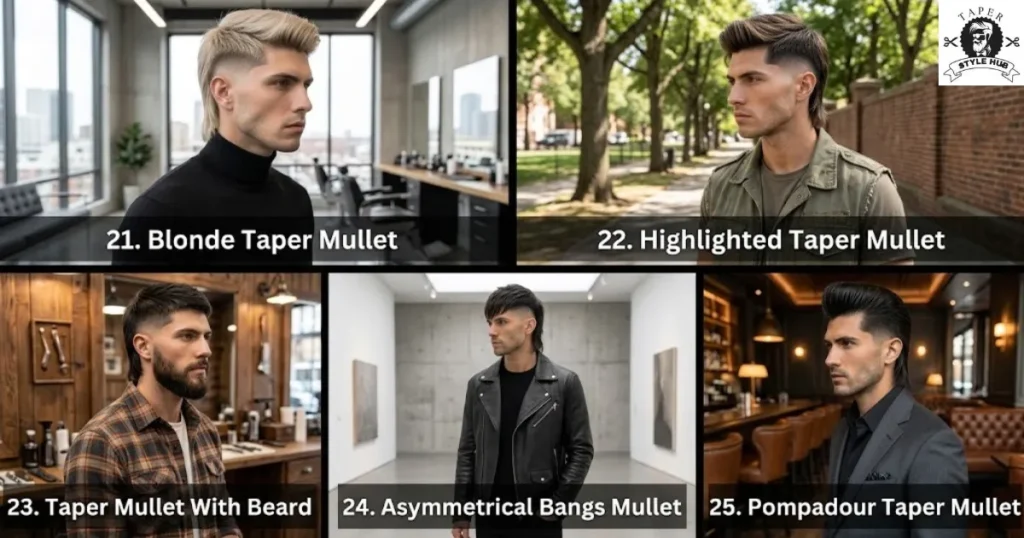
These final options add color, facial hair, and personality to the cut. They are ideal when you want your straight hair taper mullet fade to feel completely your own. Small details make a big difference here.
“All The Types Shown Below Are Displayed In The Single Image Above☝️”
21. Blonde Taper Mullet
Blonde tones highlight the layers and make texture far easier to see. The taper keeps the color from overwhelming the look. Book a professional toning session to control brassiness.
- Best for: bold personal style.
- Ask for: bleach and tone, then a tapered cut.
- Style it: purple shampoo when needed.
22. Highlighted Taper Mullet
Soft highlights add dimension without a full color change. They grow out with less visible regrowth, so upkeep stays manageable. Face-framing pieces lift both the top and the back.
- Best for: dark or medium straight hair.
- Ask for: fine, blended highlights.
- Style it: a color-safe shampoo.
23. Taper Mullet With Beard
A tapered beard that blends into the sideburns creates one continuous line from hair to jaw. The beard balances the volume of the longer back. Match the taper height to the beard fade for a connected finish.
- Best for: men who already wear a beard.
- Ask for: a taper that meets the beard line.
- Style it: balm for the beard and clay for the hair.
24. Asymmetrical Bangs Mullet
An uneven fringe frames the face in an offbeat way and feels almost editorial. The straight length behind keeps the rebellious mullet spirit alive. Choose a stylist skilled in asymmetry for balanced results.
- Best for: oval and angular faces.
- Ask for: intentionally uneven bangs.
- Style it: a light styling balm.
25. Pompadour Taper Mullet
The top is swept high with volume before dropping into the longer back. It feels theatrical and commands attention. A blow dryer and comb are essential for building height at the front.
- Best for: diamond and rectangle faces.
- Ask for: a tapered pompadour with a mid-neck back.
- Style it: blow drying first, then pomade.
Guard Numbers for a Straight Hair Taper Mullet Fade
Guard numbers tell your barber how much hair a clipper guard leaves behind. Lower numbers leave less length, and most barbers combine several guards to build a smooth blend. Here are the common sizes.
- Guard 1: about 1/8 inch (3 mm) for a very close finish.
- Guard 2: about 1/4 inch (6 mm) for a short, tidy taper.
- Guard 3: about 3/8 inch (10 mm) for a softer blend.
- Guard 4: about 1/2 inch (13 mm) for the gentlest transition.
Ask which guards your barber plans to use if you want to understand how short the taper will be. Pairing a photo with a guard range removes most of the guesswork.
Choosing the Right Taper Height for Your Straight Hair Taper Mullet Fade
Taper height changes the whole personality of the cut. A low taper looks the most natural, a mid taper adds visible contrast, and a high taper creates the sharpest, most dramatic shape.
If this is your first mullet, start low and adjust at your next visit. Your barber can raise the taper gradually once you know how much contrast you actually enjoy.
Hairline and growth patterns matter too. A cowlick at the nape, for example, may call for a slightly longer taper so the neckline stays neat between visits.
Straight Hair Taper Mullet Fade vs Wolf Cut vs Short Mullet
These three cuts overlap, which confuses a lot of people. The table below shows where each one stands so you can name the right style at the barbershop.
| Cut | Main Feature | Best For |
|---|---|---|
| Taper mullet | Clean, gradual sides with a longer back | Structure and polish |
| Wolf cut | Heavy layering across the whole head | Volume and a shaggy shape |
| Short mullet | Small length difference at the back | Beginners and offices |
A straight hair taper mullet fade focuses on how the sides are finished, while a short mullet describes the back length. You can combine both ideas into one cut.
Best Face Shapes for a Straight Hair Taper Mullet Fade
Face shape helps decide proportions, though hair type and personal taste matter just as much. Use the list below as a starting point for your straight hair taper mullet fade, then adjust with your barber.
- Oval: almost every variation works, so experiment freely with top and back length.
- Round: add height on top and keep the sides controlled to create a longer look.
- Square: soft layers and a moderate taper complement a strong jawline.
- Oblong: avoid extra height and try a fringe or middle part for balance.
- Heart-shaped: a side-swept fringe and some volume at the back balance a wider forehead.
- Diamond: a fringe or middle part softens prominent cheekbones.
Hair thickness and forehead height also influence which fringe or part looks best, so treat your face shape as only one piece of the puzzle.
Remember that these are guidelines, not rules. A confident barber can read your hairline, crown, and growth pattern and adjust the taper height to match.
Straight Hair Taper Mullet Fade for Thin, Fine, and Thick Hair
Density changes how the cut behaves. The same straight hair taper mullet fade looks very different on thin strands than on thick, heavy hair, so match the approach to your hair type.
| Hair Type | Best Approach | Product Pick |
|---|---|---|
| Thin | Shorter textured back and light layers | Texture powder |
| Fine | Longer top with point cutting | Sea salt spray |
| Medium | Balanced layers with a mid taper | Matte clay |
| Thick | Weight removal and internal layers | Strong paste |
Thin hair should avoid an excessively long back, which can make it look even finer. Thick hair needs thinning work so the sides stay flat and the shape does not puff outward.
Best Products for a Straight Hair Taper Mullet Fade
Straight hair is slippery, so the right product makes a huge difference. Lightweight formulas add grip and lift without weighing down the long back of your straight hair taper mullet fade.
- Matte clay: strong hold with no shine for thick hair.
- Matte paste: flexible control for everyday styling.
- Sea salt spray: grit and volume for fine hair.
- Texture powder: instant lift at the crown.
- Light pomade: polish for side parts and slicked styles.
- Heat protectant: essential if you use a straightener.
Always read the label before buying. Alcohol-heavy sprays dry out the longer back, and oil-based waxes attract dust and build up on the scalp.
Is a Straight Hair Taper Mullet Fade Professional?
Yes, with the right choices. A low taper, collar-length back, and side part make the style look neat enough for most offices and client meetings.
Dress codes vary, so check your workplace rules. If the back needs to stay tidy, tying it low or choosing a shorter mullet keeps the shape polished.
How Long Does Your Hair Need to Be for a Straight Hair Taper Mullet Fade?
You need about three to four inches on top and enough length at the back to sit at or below the collar. Shorter hair still works as a baby mullet.
If you are starting from a short cut, ask your barber to taper the sides while the back grows. Hair grows roughly half an inch a month, so expect several months before the shape fully develops.
How to Ask Your Barber for a Straight Hair Taper Mullet Fade
Mullet is a broad word, and the gap between a blended taper mullet and a disconnected one is enormous. Bring a reference photo, then explain exactly how you want the sides, top, and back handled.
- Name the taper height: say low, mid, or high.
- State the back length: collar, mid-neck, or shoulder.
- Describe the top: fringe, middle part, side part, or slicked back.
- Ask for texture: point cutting or layers prevent a flat finish.
- Mention your routine: tell your barber how much time you spend styling.
A simple script works well: ask for a modern mullet with a low taper around the sideburns and neckline, a collar-length back, and texture through the crown.
Finish by asking how the cut will grow out over the next four to eight weeks. A good barber will happily explain.
What to Wear With a Straight Hair Taper Mullet Fade
The haircut is flexible enough to match almost any wardrobe. Denim jackets, plain tees, and oversized shirts bring out the relaxed side, while a blazer and a side part lift it into smart casual territory.
Bolder outfits work well too, because this cut already carries plenty of attitude. Keep the rest of your look simple and let the silhouette of the cut do the talking.
How to Style a Straight Hair Taper Mullet Fade at Home
Straight hair wants to lie flat, and a mullet needs lift at the crown to keep its shape. These steps keep your straight hair taper mullet fade looking sharp without a long routine.
- Start with damp, towel-dried hair.
- Rough dry with your fingers, pushing the top back and up.
- Use a blow dryer on low heat to lift the roots.
- Apply a small amount of matte clay or paste to the top.
- Leave the back mostly alone so it looks lived in.
Skip heavy pomades on the back, because shine flattens texture and makes longer hair look greasy. Sea salt spray adds grip if your strands are fine and slippery.
Growing Out a Straight Hair Taper Mullet Fade
A taper makes the grow-out phase much easier than a hard fade. Because the sides keep some length, the awkward in-between stages are less obvious and the shape stays tidy.
Hair grows around half an inch per month, so the back can reach the shoulders in roughly a year. Regular trims on the ends keep the length looking healthy instead of thin.
If you decide to move away from the mullet later, ask your barber to blend the back upward gradually. Straight hair makes that transition smooth and almost unnoticeable.
Straight Hair Taper Mullet Fade Maintenance and Upkeep
The sides decide how fresh the cut looks. Most men book a touch-up every three to five weeks to keep a straight hair taper mullet fade crisp around the ears and neckline.
The back can wait longer. A full trim every six to eight weeks removes split ends and keeps the length looking healthy and intentional.
Wash two to three times per week with a gentle shampoo, and focus conditioner on the longer back section. Washing daily strips oil and leaves the ends dry and frizzy.
Common Straight Hair Taper Mullet Fade Mistakes to Avoid
A few small errors can spoil a great haircut. Watch out for these common problems before you sit in the barber chair.
- Starting with a taper that is too high on a first mullet.
- Cutting the back too short, which removes the contrast.
- Using heavy gel or wax that weighs the hair down.
- Skipping texture, which leaves straight hair looking flat.
- Arriving without a reference photo.
- Ignoring your face shape and hair density.
Another frequent issue is skipping regular trims. Split ends make the long back look thin, and a grown-out taper loses its clean edge, so stay on schedule for the best result.
Most disappointments come from unclear communication. Show a photo, name the taper height, and describe the length you want at the back.
Pros and Cons of a Straight Hair Taper Mullet Fade
Every haircut involves trade-offs. Here is an honest look at what you are signing up for with this style.
Pros
- Softer and more natural than a hard fade mullet.
- Straight hair shows the taper and layers clearly.
- Grows out with fewer awkward stages.
- Works in the office, at school, and on weekends.
- Easy to adjust the length over time.
Cons
- Needs a barber who understands blending and scissor work.
- Straight hair can look flat without texture.
- Sides need regular touch-ups.
- The back needs patience while it grows.
Final Thoughts on the Straight Hair Taper Mullet Fade
The straight hair taper mullet fade blends modern barbering with classic mullet attitude. The taper keeps everything clean, while the longer back adds movement and personality.
The best version depends on your hair density, face shape, and routine. Choose a low taper for a subtle look or a burst fade for a statement, and always bring a reference photo.
Finally, remember that confidence matters as much as technique. A haircut with this much personality looks best when you wear it comfortably, so choose the version you actually enjoy styling and adjust the details together with a barber you trust over time and keep experimenting.
FAQs About the Straight Hair Taper Mullet Fade
Is a taper mullet good for straight hair?
Yes. Straight hair shows the clean taper and longer back clearly, so the shape is easy to define and style.
How long should the back of a mullet be?
It can touch the collar or reach the shoulders. Start at collar length and grow it longer later.
Is a taper better than a fade for a mullet?
A taper gives a softer, natural finish, while a fade gives stronger contrast. Pick the look you prefer.
Can thin straight hair pull off this cut?
Yes. A shorter, textured back with light layers adds movement and makes thin hair look fuller.
How often should I trim a taper mullet?
Touch up the sides every three to five weeks. Trim the back every six to eight weeks.

I’m M Ahmad Ansari, founder and content creator at Taper Style Hub. With 3+ years of experience researching taper haircuts, hairstyles, grooming, and men’s style, I create practical, accurate, and easy-to-understand content. My goal is to provide readers with trustworthy information, useful tips, and inspiring ideas for choosing and styling the perfect taper haircut.