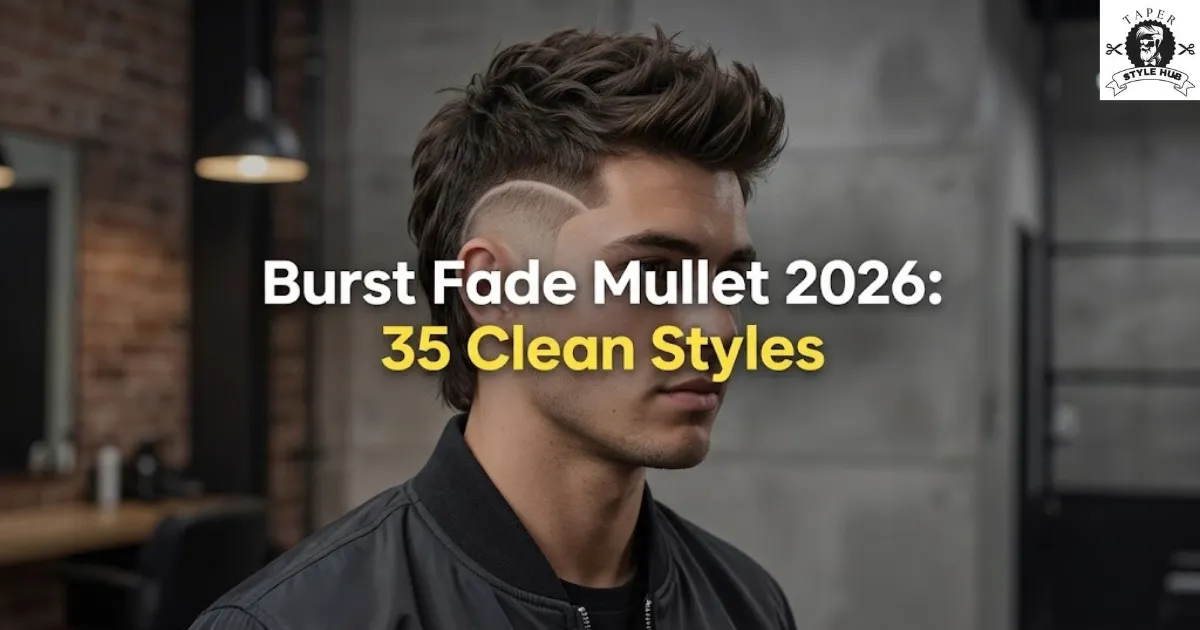
Burst Fade Mullet 2026: 35 Clean Styles
A burst fade mullet gives you the attention-grabbing length of a classic mullet with the clean, curved sides of a modern fade. The hair wraps around the ear in a half circle, then flows into a longer, layered back.
This guide covers 35 styles sorted into clear categories, along with face shape advice, hair type tips, barber scripts, guard sizes, styling steps and a realistic maintenance plan. Use it to choose one cut and explain it to your barber without confusion.
👉 Also Read: Taper Mullet
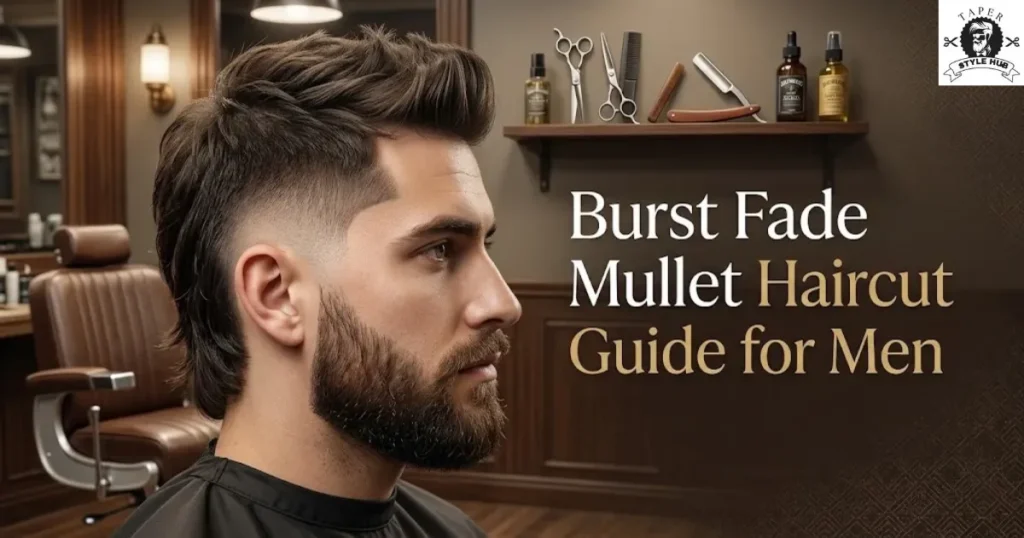
Burst Fade Mullet Haircut Guide for Men
What Is a Burst Fade Mullet?
A burst fade mullet is a mullet with sides that fade in a curved arc around the ear. The hair is shortest right behind the ear and grows longer as it moves away from that point, which creates the burst shape.
The mullet part controls length. The top keeps some texture, while the back stays long enough to touch the collar or sit below it. The burst fade controls the sides and keeps the whole haircut looking sharp.
Unlike a standard taper that runs straight along the sideburn and neckline, the burst leaves the crown and back untouched. That is why the two ideas pair so naturally and why barbers recommend the combination so often.
The name comes from the way the fade radiates outward from the ear, a bit like a small sunburst. Barbers also call it a radial fade or a halo taper, so you may hear all three names in a shop.
👉 Also Read: Low Burst Fade Mullet
Why the Burst Fade Mullet Is So Popular in 2026
The old mullet had a reputation for looking messy and unplanned. Modern barbers fixed that with precise fading, controlled layers and a smooth blend between the sides and the back. The result looks deliberate instead of accidental.
Flexibility is another reason. You can keep the back short for a subtle office look or let it grow into a shaggy statement. Straight, wavy, curly and coily hair types can all wear it with small adjustments.
Styling also takes very little time. Once the cut is shaped well, a splash of sea salt spray and a few minutes with your fingers are usually enough to leave the house looking put together.
Social media also played a part. Short videos showing before and after transformations made the curved fade easy to understand, and barbers noticed clients arriving with saved photos and a clear idea of what they wanted.
👉 Also Read: Straight Hair Taper Mullet Fade
Burst Fade Mullet Quick Snapshot
Before diving into the styles, here is a fast overview of the main facts. Think of it as a cheat sheet you can screenshot and show your barber. It takes under a minute to read.
👉 Also Read: Taper Mid Fade
| Detail | Quick Answer |
|---|---|
| What it is | A mullet with a curved, ear hugging fade on the sides |
| Also called | Radial fade mullet, halo taper mullet, burst taper mullet |
| Fade heights | Low for subtle, mid for balanced, high for bold, skin for sharpest |
| Back length | Short and neat, collar grazing or long and shaggy |
| Best hair types | Straight, wavy, curly and coily with small tweaks |
| Styling time | About five minutes with a light product |
| Trim schedule | Every two to four weeks depending on fade height |
| Biggest watch out | The fade softens fast as hair grows |
Who Should Get a Burst Fade Mullet?
The cut suits teenagers through men in their forties and beyond, but a few details decide how well it works for you. Your face shape, hair type and daily routine matter more than your age.
👉 Also Read: Mid Taper Fade Black Male
Face Shape Guide
Face shape changes where the fade should sit and how much volume belongs on top. Use the table below as a starting point, then ask your barber to adjust it for your proportions.
👉 Also Read: Mid Taper Textured Fringe
| Face Shape | Best Adjustment |
|---|---|
| Oval | Almost any fade height works, so mid and high bursts are easy to try |
| Round | Choose a higher fade and add height on top to lengthen the face |
| Square | Pick a low or mid fade with a textured top to soften sharp angles |
| Heart | Add a fringe and keep fullness in the back to balance the chin |
| Diamond | Keep the sides tidy and add texture near the forehead |
| Long | Avoid too much crown height and keep the fade moderate |
Hair Type and Density
Hair texture decides how the back sits and how much shaping it needs. Here is what usually works for each type.
- Straight hair: shows the fade clearly but needs layers so the back does not stick out like a shelf.
- Wavy hair: the easiest match, since natural movement builds the mullet shape with very little effort.
- Curly hair: looks great, but the barber should cut it dry so shrinkage does not shorten the back.
- Coily hair: holds shape beautifully and creates strong contrast between the faded sides and the fuller back.
- Fine hair: works best with a shorter back, light layers and a low or mid fade for extra body.
- Thick hair: handles long backs well, though thinning or point cutting removes unwanted bulk.
👉 Also Read: Medium Taper Fade Haircut
Lifestyle and Workplace
Stricter workplaces usually accept a low burst fade with a short, tidy back. Creative jobs and casual settings give you room for higher fades, longer backs and bolder texture.
Also think about upkeep. If you can visit your barber every two weeks, a mid or high fade is realistic. If you prefer monthly visits, start low and keep the contrast gentle.
👉 Also Read: Mid Fade Haircut Taper
Burst Fade Mullet vs Other Popular Haircuts
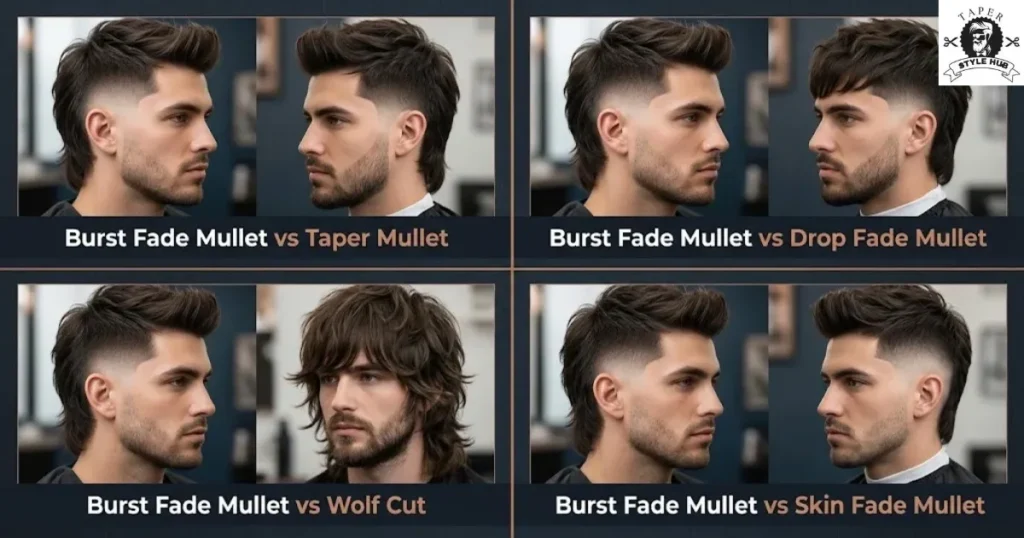
Many men mix up similar cuts, so a quick comparison saves time at the barbershop. The difference always comes back to the shape of the fade and the amount of length left behind.
“All The Types Shown Below Are Displayed In The Single Image Above☝️”
Burst Fade Mullet vs Taper Mullet
A taper fades gradually along the natural hairline, so it looks softer and grows out smoothly. The burst curves around the ear and creates more contrast, which makes it bolder and more noticeable.
👉 Also Read: Mid Taper Mullet
Burst Fade Mullet vs Drop Fade Mullet
A drop fade follows the curve behind the ear and falls lower at the nape. A burst wraps around the front and side of the ear, so it emphasizes the ear area instead of the neckline.
Burst Fade Mullet vs Wolf Cut
A wolf cut is layered all over with a shaggy, voluminous finish and no sharp faded sides. The burst version keeps clean sides and a longer back, though the two ideas can blend for a softer look.
Burst Fade Mullet vs Skin Fade Mullet
A skin fade describes the finish, where the hair drops to bare skin. A burst describes the shape. You can combine both and ask for a skin burst when you want maximum contrast.
| Cut | Fade Shape | Contrast | Best For |
|---|---|---|---|
| Burst fade mullet | Curves around the ear | High | Bold, modern looks |
| Taper mullet | Straight along the hairline | Low to moderate | Conservative, easy upkeep |
| Drop fade mullet | Arcs lower behind the ear | Moderate to high | Curved head shapes |
| Wolf cut | No faded sides, layers all over | Low | Shaggy, voluminous hair |
| Skin fade mullet | Any shape down to bare skin | Very high | Sharpest, cleanest finish |
Fade Height and Finish Burst Fade Mullet Styles
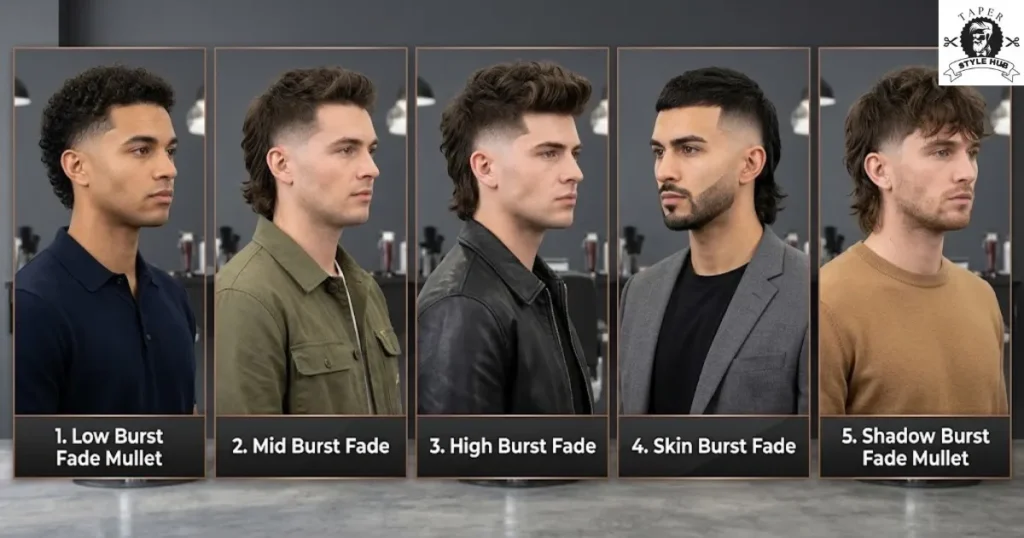
Fade height and finish set the tone of the whole haircut. These five options run from soft and subtle to sharp and dramatic.
“All The Types Shown Below Are Displayed In The Single Image Above☝️”
1. Low Burst Fade Mullet
The fade starts low near the ear and neckline, so more hair stays on the sides. The contrast is gentle, which makes it a safe pick for offices, schools and first-time mullet wearers.
Best for first timers and office settings. Ask your barber for a low burst around the ear with a number two guard, and plan a trim every three to four weeks.
2. Mid Burst Fade
The curve climbs to about temple height and delivers clear structure without going extreme. It suits almost every face shape and is the most popular height for good reason.
Best for oval, square and heart faces. Ask for a mid curve that sits at the temple, blended smoothly into a textured crown, with a trim about every two to three weeks.
3. High Burst Fade
Here the fade rises toward the crown and leaves the sides very short. The top and back stand out strongly, so this version works well on thick hair and confident dressers.
Best for round and oval faces. Ask for a high curve with a clean outline, and keep enough crown length to bridge the short sides into the back.
4. Skin Burst Fade
The base drops to bare skin for the cleanest, most graphic result. It needs cleanups every two weeks, and the exposed scalp needs sunscreen during warm months.
Best for straight and wavy hair. Ask for a zero guard at the lowest point, and book a refresh every ten to fourteen days to keep the edge crisp.
5. Shadow Burst Fade Mullet
A shadow fade leaves a faint layer of stubble at the base instead of bare skin. It looks softer, hides regrowth better and suits men who dislike harsh skin lines.
Best for fast-growing hair. Ask for a number one or two guard at the base, which grows out more softly and stretches the time between visits.
Length Based Burst Fade Mullet Styles
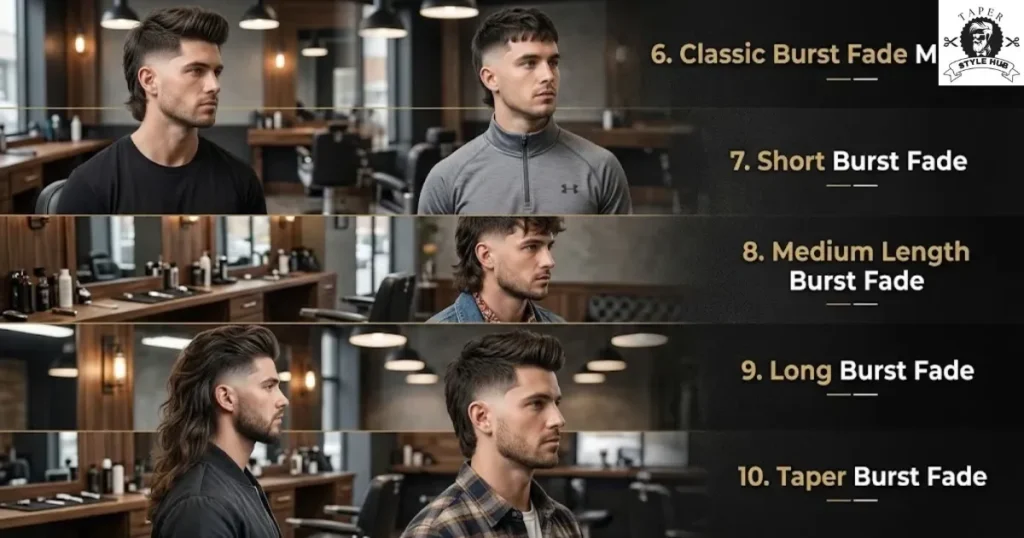
Length controls how loud the mullet feels. The fade stays the same while the back and top change from compact to dramatic.
“All The Types Shown Below Are Displayed In The Single Image Above☝️”
6. Classic Burst Fade Mullet
The classic version pairs a mid fade with a collar length back and a lightly textured top. It is balanced, easy to explain to a barber and the best starting point for most men.
Best for almost everyone. Ask for a mid curve around the ear, a collar length back and light texture on top, then add details later.
7. Short Burst Fade
The back sits only slightly longer than the top, creating a compact shape that is easy to manage. It works well for conservative workplaces and men easing into the style.
Best for stricter dress codes. Ask for a modest back length with a low fade, and tell your barber you want the mullet shape to stay subtle.
8. Medium Length Burst Fade
The back reaches the collar and the top has enough length to sweep forward or sideways. This is the most balanced length and handles most hair types well.
Best for most hair types. Ask for a back that grazes the collar, softly layered, with enough length on top to push forward or sweep aside.
9. Long Burst Fade
The back drops past the collar toward the shoulders while the fade keeps the sides tight. Layers are essential here, or the length can look stringy instead of intentional.
Best for thick or wavy hair and creative looks. Ask for long layers through the back and a tight curve, then trim the ends every six to eight weeks.
10. Taper Burst Fade
This softer version blends the burst curve with a gradual taper near the neckline. It grows out cleanly, feels comfortable in professional settings and needs fewer barber visits.
Best for men who want an easy grow-out. Ask for a gentle curve that fades into a tapered nape, so the neckline stays neat for longer.
Textured and Layered Burst Fade Mullet Styles
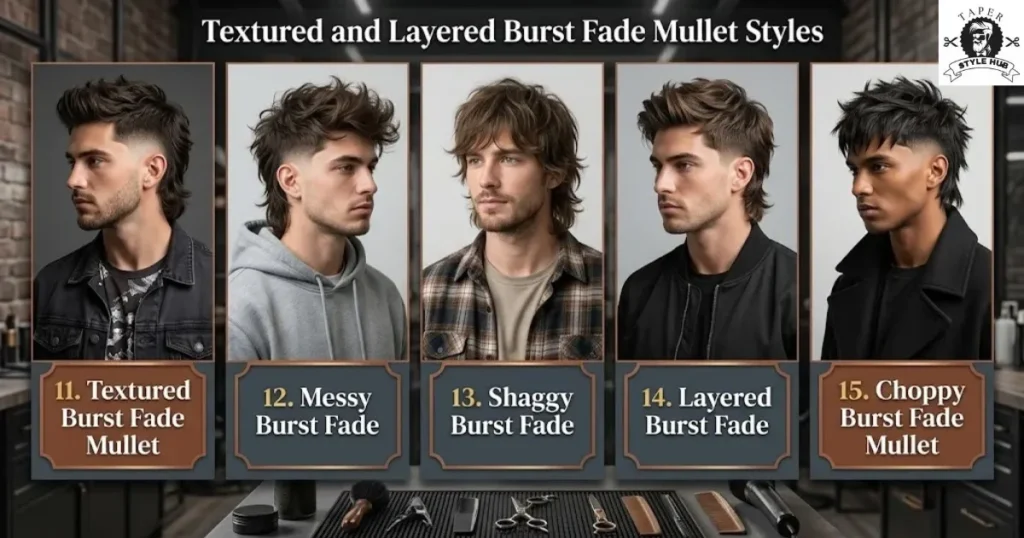
Texture gives a mullet movement. Layers and cutting techniques decide how that movement looks in daily life.
“All The Types Shown Below Are Displayed In The Single Image Above☝️”
11. Textured Burst Fade Mullet
Point cutting and razor work separate the strands on top and through the back. The hair looks lived in and holds its shape without heavy product.
Best for medium thickness hair. Ask for point cutting through the crown and back, and use a light sea salt spray to keep the strands separated.
12. Messy Burst Fade
Messy styling leaves the top loose and the back slightly uneven on purpose. The clean fade around the ear makes the chaos look planned instead of neglected.
Best for a casual, undone vibe. Ask your barber to keep the back uneven and the top loose, while the fade stays crisp around the ears.
13. Shaggy Burst Fade
Heavy layering builds volume and a wild outline. The fade tightens the sides so the shag stays focused on the top and back, which keeps the shape from feeling oversized.
Best for thick or wavy hair. Ask for heavy layers through the top and back, and plan regular trims so the layers do not grow shapeless.
14. Layered Burst Fade
Layers stack from the crown to the nape for a smooth, flowing shape. It looks softer than the shaggy version and adds welcome lift to fine or medium hair.
Best for fine to medium hair that needs lift. Ask for stacked layers from the crown down to the nape, then blow dry the top for body.
15. Choppy Burst Fade Mullet
Bold, uneven sections create an edgy outline with strong separation. A matte paste keeps each piece defined, so the choppy texture survives wind, sweat and a long day.
Best for men who want strong separation. Ask for bold, uneven sections and finish the look with a matte paste instead of a shiny gel.
Hair Type Burst Fade Mullet Styles
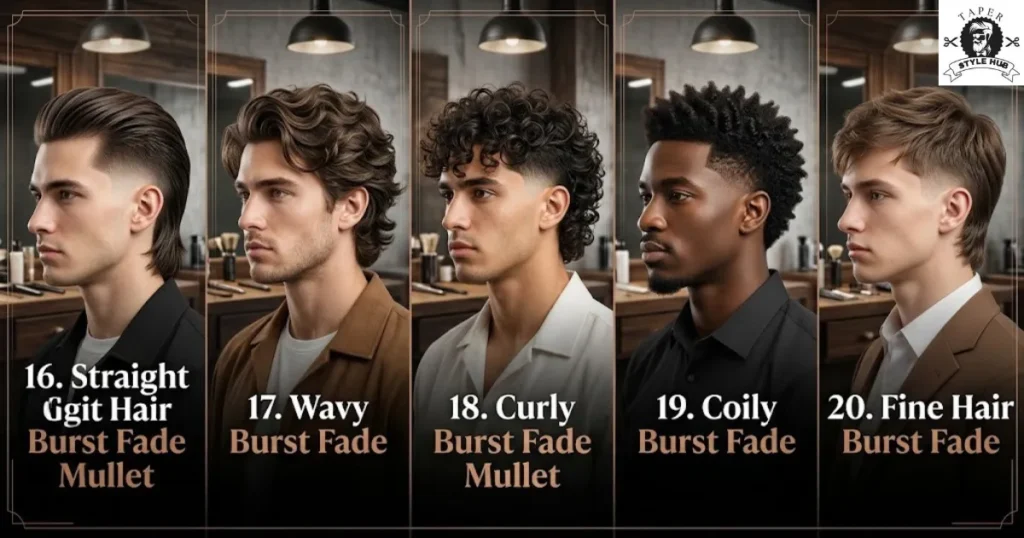
The cut adapts to every hair type when your barber adjusts the layers and length for your natural texture.
“All The Types Shown Below Are Displayed In The Single Image Above☝️”
16. Straight Hair Burst Fade Mullet
Straight hair shows every edge of the fade, so the curve looks extra crisp. Soft layers through the back stop the length from hanging flat or sticking out.
Best for straight, medium density hair. Ask your barber to soften the ends and remove weight, so the back flows instead of hanging heavy.
17. Wavy Burst Fade
Waves give the mullet built-in shape and movement. Air drying with a light cream or sea salt spray is usually enough to finish the look.
Best for loose to medium waves. Ask for length in the back and on top, with the fade only on the sides, and let the waves do the work.
18. Curly Burst Fade Mullet
Curls build a full, bouncy back, while the faded sides keep the volume looking intentional. Ask for a dry cut so each curl is shaped at its true length.
Best for round and oval faces. Ask for the cut to be done dry, and tell your barber to remove bulk near the temples so curls do not puff wide.
19. Coily Burst Fade
Coily hair holds structure beautifully and creates striking contrast against the faded sides. Leave extra length in the back, because shrinkage can hide several inches.
Best for type four hair. Ask for extra back length to allow for shrinkage, and keep a clean, even curve on both sides of the head.
20. Fine Hair Burst Fade
Shorter layers and a low or mid fade keep fine hair looking full instead of wispy. A light volumizing mousse adds body without weighing the strands down.
Best for fine or thinning hair. Ask for a low curve, a shorter back and light texture on top, so the whole shape looks thicker than it is.
Front and Top Burst Fade Mullet Styles
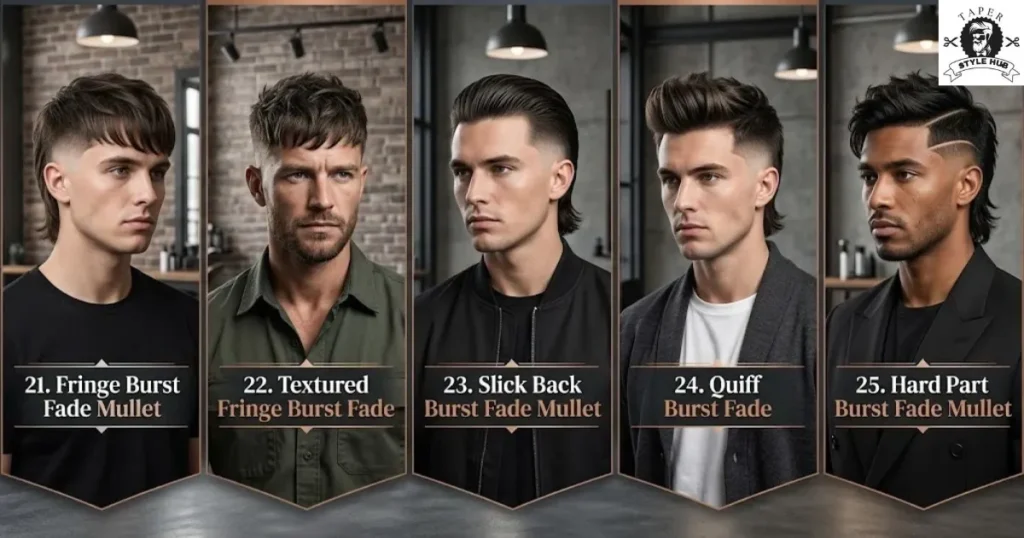
The front of the haircut controls how formal or relaxed it feels. These options change the mood without changing the base cut.
“All The Types Shown Below Are Displayed In The Single Image Above☝️”
21. Fringe Burst Fade Mullet
A fringe brings hair forward over the forehead and softens the front profile. It also helps balance a larger forehead or a receding hairline.
Best for heart, long and oval faces. Ask for a fringe that falls just above the brow, with soft layers that blend into the crown.
22. Textured Fringe Burst Fade
Choppy, separated pieces across the forehead give the front a modern, broken-up finish. Matte clay keeps the edges loose and the fringe light.
Best for straight to wavy hair. Ask for choppy, point-cut pieces across the front, and style them with a small amount of matte clay.
23. Slick Back Burst Fade Mullet
Slicking the top back connects it to the back length in one smooth line. A light pomade gives hold without a stiff, wet look, which suits formal events.
Best for straight or slightly wavy hair. Ask for enough top length to comb back, and use a light pomade for hold without a wet finish.
24. Quiff Burst Fade
The front lifts into a rounded peak while the back stays long. The contrast from the fade makes the volume stand out and adds height to the profile.
Best for medium to thick hair. Ask for extra height at the front, then lift the quiff with a blow dryer and a touch of texture spray.
25. Hard Part Burst Fade Mullet
A razor-shaved line divides the top and adds a graphic detail. Place it where you naturally part your hair so it looks like a real part of your styling.
Best for men who like sharp details. Ask for the part to be placed at your natural parting, and refresh it often because it closes up quickly.
Bold Statement Burst Fade Mullet Styles
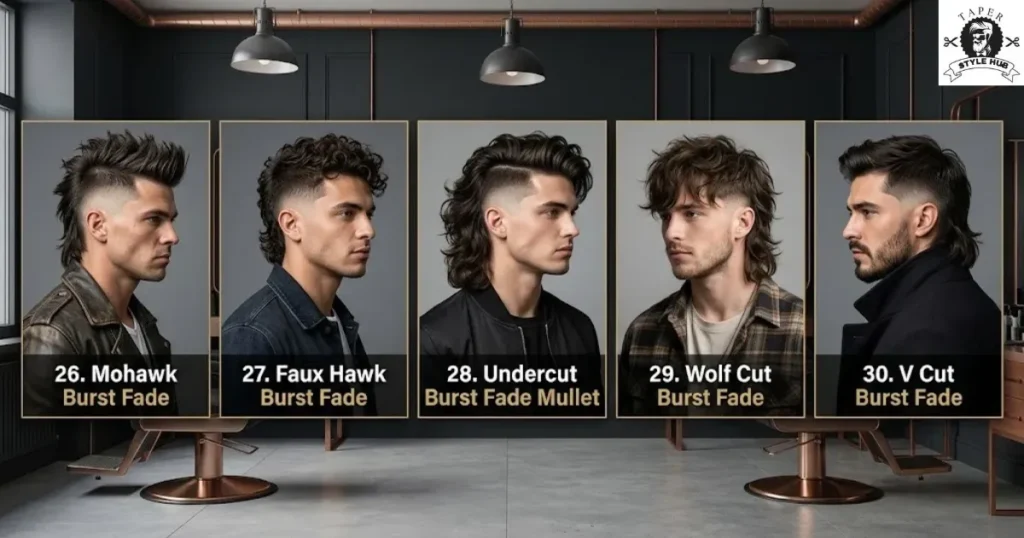
These styles push the haircut into louder territory. Each one borrows an idea from another trend and combines it with the curved fade.
“All The Types Shown Below Are Displayed In The Single Image Above☝️”
26. Mohawk Burst Fade
The sides fade tight while a longer strip runs through the center and flows into the back. Choose a mid or high fade so the strip has enough contrast.
Best for thick hair and bold personalities. Ask for a mid or high curve with a center strip kept long into the back, and trim every two weeks.
27. Faux Hawk Burst Fade
A faux hawk pushes the center forward and up without shaving the sides completely. You get the mohawk attitude with easier upkeep and fewer barber visits.
Best for men who want a mohawk feel without the commitment. Ask for the center to be styled up and forward, with the sides tapered rather than shaved.
28. Undercut Burst Fade Mullet
The sides disconnect from the top for sharp contrast, and the burst smooths that gap into a curve. It suits men who like bold geometry with movement.
Best for confident dressers with thick hair. Ask for a clear disconnection on the sides, and keep the top long enough to move.
29. Wolf Cut Burst Fade
Heavy shag layering meets tight faded sides for maximum volume on top and at the back. It is one of the most current takes on the mullet right now.
Best for wavy, thick or textured hair. Ask for layering throughout the top and back, not only at the ends, for that shaggy movement.
30. V Cut Burst Fade
The nape is cut into a shallow V that points down the neck. It sharpens the back view and gives the haircut a second focal point.
Best for men who want a signature back view. Ask for a shallow, centered V with layered ends, and keep it clean between trims.
Detail, Color and Grooming Burst Fade Mullet Styles

Small finishing touches can turn a good haircut into a memorable one. These five add precision, color or a cohesive grooming look.
“All The Types Shown Below Are Displayed In The Single Image Above☝️”
31. Line Up Burst Fade Mullet
A crisp line along the forehead and temples sharpens the front while the back keeps its relaxed length. Expect the line to soften within about a week.
Best for any hair type and photo-ready results. Ask for the line up to be refreshed on a shorter schedule than the fade itself.
32. Razor Design Burst Fade
A simple curved line or small pattern near the ear turns the fade into a statement. Keep it simple, since fine details grow into the skin within two weeks.
Best for special occasions. Ask for a larger, simpler shape rather than fine detail, since small lines blur fastest as hair grows.
33. Beard Blend Burst Fade Mullet
The fade runs from the sideburn into the beard with no visible line. Book both services in the same session so the transition stays seamless.
Best for men with medium or full beards. Ask for the beard and fade to be blended in one session, and keep both on a similar trim schedule.
34. Blonde Burst Fade
Platinum or golden blonde highlights the layers and creates strong contrast with the darker fade. Color care means a gentle shampoo and a moisturizing conditioner.
Best for men who want a high-contrast color change. Ask for bleached or golden pieces through the layers, and use purple shampoo to control brassiness.
35. Braided Burst Fade Mullet
Braids or twists along the top or back add structure and texture, while the fade gives them a sharp base. It is a bold, creative choice for men with coily hair.
Best for men with coily hair who want structure. Ask for neat, moisturized braids or twists, and keep the scalp hydrated between visits.
How to Choose the Right Burst Fade Mullet
With 35 options, narrowing the list can feel hard. Start with the practical limits, such as dress code, hair type and how often you can visit a barber. Then pick the personality level.
| Your Priority | Best Starting Point | Why |
|---|---|---|
| First time with a mullet | Classic or low burst fade | Gentle contrast and easy grow-out |
| Office or school | Low or taper burst fade | Neat arc with soft contrast |
| Maximum impact | High or skin burst fade | Short sides make the back stand out |
| Curly or coily hair | Curly or coily burst fade | Controls side puff and keeps curls defined |
| Fine hair | Fine hair burst fade | Short layers add body |
| Low effort | Short or messy burst fade | Minimal styling and forgiving grow-out |
| Beard wearers | Beard blend burst fade | Smooth sideburn connection |
How to Choose a Barber for a Fade Haircut
Fades demand skill, so the barber matters as much as the style you pick. Check recent photos of their work, especially fades that curve around the ear, before you book.
During the consultation, a good barber asks about your hair type, daily routine and how often you can return. They should also explain the plan before cutting and point out anything that may not suit your head shape.
Do not be afraid to ask questions about guard numbers, layering and the neckline. Clear communication prevents most haircut disasters, and a confident barber will welcome it.
How to Ask Your Barber for a Burst Fade Mullet
A reference photo is the fastest way to avoid surprises. Bring one that shows the front, side and back, because the word burst means slightly different things to different barbers.
After that, a short script covers the main decisions. Say it calmly and let your barber confirm each point before the clippers start.
- Name the cut: I want a burst fade mullet.
- Choose the fade height: low, mid or high around the ear.
- Choose the finish: skin, shadow or a number two guard at the lowest point.
- Give the top length and describe the texture you want.
- Give the back length, such as collar length with a tapered neckline.
- Mention your hair type and how you usually style it.
Burst Fade Mullet Guard Sizes
Guard numbers control how much hair stays after the clippers pass. Barbers usually start with a longer guard and step down as they approach the ear.
| Guard | Length | Where It Is Used |
|---|---|---|
| #1 | About 1/8 inch (3 mm) | Shortest area near the ear for a tight, clean base |
| #2 | About 1/4 inch (6 mm) | Shadow finish and short base layer |
| #3 | About 3/8 inch (10 mm) | Middle of the fade for blending upward |
| #4 | About 1/2 inch (13 mm) | Upper fade where the sides meet the top |
Treat this as a starting range. The exact sequence depends on your hair density, head shape and the amount of contrast you want. Always confirm with your barber.
How to Style a Burst Fade Mullet
Styling takes about five minutes once the haircut is shaped well. Follow these steps for a reliable daily routine.
- Wash with a shampoo suited to your hair type and condition the lengths.
- Towel dry gently by pressing, not rubbing, to limit frizz.
- Work sea salt spray or a light cream through damp hair.
- Blow dry the top for lift, or use a diffuser for waves and curls.
- Warm a pea-sized amount of matte clay or paste and shape the top first.
- Finish by tousling the back and adding a light mist of hairspray if needed.
Start with less product than you think you need. You can always add more, but removing it means washing your hair again.
| Product | Best For | Finish |
|---|---|---|
| Sea salt spray | Straight and wavy hair | Matte and textured |
| Matte clay | Thick hair and messy looks | Strong hold with no shine |
| Texture paste | Choppy and layered styles | Natural look, medium hold |
| Pomade | Slick back and side part looks | Polished finish |
| Curl cream | Curly and coily hair | Soft and defined |
| Volumizing mousse | Fine hair | Airy body |
Styling Tools That Make Daily Routines Easier
You do not need a bathroom full of gear. A few simple tools make the routine faster and help the layers fall the way your barber intended.
- A wide-tooth comb for detangling the back without pulling the layers apart.
- A small blow dryer with a diffuser attachment for waves and curls.
- A boar bristle brush for smoother, slicked back versions.
- A fine mist spray bottle to dampen the hair before adding product.
- A satin pillowcase to reduce frizz and keep the shape overnight.
Burst Fade Mullet Maintenance and Trim Schedule
The fade needs far more attention than the back. Hair grows roughly half an inch per month, so even a clean fade starts to blur within two to three weeks.
| Fade Type | Trim Every | Why |
|---|---|---|
| Burst taper | 4 to 5 weeks | Subtle fade hides growth |
| Low burst | 3 to 4 weeks | Sharp near the ear but softer overall |
| Mid burst | 2 to 3 weeks | Higher contrast shows growth sooner |
| High or skin burst | 10 to 14 days | Bare skin grows in quickly |
The back is meant to grow, so you can leave it alone for longer. A small trim every six to eight weeks removes split ends and keeps the outline neat.
Between visits, wash two or three times a week with a gentle shampoo and condition the mid lengths and ends. Keep the sideburns and nape tidy, because those small areas make the whole haircut look fresh.
Scalp and Hair Care for a Burst Fade Mullet
Short sides expose more scalp, so sunscreen matters during summer. Skin fades can feel sensitive right after a visit, so mention any irritation to your barber.
Longer backs need moisture. A light leave-in conditioner or a few drops of oil on the ends prevents dryness, frizz and breakage, especially for curly, coily or colored hair.
If you notice unusual thinning, itching or flaking, check with a dermatologist rather than guessing. A healthy scalp makes every haircut look better.
Seasonal Tips for Summer and Winter
In summer, short sides heat up quickly, so apply sunscreen to exposed skin and rinse the back after swimming. Chlorine and salt water dry out longer hair, which can make layers look rough.
In winter, the back works like a natural scarf, but dry air and hats cause static and frizz. A leave-in conditioner and a satin-lined beanie keep the layers smooth and the shape intact.
Growing Out a Burst Fade Mullet
Growing the style out takes patience, but the stages are predictable. In the first three weeks the fade softens and the edges blur.
By the second month the sides fill in and the back reaches the collar. Between months three and four, the cut turns into a classic mullet or a layered shag.
After six months the sides catch up and leave a long, even length. Ask your barber for light shaping during the awkward phase so the outline never looks neglected.
Patience is the real secret. Resist the urge to shave the sides during the grow-out, because the fade helps the awkward lengths look planned while the back catches up.
Common Mistakes to Avoid With a Burst Fade Mullet
Most disappointing haircuts come from a handful of repeatable errors. Avoid these and your result will look better and last longer.
- Skipping the reference photo, which leaves too much room for misunderstanding.
- Taking the fade too high on the first visit, which is hard to undo.
- Cutting the back too short and losing the mullet shape completely.
- Ignoring hair type, since fine, thick and curly hair need different layering.
- Cutting wet curly hair, which shrinks as it dries and leaves the back shorter than planned.
- Overusing product, which weighs down the top and dulls texture.
- Neglecting the neckline, which makes the whole cut look unfinished.
Final Thoughts on the Burst Fade Mullet
The burst fade mullet is flexible enough to fit almost any hair type, face shape and lifestyle. You can start low and subtle, then move toward a higher fade and a longer back once you feel comfortable.
Choose one style from the categories above, save a clear photo and use the barber script. With regular trims and a simple routine, the haircut stays sharp, modern and easy to wear.
Burst Fade Mullet FAQs
What is a burst fade mullet?
A burst fade mullet is a mullet with a curved, ear-hugging fade on the sides. The hair is shortest behind the ear and blends into a longer back.
How often does a burst fade mullet need a trim?
Low bursts need a trim every three to four weeks, mid bursts every two to three, and high or skin bursts every ten to fourteen days.
Does a burst fade mullet work on curly hair?
Yes. Curly and coily hair suits the cut well, and a dry cut keeps shrinkage from leaving the back too short.
Is a burst fade mullet professional enough for work?
A low burst fade with a short, tidy back looks neat in most offices. Bolder versions suit creative or casual workplaces better.
How long does it take to grow out a burst fade mullet?
Hair grows about half an inch a month, so the sides usually catch up in around six months. The back reaches classic mullet length in two to four months.

I’m M Ahmad Ansari, founder and content creator at Taper Style Hub. With 3+ years of experience researching taper haircuts, hairstyles, grooming, and men’s style, I create practical, accurate, and easy-to-understand content. My goal is to provide readers with trustworthy information, useful tips, and inspiring ideas for choosing and styling the perfect taper haircut.

3 Comments