
Mid Burst Fade Haircuts You Need In 2026
A mid burst fade is a men’s haircut where the sides blend in a rounded arc around the ear and climb about halfway up the head. The top and back keep their length.
This guide covers 30 styles, clear comparisons with other fades, and the exact words to tell your barber. You will also find styling steps, product ideas, upkeep advice, and common mistakes.
👉 Also Read: Low Burst Fade
Mid Burst Fade Haircut: The Complete Guide for Men
What Is a Mid Burst Fade Haircut?
A mid burst fade combines two separate choices. The burst is the curved shape around the ear, and mid is the height where that curve reaches on the side of your head.
Hair near the ear stays shortest, sometimes down to bare skin, and length builds gradually as the fade moves up and outward. Longer hair remains on top and often at the back.
Because the name describes only height and shape, the top can be styled in many ways. That flexibility is the main reason barbers recommend this cut so often.
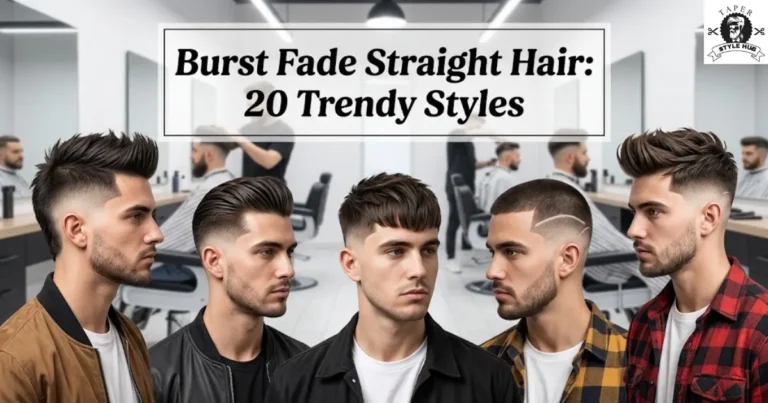
👉 Also Read: Burst Fade Straight Hair
Why Is It Called a Burst Fade?
The word burst comes from the radiating shape of the fade. Seen from the side, the short hair near the ear appears to spread outward like a small sunburst.
Some barbers call this pattern a radial fade or a halo taper. A standard fade runs in a level band, while a burst curves in a semicircle from behind the ear.
Many men like this contrast because it removes bulk from the sides without forcing a very short cut across the whole head. It also frames the ear cleanly.
👉 Also Read: Burst Fade Design
Level, Depth, and Shape Explained for a Mid Burst Fade

Every fade is built from three independent decisions. Understanding them helps you ask for exactly what you want instead of hoping your barber guesses correctly.
👉 Also Read: Burst Fade Mullet Curly Hair
Level: Where the Fade Starts
Level means how high the fade climbs. A low fade stays close to the ear, a mid fade reaches roughly halfway up the side, and a high fade travels toward the crown.
👉 Also Read: Burst Fade Mullet
Depth: How Short the Shortest Point Goes
Depth describes the shortest point of the fade. It can be bare skin for sharp contrast or a light shadow that grows out softly and hides regrowth for longer.
👉 Also Read: Taper Mullet 40 Modern Types For Men
Shape: Standard, Drop, or Burst
Shape describes the path of the fade line. A standard fade runs level, a drop fade dips behind the ear, and a burst curves in a rounded arc around the ear.
Asking for a mid burst fade settles level and shape, but depth stays open. Always tell your barber whether you want skin or a shadow at the shortest point.
👉 Also Read: Low Burst Fade Mullet
Why the Mid Burst Fade Is Still Popular in 2026
Trends come and go, yet this cut keeps appearing in barbershops. It works for teens, working professionals, and older men without looking too young or too safe.
The curved line looks deliberate even on a simple haircut. A barber can also raise or lower the fade, or change the top length, without forcing you to start over.
It photographs well, too. The contrast between the faded sides and the textured top stays visible in a quick phone picture, and it looks equally sharp in person.
It also suits different lifestyles. You can wear it clean for work on Monday and textured for a night out on Saturday, using the same haircut.
👉 Also Read: Straight Hair Taper Mullet Fade
Who Should Try a Mid Burst Fade Haircut?

“All The Types Shown Below Are Displayed In The Single Image Above☝️”
Most men can wear some version of this cut. It is forgiving across hair types, and a good barber can adjust the height and contrast to suit your head shape.
Best Choices by Hair Type
Thick hair benefits because the fade removes bulk from the sides. Curly hair looks more defined, wavy hair gains balance, and straight hair gets contrast that prevents a flat look.
Face Shapes That Suit This Cut
Oval, round, square, diamond, and heart-shaped faces all work well with a mid burst fade. Oval faces are the most versatile, since almost any height flatters them.
Long or angular faces can still wear the style. Ask for a slightly lower fade with more length on top to soften the contrast.
Mid Burst Fade Face Shape Guide
Face shape is a secondary guide, not a strict rule, but it helps you pick a height and top length that feel balanced. Use these suggestions as a starting point.
Round and Square Faces
Round faces benefit from extra height on top, so a pompadour or faux hawk adds visual length. Square faces look balanced with a softer top that does not exaggerate the jaw.
Oval and Diamond Faces
Oval faces can carry almost any version, which makes experimenting easy. Diamond faces gain from a textured fringe that adds width at the forehead and softens the cheekbones.
Long and Heart-Shaped Faces
Long faces look better with a slightly lower fade and more length on top, which avoids adding height. Heart-shaped faces balance well with a fringe that reduces the width of the forehead.
Texture, density, and growth direction matter just as much as face shape, so always judge the final result in a mirror before leaving the chair.
Quick Decision Guide for Choosing Your Style
Not ready to read all 30 styles? Use this quick guide to jump straight to the look that fits your hair, face, and daily routine.
- Round or square face: try the pompadour or faux hawk for extra visual height.
- Thick or curly hair with little time: try the buzz cut or the low maintenance version.
- Bold and current: try the mullet, mohawk, or undercut.
- Professional setting: try the side part, comb over, or slick back.
- Fine or thin hair: try the textured or thin hair version for visible volume.
30 Mid Burst Fade Styles to Show Your Barber
Every style below uses the same curved fade. What changes is the top length, texture, and finishing detail, so you can mix and match ideas with your own hair.
To keep things organized, the styles are grouped into five categories. Read the group that matches your goal, then save a few photos for your barber.
Classic and Blend Styles for a Mid Burst Fade
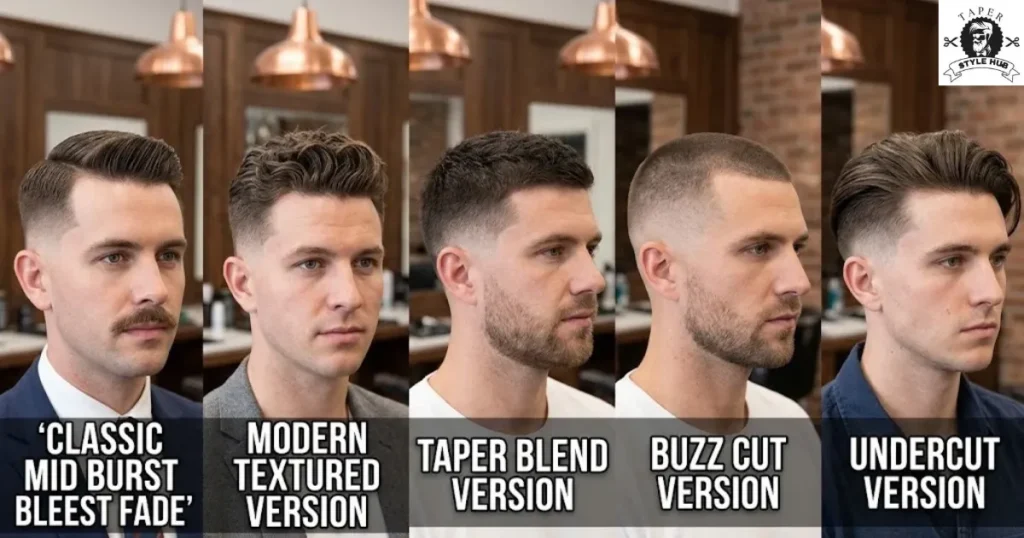
“All The Types Shown Below Are Displayed In The Single Image Above☝️”
1. Classic Mid Burst Fade
An evenly blended fade around the ears with a short, controlled top. It is the safest starting point if you have never worn a fade before.
It needs only a little pomade on damp hair, and you can dress it up for a night out with a touch more product.
2. Modern Textured Version
Sharper sides meet a slightly undone, textured top instead of a smooth one. Barbers often use point cutting to break up density and add movement.
This is usually the first version a barber shows when you ask for something current without straying far from the classic shape.
3. Taper Blend Version
This version swaps the hard burst line for a feathered, gradual transition. The fade melts into the top instead of stopping at a visible edge.
It hides new growth longer between trims, which makes it practical for anyone who travels often or cannot keep a strict barber schedule.
4. Buzz Cut Version
A short, even top, usually cut with a number 2 to 4 guard, blends into the burst at the sides. No length is left to manage.
It suits thick or curly hair particularly well and is one of the easiest cuts to maintain yourself between professional visits.
5. Undercut Version
The sides are cut far shorter than the top, leaving a clear step before the line swings into the burst around the ear.
It reads bolder than the classic version and suits thicker hair on top, though it takes longer to grow out cleanly than softer options.
Texture and Detail Styles Using a Mid Burst Fade
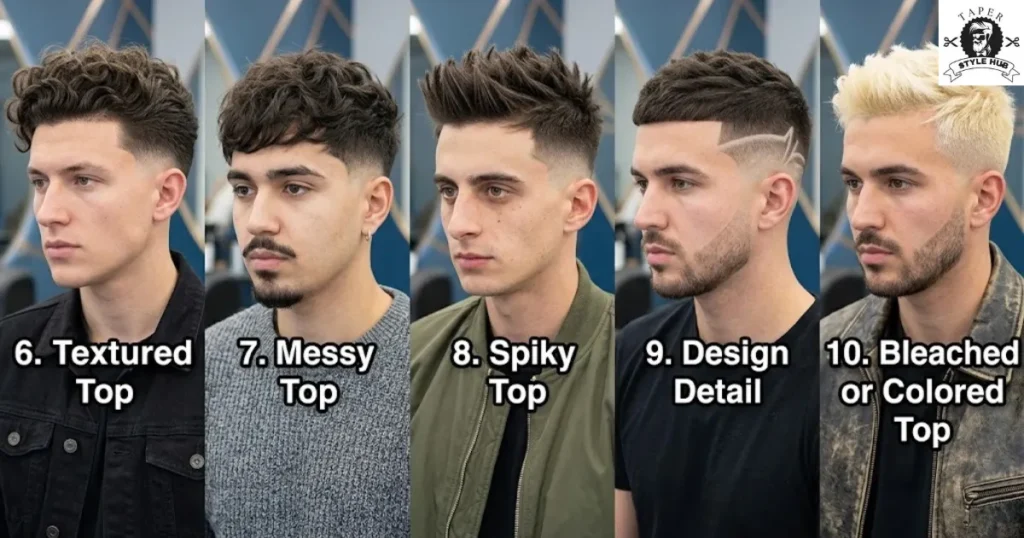
“All The Types Shown Below Are Displayed In The Single Image Above☝️”
6. Textured Top
Layered or point-cut detail on top adds real movement and breaks up thickness, paired with a clean fade underneath.
A little texture powder near the roots is usually enough to hold the shape all day without the heavy product a slicked style needs.
7. Messy Top
A deliberately tousled top against sharp, clean sides makes the contrast look styled instead of simply uncombed.
Work in matte clay with your fingers rather than a comb. It suits wavy or naturally textured hair more easily than very fine, straight hair.
8. Spiky Top
The top is styled upward with a strong-hold gel or wax instead of being left loose. It works best on short to medium lengths.
Natural thickness helps the spikes hold. Very fine hair tends to lose the shape by afternoon and may need a quick touch-up.
9. Design Detail
A shaved line, geometric shape, or small pattern is cut into the fade area or along the neckline for a personal finish.
Designs need trimming every two to three weeks to stay sharp, so this is a higher upkeep choice than most styles on this list.
10. Bleached or Colored Top
Bleach, copper, or red tones make the contrast between the fade and the top even stronger and turn the haircut into a statement.
Colored hair needs extra care, so add a moisturizing conditioner to your routine and keep the fade fresh to protect the overall shape.
Mid Burst Fade Top Style Pairings
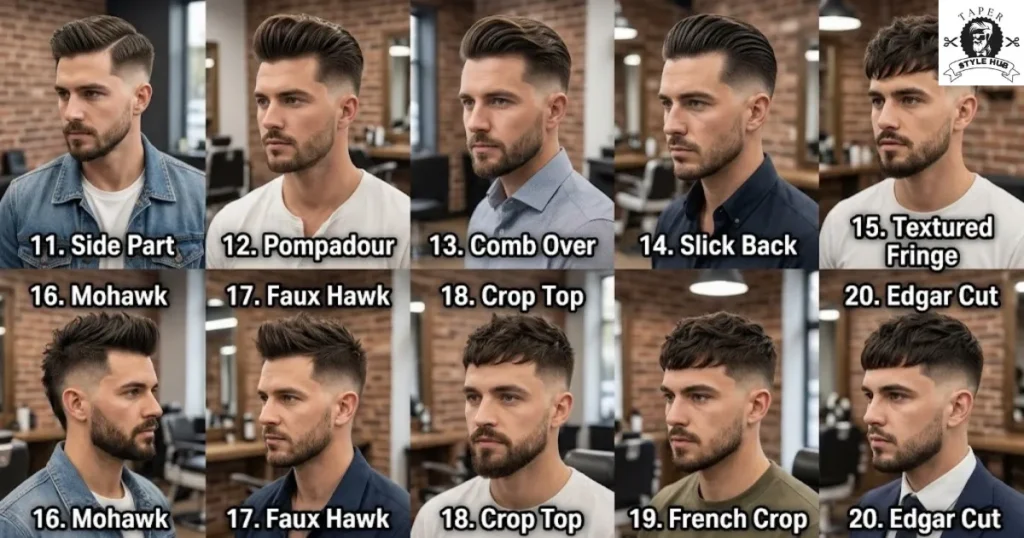
“All The Types Shown Below Are Displayed In The Single Image Above☝️”
11. Side Part
A crisp, combed part sits on top while the fade works quietly underneath. It looks polished enough for an office and relaxed enough for a weekend.
It holds cleanest on straight or slightly wavy hair with a light, medium-shine pomade rather than a high-gloss finish.
12. Pompadour
Height and volume are swept up and back at the front, with a tight fade underneath for a bolder, classic-leaning combination.
It needs a blow dryer and a firm-hold pomade, so be honest about your morning routine before choosing it.
13. Comb Over
A traditional comb over meets a modern fade for contrast between old and new. It is one of the more office-friendly pairings here.
A comb and a light styling cream on slightly damp hair are usually enough to keep it flat and controlled.
14. Slick Back
Hair is pushed straight back off the face over faded sides. It photographs cleanly and suits everything from formal events to ordinary weekdays.
Medium-shine pomade keeps it sleek without making the top stiff or wet-looking, which is the most common way this style goes wrong.
15. Textured Fringe
Longer hair stays at the front for a younger, trend-forward look that works especially well on naturally textured hair.
Ask for a textured, layered fringe, because a blunt fringe can look old-fashioned and clash with the casual burst shape.
16. Mohawk
A strip of longer hair runs down the center, with hard fades on both sides down to skin. It is bold without going fully extreme.
It needs strong-hold gel or wax daily to keep the center standing, especially if your hair is on the finer side.
17. Faux Hawk
This is a softer, shorter take on the mohawk with less height and a more relaxed attitude. The sides are not shaved down as hard.
A lightweight styling paste lifts the center without a full mohawk commitment, which makes it easier to wear in conservative settings.
18. Crop Top
Short, textured length stays close to the head over a clean fade. It keeps visible texture while staying one of the easiest styles to live with.
It works on nearly every hair type with little adjustment, which is why barbers recommend it as a default.
19. French Crop
A sleeker cousin of the crop top, cut with a straight, defined fringe instead of a choppy one. It reads cleaner and more deliberate.
It suits men who prefer structure over movement and generally works better on straighter hair than on very curly or coily textures.
20. Edgar Cut
The Edgar cut has a squared-off, boxy fringe that contrasts sharply with the rounded fade shape on the sides.
That clash between a blunt top line and a soft curve makes this pairing stand out, and it looks especially good from the side.
Mid Burst Fade Styles for Every Hair Type

“All The Types Shown Below Are Displayed In The Single Image Above☝️”
21. Curly Top
Removing bulk from the sides lets natural curls stand out instead of blending into overall volume. It is a strong option when you are growing curls out.
A curl cream applied right after washing keeps the pattern defined without leaving curls stiff or crunchy by the end of the day.
22. Wavy Top
The fade adds a sharp edge on the sides while the top stays loose and textured. It plays up a natural wave pattern better than a straight cut can.
Sea salt spray on towel-dried hair brings out the waves with almost no effort and no heat styling.
23. Straight Hair
Straight hair can look flat without contrast, and the fade supplies exactly that. The top reads fuller and more deliberate by comparison.
A lightweight texturizing wax worked through the ends stops the finish from looking one-dimensional against the sharper sides.
24. Thick Hair
The fade strips real weight and bulk from the sides so thick hair on top does not sit heavy or shapeless.
It is a functional pairing, not just a style choice, because the sides carry far less bulk to maintain between visits.
25. Thin Hair
Tight sides against a textured top create the appearance of more density than fine hair actually has.
Apply texture powder near the roots rather than throughout, because heavy creams can weigh fine hair down flat.
26. Afro Texture
The sides stay clean and blended while natural afro texture remains full and defined on top, so the fade does the shaping.
A moisturizing cream keeps the top healthy between visits, since coily hair tends to dry out faster than other textures.
27. Long Top
More length stays on top than in most styles here, so you can wear it messy, slicked back, or textured depending on the day.
It suits men who get bored with one look quickly and want variety without changing the haircut itself.
Special Mid Burst Fade Styles Worth Knowing
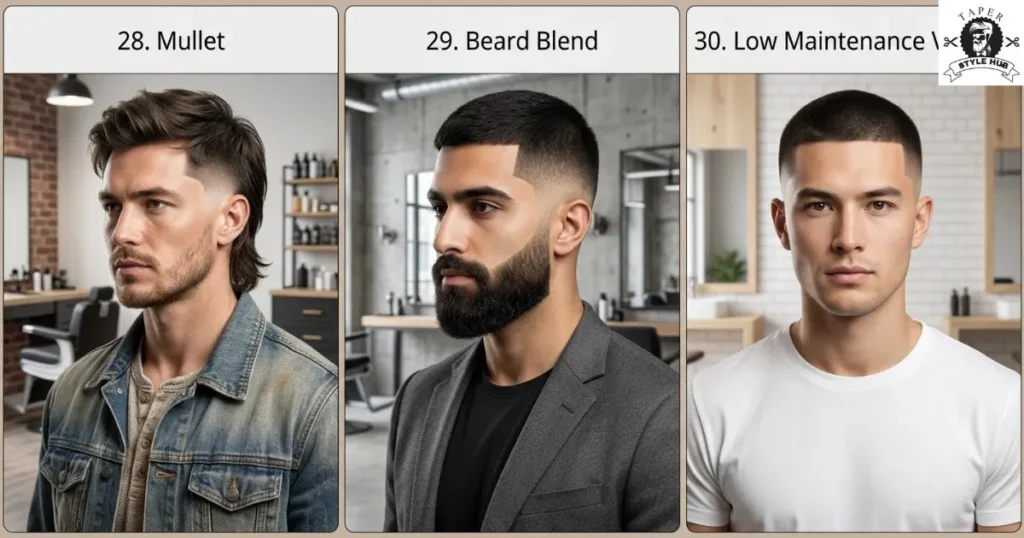
“All The Types Shown Below Are Displayed In The Single Image Above☝️”
28. Mullet
Tight sides with noticeably longer hair at the back create a bold, personality-driven look that is popular with younger guys.
The fade makes the length contrast read as intentional. Thicker hair carries the weight at the back better than thin hair.
29. Beard Blend
The fade line blends directly into a full beard, so there is no hard break between hair and facial hair.
Regular beard trims matter as much as the fade, because an overgrown beard can make a fresh fade look unfinished.
30. Low Maintenance Version
This version is built around minimal daily effort across several top lengths, not just one very short cut.
The fade does most of the visual work, so styling time stays close to zero and trims can be spaced slightly further apart.
Mid Burst Fade for Black Men and Textured Hair
Coily and afro-textured hair gives a mid burst fade strong contrast. The arc clears the ear area while the top keeps its height, fullness, and natural shape.
Waves, Twists, and Coils
The fade works with 360 waves, twists, short afro tops, and loose curls. It frames each texture cleanly and keeps the sides neat while the top stays expressive.
Coily hair shrinks from its stretched length, so judge the shape at its natural resting length. A barber who cuts coily textures regularly will get a more even result.
Keeping the Top Connected
The curve should stay connected to the top, otherwise the sides can look separate from the rest of the hair. Ask your barber to blend the transition carefully.
Moisturize the top regularly and protect it at night. Healthy, hydrated coils hold their shape better and make the fade look sharper for longer.
Mid Burst Fade vs Low Burst Fade
Both cuts use the same curve around the ear, so the main difference is height. A low burst stays near the ear, while a mid burst exposes more of the side.
That makes the low version quieter and easier to wear in conservative settings. The mid version reads bolder and shows the curve more clearly.
| Feature | Mid Version | Low Version |
|---|---|---|
| Where it starts | Halfway up the side | Near the ear and neckline |
| Contrast | Moderate to sharp | Soft and subtle |
| Best for | Bold, modern, textured looks | Professional and everyday cuts |
| Maintenance | Every 2 to 4 weeks | Every 3 to 4 weeks |
Mid Burst Fade vs High Burst Fade
A high burst pushes the fade much closer to the crown, so more scalp shows and the contrast increases. The mid version leaves more hair above the arc for support.
For that reason, many barbers treat the mid height as the best all-rounder, and it is a sensible first burst if you have never tried one.
| Feature | Mid Version | High Version |
|---|---|---|
| Where it starts | Halfway up the side | Near the crown |
| Contrast | Moderate and balanced | Very high |
| Commitment | Easier to adjust or grow out | Bigger commitment |
| Best for | Most hair types | Thick hair with a full top |
| Maintenance | Every 2 to 4 weeks | Every 2 to 3 weeks |
Mid Burst Fade vs Drop Fade, Taper Fade, and Regular Mid Fade
These cuts get mixed up constantly because barbers use the labels loosely. A reference photo is the safest solution, but knowing the differences helps you speak clearly.
| Cut | Fade Line | Character |
|---|---|---|
| Burst | Rounded arc around the ear | Soft and ear-focused |
| Drop fade | Dips behind the ear toward the nape | Long, sloping line |
| Taper fade | Straight, gradual blend | Classic and traditional |
| Regular mid fade | Level band at halfway height | Clean and uniform |
| Burst taper | Small arc at the ear and sideburn | Gentlest option |
If a mid burst fade feels like too much, a burst taper is the quieter relative. If you want a sloping line toward the neck, ask for a drop fade instead.
Mid Burst Fade vs Mohawk Fade
A mohawk fade removes much more hair from the sides and leaves a bold strip down the center. A mid burst fade only curves around the ear and keeps far more length overall.
The two can be combined, which gives you a mohawk top with a curved fade underneath. It is a strong choice for men who want a louder look without losing the burst shape.
How to Ask Your Barber for a Mid Burst Fade
Good communication prevents most disappointing haircuts. Ask for the cut by name, then fill in the details that the name leaves open.
- Say mid burst fade and point to where the curve should top out, about halfway up the side.
- Choose your depth: bare skin for sharp contrast or a short shadow for a softer finish.
- Give a specific top length, such as an inch on top, instead of saying not too short.
- Mention your hair texture, whether curly, straight, thick, thin, or wavy.
- Decide between a sharp contrast line and a softer blend.
- Confirm the neckline: natural, rounded, straight, or V-cut.
- Bring a side photo and a rear photo of hair similar to yours.
A Simple Script to Use
Try saying: I would like a mid burst fade, curved around the ear, taken to a light shadow at the shortest point, with weight kept on top.
Do You Need to Know Guard Numbers?
Not really. Guards only set length and do not decide where the fade starts. Still, many a mid burst fade begins around a number 2 or 1.5 and blends down toward the ear.
Why Reference Photos Matter for a Mid Burst Fade
Words describe a haircut loosely, but photos settle details such as arc height, fade depth, and what happens behind the ear. One clear picture can prevent a mismatch.
Bring a side photo and a rear photo whenever possible. A front-facing picture shows almost nothing about the curve, so it rarely gives your barber enough information.
Choose pictures of a mid burst fade on hair that resembles yours in texture, density, and length. A photo of very different hair can promise a result that your head cannot produce.
What to Look for in a Barber
Because the curve around the ear is hard to execute, the barber matters. Look at their previous fades, especially close-up photos taken from the side and back.
Ask whether they cut your hair texture often. A barber who works with coily, wavy, or fine hair regularly will understand how each type reacts to clippers.
Pay attention to how they communicate. A good barber asks about depth, top length, and neckline, then checks the shape in a hand mirror before finishing.
If the first visit goes well, return to the same barber so they learn your growth pattern. Consistency makes every later haircut closer to your ideal.
Neckline Options for a Mid Burst Fade
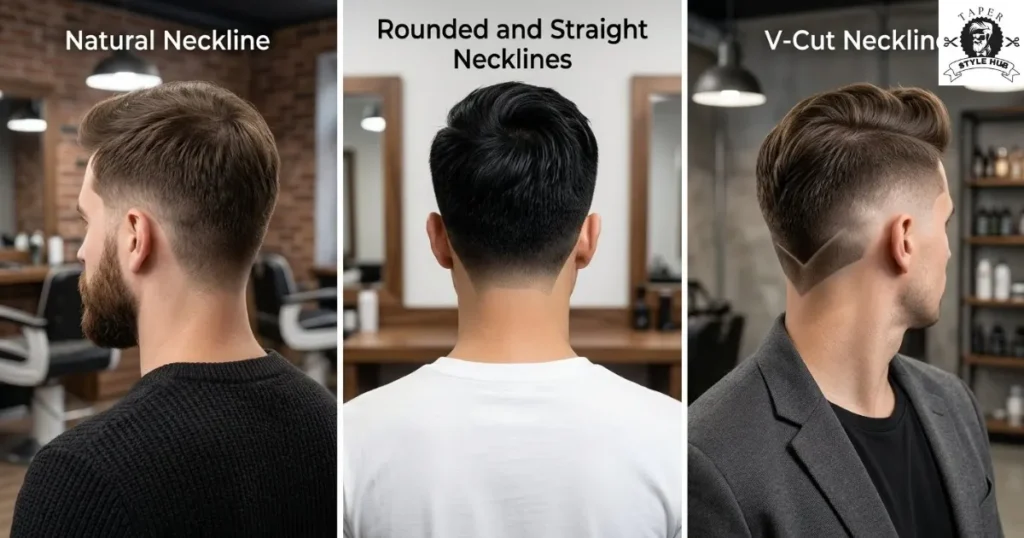
The neckline is the detail most men forget to mention. A burst fade curves around the ear, but the back of the neck still needs a clear finish.
Natural Neckline
A natural neckline follows your own hairline and grows out softly. It is forgiving, low maintenance, and works well with a shadow finish.
Rounded and Straight Necklines
A rounded neckline looks soft and friendly, while a straight or squared line looks sharper. Both need cleaning every couple of weeks to stay crisp.
V-Cut Neckline
A V-cut points down the center of the nape and adds extra detail. It looks striking on straight hair but needs regular touch-ups to hold its shape.
Skin Fade or Shadow Fade for Your Mid Burst Fade
Depth is the decision that changes the look most. Two men can both ask for a mid burst fade and leave with very different results because one chose skin and the other chose shadow.
Skin Finish
A skin finish takes the shortest point down to bare skin, which gives the sharpest contrast and the cleanest curve. It also shows regrowth fastest.
Choose it if you enjoy a crisp look and can visit your barber every two to three weeks. It works especially well on thick hair, curls, and strong waves.
Shadow Finish
A shadow finish leaves a very short layer of stubble at the shortest point. The curve stays visible, but the transition looks softer and more natural.
It grows out more gracefully because there is no bare skin to reveal new hair. It is also kinder to sensitive skin.
Taper Finish
A taper finish keeps a little more length near the ear and blends gradually into the top. It is the gentlest option and the easiest to wear in conservative settings.
If you are unsure, start with shadow. You can always ask your barber to go shorter at the next visit once you know how it suits you.
How to Style a Mid Burst Fade at Home
Daily effort comes from the hair on top, not the fade itself. A simple routine keeps the look clean without taking much time.
- Towel-dry your hair so it stays slightly damp, since products spread more evenly that way.
- Apply a small amount of product, working from the roots outward.
- Use your fingers for texture, or a comb for defined looks like a side part.
- Blow-dry on medium heat if the style needs lift, aiming against the direction it should sit.
- Finish with a light hairspray only if you need hold through humidity or a long day.
- Check the fade from the side every few days, since regrowth shows there first.
Best Products for a Mid Burst Fade
The right product depends on your texture and finish. Keep it on the top section, because product dragged into the sides makes the blend look patchy.
- Water-based pomade: shine and strong hold for slick backs, pompadours, and comb overs.
- Texture powder: volume without weight, ideal for messy and thin hair versions.
- Matte clay: strong hold with no shine for textured, curly, and afro styles.
- Sea salt spray: a lived-in, beachy texture for waves and messy tops.
- Curl cream or gel: definition for curls, best applied to wet hair.
- Light hairspray: flexible hold for pompadours and spikes.
Mid Burst Fade Maintenance and Upkeep
Most men see the sharp line last about two to four weeks. Faster growth pulls that toward two weeks, while a softer blend can stretch closer to four.
| Version | Typical Refresh | Reason |
|---|---|---|
| Skin finish | Every 2 to 3 weeks | Regrowth shows quickly on bare skin |
| Shadow finish | Every 3 to 4 weeks | Softer line hides growth |
| Taper blend | Every 3 to 4 weeks | Gradual transition grows out gently |
| Design detail | Every 2 to 3 weeks | Fine lines blur fast |
Washing and Daily Care
Wash two or three times a week with a gentle shampoo. Heavy product left near the fade is the most common reason a sharp cut looks flat early.
Skin Irritation and Razor Bumps
A skin finish can irritate sensitive skin, especially with curly hair. Ask for a short shadow instead, and see a doctor if bumps persist or spread.
How Much Does a Mid Burst Fade Cost?
The mid height rarely changes the price, so expect roughly what your barber charges for a standard fade. Experience and location matter far more.
Extras like beard work, designs, or color can raise the total. Ask for a quote when you book rather than assuming a number.
Common Mid Burst Fade Mistakes to Avoid
- Choosing the wrong height for your face shape and growth pattern.
- Ignoring hair texture when booking, which leads to a generic cut.
- Waiting too long between trims, since a fade fades out slowly.
- Overloading fine hair with heavy product that weighs down volume.
- Forgetting to mention the neckline, so the barber defaults to habit.
Can You Cut a Mid Burst Fade at Home?
It is possible, but it is one of the harder fades to do well. The rounded line around the ear needs steady clipper control and a clear view from every angle.
Most men get better results by leaving the fade to a barber and handling only light neck cleanup at home. A crooked curve is difficult to repair afterward.
If you do try, work slowly, use a mirror setup, and start with longer guards. You can always remove more hair, but you cannot put it back.
Can You Grow Out a Mid Burst Fade?
Yes, and this is one of the underrated benefits of the cut. Because the top length is controlled separately, you can grow it into a longer crop, a slick back, or even a small mullet.
Keep the fade maintained while the top grows, otherwise the contrast between short sides and longer hair starts to look uneven. Tell your barber you want to maintain the fade while growing the top.
Mid Burst Fade for Teens and Kids
Teens and younger guys can wear this cut comfortably. It is neat, current, and leaves room to experiment with top length and texture as personal style develops.
Low commitment on top and consistent sides underneath also make it easy for a barber to adjust gradually over a school year. Always check dress code rules first.
Wearing a Mid Burst Fade at Work, School, and Events
Many people ask whether this cut is too bold for conservative settings. In most cases it is not, especially when you choose a soft blend and a neat top.
For an office, pair a shadow finish with a side part or comb over. The curve stays subtle, and the overall look reads polished and intentional.
For a night out or a weekend event, switch to a textured top, a fringe, or a faux hawk. The same fade supports every one of those styles.
Schools and workplaces sometimes have grooming rules, so check them before choosing a high contrast or design heavy version. Your barber can adjust the depth easily.
Common Myths About the Mid Burst Fade
One myth says this cut only suits young men. In reality, the curved fade works on any age group, and a soft blend looks distinguished with gray or silver hair.
Another myth says it needs constant upkeep. A shadow finish or taper blend can last three to four weeks, so the effort depends heavily on the depth you choose.
A third myth says it only works with thick hair. Fine hair can wear the style too, as long as the barber leaves enough weight above the curve for support.
A fourth myth says it clashes with beards. In truth, the fade blends into facial hair.
Final Thoughts on the Mid Burst Fade
The mid burst fade earns its popularity honestly. It works with nearly every hair type, adapts to different face shapes, and can look clean and professional or bold and textured depending on the day.
Choose your height, decide between skin and shadow, and pick a top you will actually style. Save a side photo and a rear photo, then be specific with your barber.
Stay on top of your trim schedule and the haircut will do most of the work for you. If you want less contrast, go low, and if you want more, go high.
Mid Burst Fade FAQs
What is a mid burst fade haircut?
It is a fade that curves around the ear and climbs about halfway up the side, leaving more length on top and often at the back.
How long does a mid burst fade last?
The sharp line usually lasts two to four weeks, depending on how fast your hair grows and whether you chose skin or shadow.
Is a mid burst fade good for curly hair?
Yes. Removing bulk from the sides gives curls room to show, so they look deliberate instead of blending into the rest of the hair.
Can I get a mid burst fade with a beard?
Definitely. Barbers blend the fade into the beard edge, which creates one clean, connected shape without a hard break.
What is the difference between a mid burst fade and a drop fade?
A burst curves in a semicircle around the ear, while a drop fade dips lower behind the ear toward the nape.

I’m M Ahmad Ansari, founder and content creator at Taper Style Hub. With 3+ years of experience researching taper haircuts, hairstyles, grooming, and men’s style, I create practical, accurate, and easy-to-understand content. My goal is to provide readers with trustworthy information, useful tips, and inspiring ideas for choosing and styling the perfect taper haircut.


5 Comments