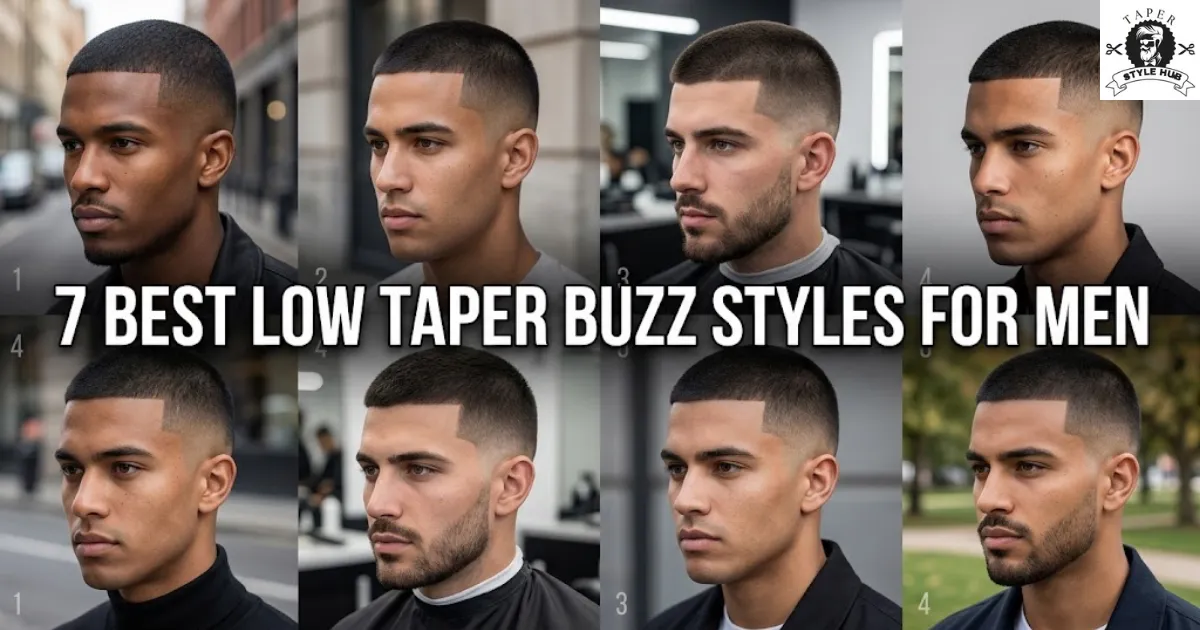
7 Best Low Taper Buzz Styles For Men
A low taper buzz is the haircut for men who want to look sharp without sitting in a barber’s chair every other week. The top stays short and even, while the sides blend down softly around the ears and neckline. It looks clean on day one and still looks right three weeks later.
This guide covers what the cut really is, how it differs from a fade, which clipper guard to pick, and what suits your face shape and hair type. You will also get the exact words to say to your barber and a simple plan to keep it fresh.
👉 Also Read: Taper Fade Curly Hair
Your Complete Low Taper Buzz Guide for a Clean, Low-Maintenance Look
Short hair gets judged on details. A one-guard difference on top, or a blend that starts half an inch too high, can change how the whole cut reads. That is why this style deserves more attention than a quick phone photo and a hopeful request.
Below, each topic sits in its own section so you can jump straight to what you need. Start with the basics if you are new to the cut, or skip ahead to guard sizes and barber instructions if you already know what you want.
👉 Also Read: Taper Fade Long Hair
What Is a Low Taper Buzz Cut?
A low taper buzz cut combines two simple ideas. The buzz cut is the top, where the hair is clipped to one short, even length with a clipper guard. The taper is the sides and back, where hair gets gradually shorter as it moves down toward the ears and neck.
The word “low” tells you where the taper begins. It starts just above the ear and stays close to the neckline, so the sides keep most of their length. The result is a soft, natural shape rather than a dramatic contrast between top and sides.
👉 Also Read: Taper Fade Mid
The Buzzed Top
The top is usually cut with a number 2, 3 or 4 guard, which leaves a dense, brush-like surface. There is no parting, combing or styling involved. You simply wash, dry and go, which is exactly why so many men switch to this cut.
👉 Also Read: Taper Fade Buzz Cut
The Low Taper on the Sides
On the sides, the clippers move through shorter guards as they travel down the head. A taper leaves a little length even at its shortest point, so you get structure without a harsh skin line. From a few feet away, the sides can look like one even length.
👉 Also Read: Taper Fade Long on Top
Where the Blend Actually Happens
The graduation is easiest to spot behind the ear and around the nape. Everywhere else, the hair simply looks tidy and uniform. That subtlety is the whole point, and it is why the cut works equally well in a gym and in a meeting room.
👉 Also Read: Buzz Cut Taper Fade
Low Taper Buzz vs Skin Fade, Mid Taper and Regular Buzz Cut
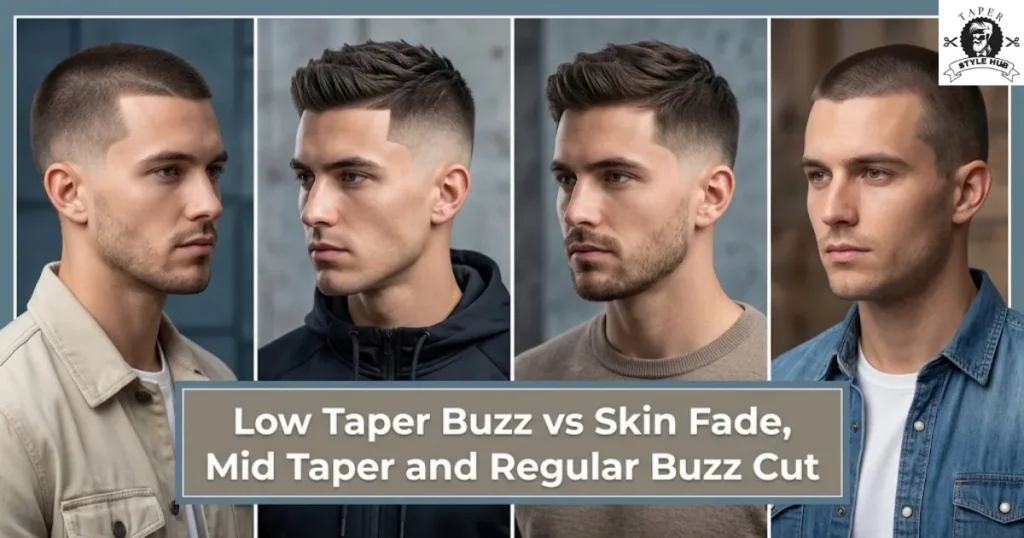
Most confusion in the barbershop comes from mixing up two separate choices: where the blend starts and how short it finishes. Low, mid and high describe the starting point. Taper and skin fade describe the finish at the bottom.
| Cut | Where It Starts | Bottom Finish | Contrast | Regrowth |
|---|---|---|---|---|
| Low taper buzz | Just above the ear or lower | Light length kept | Subtle | Gradual and forgiving |
| Mid taper buzz | Around the top of the ear | Light length kept | Moderate | Visible in two to three weeks |
| Skin fade buzz | Low, mid or high | Bare skin | Sharp | Shows within ten days |
| Regular buzz cut | No blend | One length everywhere | None | Even but shapeless |
A regular buzz cut keeps one length across the whole head. It is simple, but it can look plain and loses its shape fast around the ears. Adding a low taper buzz gives the outline a cleaner finish with almost no extra effort.
A skin fade looks sharper on day one, but the shaved zone grows in quickly. A low taper has no hard fade line to lose, so it softens evenly instead of suddenly looking tired halfway through the month.
A mid taper sits between the two. It starts higher on the head, so the contrast with the top is easier to see from the side. It suits men who want a more defined look and do not mind trimming a little sooner.
Why the Low Taper Buzz Is So Popular
Men keep choosing this style because it solves a real problem. Many short cuts either look too plain or grow out badly within a week. The low taper buzz stays tidy for much longer than most of them.
- Very little daily styling
- A clean, intentional shape around the ears and neckline
- Comfortable in hot weather and during workouts
- Easy to keep up between barber visits
- Suitable for school, the office and weekends
- Looks good fresh and slightly grown out
It also fits a wide range of lifestyles. Athletes like it under caps and helmets, office workers like how professional it looks, and students like that it needs almost no time in front of the mirror.
Who Should Get a Low Taper Buzz Cut?

Almost any man can wear this cut, but some lifestyles benefit more than others. Think about where you spend your week, how much time you have each morning and how often you can realistically visit a barber.
For Work and Professional Settings
Offices and client-facing jobs reward a neat, controlled appearance. A low taper buzz gives you that without looking stiff. The soft taper reads as groomed from every angle, and the short top never needs a part or product.
For Sport and Active Lifestyles
If you train often, you already know how annoying sweat and styling can be. A low taper buzz dries in minutes, sits comfortably under a cap or helmet and still looks sharp when you leave the gym.
For School and Everyday Life
Students and busy people want a haircut that looks good with zero effort. This cut passes most dress codes, survives a rushed morning and holds its shape long enough that you can stretch the gap between visits.
For Men Switching From Longer Hair
Going from longer hair to a buzz can feel like a big jump. A low taper buzz with a number 4 or 5 on top is a gentle first step. You keep some texture and can go shorter once you feel comfortable.
Best Guard Sizes for a Low Taper Buzz
Guard choice is the biggest decision you will make with this cut. The gap between sizes looks small on paper but feels big on your head. Here is a quick reference before the details.
| Guard | Approx. Length | General Look |
|---|---|---|
| #1 | 1/8 inch (3 mm) | Very close, scalp shows through |
| #2 | 1/4 inch (6 mm) | Short and sharp, the classic buzz |
| #3 | 3/8 inch (10 mm) | Slight texture, easy upkeep |
| #4 | 1/2 inch (13 mm) | Noticeable texture, softer feel |
| #5 | 5/8 inch (16 mm) | Enough length for light styling |
Guard sizes can vary slightly between clipper brands, so ask your barber which guard they will actually use. Hair density and colour also change the result. Dark, dense hair looks almost solid at a number 2, while fine or light hair shows more scalp at the same setting.
Very Short Guards (#1 and #2)
A number 1 gives a military-style finish with plenty of scalp showing. It suits strong jawlines and men who want near-zero maintenance. A number 2 is the classic buzz, short enough to look sharp and long enough to avoid looking shaved.
Medium Guards (#3 and #4)
A number 3 is the most requested length for a low taper buzz cut. It looks intentional, keeps a bit of softness and hides small imperfections. A number 4 adds texture and works well for fine hair or men moving from longer hair.
Longer Guards (#5)
A number 5 sits right at the edge of the buzz range. You can add a little matte product and give the top some movement. It is a good bridge if you are not ready to commit to something very short.
How to Choose Your First Guard
If this is your first time, go one guard longer than you think you need. Going shorter at the next visit is easy. Fixing a cut that was too short means waiting for it to grow back.
Low Taper Buzz Styles by Category
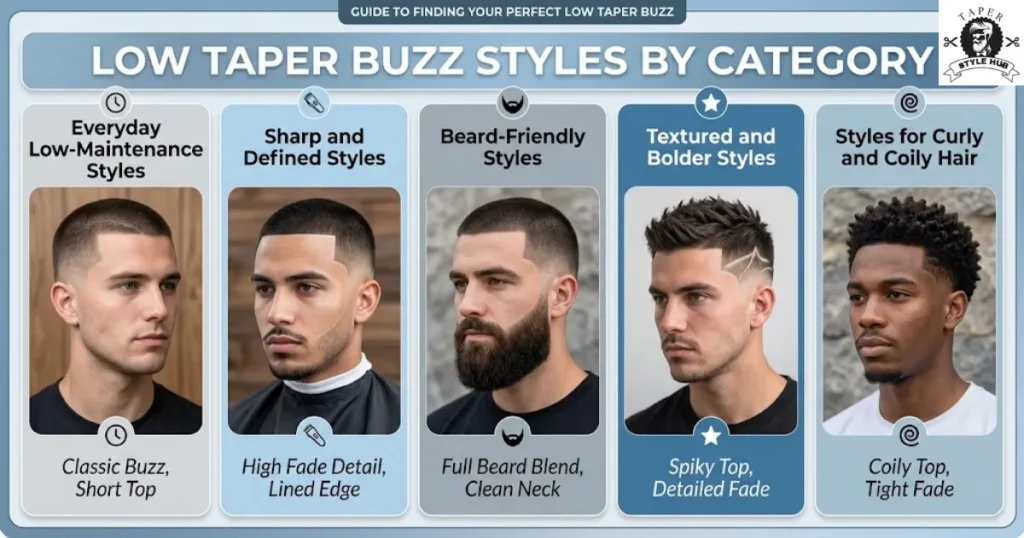
Instead of treating every variation as the same thing, it helps to group the styles by what they do best. Pick the category that matches your routine, then choose the version inside it that suits your face and hair.
Everyday Low-Maintenance Styles
The classic uniform version is the baseline. One guard sits across the top, usually a number 3 or 4, tapering into a number 1 near the ears. It needs almost nothing and grows out cleanly.
An athletic version follows the same idea with more practicality. It stays comfortable during workouts and works under caps and helmets. Nothing about it needs product, a hairdryer or a mirror.
Sharp and Defined Styles
A line-up adds crisp edges along the forehead and temples, cut with a razor or detail trimmer. It gives a subtle taper that just-left-the-shop finish. A skin-finish version fades closer to bare skin near the ears and neck for stronger contrast.
The trade-off is upkeep. Hairlines and skin fades both grow back faster than a plain taper, so these looks need a trim sooner. Choose them if you enjoy the sharper look and do not mind the extra visits.
Beard-Friendly Styles
A low taper buzz with a beard blends the sides straight into the beard line along the jaw. Hair and beard read as one connected shape. Even a short beard makes the cut look more mature and balanced.
Textured and Bolder Styles
A textured crop leaves the top a little longer, around a number 4 or 5, with light texturizing for movement. A faux hawk keeps the centre strip longer while the low sides keep it grounded. Both add personality without losing the clean taper.
Styles for Curly and Coily Hair
Curly hair adds natural texture to the buzzed top, so most men do better keeping it slightly longer. Tight curls shrink after cutting, so a number 4 can settle closer to a number 2. Taper the sides instead of taking them to skin.
Best Low Taper Buzz for Your Face Shape
A cut can be technically perfect and still not suit the person wearing it. The low taper is forgiving, but top length deserves a small adjustment depending on your face shape.
| Face Shape | Recommended Top | Why It Works |
|---|---|---|
| Round | #3 or #4 | Adds height and avoids extra width |
| Square | #2 or #3 with a line-up | Complements a strong jawline |
| Oval | Almost any guard | Naturally balanced proportions |
| Diamond | #3 or #4 with light texture | Softens cheekbone width |
| Heart | #3 or #4 textured crop | Balances a wider forehead |
| Oblong | #2 or #3, minimal height | Prevents extra length |
Round faces benefit from a little more length on top for vertical lift. Square faces pair naturally with crisp edges because the straight lines echo the jaw. Oval faces are the most flexible and can wear nearly every version of the cut.
Diamond and heart-shaped faces do best with a bit of texture on top to balance the forehead and cheekbones. Oblong faces look better with a shorter, uniform top so the face does not appear longer than it is.
Low Taper Buzz for Different Hair Types

The same guard number can look completely different on two heads. Hair texture and density change how the cut sits, how sharp the blend looks and how often you need a touch-up.
By Texture: Straight, Wavy, Curly and Coily
Straight hair is the most predictable. It lies flat and grows in one direction, so the blend between top and sides comes out crisp. Wavy hair adds a subtle ripple even at a number 2, although the crown may need extra blending.
Curly and coily hair needs more care. Shrinkage makes the cut look shorter than the guard suggests, and a hard skin line can look disconnected against a dense top. A softer taper cut with clipper over comb keeps the texture looking natural.
By Density: Thick, Fine and Thinning Hair
Thick hair holds up well at shorter guards, and the taper removes excess bulk from the sides. Fine hair looks fuller at a number 3 or 4 because very short guards expose the scalp.
For thinning hair, a taper hides uneven density more kindly than a skin fade does. A slightly longer top can also reduce the contrast between thin and full areas.
Cowlicks and Crown Growth
Cowlicks at the crown or nape can pull a buzzed top out of line. Ask your barber to check growth direction before choosing a guard, and cut with the grain where possible. A slightly longer guard hides swirls better.
Hairline, Neckline and Sideburns on a Low Taper Buzz
The details around the edges finish the cut. On short hair there is nowhere for mistakes to hide, so the outline matters more than most men expect. Three areas deserve your attention.
Tapered vs Squared Neckline
A squared neckline looks sharp when fresh but shows regrowth quickly. Within about ten days it can look like a line drawn across the back of your neck. A tapered neckline follows your natural hairline and grows out smoothly.
Sideburns and Temples
Hard-edged sideburns look disconnected once the face hair grows in around them. Tapering them into the face keeps the cut looking fresh for another week or two. The same logic applies to the temples.
Line-Up vs Shape-Up
A line-up sharpens the front hairline and temple corners. A shape-up covers the whole outline, including sideburns and the back of the neck. Most barbers finish with both, using a straight razor or fine trimmer.
How to Ask Your Barber for a Low Taper Buzz
The gap between what you picture and what you get is usually about vocabulary, not skill. Barbers hear “low fade” all day, and without detail they fall back on their own habits. A few specifics close that gap.
- Give a real guard number for the top
- Say “low taper, not a full fade” if you want length kept at the bottom
- Tell them where the taper should start, such as just above the ear
- Mention whether you want a line-up, soft or sharp
- Flag any razor bumps or sensitive skin
Here is a sample request you can adapt: “I’d like a low taper buzz with a number 3 on top. Start the taper just above my ear, do not take it to skin, and keep the line-up soft.”
Bring a reference photo, but pair it with words. Before you leave, check the back with a hand mirror and look near a window, since uneven blending is easier to fix at the chair than the next morning.
What to Check Before You Leave the Chair
- The taper starts just above the ear, not at the temple
- No visible ledge or patchy spots where the guards meet
- Both sides match in height and length
- The neckline looks clean from the back
- The top is even across the crown
Use a hand mirror and a window rather than the shop lights. Small issues are quick to correct while you are still in the chair, and most barbers are happy to adjust.
Common Low Taper Buzz Mistakes to Avoid
- Going too short on the first visit
- Letting the taper start too high, which turns it into a high fade
- Squaring the neckline when you want an easy grow-out
- Over-shaping the hairline every week
- Ignoring scalp care on exposed skin
Most of these mistakes come down to asking for too much on the first visit. Start moderate, see how the length works on your head, and adjust from there.
Skipping scalp care is easy to miss. Short hair exposes more skin, so dryness and flaking are far more visible than they would be on a longer style.
Common Low Taper Buzz Myths

A few misunderstandings keep men from trying this cut. Clearing them up makes it easier to decide whether it fits your routine.
Myth: It Is Just a Fade in Disguise
A fade usually reaches bare skin and creates a visible line. A low taper keeps some length at its shortest point and blends gradually, so the two look and age very differently.
Myth: It Only Suits Certain Hair Types
The cut can be adjusted for straight, wavy, curly and coily hair. Barbers simply change the guard and the taper depth to match your texture and density.
Myth: You Need a Barber Every Week
This cut is built for longer gaps between visits. Two to three weeks is typical, and many men stretch it to four with a quick neckline clean-up in between.
How to Maintain a Low Taper Buzz
This cut is easy to live with, but it still needs a rhythm. Most barbers suggest a touch-up every two to three weeks, especially around the ears and neckline, where hair returns first.
Touch-Up Schedule
Hairline edges soften within a week or ten days, while the taper itself holds longer. If you wait too long, the blend disappears into one length and the point of the cut is lost.
Home Tools Worth Owning
- A clipper set with adjustable guards
- A detail trimmer for the hairline and neckline
- A handheld mirror for the back and crown
- A light moisturizer or scalp oil
Work on clean, dry hair in small sections, and leave the tapered sides to your barber. Blending between guards without a visible line takes practice, and a slip near the ear shows more than an uneven top.
Quick Home Clean-Up Between Visits
- Start with clean, fully dry hair
- Trim around the neckline with a detail trimmer
- Check the back with a handheld mirror
- Leave the tapered sides alone
Growing Out a Low Taper Buzz
Because the cut never relies on a hard fade line, a low taper buzz grows out better than most short styles. Skip the sharp trims and ask for light shape-ups that keep the sides even as they lengthen.
Scalp Care and Products
Keep products minimal. A little matte clay or light pomade adds texture if the top is long enough, while heavy gels look greasy. Wash regularly, use a gentle moisturizer, and wear sunscreen in strong sun.
If you get your edges razored, a gentle exfoliating scrub once or twice a week helps prevent ingrown hairs and razor bumps.
Preparing Your Low Taper Buzz for Big Occasions
Weddings, interviews and photo days call for a cut at its best. Book your appointment three to five days beforehand, not the same morning. That gives the skin around the taper time to settle and the edges time to look natural.
Ask for a soft line-up with slightly squared corners, since cameras tend to flatten subtle definition. Avoid trying anything new at the last minute. If you want to change your guard, test it at a regular appointment first.
Final Thoughts on the Low Taper Buzz
The low taper buzz works because it solves one specific problem: looking deliberately groomed without constant upkeep. Where the taper starts, which guard sits on top, your hair type and your face shape are the details that separate a forgettable cut from one that suits you.
Walk into your next appointment with the vocabulary, meaning guard number, taper placement and finish preference, and you will be in a far better position than a photo alone. Get those basics right and the cut becomes one of the easiest to keep sharp, visit after visit.
If you are still unsure, start with a number 3 on top and a taper that begins just above the ear. It is the safest middle ground, and your barber can fine-tune the length and blend at every visit until the cut feels like your own. Small tweaks over time make it truly yours.
Low Taper Buzz Frequently Asked Questions
What is the best guard number for a low taper buzz?
A number 3 is the most popular choice because it looks intentional and needs almost no effort. Thick hair can go to a 2, while fine hair often looks better at a 4.
How often does a low taper buzz need a touch-up?
Every two to three weeks keeps it looking fresh. Edges soften first, so a quick neckline clean-up between visits helps.
Is a low taper buzz good for thinning hair?
Often yes, because short hair makes thinning less obvious and a taper hides uneven density better than a skin fade. Avoid very short guards if the scalp shows too much.
Does a low taper buzz work with a beard?
Yes. The taper can blend into the beard line, which makes the whole look feel connected. Even a short beard adds balance.
Is a low taper buzz appropriate for the office or school?
Yes. It is one of the safest short styles for professional and casual settings because it looks neat without trying too hard.

I’m M Ahmad Ansari, founder and content creator at Taper Style Hub. With 3+ years of experience researching taper haircuts, hairstyles, grooming, and men’s style, I create practical, accurate, and easy-to-understand content. My goal is to provide readers with trustworthy information, useful tips, and inspiring ideas for choosing and styling the perfect taper haircut.

5 Comments