30 Low Taper Buzz Cut Ideas + Barber Tips
A low taper buzz cut is the haircut that looks sharp on day one and still looks tidy three weeks later. It keeps the top short and even, then blends the sides gently from the ears and neckline. If you want a clean look without daily styling, this is the cut to start with.
This guide covers everything you need before you sit in the barber’s chair. You will learn how guard sizes work, which of the 30 styles suits your hair type and face shape, how to explain the cut clearly, and how to keep it fresh between visits.
👉 Also Read: Low Taper Fade Black Men
What Is a Low Taper Buzz Cut and How Does It Work?
A low taper buzz cut combines two simple ideas. The top is clipped to one short, uniform length with a clipper guard, while the sides and back shorten gradually toward the skin. The blend starts low, just above the ears and around the neckline, so most of the head keeps its hair.
The word taper matters here. A taper shortens the hair step by step without a hard line, while a fade often drops to bare skin and creates strong contrast. Because the transition is gradual, the haircut looks natural and grows out gracefully.
Barbers usually build it with a handful of guard sizes. They set the top with a number two, three or four guard, then work the sides with shorter guards and a trimmer around the edges. The result reads as one clean shape rather than a short top sitting on separate sides.
👉 Also Read: Low Taper Mullet
Why the Low Taper Buzz Cut Is So Popular Right Now
Most men want a haircut that saves time. A buzz needs no blow dryer, no comb and almost no product, and the taper adds the polish that a plain clipper cut lacks. You wake up, wash your hair and walk out the door.
Clippers have also improved, so barbers can blend smoother transitions with fewer visible lines. That precision photographs well, which is why this style keeps appearing on social media, in gyms and in offices. It simply works in every setting.
👉 Also Read: Blonde Low Taper Fade
Low Taper Buzz Cut vs Fade: Why the Taper Grows Out Better

A skin fade has a defined starting point where bare skin meets hair. That contrast is sharpest on the first day, but stubble softens the line within ten days or so. After two weeks, many fades already look overgrown.
A taper has no hard start point, so there is nothing sharp to lose. As the hair grows, the gradient simply stays gradual. That is why many men stretch a taper to three or four weeks, while a skin fade needs attention every two weeks.
👉 Also Read: Low Taper Fade Fluffy Hair
Who Should Choose a Low Taper Buzz Cut
This cut suits almost anyone who wants low maintenance and a tidy appearance. Athletes like it because short hair stays cool and needs no fixing after training. Students and office workers like it because it looks neat without looking severe.
It also helps men with thinning hair or a receding hairline. A uniform short length hides density changes better than longer styles do, especially when the barber keeps the hairline soft instead of razor sharp.
👉 Also Read: Low Taper Buzz
Benefits of a Low Taper Buzz Cut
The benefits are practical rather than flashy, and they explain why men keep returning to this cut year after year.
- No daily styling: a towel dry is usually all the top needs.
- Cooler in summer: short hair feels lighter during heat and workouts.
- Forgiving regrowth: with no hard skin line, the cut ages gracefully.
- Hides thinning: an even length makes sparse areas less obvious.
- Lower grooming cost: you use less shampoo and styling product.
Best Guard Sizes for a Low Taper Buzz Cut
Guard numbers control how much length stays on top, and the jump between sizes looks bigger in person than it does on paper. Choosing the right one matters more than any other decision. Here is a quick reference before you book.
| Guard | Length | Look | Best For |
|---|---|---|---|
| Number 1 | 1/8 inch (3mm) | Very close, scalp shows through | Dense hair and a bold look |
| Number 2 | 1/4 inch (6mm) | Short and sharp | Most men with normal density |
| Number 3 | 3/8 inch (10mm) | Slight texture, more coverage | Fine or thinning hair |
| Number 4 | 1/2 inch (13mm) | Visible texture, light styling | First-timers and curly hair |
If you are unsure, go one size longer than you think you need. It is easy to cut shorter next time, but you cannot add length back. A number three is a safe starting point for your first low taper buzz cut.
Guard Sizes for the Sides and Back
The sides usually start around a number one near the top of the taper, then step down with shorter guards toward the neckline. A trimmer finishes the edges. Ask your barber to keep the shortest point above bare skin if you want a softer, more forgiving blend.
How Hair Color and Density Change the Result
Dark, dense hair at a number two can look almost solid, while fine or light hair at the same guard shows more scalp. Two men can request the same number and leave with different looks. Judge by your own density, not by photos alone.
30 Best Low Taper Buzz Cut Styles Explained by Category
Instead of one long list, these styles are grouped into six categories so you can compare similar cuts quickly. Each category explains what changes, and each style gives you a clear idea to bring to your barber.
Classic Low Taper Buzz Cut Styles by Guard Length
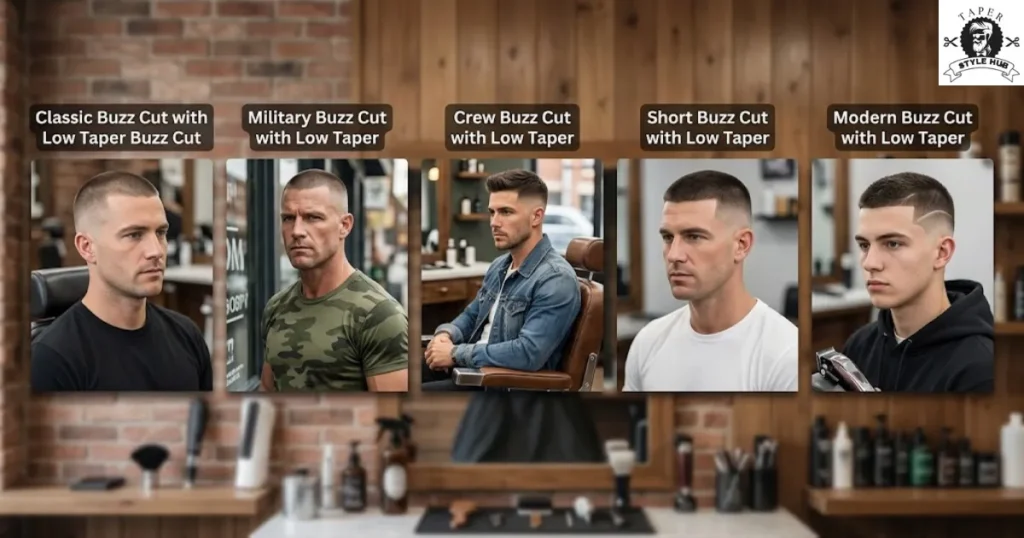
These styles are defined mainly by the guard on top. A shorter guard looks bolder and needs less thought, while a longer one leaves room for texture. Start here if you want the most traditional version of the haircut.
“All The Types Shown Below Are Displayed In The Single Image Above☝️”
Classic Buzz Cut with Low Taper Buzz Cut
This is the baseline version. A number two or three guard sits on top, and the taper blends softly near the ears and neckline. It needs no styling and suits every setting, which makes it the safest first request.
Military Buzz Cut with Low Taper
The top drops to a number one guard for a tight, regulation-style finish. The low taper keeps it from looking purely functional and gives the sides a modern edge. Skip product entirely and simply rinse and go.
Crew Buzz Cut with Low Taper
A number four guard leaves slightly more length, enough to brush forward for a touch of shape. The taper stops the sides from looking bulky underneath. A light matte cream helps the longer top hold its direction.
Short Buzz Cut with Low Taper
This version uses a number 1.5 guard on top with a quick, tight taper at the bottom. There is very little length anywhere, so it works on any hair type. Wear sunscreen, since so much scalp is exposed.
Modern Buzz Cut with Low Taper
Most barbers default to this one today. A number four guard blends into a clean taper with no extra detailing. It looks casual enough for weekends and deliberate enough for work, and a pinch of texture powder adds fullness.
Low Taper Buzz Cut Styles with Fade and Edge Detail
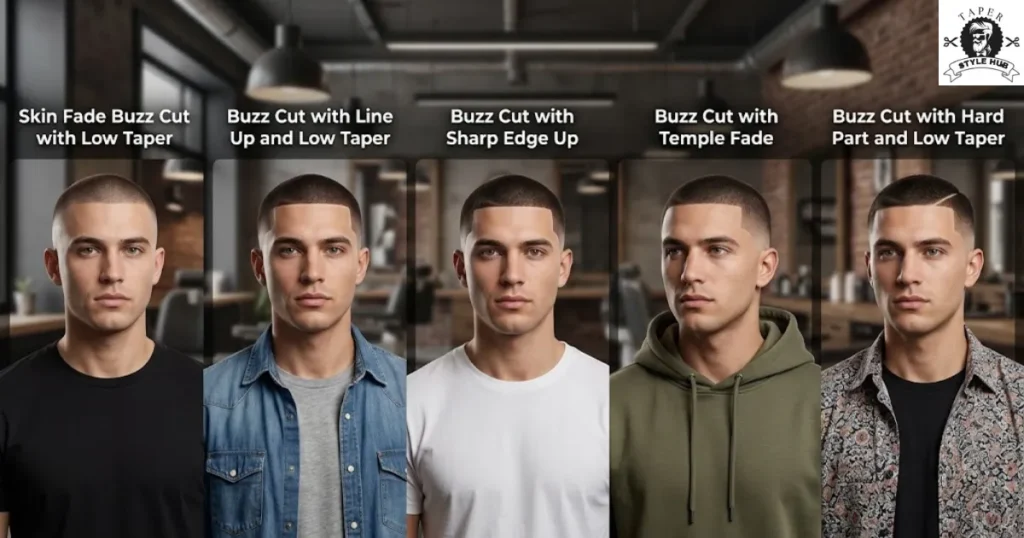
Edges change the personality of the cut more than length does. These styles add contrast or definition around the hairline, so they look sharper but usually need more frequent upkeep.
“All The Types Shown Below Are Displayed In The Single Image Above☝️”
Skin Fade Buzz Cut with Low Taper
The bottom edge is pushed all the way to bare skin while the blend still starts low. It creates more contrast than a standard taper without becoming a high fade. Moisturize the exposed skin so it does not look dry.
Buzz Cut with Line Up and Low Taper
A trimmer or razor cuts a crisp edge along the front hairline and temples. Combined with the taper, it looks polished without much extra work on the sides. Expect the line to soften within a week.
Buzz Cut with Sharp Edge Up
This version focuses on precision behind the ears, along the neckline and at the temples instead of adding designs. The result looks meticulously clean rather than flashy. Gently exfoliate around the edges to avoid razor bumps.
Buzz Cut with Temple Fade
The blend is limited to the temple area while the neckline stays cut in a straight line. It looks neat from the front without detailing everywhere. Brush the front slightly forward to highlight the temple blend.
Buzz Cut with Hard Part and Low Taper
A razor shaves a thin line where a natural part would sit, adding a graphic detail above the taper. It is a small change that transforms the whole look. Refresh the part every one to two weeks.
Low Taper Buzz Cut Styles with Texture, Beards and Designs

These variations add something extra to the basic shape, whether that is facial hair, a pattern or extra height. They suit men who want their haircut to say a little more.
“All The Types Shown Below Are Displayed In The Single Image Above☝️”
Textured Buzz Cut with Low Taper
The barber uses point cutting or scissor-over-comb on top to break up the flat buzz surface. This adds subtle movement while the taper stays clean. Work a small amount of clay through damp hair for definition.
Buzz Cut with Beard and Low Taper
Sideburns fade into a groomed beard line so the hair and beard form one continuous shape. Trim the beard on the same schedule as the haircut. That keeps the connection sharp instead of patchy.
Buzz Cut with Beard Fade Design
A shaved line at the temple pairs with a matching faded connection into the beard. The two details work together as one feature. Refresh both at the same visit because they grow out at different rates.
Buzz Cut with Hair Design and Low Taper
A barber shaves a thin line, shape or pattern into the tapered section near the temple. Keep the rest of the cut simple so the design stands out. Plan on weekly touch ups to keep it visible.
Faux Hawk Buzz Cut with Low Taper
The center strip stays slightly longer than the rest of the top, creating subtle height down the middle. The low taper keeps everything grounded. A little matte paste worked upward gives the center definition.
Low Taper Buzz Cut Styles for Different Hair Types
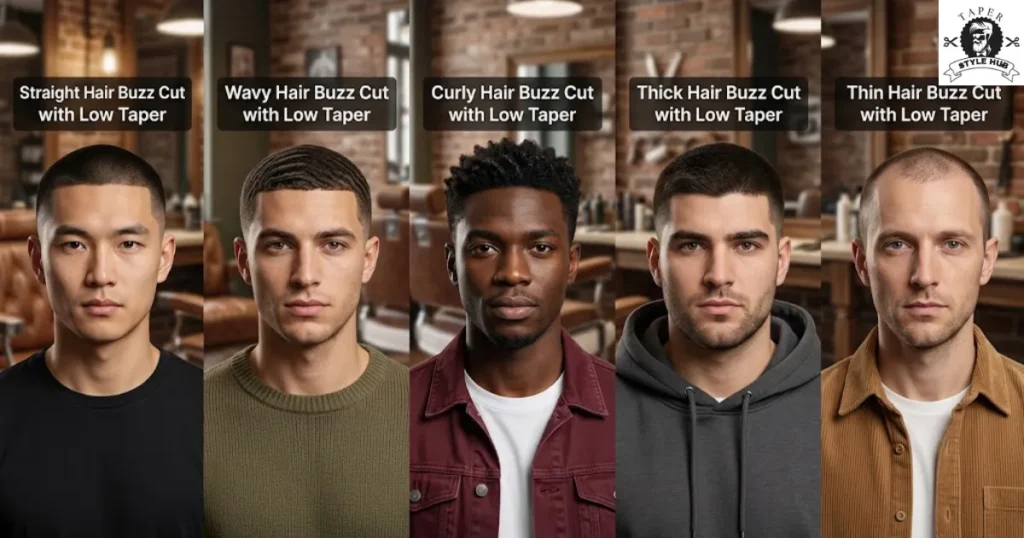
Hair texture changes how a guard behaves, so the same cut can look different from head to head. These styles are tuned to common textures, which helps you ask for the right length.
“All The Types Shown Below Are Displayed In The Single Image Above☝️”
Straight Hair Buzz Cut with Low Taper
Straight hair lies flat, so the line between the buzzed top and the taper looks especially crisp. It needs the least product of any type. Brush forward while damp if you want the top to sit flatter.
Wavy Hair Buzz Cut with Low Taper
Waves add natural texture on top without any product. A number two or three guard usually leaves enough length for the movement to show. Let it air dry rather than brushing it flat.
Curly Hair Buzz Cut with Low Taper
Leave the top slightly longer, around a number three or four, so the curl pattern shows instead of being cut away. The taper tidies the perimeter. A light leave-in cream on damp hair keeps curls defined.
Thick Hair Buzz Cut with Low Taper
Thick hair holds shorter guards well and still looks dense, so you can go a size shorter than usual. The taper removes bulk from the sides that would otherwise look heavy. Matte wax keeps stray strands under control.
Thin Hair Buzz Cut with Low Taper
Going short across the board is one of the best tricks for thinning hair, since a uniform length hides where density drops. A number three or four often looks fuller than going shorter. Avoid shiny products that spotlight the scalp.
Low Taper Buzz Cut Styles for Hair Color and Texture
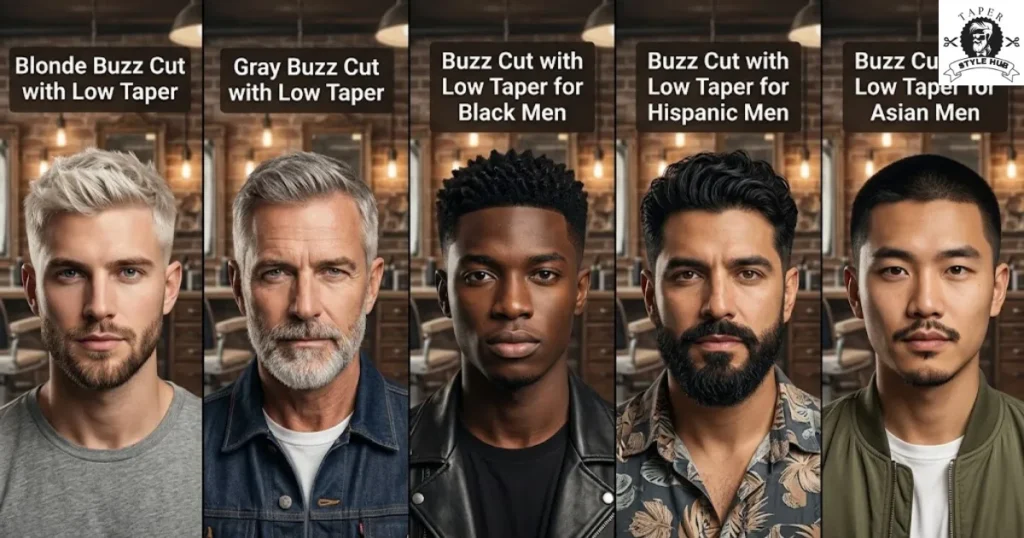
Color and natural texture affect contrast and shape more than most people expect. These styles show how the same taper adapts to light, gray, dark, coarse and coily hair.
“All The Types Shown Below Are Displayed In The Single Image Above☝️”
Blonde Buzz Cut with Low Taper
On blonde or lightened hair, the contrast between the top and the taper softens because there is less color difference against the skin. It looks understated. Use a color-safe shampoo if the hair is treated.
Gray Buzz Cut with Low Taper
Gray and salt-and-pepper hair shows off a taper nicely, since lighter strands create their own contrast at the blend. Keeping the top around a number three balances the color. A hydrating scalp oil helps, as the skin often runs drier.
Buzz Cut with Low Taper for Black Men
Coily and kinky textures hold a low taper beautifully, creating a smooth transition into the skin while keeping density on top. A number three or four keeps enough length for texture. A light wave cream and a durag at night help between trims.
Buzz Cut with Low Taper for Hispanic Men
On thick, dark hair this cut produces strong contrast between top and taper, which sharpens the jawline and cheekbones. It pairs especially well with a defined line up. A light pomade adds shine without weighing the top down.
Buzz Cut with Low Taper for Asian Men
Straight, coarse hair that flares outward benefits from the taper removing bulk at the sides. It keeps the overall shape close to the head and solves the common complaint of buzz cuts looking wide. A strong-hold matte product helps if you style the top forward.
Low Taper Buzz Cut Styles for Every Lifestyle

Your daily routine matters as much as your hair. These styles are matched to common lifestyles, from the office to the sports field, so the cut fits how you actually live.
“All The Types Shown Below Are Displayed In The Single Image Above☝️”
Professional Buzz Cut with Low Taper
Built for office settings, this version keeps the top a bit longer and stops the taper short of bare skin. It lands at a soft stubble finish that reads polished. A small amount of pomade adds subtle shine for meetings.
Athletic Buzz Cut with Low Taper
Short and sweat-friendly, this style needs almost no attention during training. It looks sharp off the field too. A number two works well for most athletes, and a quick clipper pass keeps it tidy.
Teen Boy Buzz Cut with Low Taper
A favorite among school students, it prioritizes speed and simplicity. Towel dry it and it is ready. It still looks current without any grooming routine, and a three-week trim schedule keeps it fresh.
Kids Buzz Cut with Low Taper
Parents like this style for school-age boys because it stays neat between visits. A number three or four guard works well. A soft neckline taper keeps it within most dress codes without looking flashy.
Buzz Cut with Low Taper for Receding Hairline
A uniform short top, around a number two or three, draws less attention to where the hairline sits. Ask the barber to keep the front soft instead of razor sharp. A hard edge can emphasize unevenness rather than hide it.
How to Ask Your Barber for a Low Taper Buzz Cut
Vague requests lead to surprises, so give your barber specifics. Name a guard for the top, say where the taper should begin, and describe the finish. A reference photo removes most of the guesswork.
Try this script in the chair: “I would like a buzz cut on top with a number three guard. Give me a low taper on the sides and back, starting just above the ear and at the bottom of my neck. Keep it soft, with no hard lines unless I ask.”
Fade Height, Hairline and Neckline
Ask for the blend to stay below the top of the ear, since some barbers default higher out of habit. Choose between a natural hairline and a crisp line up. A tapered neckline follows the natural hairline and grows out neatly, while a squared one shows regrowth faster.
Sideburns and Beard Blending
Tapered sideburns that melt into the face outlast hard-edged ones by a week or more. If you wear a beard, ask the barber to fade the sideburns into the beard line so the haircut and facial hair read as one continuous shape.
Barber Terms You Should Know Before Your Visit
A little vocabulary goes a long way in the chair. These common terms help you describe the cut accurately and understand what your barber suggests.
- Guard: the plastic attachment that sets how much hair the clippers leave.
- Taper: a gradual shortening of hair that often stops above bare skin.
- Fade: a blend that usually reaches bare skin for stronger contrast.
- Line up: a crisp edge cut along the hairline and temples.
- Edge up: cleaning the borders around the ears and neckline.
- Neckline: the shape of the hair at the back of the neck.
- Sideburns: the hair in front of the ears, which can be tapered or squared.
Tools Barbers Use to Create a Low Taper Buzz Cut
Knowing the tools helps you understand why the cut costs what it does and why a rushed job looks different. A good barber combines several tools instead of relying on one.
Clippers and Guards
Clippers do most of the work. The barber sets the top with one guard, then switches to shorter guards or uses the clipper-over-comb technique to build the gradient on the sides and back.
Trimmers and Razors
Trimmers create the crisp edges around the ears, neckline and temples. A razor may be used for a line up or a hard part. These tools finish the cut and make the taper look intentional.
Scissors and Combs
Scissors and combs help soften stray steps in the blend and add texture when the top is a little longer. They are small details, but they separate a clean taper from a patchy one.
Best Face Shapes for a Low Taper Buzz Cut
Most face shapes carry this cut well, and small changes to top length fine-tune the result. Treat these as starting points rather than strict rules.
- Oval: nearly every guard and variation works.
- Round: a slightly longer top, around a number four, adds height and slims the face.
- Square: a short top with a defined line up highlights a strong jaw.
- Diamond: a little extra length on top balances wide cheekbones.
- Heart: a softer top texture keeps the crown from looking too wide.
- Oblong: a shorter top, around a number two or three, avoids adding height.
Best Hair Types for a Low Taper Buzz Cut
Texture and density change how the same guard looks once it is cut and dry. A cut that looks crisp on straight hair may look softer on curls, so match your barber’s technique to your hair.
- Straight hair lies flat and gives the crispest line between top and taper.
- Wavy hair adds subtle movement without product.
- Curly hair looks fuller and often needs a slightly longer guard to allow for shrinkage.
- Coily hair stays neat with a taper instead of a hard skin line.
- Thick hair holds shorter guards and still looks dense.
- Fine hair looks fuller with a bit more length on top.
Pros and Cons of a Low Taper Buzz Cut
No haircut is perfect, so weigh the trade-offs honestly before you commit to this one.
| Pros | Cons |
|---|---|
| Almost no daily styling time | Needs regular barber visits to stay sharp |
| Keeps your head cool in hot weather | Highlights scalp bumps or scars |
| Uses less product and shampoo | Higher sunburn risk on an exposed scalp |
| Works well for thinning hair | Limited styling flexibility for special events |
How a Low Taper Buzz Cut Grows Out Week by Week
Understanding the grow-out helps you time your next appointment. The cut changes slowly, which is exactly its advantage over harder fades.
Week One
The cut is at its cleanest. The neckline is crisp, the sideburns are tight and the blend looks smooth. This is the best time for photos, interviews and events.
Weeks Two and Three
Regrowth softens the edges, but the taper still looks deliberate. Most men notice the neckline first. If you keep a line up or hard part, expect those details to blur sooner.
Week Four and Beyond
The blend starts to disappear into the top length. If the cut still looks intentional at this point, it was a good taper. Book your next visit before it turns into a shapeless crop.
How to Style a Low Taper Buzz Cut
There is little length to work with, but a few small touches keep the cut looking finished instead of freshly clipped. The right product depends on your hair type and the guard you chose.
Best Products for a Short Tapered Cut
- Matte cream: keeps straight hair lying flat without a greasy look.
- Light clay: adds control to thicker or coarser textures.
- Pomade: gives subtle shine for events and meetings.
- Beard oil: keeps sideburns and beard soft.
- Scalp moisturizer: prevents flaking on exposed skin.
Simple Styling Steps
Pat your hair dry with a towel instead of rubbing it. Warm a pea-sized amount of product between your palms, then run your hands forward over the top. Finish with a soft brush if you want extra direction.
How to Maintain a Low Taper Buzz Cut
Most barbers suggest a touch up every two to four weeks, depending on how crisp you like the edges. Waiting too long blurs the taper into a uniform length. At that point you are starting over rather than refreshing.
Scalp Care and Sun Protection
Short hair exposes your scalp, so wash two or three times a week with a gentle shampoo and moisturize lightly. Apply sunscreen when you will be outside for long periods, because a buzzed scalp burns easily.
Touching Up at Home
The top is fairly safe to even out with clippers between visits. The taper itself is trickier to blend seamlessly, so leave it to your barber. Clean and oil your clipper blades after each use to keep them cutting smoothly.
Low Taper Buzz Cut vs Other Short Haircuts
Short haircuts overlap, and the names are often used loosely. These comparisons show where this cut sits and when another option might suit you better.
Low Taper Buzz Cut vs Regular Buzz Cut
A regular buzz cut keeps the same length across the entire head with no blending at all. Adding a taper introduces a smooth transition at the edges, which looks more deliberate and current.
Low Taper Buzz Cut vs Skin Fade Buzz Cut
A skin fade takes the sides to bare skin, creating sharp contrast that fades fast as hair grows. A low taper keeps a little length at its shortest point, so it stays presentable longer between trims.
Low Taper Buzz Cut vs Mid Taper Buzz Cut
A mid taper starts higher, around the top of the ear, so it draws more attention to the sides. The low version stays subtle and keeps focus on the top. Round faces often benefit from the extra definition of a mid taper.
Low Taper Buzz Cut vs Crew Cut
A crew cut leaves enough length on top to comb or push to one side. A buzz stays too short for that. Crew cuts also usually pair with a slightly higher fade than the low taper does.
Low Taper Buzz Cut for Different Occasions
One reason this cut stays popular is how well it adapts. A low taper buzz cut looks natural in a meeting, at a wedding and on a weekend hike, so you rarely need to change your routine for the calendar.
Office and Interviews
For professional settings, choose a number three guard and keep the taper soft and the neckline tapered. At this length, a low taper buzz cut reads clean and confident, and it never looks like you tried too hard.
Weddings and Special Events
For a wedding or party, book your appointment three to five days ahead so the edges settle but still look crisp. A fresh line up on a low taper buzz cut looks especially sharp in photographs.
Gym and Outdoor Life
Short hair is easy to wash, dries quickly and stays out of your eyes. Active men often choose a number two with a quick taper, so the cut survives sweat, hats and helmets without losing its shape.
Seasonal Care for a Low Taper Buzz Cut
Weather affects short hair and exposed skin more than most men realize. A low taper buzz cut is easy in every season, but a few adjustments keep your scalp comfortable and the cut looking neat.
Summer Care
Heat and sun are the main concerns. Apply sunscreen to your scalp, wear a hat during long days outside, and rinse sweat out promptly. Your low taper buzz cut will feel lighter than longer styles, which is a real advantage in warm weather.
Winter Care
Cold air and indoor heating dry out the scalp, so moisturize more often and use a gentle shampoo. A beanie keeps you warm, but remove it when you can so the hair does not flatten unevenly.
How to Choose a Barber for a Low Taper Buzz Cut
The cut looks simple, but blending a clean taper takes skill. Look at a barber’s recent work on social media or in the shop, and pay attention to how smooth the transitions look. Ask whether they do a low taper buzz cut regularly.
A good barber asks questions before touching the clippers. They check your hairline, hair density and head shape, then suggest a guard length. If your barber explains why a low taper buzz cut suits you, that is a strong sign you are in good hands.
Questions to Ask Before You Sit Down
- Which guard would you use on top for my hair density?
- Where will the taper start, and can we keep it low?
- Should we taper or square the neckline?
- How often should I come back for a touch up?
Is a Low Taper Buzz Cut Right for You?
If you want a neat, low-effort haircut that ages well between visits, the answer is probably yes. A low taper buzz cut gives you structure without commitment, and it is easy to change later by growing the top out.
It may not suit you if you love styling or want length to experiment with. In that case, a longer taper with a textured top gives you more room to play. Otherwise, this cut is hard to beat for simplicity.
Where to Find Inspiration for Your Next Cut
Footballers, actors and musicians have all worn short tapered cuts because they look good on camera and need little upkeep. Searching for photos of the style on hair like yours gives you a realistic target.
Save two or three pictures and show them to your barber. Photos communicate guard length, taper height and edge sharpness faster than words, and they protect you from misunderstandings.
Common Myths About the Low Taper Buzz Cut
Because the cut is so common, a few common myths have grown around it. Clearing them up helps you decide with real confidence.
Myth: It Only Works on Thick Hair
Thin and fine hair often looks better with this cut, because an even length hides density changes. Choosing a number three or four guard keeps the top looking full.
Myth: It Is Too Plain to Look Stylish
A clean blend, a crisp neckline and a well-chosen guard look sharp on their own. Add a line up or a subtle design if you want extra personality.
Myth: You Can Never Style It
Short hair still responds to product. Matte cream, light clay and a soft brush change the finish noticeably, even when the top is only a quarter inch long.
Myth: It Needs No Care at All
Short hair still needs washing, moisturizer and sunscreen, and the taper needs regular trims to keep looking its best.
Common Mistakes to Avoid With a Low Taper Buzz Cut
Even a simple cut can go wrong when a few basics are missed. These are the mistakes barbers see most often.
- Choosing too short a guard on the first visit. Start with a number three so you can go shorter later.
- Waiting more than five weeks between trims. The taper disappears into the rest of the length.
- Skipping scalp care. Dry, flaky skin shows far more under short hair.
- Ignoring sunscreen. A sunburned scalp is uncomfortable and peels.
- Using too much product. A tiny amount is enough, and extra looks greasy.
- Letting the taper start too high. Confirm the starting point before the clippers come out.
Final Thoughts on the Low Taper Buzz Cut
The low taper buzz cut earns its popularity by solving a real problem. It lets you look put together without the daily effort longer styles demand. With 30 variations, there is a version for nearly every hair type, face shape and lifestyle.
Whatever style you choose, give your barber a specific guard number and a clear taper starting point. That one habit makes the biggest difference between a decent cut and a great one.
Low Taper Buzz Cut FAQs
What is the best guard number for a low taper buzz cut?
Most men land between a number two and a number four on top. Start with a three if you are unsure, since you can always go shorter later.
How often should I trim a low taper buzz cut?
Every two to four weeks works for most men. Choose the shorter end for crisp edges, or the longer end for a softer look.
Is a low taper buzz cut good for thinning hair?
Yes. An even short length makes thinning areas far less noticeable. Keep the hairline soft rather than razor sharp for the most forgiving result.
Does a low taper buzz cut work with a beard?
Absolutely. Ask your barber to fade the sideburns into the beard line so the haircut and beard look like one connected shape.
What is the difference between a low taper and a low fade?
A low taper shortens hair gradually and often stops short of bare skin. A low fade usually goes down to skin and creates stronger contrast.

I’m M Ahmad Ansari, founder and content creator at Taper Style Hub. With 3+ years of experience researching taper haircuts, hairstyles, grooming, and men’s style, I create practical, accurate, and easy-to-understand content. My goal is to provide readers with trustworthy information, useful tips, and inspiring ideas for choosing and styling the perfect taper haircut.

5 Comments