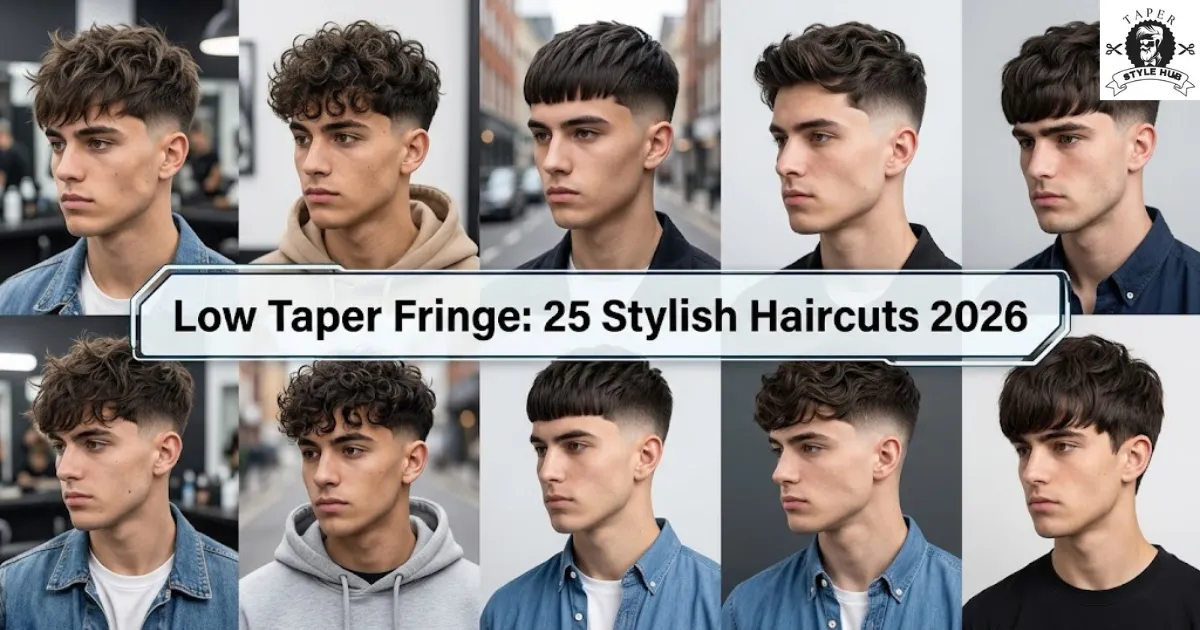
Low Taper Fringe: 25 Stylish Haircuts 2026
A low taper fringe pairs a longer, forward-falling top with sides that shorten gently around the ears and neckline. It looks sharp without the starkness of a skin fade, and it works on straight, wavy, curly and coily hair.
This guide breaks down 25 distinct styles, grouped by texture, length, hair type, shape and taper variation. You will also get face-shape advice, barber wording, styling steps, product picks, upkeep tips and a realistic look at cost.
👉 Also Read: Short Low Taper Fade
What Is a Low Taper Fringe Haircut?
A low taper fringe is a men’s haircut that combines a fringe, hair left long enough to fall over the forehead, with a low taper on the sides and back. The taper shortens the hair gradually, but only near the sideburns, ears and nape.
The fringe is the feature, and the taper is the frame. A taper usually leaves some visible hair at the edges, while a skin fade takes the shortest areas down to bare skin. That makes this cut a softer, easier-to-live-with cousin of a low fade with a fringe.
You will also see the terms low taper fade fringe and low taper fade with fringe used for the same look. Barbers do not all draw the line between a taper and a fade in the same place, so describe the finish you want rather than relying on the name alone.
The word low describes where the shortening happens. The hair stays full above the temples, and the blend stays close to the hairline. That placement keeps the contrast gentle and the grow-out forgiving.
👉 Also Read: Low Taper Fade Curly Hair Men
What Does a Low Taper Fringe Look Like?
From the front, the fringe does most of the talking. From the side and back, the taper keeps everything tidy. These are the building blocks of the cut:
- Top: Noticeably longer than the sides, usually long enough to reach the forehead. It can be choppy, smooth, blunt or tousled.
- Fringe: Falls forward, sweeps to one side or splits in the middle, depending on the variation.
- Sides: Keep some length through the upper sides, then tighten gradually toward the sideburns and ears.
- Back: Tapers toward the neckline, which can be left natural or squared off.
- Overall shape: A soft, rounded top over tidy, close edges, with a clear but gradual contrast and no hard line.
👉 Also Read: Low Taper Fade Haircut
Low Taper Fringe vs. Similar Haircuts
The key difference between these cuts is how much of the sides are cut short and how abruptly. The lower and softer the taper, the gentler the grow-out will be.
| Haircut | Sides | Contrast | Grow-Out |
|---|---|---|---|
| Low taper fringe | Short only around ears and neckline | Moderate, gradual | Soft; ears and neckline go first |
| Low fade with fringe | Reaches skin low down | Sharper at the edges | Edges look untidy sooner |
| Mid or high fade with fringe | Short, often skin-tight higher up | High and dramatic | Most noticeable as it grows |
| Classic taper with side part | Neat, usually longer | Low and conservative | Very gradual |
| French crop | Tight sides | High, with a short blunt fringe | Depends on the fade |
If you like the fringe but want a bolder side profile, move toward a mid fade. If you want something quieter, a longer and more conservative taper is the better fit.
👉 Also Read: Low Taper Fluffy Fringe
Who Does a Low Taper Fringe Suit?
It suits a wide range of men because the length stays on top and the sides can be adjusted. What matters most is how your hair behaves, so match the cut to your texture and density:
- Straight hair: Falls forward easily but can look flat, so it benefits from texture and cut-in layering.
- Wavy hair: Gives natural movement and a relaxed fringe with little effort.
- Curly hair: Adds volume and shape, while the taper keeps the sides from widening the silhouette.
- Coily hair: Forms a defined, compact fringe, though shrinkage means it sits shorter than its stretched length.
- Fine or thick hair: Fine hair works best with a shorter, denser fringe, while thick hair often needs thinning to avoid bulk.
Two practical checks are worth making. A strong cowlick at the front hairline can push the fringe in an unexpected direction, so mention it to your barber. A receding hairline can be softened by a fringe, though a shorter, side-swept version usually looks more natural than a heavy one.
👉 Also Read: Messy Fringe Low Taper
Why the Low Taper Fringe Keeps Trending in 2026

Men keep asking for the low taper fringe because it solves a common problem. It looks styled and intentional, yet it does not demand the constant upkeep of a skin fade or a sharp, high-contrast cut.
It also borrows from several trends at once. The crop and curtain shapes echo current street styles, while the soft taper keeps the cut wearable at school, in the office and on weekends.
Social media has helped too. A fringe photographs well from every angle, and reference images make it simple to explain to a barber, which reduces the risk of a bad surprise.
👉 Also Read: Low Taper Fade Boys
Best Low Taper Fringe for Your Face Shape
Face shape is a guide, not a rule. Fringe length, volume and side width all change how balanced the face looks, so use these pairings as a starting point:
- Oval: Flexible. Most fringe lengths and directions work.
- Round: Extra height on top and an angled fringe lengthen the look, while a heavy straight-across fringe can emphasize width.
- Square: A softer, textured or curtain fringe balances a strong jaw, whereas a very blunt fringe adds more angles.
- Oblong: A fuller fringe covering part of the forehead shortens the look. Too much height on top lengthens it further.
- Heart: A side-swept or curtain fringe softens a wider forehead. Keep the sides from looking too narrow.
- Diamond: A fuller fringe adds width at the forehead and balances prominent cheekbones.
👉 Also Read: Taper Fade Black Male
25 Best Low Taper Fringe Styles for Men
Rather than throwing 25 names at you at once, the styles below are sorted into five categories. Fringe names overlap in barbershops, so a reference photo always helps whichever version you choose.
Texture-Based Low Taper Fringe Styles
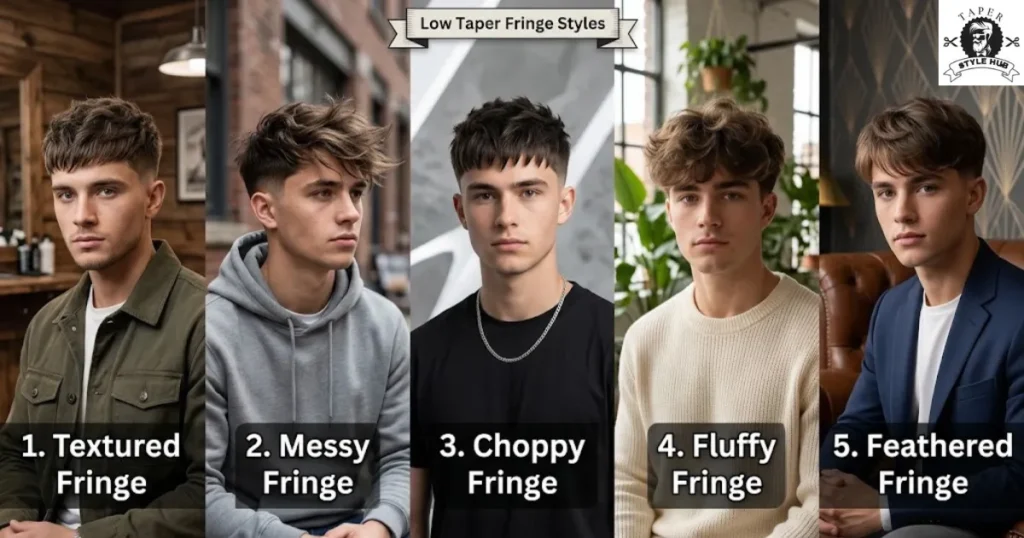
Texture changes how a fringe moves, and it is the easiest variable to adjust. These five versions rely on cutting technique and finishing product rather than extra length.
“All The Types Shown Below Are Displayed In The Single Image Above☝️”
1. Textured Fringe
The textured fringe is the dependable default. The barber point-cuts the ends so the top separates into distinct pieces, then you push it forward with matte clay. It suits straight and wavy hair and gives you flexible styling.
2. Messy Fringe
A messy fringe looks intentionally undone, with pieces falling in different directions across the forehead. It is looser and more casual than the textured version and forgives imperfect styling. Thick and wavy hair carry it best.
3. Choppy Fringe
Choppy layers use deeper point cutting to create jagged, visible steps along the fringe. The result is bold and energetic, which suits dense hair that needs weight removed. Use a firm paste to keep the pieces defined.
4. Fluffy Fringe
The fluffy fringe is soft, airy and rounded, with volume but no sharp separation. Blow-dry it with a round brush and finish with a light product. It works best on fine to medium hair and reads relaxed rather than structured.
5. Feathered Fringe
Fine layering along the ends creates a soft, wispy edge instead of a blunt line. This adds movement to fine hair without heavy product. Against a clean taper it looks gentle, so it suits calmer, more polished settings.
Length-Based Low Taper Fringe Styles
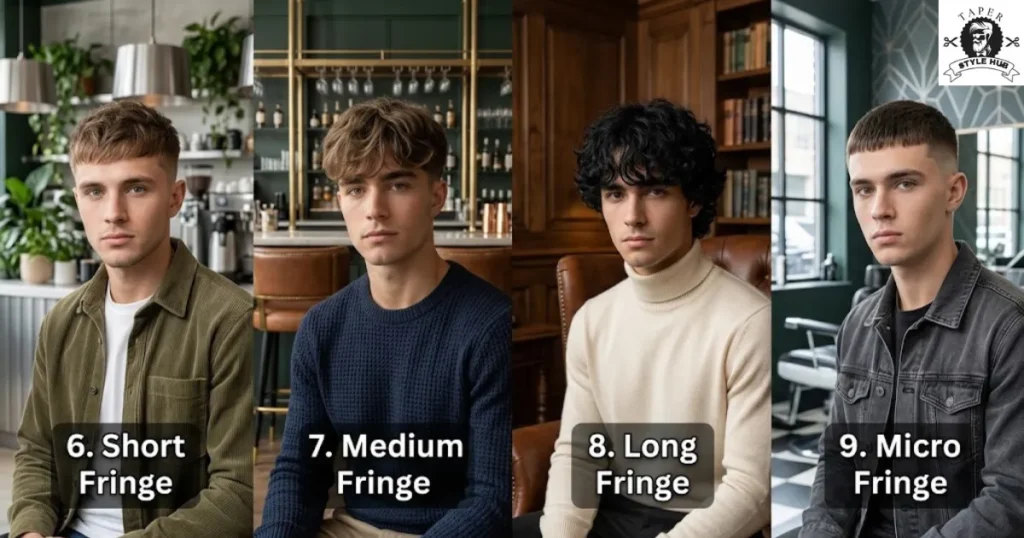
Fringe length decides how much styling and trimming the cut demands. These four versions run from barely there to eyebrow-grazing, so pick the one that fits your daily routine.
“All The Types Shown Below Are Displayed In The Single Image Above☝️”
6. Short Fringe
A short fringe sits above or around the eyebrows, with a little more length behind it. It is easy to manage and keeps hair out of your eyes. Students, athletes and anyone wanting less styling will appreciate it.
7. Medium Fringe
The medium fringe brushes the eyebrows and is the most versatile length. It can sweep sideways, fall forward or lift with a quick blow-dry. If you are unsure where to start, this is the safest choice.
8. Long Fringe
A long fringe reaches the eyebrows or lower and can be swept aside or pulled back. It offers the most styling choice but needs regular trims to avoid growing into your eyes. Thicker hair carries it best.
9. Micro Fringe
A micro fringe is cut to roughly half an inch and sits high on the forehead. Paired with a tight low taper, it gives a clean, graphic look. Square faces suit it, since the blunt edge adds a clear line.
Hair-Type Low Taper Fringe Styles
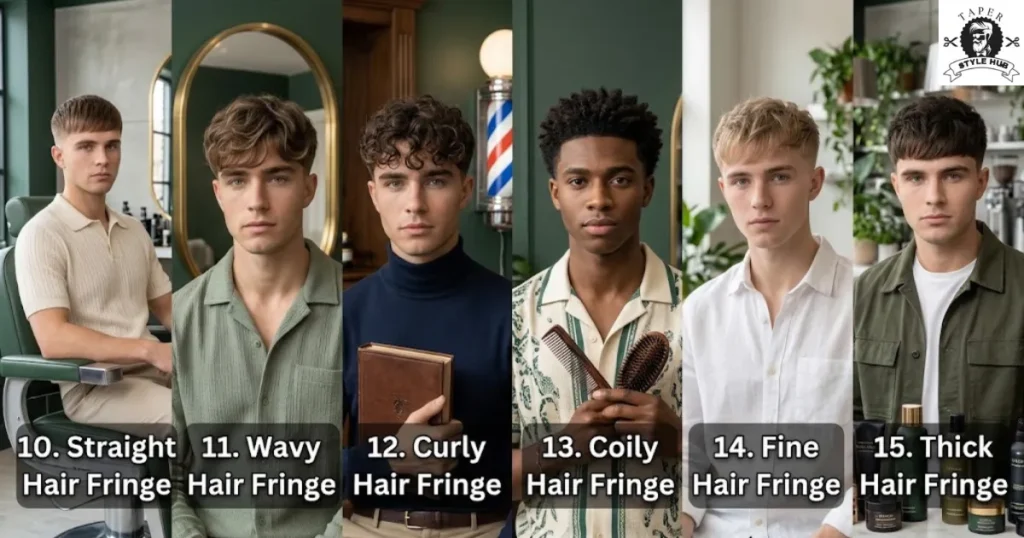
Your hair’s natural behavior should guide the cut more than any trend. These six versions are built around how different hair types actually fall and hold shape.
“All The Types Shown Below Are Displayed In The Single Image Above☝️”
10. Straight Hair Fringe
Straight hair tends to fall flat and heavy, so this version relies on layering or point cutting for movement. The fringe is usually a bit shorter and lighter. Sea salt spray adds grip without weighing it down.
11. Wavy Hair Fringe
Loose S-shaped waves give the fringe a relaxed, flowing look. Cut it slightly longer than you would straight hair, since waves lift as they dry. A little cream keeps it soft instead of frizzy.
12. Curly Hair Fringe
Curls fall forward over the forehead while the taper keeps the sides narrow. The curl pattern provides the volume, so the goal is definition rather than bulk. Cut it dry so the barber sees the natural spring.
13. Coily Hair Fringe
Coily hair forms a rounded, defined fringe, often shaped with twists, coils or a twist-out. Shrinkage makes it look shorter than it measures, so discuss length before the cut. Moisture keeps the pattern clean.
14. Fine Hair Fringe
Fine hair looks thicker when cut shorter and slightly blunt. Keep the fringe compact with minimal layering, and use a volumizing product for body. Heavy pomades tend to weigh fine strands down.
15. Thick Hair Fringe
Dense hair makes a full fringe with real weight. A good barber thins the inside so it does not turn bulky, and a firmer-hold product keeps the shape. A heavy Korean fringe also works well here.
Cut-Shape Low Taper Fringe Styles
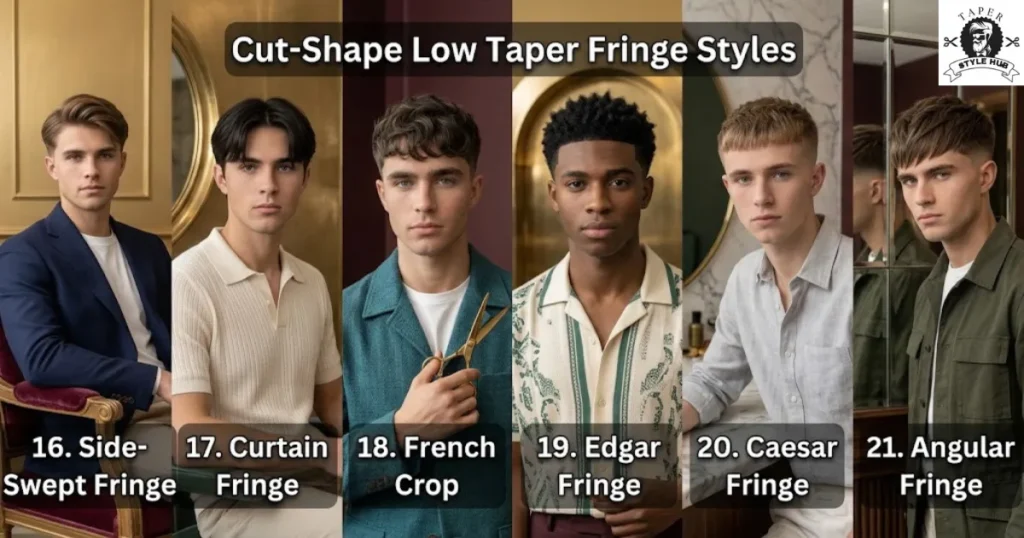
The shape of the front edge changes the whole personality of the cut. Here are six variations, ranging from soft and swept to sharp and blunt.
“All The Types Shown Below Are Displayed In The Single Image Above☝️”
16. Side-Swept Fringe
The fringe angles across the forehead to one side, usually following your natural parting. It is tidier and more classic than the messy styles. An Ivy-inspired version combs the top forward over a hidden part for a vintage feel.
17. Curtain Fringe
A center or slightly off-center part lets the fringe fall in two soft sections around the forehead. It needs enough length to separate. This version suits wavy or straight hair better than very tight curls.
18. French Crop
The French crop has a short, blunt fringe over a textured top. In a low taper version, the sides stay softer than in the classic tight fade. It is a low-fuss pick for straight or wavy hair.
19. Edgar Fringe
The Edgar has a straight-across fringe cut close to horizontal, giving a sharp line against the taper. It works best on thicker, straighter hair. The name is used loosely, so show your barber a photo.
20. Caesar Fringe
The Caesar is a short, even-length fringe combed forward and cut straight across. Compared with the Edgar, it is shorter and lighter. It gives a clean, minimal look that needs very little product.
21. Angular Fringe
An angular fringe is cut on a diagonal rather than straight across, drawing the eye to one side. It softens a strong jawline and adds asymmetry. Use a light cream to keep the angle crisp.
Taper-Variation Low Taper Fringe Styles
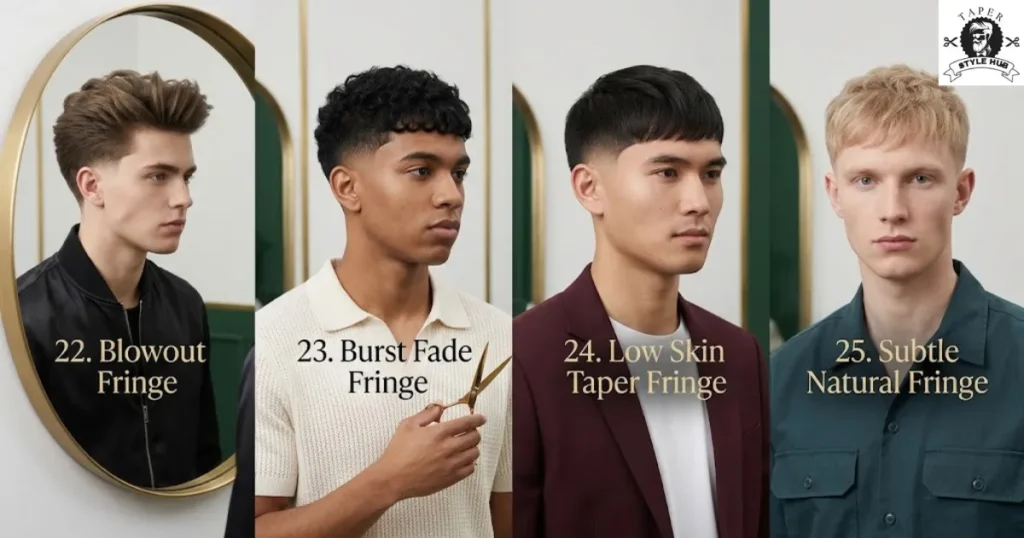
The final group changes the taper itself while keeping the fringe on top. These four show how far you can push the idea without losing its soft character.
“All The Types Shown Below Are Displayed In The Single Image Above☝️”
22. Blowout Fringe
Here the top is blow-dried for lift at the front, then finished with a texturizing product. The result is a fuller fringe that stands slightly off the forehead. It works best on medium-density hair with enough length.
23. Burst Fade Fringe
A burst fade curves around the ear in a half circle and leaves the hair behind it longer. That shape keeps weight at the back and frames a soft fringe nicely. Expect more frequent tidy-ups.
24. Low Skin Taper Fringe
This version takes the very edges, around the ears and neckline, down to skin while the rest stays longer. It gives a crisper outline but looks untidy sooner as the skin areas grow back in.
25. Subtle Natural Fringe
The lowest-effort option is a short, relaxed fringe that falls forward on its own over a very gentle taper. Little styling is needed, and it grows out gracefully. It suits conservative settings and natural finishes.
How Long Should Your Hair Be for a Low Taper Fringe?
The top needs enough length to fall forward to about the forehead when styled. If you can only just pinch it between your fingers, wait a little longer or choose a shorter, crop-style version.
For curly and coily hair, judge length by how it sits naturally, not stretched. A fringe that reaches the forehead when pulled straight may sit well above the eyebrows once it relaxes and shrinks.
The sides do not need to be long. They only need enough hair on the upper sides for the taper to blend into, which is why most barbers start the blend low and build upward.
What to Ask Your Barber for a Low Taper Fringe
The name alone will not get you the exact result. Walk in with specific instructions, and cover each of these points before the clippers come out:
- Taper, not fade: Ask for a low taper with a soft finish, and say whether you want any skin showing at the edges.
- Fringe length: Describe it against your face, such as at the eyebrow, just above or below.
- Texture: Request point cutting or texturizing for a choppy look, or a cleaner line for a smoother one.
- Sides: Ask how much length stays on the upper sides before the taper begins.
- Neckline: Choose natural for easier grow-out, or squared or rounded for a sharper look.
- Hairline concerns: Mention cowlicks, a receding hairline or uneven growth.
Here is a simple script you can adapt: “I’d like a low taper that stays soft around my sideburns and neckline. Leave a textured fringe about two to three inches long, styled forward with a natural finish.” Bring a reference photo too, because barbers use different names for the same look.
What to Expect in the Barber’s Chair
A good barber starts with a consultation, not the clippers. Expect questions about how you style your hair, how often you plan to visit and how your hair behaves when it dries.
Next, the barber checks your density, cowlicks and growth direction, then sections off the top. The taper is built from the bottom upward, blending gradually into the longer hair above.
The fringe is cut and texturized last, and the neckline is finished at the end. When a low taper fringe is done well, you should see no hard line anywhere on the sides.
Low Taper Fringe for Thinning Hair and Receding Hairlines
A fringe can be a smart choice for thinning hair because it moves volume forward and softens the front hairline. The key is keeping the length controlled so thin areas do not become obvious.
A shorter, side-swept low taper fringe usually looks more natural than a long, heavy one. Add a light texture powder at the roots for lift, and avoid greasy products that clump fine strands together.
If thinning is concentrated at the temples, ask your barber to leave a little extra length there. That small detail helps the taper blend rather than expose the area.
Low Taper Fringe With a Beard
A low taper fringe pairs naturally with a beard because both rely on clean, gradual transitions. The taper can blend straight into the sideburns, creating one continuous line from hair to beard.
Ask your barber to match the beard’s fade with the taper height. Stubble or a neatly trimmed beard keeps the look balanced, while a longer beard works best with a slightly fuller fringe on top.
How to Style a Low Taper Fringe at Home
Styling takes a few minutes once you know the order of steps. Follow this routine for most hair types, and adjust the product to suit your texture:
- Start damp. Towel-dry until the hair is damp, not dripping. Curly hair benefits from a leave-in or curl cream at this stage.
- Set the direction. Blow-dry the fringe forward, or toward the side you want, using your fingers or a brush.
- Add product. Work a small amount through your fingertips, mostly at the ends, because too much weighs the fringe down.
- Define the pieces. Separate and place the fringe with your fingers, or comb it into shape for a smoother finish.
- Finish lightly. A little more product or a light mist of spray holds the look without stiffness.
Curls do best when scrunched and air-dried or dried with a diffuser. Coily hair needs a defined pattern, a gentle shaping and plenty of moisture.
Best Products for a Low Taper Fringe
Product type matters more than brand. Choose by the finish you want, and always start with less than you think you need:
- Matte clay or paste: Texture and hold with a natural finish, and a good default for textured and messy fringes.
- Styling cream: Soft, flexible hold with a little moisture, ideal for wavy, fluffy or natural looks.
- Texture powder or volumizing mousse: Adds lift and body to fine hair without heaviness.
- Sea salt spray: Boosts grip and texture, though it can dry out hair if overused.
- Curl cream or leave-in conditioner: Defines curls and coils while reducing frizz.
- Light pomade: Better for smooth, polished finishes than for a loose fringe, so use it sparingly.
- Heat protectant: Worth using before every blow-dry or diffuser session.
Low Taper Fringe Maintenance and Upkeep
The sides and neckline show wear first. The tapered areas lose their clean edge as hair grows, even when the top still looks fine. A low taper is more forgiving than a skin fade, but it still needs regular tidy-ups.
| Area | Typical Timing | What to Do |
|---|---|---|
| Taper and neckline | Every 3 to 5 weeks | Book a tidy-up to restore the clean edge |
| Fringe | When it reaches your eyes | Trim the front without cutting the whole top |
| Thick hair | Every few visits | Ask for thinning to prevent bulk |
| Skin taper | Every 2 to 3 weeks | Expect faster regrowth around the edges |
At home, wash as your hair type requires and clarify occasionally to remove product buildup. As the cut grows out, the taper softens into a longer, fuller shape, which makes it easy to grow into something else.
How a Low Taper Fringe Grows Out
One reason men love this cut is how gracefully it ages between appointments. Here is roughly what to expect as the weeks pass:
- Weeks 1 to 2: The taper is crisp and the fringe holds its intended shape.
- Weeks 3 to 4: The neckline and ears begin to soften, though the top still looks styled.
- Weeks 5 to 6: The taper blends into the sides, and the fringe may reach your eyes.
- Week 7 and beyond: The cut becomes a longer, fuller shape that is easy to reshape.
Because the blend starts low, a low taper fringe never looks dramatically overgrown overnight. That slow change gives you room to stretch a visit when life gets busy.
Common Low Taper Fringe Mistakes to Avoid
Most disappointing results come from a handful of avoidable errors. Watch for these before your next appointment:
- Asking only for the name: Different barbers read it differently, so describe lengths and bring a photo.
- Ignoring your hair type: A fringe that works on straight hair can behave very differently on curls.
- Cutting the top too short: Once the fringe is gone, you have to wait for it to return.
- Using too much product: It makes fine hair limp and thick hair heavy.
- Forgetting grow-out: A skin taper looks untidy faster than a soft one.
- Overlooking cowlicks: A front cowlick can change how the fringe falls.
Pros and Cons of a Low Taper Fringe
No haircut suits everyone, so weigh the strengths against the trade-offs before you commit. Here is an honest summary of both sides.
What Works
- A clean, modern look without a dramatic fade
- Many fringe options for different hair types
- A softer, more forgiving grow-out than a high fade
- Suitable for school, work and casual settings
- Easy to style neat or messy
What to Consider
- The sides and neckline need regular tidy-ups
- The fringe can fall in your eyes during sport
- Cowlicks and thin areas can complicate the front
- Textured versions take a few minutes to style
- Very short hair limits your options until it grows
How Much Does a Low Taper Fringe Cost?
There is no single price. Cost depends on the shop, the barber’s experience, your city and add-ons like a beard trim, line-up or styling. Many shops price a taper as a standard men’s haircut, while some charge more for detailed fringe work.
Prices in the USA, UK and Canada vary widely, so check the shop’s price list or ask before booking. Remember to budget for a tip where that is customary.
A few habits keep the cost reasonable. Book regular tidy-ups instead of full cuts, bring a clear photo so nothing needs redoing, and ask whether your low taper fringe includes a wash and styling.
Is a Low Taper Fringe Right for You?
It is a good fit if you want a clean, current look with real versatility on top and a conservative finish on the sides. It works especially well if you have enough length to style and are happy to book regular tidy-ups.
It may not suit you if you want almost no maintenance, a very short cut or a dramatic high-contrast fade. In those cases, consider a longer taper or a shorter crop instead.
If you are still undecided, book a consultation and ask your barber to sketch how a low taper fringe would sit on your hairline and density. A short chat prevents regret later. A well-matched low taper fringe is worth the wait.
Conclusion
The low taper fringe lasts because it adapts. You can keep it short and tidy, or long and tousled, with curls, waves or straight hair, and still get the same clean outline around the ears and neck.
To get it right, choose a fringe length that suits your hair type and daily routine, describe the taper you want rather than only naming it, and bring a photo. With the right product and regular tidy-ups, it works in almost any setting.
Frequently Asked Questions
What is a low taper fringe haircut?
It is a cut with a longer fringe on top and sides that shorten gradually near the ears and neckline. The taper leaves visible hair, so it looks softer than a skin fade.
How often should I trim a low taper fringe?
Refresh the taper and neckline every three to five weeks. Trim the fringe sooner if it starts touching your eyes or losing its shape.
Does a low taper fringe work on curly hair?
Yes, curls and coils add natural volume to the fringe. Ask for a dry cut and leave extra length to allow for shrinkage.
Which product is best for a textured fringe?
Matte clay or texture powder gives separation and a natural finish. Use a small amount on dry or nearly dry hair.
How is a low taper fringe different from a French crop?
A French crop has a shorter, blunt fringe and usually tighter sides. A low taper fringe is longer, softer and moves more freely.

I’m M Ahmad Ansari, founder and content creator at Taper Style Hub. With 3+ years of experience researching taper haircuts, hairstyles, grooming, and men’s style, I create practical, accurate, and easy-to-understand content. My goal is to provide readers with trustworthy information, useful tips, and inspiring ideas for choosing and styling the perfect taper haircut.



6 Comments