
Low Taper Textured Fringe: Haircuts 2026
The low taper textured fringe has become one of the most requested men’s haircuts in barbershops right now. It pairs loose, choppy hair on top with sides that fade gently near the ears and neckline. The result looks relaxed, sharp and easy to wear.
Part of its charm is balance. The top carries all the personality, while the sides stay clean without turning severe. You get a modern men’s hairstyle that works at the office, in a lecture hall or on a weekend out with friends.
This guide covers everything in one place. You will learn what the cut is, how barbers build it, which face shapes and hair types suit it, and fifteen popular types sorted into clear categories. We also cover barber talk, styling, products and upkeep.
👉 Also Read: Low Taper Fringe
Everything You Need to Know About the Low Taper Textured Fringe
Before you book your next appointment, it helps to understand the cut properly. A little knowledge makes the conversation with your barber easier and the result far more predictable. Here is the full breakdown, step by step.
👉 Also Read: Short Low Taper Fade
What Is a Low Taper Textured Fringe Haircut?
A low taper textured fringe is built from two parts. The top is left longer at the front so it falls forward as a fringe, and it is cut to look choppy and uneven. The sides and back are tapered short, starting low.
The word taper means the hair shortens gradually toward the neckline instead of dropping straight to bare skin. The word low tells you the blend begins near the sideburns and nape, not halfway up the head. That keeps the shape natural.
The word textured describes how the fringe is cut and styled. Instead of lying flat like a bowl cut, the strands are separated and piecey. The fringe looks lived in, as if you simply ran your hands through it after a shower.
👉 Also Read: Low Taper Fade Curly Hair Men
The Anatomy of a Low Taper Textured Fringe
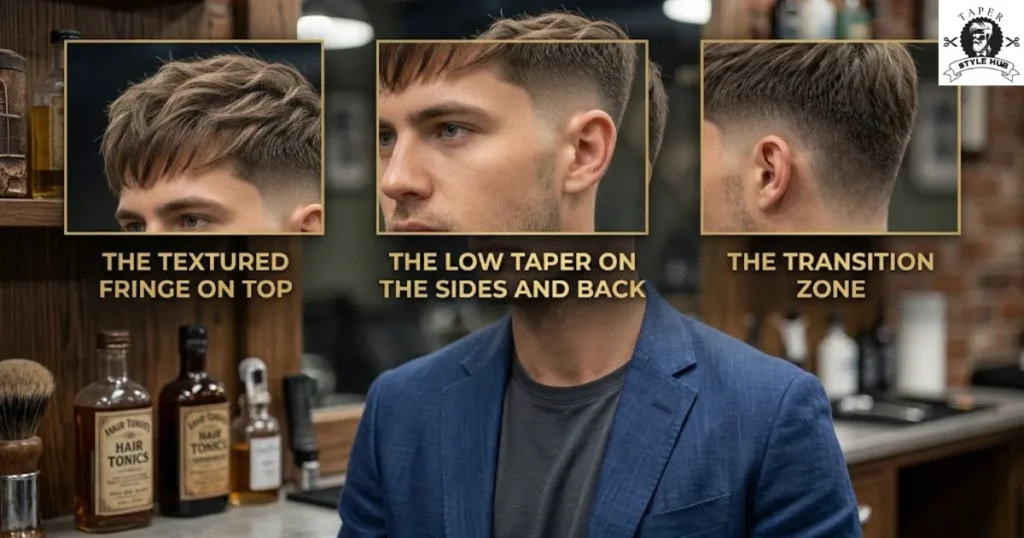
Every good version of this haircut depends on three zones working together. When one of them is off, the whole look feels disconnected. Here is what each zone does and why it matters.
👉 Also Read: Low Taper Fade Buzz Cut
The Textured Fringe on Top
The fringe usually sits anywhere from mid forehead to just above the eyebrows. Barbers use point cutting, slide cutting or texturizing shears to remove weight and create jagged ends. Those uneven ends clump into soft pieces once product goes in.
Without that texture, the front can look flat and heavy. With it, you get height, movement and a rugged finish. The top should feel light and airy, never like a helmet sitting on your head.
👉 Also Read: Low Taper Buzz Cut
The Low Taper on the Sides and Back
A low taper begins at the sideburns and the base of the neck. The hair shortens over a small area, often within an inch of the natural hairline. That leaves plenty of density around the temples.
That density matters. It supports the volume of the fringe and keeps the head shape square and masculine. It also means the cut grows out far more gracefully than a high skin fade does.
👉 Also Read: Low Taper Fade Black Men
The Transition Zone
The transition zone is where the short sides meet the longer top. A skilled barber uses scissor-over-comb or clipper-over-comb work to blend this area softly. There should be no steps, harsh lines or sudden jumps.
On thick hair, the barber may also remove bulk from the mid-lengths. This stops the fringe from looking mushroom shaped and keeps movement natural through the day.
👉 Also Read: Low Taper Mullet
How Barbers Cut a Low Taper Textured Fringe Step by Step
Knowing the process helps you spot a skilled barber. A careful cut follows a clear order, and each stage builds on the last one.
- Sectioning: The barber separates the fringe and top from the sides and back so each area can be handled on its own.
- Fringe length: The front is cut to the agreed length, usually between mid forehead and just above the eyebrows.
- Texturizing: Point cutting or slide cutting removes weight and creates movement through the top.
- Taper: Clippers shape the low taper around the temples and neckline, starting at the sideburns.
- Blending: Clipper-over-comb or scissor-over-comb work softens the line between the sides and the top.
- Detailing: A trimmer cleans the edges around the ears and neckline for a sharp finish.
A good barber checks the result from several angles and lets the hair fall naturally before finishing. If the cut looks heavy or stiff, they should fix it before you leave the chair.
👉 Also Read: Blonde Low Taper Fade
Why the Low Taper Textured Fringe Is So Popular
Men’s grooming has been moving away from heavy, shiny, product-loaded looks. People now want hair that looks intentional but natural. The low taper textured fringe fits that shift almost perfectly.
It is also easy to live with. A pea-sized amount of matte clay, a quick rough-up with your fingers, and you are done. There is no precise parting, no combing and no long morning routine.
Social media gave it a push too. Barbers post this cut constantly on TikTok and Instagram because it photographs well from every angle. It looks messy and clean at the same time, and that contrast grabs attention.
Another reason is how forgiving the cut feels as it grows. A high skin fade can look blurry after two weeks, but a low taper holds its shape for much longer. That suits busy students and professionals.
👉 Also Read: Low Taper Fade Fluffy Hair
The Evolution of the Fringe in Men’s Hairstyling
The fringe is far older than social media. Ancient Roman men wore short, forward-combed hair that gave us the Caesar cut, and the 1960s Mod movement brought neat, forward-falling styles back into fashion.
What changed recently is the finish. Old fringes were cut straight across and worn flat. The modern low taper textured fringe prioritizes irregular ends and flow, which feels far more personal and far less rigid.
Adding a low taper gave the look its final polish. The top stays wild and free, while the sides stay disciplined. That mix of messy and clean explains why the style keeps outperforming older, stiffer cuts.
👉 Also Read: Low Taper Buzz
Low Taper Textured Fringe vs Other Fade Styles
Choosing the right fade height changes the whole feel of the haircut. The table below compares the low taper with a mid fade and a high fade crop, so you can see the practical differences clearly.
| Feature | Low Taper Textured Fringe | Mid Fade Textured Fringe | High Fade Crop |
|---|---|---|---|
| Fade Start | Sideburns and neckline | A little above the ears | Temple or higher |
| Side Density | High | Moderate | Low |
| Upkeep | Every 3 to 4 weeks | Every 2 to 3 weeks | Every 2 weeks |
| Best Face Shapes | Oval, heart, diamond | Round, square | Square, oval |
| Overall Vibe | Polished and relaxed | Sporty and sharp | Ultra clean and military |
As the table shows, the low taper is the most conservative option. Because more hair stays on the sides, the cut stays presentable for weeks. A high fade can start looking untidy within ten days.
Taper vs Fade: What Is the Difference?
A taper shortens hair gradually and usually stops at a short length at the hairline. A fade goes much shorter, often down to the skin, and travels higher up the sides. People mix them up, so say low taper clearly to your barber.
15 Types of Low Taper Textured Fringe by Category
There is no single version of this haircut. Length, fringe shape, taper finish and hair type all change the result. To keep things clear, the fifteen types below are grouped into four categories.
Length-Based Low Taper Textured Fringe Types

Length on top is the first decision you make. It controls how much movement you get and how much styling time you need each morning.
“All The Types Shown Below Are Displayed In The Single Image Above☝️”
1. Short Textured Fringe
The fringe sits close, roughly an inch and a half to two and a half inches. It is the lowest effort option and suits warm climates and busy routines.
2. Medium Textured Fringe
Around three to five inches on top is what most people picture. It falls forward with real movement and works on nearly every face shape.
3. Long Messy Fringe
Worn longer and more undone, this version falls unevenly across the forehead. A little clay worked through with your fingers gives it that off-duty feel.
4. Textured Crop
A cousin of the French crop, this version keeps the fringe shorter and higher on the forehead. It pairs neatly with a low taper and needs very little styling.
Fringe-Shape Low Taper Textured Fringe Types

Next comes the way the front sits on your forehead. Small changes in angle shift the entire mood of the cut.
“All The Types Shown Below Are Displayed In The Single Image Above☝️”
5. Side-Swept Fringe
The fringe is pushed slightly to one side, which gives a smarter look. It is a popular choice for office settings and job interviews.
6. Forward-Swept Fringe
Here the hair falls straight toward the forehead in loose pieces. It feels casual and youthful, and it is great for hiding a high forehead.
7. Blunt Textured Fringe
The front edge is cut straighter, then texturized through the top. The shape feels structured but still modern, and it sits best on straight hair.
8. Choppy Layered Fringe
Heavy point cutting creates layers and jagged ends at the front. This version adds the most movement and works especially well on thick hair.
Taper-Finish Low Taper Textured Fringe Types
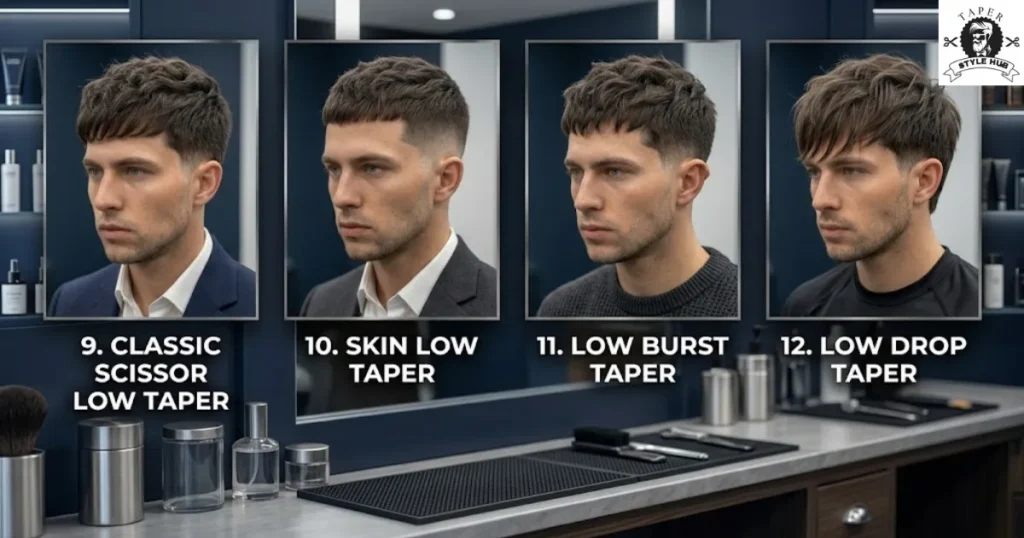
The sides can be finished in several ways. Each finish changes the contrast between the top and the sides.
“All The Types Shown Below Are Displayed In The Single Image Above☝️”
9. Classic Scissor Low Taper
The sides are tapered with scissors and clippers over comb, leaving a little hair at the edges. It looks soft and suits conservative workplaces.
10. Skin Low Taper
The taper runs down to the skin at the ear and neckline. This sharpens the contrast while the top stays relaxed and loose.
11. Low Burst Taper
The blend curves around the ear instead of running level. It adds a rounded shape and pairs well with a fuller fringe.
12. Low Drop Taper
The line dips down behind the ear, following the natural curve of the head. It gives a sleek, modern finish at the nape.
Hair-Type Low Taper Textured Fringe Types

Finally, your natural hair pattern decides how the cut behaves. These three versions are adjusted for each hair type.
“All The Types Shown Below Are Displayed In The Single Image Above☝️”
13. Wavy Hair Version
Wavy hair is arguably the easiest match. The waves add built-in texture, so the barber mainly manages length and bulk.
14. Curly Hair Version
Curls shrink as they dry, so the barber cuts slightly longer than the target length. The low taper keeps the silhouette tight and tidy.
15. Straight and Fine Hair Version
Straight hair needs more point cutting and light products to create texture. Fine hair needs a gentle hand so it does not fall flat.
Mix and match these categories freely. For example, you can choose a medium length, a side-swept shape, a skin finish and a wavy hair version. Your barber can combine them into one personalized cut.
Best Face Shapes for a Low Taper Textured Fringe
Small tweaks to fringe length and volume make this cut flatter almost every face. Use the list below as a starting point for your own features.
- Oval faces: The most freedom of all, so short, medium or messy fringes all work.
- Round faces: Keep the fringe a little longer with root lift to add vertical length.
- Square faces: Choose a softer, relaxed fringe to balance a strong jawline.
- Long or oblong faces: Keep the fringe medium and skip extra height on top.
- Heart faces: Wear the fringe forward and keep the crown free of heavy volume.
- Diamond faces: A fuller fringe softens the cheekbones and narrow forehead.
Whichever shape you have, a short consultation with your barber helps. They can adjust the fringe and taper height to suit your features and hairline.
Low Taper Textured Fringe for High Foreheads and Receding Hairlines
One of the biggest advantages of this style is how well it covers the front hairline. The forward-swept fringe hides the corners of the temples, where thinning often starts first.
Texture also adds the illusion of thickness. Choppy, separated pieces look fuller than a smooth, flat fringe, which makes a low taper textured fringe a smart choice for men with thinning at the front.
Keep the fringe lightweight in this case. Use texture powder or a light clay at the roots, and avoid heavy waxes that clump the hair and expose the scalp.
Low Taper Textured Fringe With a Beard
A low taper textured fringe pairs beautifully with facial hair. Because the taper starts at the sideburns, it connects smoothly to a beard line without a harsh break. That connection is a hallmark of good barbering.
Stubble, a short boxed beard and a full beard all work. A longer beard balances the volume on top, while stubble keeps the face looking sharp. Ask your barber to blend the beard taper into the sideburn taper.
If you prefer a clean-shaven face, the cut still works. The tidy sides and relaxed top keep the overall look balanced and youthful.
How to Choose the Right Low Taper Textured Fringe for You
Start with your hair type, then think about your face shape and daily routine. Thick hair handles longer, choppier fringes, while fine hair prefers a shorter, lighter cut.
Next, decide how much time you want to spend styling. If you want the lowest effort, pick a short or medium fringe. If you enjoy styling, a long messy fringe gives you more room to play.
Finally, bring photos to your barber. A picture of a similar hair type and head shape is more useful than a picture of a celebrity with completely different hair.
How to Ask Your Barber for a Low Taper Textured Fringe
Communication is the most common point of failure in any haircut. Walking in and saying textured fringe leaves too much open. Bring a reference photo and be specific about each area.
- Top: “Keep about three inches on top with plenty of texture so it falls forward.”
- Sides: “Give me a low taper that blends softly into the top.”
- Technique: “Use point cutting to remove weight instead of heavy thinning.”
- Neckline: “Taper the neckline instead of blocking it.”
Also ask how to style the cut at home. A quick demo during the appointment saves a lot of trial and error later.
How to Style a Low Taper Textured Fringe at Home
This cut was designed to be easy. You are encouraging the hair, not forcing it. Follow these steps for a natural, lived-in finish.
- Start with damp hair. Towel dry until slightly damp, because bone-dry hair goes stiff when product is added.
- Mist on sea salt spray. It adds grit and tack, which gives the fringe its chunky texture.
- Blow dry on medium heat. Scrunch the hair forward with your fingers and keep the roots lifted.
- Warm a pea-sized amount of matte clay between your palms, then rake it through from back to front.
- Pinch the ends of the fringe to define each piece, and avoid combing the top.
Best Products for a Low Taper Textured Fringe
You do not need a crowded shelf. One or two well-chosen products will do the job. Match them to your hair density.
- Sea salt spray: Adds grit and separation, ideal for straight and wavy hair.
- Matte clay: Gives medium hold with no shine, which suits a textured top.
- Texture powder: Lifts flat roots without adding weight.
- Lightweight cream: Offers flexible hold for curls and waves.
- Fiber wax or styling paste: Defines the ends of the fringe for extra control.
Thick or coarse hair usually needs a firmer product, such as a heavy matte clay. Fine or thin hair does better with lightweight powders and sprays that add lift without weight. Always start small, because you can add more but cannot take it out.
Skip heavy gel and shiny pomade. They weigh the hair down, look dated and clump the fringe together instead of separating it.
Styling a Low Taper Textured Fringe for Different Occasions
One of the best things about this cut is how easily it changes mood. A few small styling tweaks take it from casual to formal.
For the Office
Use a small amount of clay and sweep the fringe slightly to the side. Keep the finish matte and the pieces soft for a clean, professional look.
For College and Casual Days
Scrunch in sea salt spray and let it air dry. The messier, the better, because this is the relaxed version most people love.
For Weddings and Events
Blow dry the roots for lift, then define the ends with a touch of fiber wax. Add a light hairspray to keep the shape through the night.
Pros and Cons of a Low Taper Textured Fringe
Every haircut has trade-offs. Weigh these honestly before you commit to the style. No cut suits everyone, and knowing the downsides upfront helps you plan your routine and budget. That honesty saves you from disappointment after the first few weeks.
Pros
- Works for office, college and weekend settings.
- Grows out gracefully, saving money on frequent visits.
- Balances a high forehead or a receding hairline.
- Suits most face shapes and hair types.
Cons
- Needs five to ten minutes of styling each morning.
- Requires at least one styling product.
- Can irritate oily skin when the fringe touches the forehead.
- Humidity can flatten the texture if it is not set properly.
Maintenance and Trim Schedule for a Low Taper Textured Fringe
The sides and the top run on different clocks. The taper near the ears and neckline grows out first, so most people need a cleanup every three to four weeks.
The fringe can usually stretch four to six weeks between full trims. A little extra length even adds to the relaxed look, as long as it does not hang into your eyes.
If you are growing the hair out, ask the barber to raise the blend point a little at each visit. That lets the sides fill in gradually without leaving a hard line behind.
Use a clarifying shampoo once a week to remove clay and salt buildup. A quick neckline tidy at home with a trimmer also keeps the shape sharp between visits.
Hair Care Tips for a Healthy Low Taper Textured Fringe
Healthy hair holds texture better than damaged hair. Wash two or three times a week with a gentle shampoo, and avoid scrubbing the fringe roughly. Over-washing can strip natural oils and cause frizz.
Condition the ends, especially if you use a blow dryer often. A leave-in conditioner helps thick or coarse hair stay soft and easier to control. Fine hair does better with a lightweight option.
Scalp care matters too. Massage the scalp while washing to boost circulation, and rinse out product buildup fully. A clean scalp keeps the fringe looking light, fresh and full of movement.
Common Mistakes to Avoid With a Low Taper Textured Fringe
- Asking for the fade too high and ending up with a mid fade.
- Cutting the fringe too short, so it cannot fall forward.
- Using too much product, which makes the top stiff and clumped.
- Combing the fringe flat against the forehead.
- Choosing a blunt fringe for very curly hair.
- Skipping the reference photo at the barber.
Most of these mistakes come down to clear communication and restraint. Say exactly what you want, use less product than you think you need, and give the cut a few days to settle.
Final Thoughts on the Low Taper Textured Fringe
The low taper textured fringe earns its popularity. It balances relaxed and groomed in a way few haircuts manage, and it adapts across ages, settings and hair types with small adjustments.
Choose your fringe length around your face shape, match your product to your hair type, and keep the taper fresh between visits. Get those three things right and you have one of the easiest good-looking cuts around.
If you are still unsure, book a consultation before the cut. A short chat about your hair type, routine and goals gives the barber everything needed to tailor the result to you.
FAQs About Low Taper Textured Fringe
Is a low taper textured fringe good for straight hair?
Yes. Straight hair takes texture well when the barber point cuts the top and you use sea salt spray. That combination adds the bends straight hair lacks.
How long should the fringe be?
Most people prefer three to five inches on top. That length falls forward naturally and still leaves room for movement and styling.
How often should I trim a low taper textured fringe?
Book a taper cleanup every three to four weeks. The fringe itself can wait four to six weeks between full trims.
Is this haircut hard to style every day?
Not at all. A pea-sized amount of matte clay and your fingers are enough. Most mornings take about five minutes.
Is a low taper textured fringe professional enough for work?
Yes, when it is maintained. The clean sides keep it polished, and a side-swept fringe makes it even more office friendly.

I’m M Ahmad Ansari, founder and content creator at Taper Style Hub. With 3+ years of experience researching taper haircuts, hairstyles, grooming, and men’s style, I create practical, accurate, and easy-to-understand content. My goal is to provide readers with trustworthy information, useful tips, and inspiring ideas for choosing and styling the perfect taper haircut.




5 Comments