
50 Best Black Men Fade Haircut Styles 2026
A black men fade haircut is one of the sharpest and most versatile looks you can ask a barber for. It blends short sides into a longer top, and it works with waves, coils, twists, locs, and a full afro.
Fades have been part of Black barbershop culture since the 1980s, and the craft keeps evolving. Today there are dozens of ways to wear one, which is exactly why choosing the right cut can feel confusing.
This guide clears that up. You will learn how each fade works, see 50 styles sorted into clear categories, match a cut to your hair type and face shape, and learn how to keep it fresh between visits.
👉 Also Read: Mid Fade Fringe
Everything to Know Before Getting a Black Men Fade Haircut
Before you book a chair, it helps to understand the basics. A great fade is not only about the clippers. It depends on your texture, your lifestyle, and how clearly you explain what you want.
Think of this article as a barbershop conversation you can read in advance. By the end, you will know the vocabulary, the options, and the upkeep that comes with each choice.
You do not have to read it in order. Jump to the styles if you already know your height, or start with the barber section if your next appointment is close.
👉 Also Read: Mid Fade Haircut For Straight Hair
What Is a Black Men Fade Haircut?
A black men fade haircut is a style where the hair gradually gets shorter from the top of the head down to the sides and back. The transition is smooth, so there is no hard line between lengths.
Barbers create a black men fade haircut by working through different clipper guard lengths. Some fades end at bare skin, while others stop at a short layer of stubble. Both approaches count as a fade.
Most versions of the black men fade haircut also include a clean line up. That crisp edge along the forehead, temples, and beard area is what makes the whole cut look finished instead of almost done.
The fade itself is only the base. What you leave on top is a separate decision, and that is where waves, afros, twists, and locs come in.
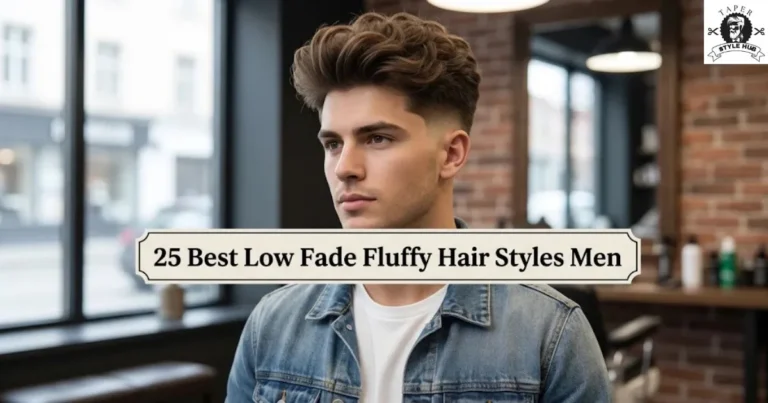
👉 Also Read: Low Fade Fluffy Hair
Why a Black Men Fade Haircut Works So Well on Black Hair
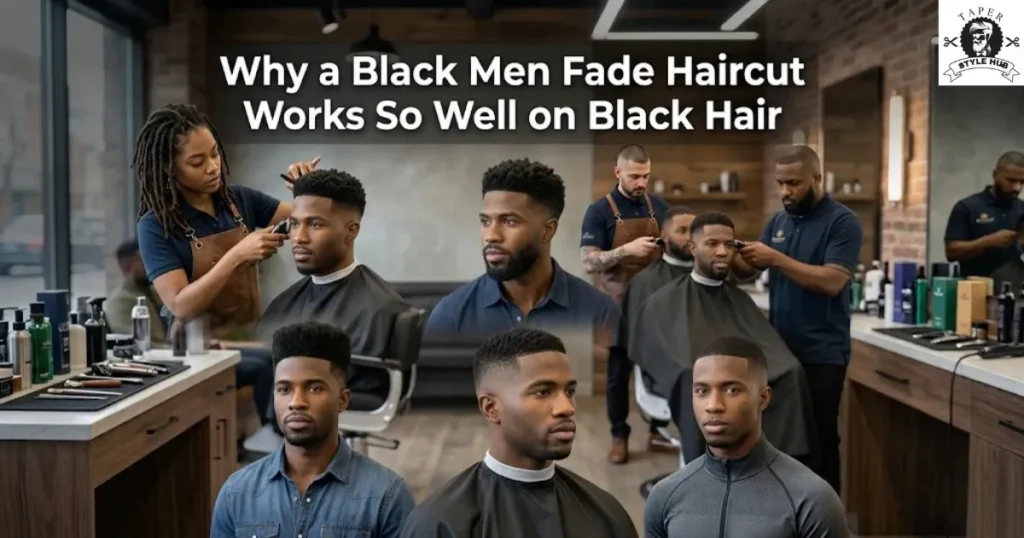
Black hair usually falls into the Type 3 and Type 4 categories, which means it curls or coils tightly. That texture holds its shape, so the gradient from skin to length reads clearly and looks sharp.
Fades also show off natural texture instead of hiding it. Short sides make curls, coils, and waves on top look fuller, and the contrast gives even a simple style a polished finish.
There is a cultural side too. Fades grew up in Black barbershops during the 1980s, alongside hip-hop, and barbers have passed the craft down ever since. It is a technique built around this hair type.
One practical note: Black hair shrinks as it dries, so a black men fade haircut can look shorter once it is fully dry. Ask your barber to account for shrinkage, or get cut on dry hair.
👉 Also Read: Mid Fade Textured Top
Fade vs Taper: What Is the Difference?
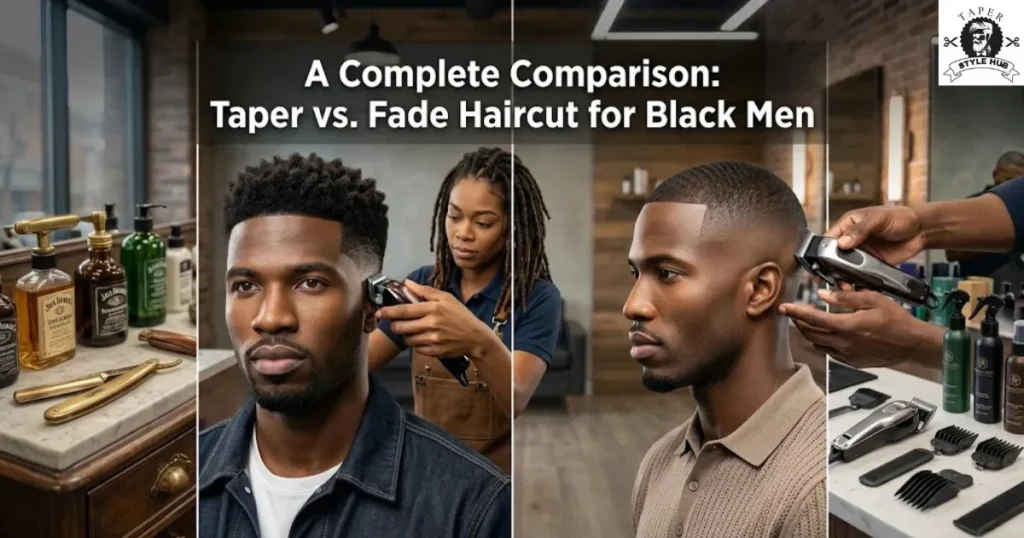
People use these two words as if they mean the same thing, but they describe different levels of contrast. A fade usually blends much shorter and can reach the skin. A taper stays longer and softer.
If you are new to the black men fade haircut, a taper is a safe starting point. You can always ask your barber to go shorter next time once you see how the cut sits on you.
| Feature | Fade | Taper |
|---|---|---|
| How short it gets | Can blend down to bare skin | Gets shorter but keeps hair at the edges |
| Contrast | High, sharp transition | Soft, gradual transition |
| Best for | Bold looks, designs, beards | Office settings and classic styles |
| Barber visits | Every 1 to 3 weeks | Every 3 to 4 weeks |
Neither option is better. The right pick depends on how much contrast you want and how often you can realistically sit in a barber chair.
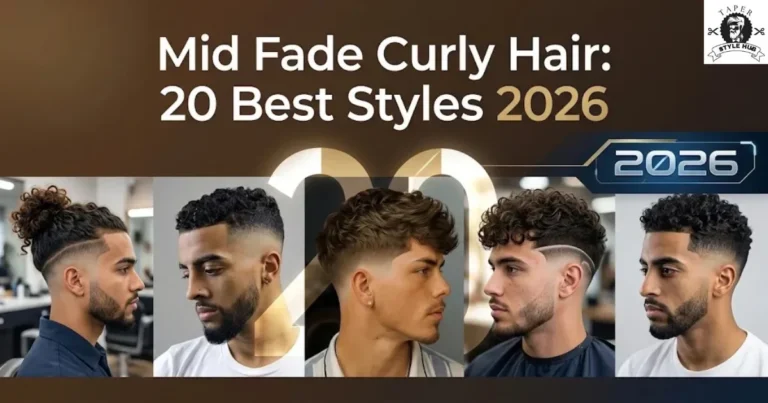
👉 Also Read: Mid Fade Curly Hair
Why the Black Men Fade Haircut Stays So Popular
Few styles have lasted as long as the fade, and the reasons are practical as much as stylish. A black men fade haircut simply solves a lot of grooming problems at once.
- It suits every texture: curly, coily, kinky, and wavy hair all take a fade well.
- It looks clean anywhere: the cut reads as sharp in classrooms, offices, and nights out.
- It adapts to any top: short crops, afros, twists, locs, and braids all sit well above a fade.
- It pairs with a beard: the fade can blend into facial hair for one connected shape.
- It is easy to customize: parts, lines, and designs make it personal.
That is why it remains one of the most requested cuts in barbershops everywhere today.
👉 Also Read: Curly Hair With Fade
The History Behind the Black Men Fade Haircut
The fade did not appear overnight. Its roots reach back to military cuts of the 1940s and 1950s, which prized hygiene and a tidy, uniform look on the sides and back.
It found its real identity in Black barbershops during the 1980s and 1990s. Barbers there refined the blend, named the variations, and turned a practical cut into a creative craft.
As hip-hop rose, the black men fade haircut became part of the look. High tops, flat tops, line ups, and shaved designs all grew out of that culture and spread worldwide.
Today the technique keeps evolving. Barbers experiment with drop and burst shapes, sharper line work, and custom patterns, so every new fade can feel personal.
👉 Also Read: Military High Fade
Types of Black Men Fade Haircut by Height and Finish
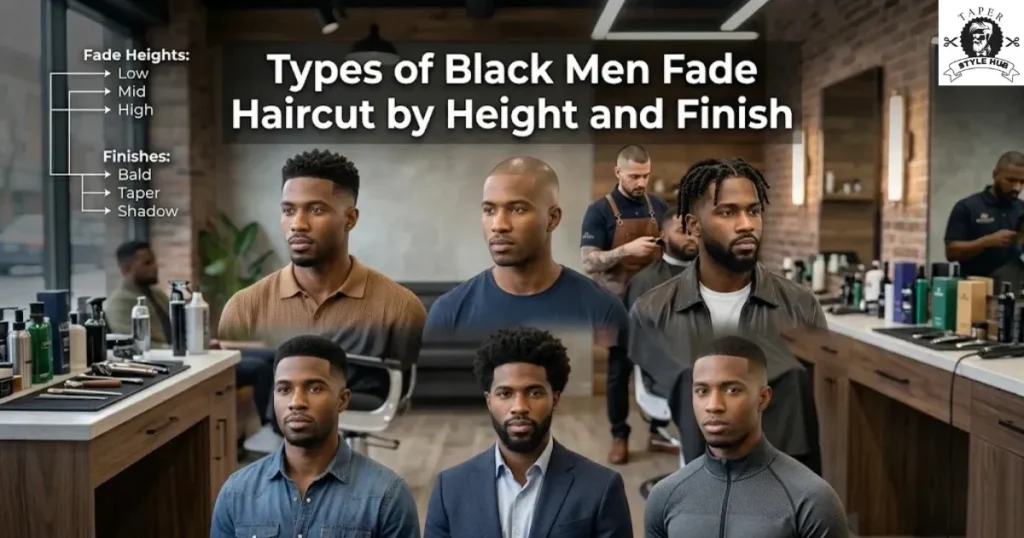
Every black men fade haircut is described by two things: where the fade starts and how short it goes at the bottom. Knowing both terms makes it much easier to talk to your barber.
👉 Also Read: Skin Fade Crew
Fade Height
- Low fade: starts just above the ears and keeps most of the side hair.
- Mid fade: starts around the temples for balanced contrast.
- High fade: starts above the temples and removes the most hair.
- Temp fade: focuses the blend around the temples, also called a temple or Brooklyn fade.
Fade Shape and Finish
- Drop fade: curves down behind the ear toward the neck.
- Burst fade: curves in a semicircle around the ear and leaves the back fuller.
- Skin fade: blends to bare scalp for maximum contrast.
- Taper fade: shortens mostly the sideburns and neckline.
Low vs Mid vs High: Which Black Men Fade Haircut Should You Start With?
Height is the single biggest choice you will make. It decides how much hair comes off the sides and how much contrast people see from across the room.
A low fade is the safest start. It keeps most of the hair, looks professional, and grows out quietly. If you like it, you can always go higher at the next visit.
A mid fade gives clearer contrast while staying balanced. It is the choice for men who want their black men fade haircut to look obviously cut but not extreme.
A high fade is the boldest option. It removes the most hair and is hard to undo, so choose it on purpose, especially if you plan to grow your hair out later.
50 Black Men Fade Haircut Styles by Category
Instead of one long jumble, these 50 styles are grouped by what they have in common. Each category shows how a black men fade haircut changes depending on the top, the shape, or the finishing details.
Fade Height and Finish Styles
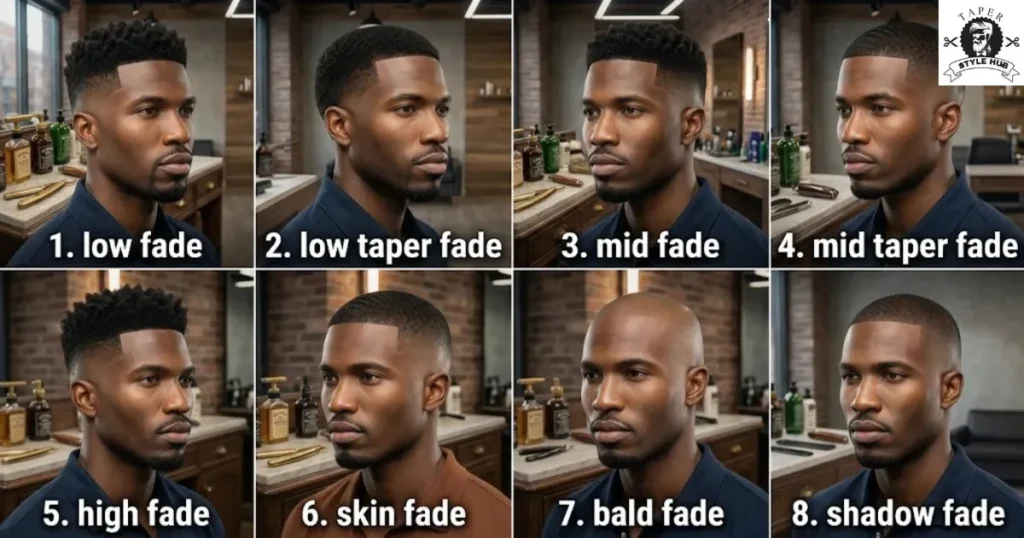
These eight cuts are the foundation. Every other style in this guide is built on one of them, so start here if you are unsure what to request.
“All The Types Shown Below Are Displayed In The Single Image Above☝️”
- Low Fade: starts just above the ears and keeps most of the sides, giving the softest contrast. It suits office jobs and grows out gently. Ask for it when you want a clean look that never feels aggressive.
- Low Taper Fade: tapers the sideburns and neckline without baring skin. It is the most versatile everyday option on this list. Barbers often recommend it as the safest first fade.
- Mid Fade: begins around the temples and delivers balanced contrast. It pairs with almost any top length or texture. If you cannot decide between low and high, this is usually the answer.
- Mid Taper Fade: keeps more length than a mid skin fade while still looking clean. It is a smart middle ground. It also grows out more gracefully than a mid skin fade.
- High Fade: starts above the temples for strong, youthful contrast. Start lower if this is your first fade, because it is hard to walk back. Expect to book a touch-up every two weeks to keep it crisp.
- Skin Fade: blends all the way to bare scalp. It looks the sharpest but shows regrowth the fastest. Plan on a visit every ten to fourteen days for the freshest finish.
- Bald Fade: is another name for the skin fade. It looks especially good with a shaped beard. The bare sides make the beard line stand out even more.
- Shadow Fade: uses clippers only for a soft, blurred gradient that leaves a hint of stubble. It suits men who want depth without the starkness of a hard skin line.
Waves and Pattern Styles
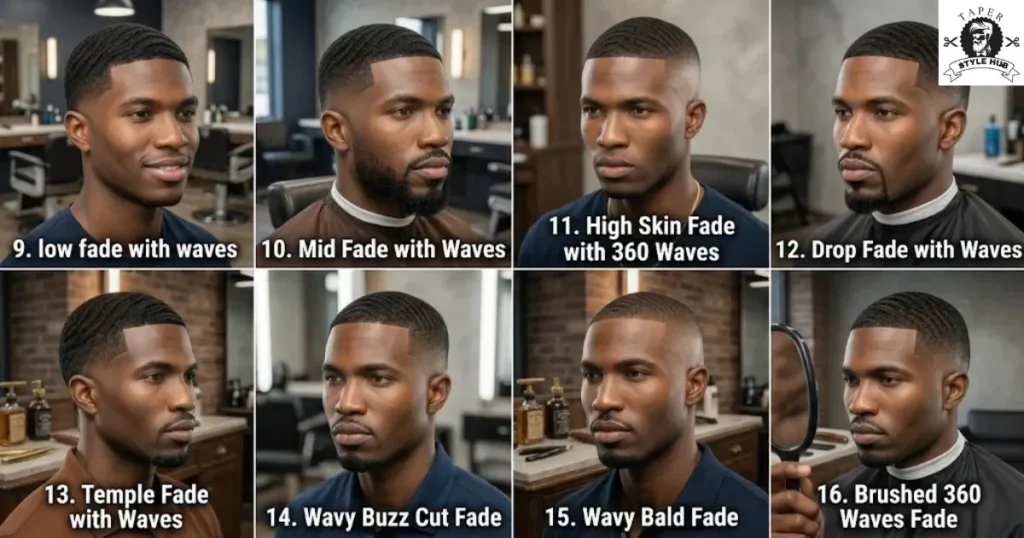
Waves need short, moisturized hair and daily brushing. A black men fade haircut gives them a clean frame, so the pattern stays the focus of the whole look.
“All The Types Shown Below Are Displayed In The Single Image Above☝️”
- Low Fade with Waves: keeps the sides tidy while the waves do the visual work. It is forgiving while your pattern is still training. Brush daily and wear a durag so the pattern stays deep.
- Mid Fade with Waves: adds more contrast and lets the ripples stand out. It works well for professional settings. The extra contrast makes the waves look deeper from every angle.
- High Skin Fade with 360 Waves: pairs bare skin at the sides with rippling texture on top. The effect is striking. It is a favorite for men who brush their waves religiously.
- Drop Fade with Waves: the curved fade line echoes the circular wave pattern. The result looks cohesive and intentional. It looks especially sharp from the side profile.
- Temple Fade with Waves: concentrates the blend at the temples and leaves the rest of the head untouched. It preserves height and texture. It is a good option when you want to keep as much height as possible.
- Wavy Buzz Cut Fade: combines short brushed waves with a mid skin fade and a sharp shape up. It suits both work and weekends. A hard shape up at the hairline completes the look.
- Wavy Bald Fade: mixes soft waves on top with clean, bare sides. It looks modern and polished. The smooth sides keep attention on the texture above.
- Brushed 360 Waves Fade: is the classic version, built on consistent brushing and a durag at night. Patience matters here, because deep waves take months to develop.
Afro and Curl Styles
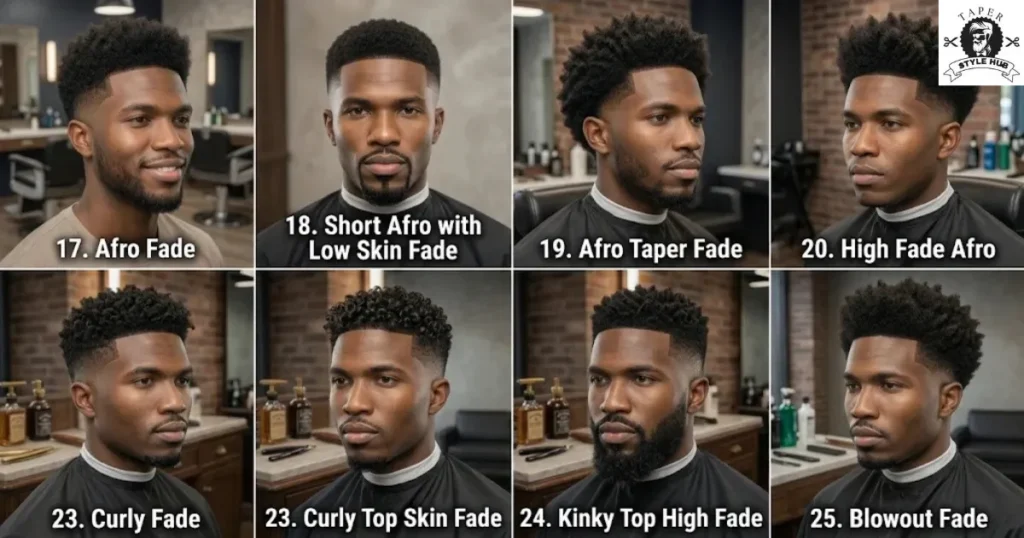
Natural volume is the star here. These styles keep the top full and let the fade shape the sides, so your texture looks intentional instead of unruly.
“All The Types Shown Below Are Displayed In The Single Image Above☝️”
- Afro Fade: combines a full afro with clean faded sides. The higher the afro and the fade, the bolder the look. It is a timeless black men fade haircut that celebrates natural texture.
- Short Afro with Low Skin Fade: shows off natural curls while the skin fade separates the beard line. A well-groomed beard adds to the overall confidence of the style.
- Afro Taper Fade: blends clean edges into longer hair and keeps the shape rounded and soft. It is soft around the edges, so it works for almost every setting.
- High Fade Afro: sets a rounded top above sharp sides. It takes little daily effort but gives a big result. Keep the shape rounded and trim the top lightly between visits.
- Sponge Curls Fade: uses a sponge tool to create small, defined coils. A low or mid fade keeps it balanced. It is one of the easier styles to maintain between barber appointments.
- Curly Fade: pairs any fade height with curls left long enough to show their pattern. Moisturize daily so the curls stay soft and defined.
- Curly Top Skin Fade: keeps volume on top and removes bulk from the sides. Curls look more defined this way. It is ideal for men who want curls to look neat but still natural.
- Kinky Top High Fade: contrasts tightly coiled 4C hair against a high fade. The tighter the curl, the more dramatic it looks. Moisture is key, since tight coils dry out quickly.
- Blowout Fade: stretches and fluffs the top for maximum volume above a skin or high fade. It suits special occasions. A sharp shape up keeps the volume looking intentional.
Twists, Locs and Braids
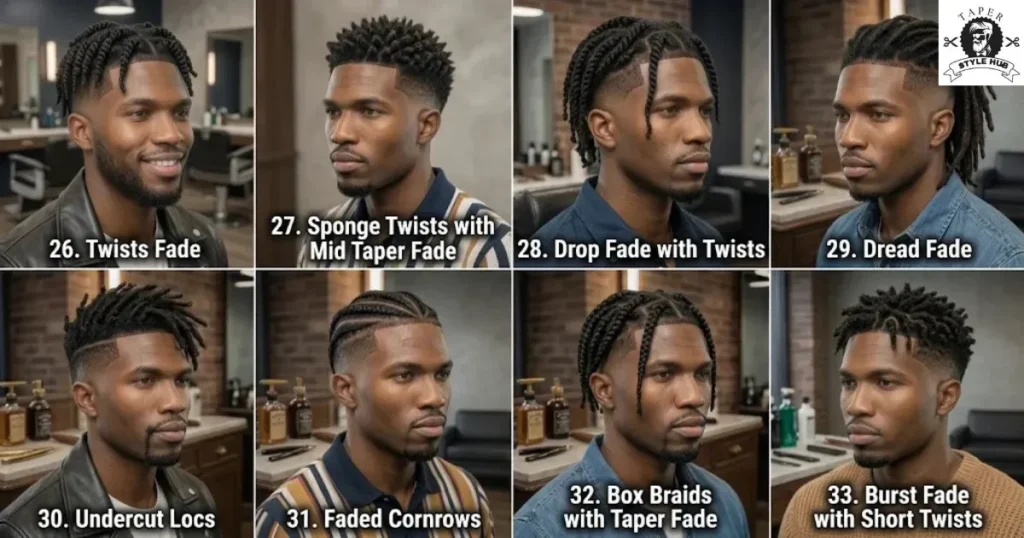
Protective and textured styles pair well with a fade because the clean sides keep longer hair looking neat. Tell your barber your growth plans before the clippers start.
“All The Types Shown Below Are Displayed In The Single Image Above☝️”
- Twists Fade: keeps the sides sharp while short twists add texture and volume on top. It is easy to install and style, and it keeps edges tidy.
- Sponge Twists with Mid Taper Fade: mixes defined twists with a seamless taper. It is stylish and practical. Length matters here, so leave enough on top for the twists to form.
- Drop Fade with Twists: dips behind the ear and frames the twists with a curved line. The curve behind the ear gives the cut extra shape from the side.
- Dread Fade: keeps locs on top and the sides neat. It looks cleanest when the fade connects to a beard. Hydrate your scalp regularly to keep the locs healthy.
- Undercut Locs: shaves the sides short and leaves long locks above for a bold contrast. It is a bold choice for men who want strong contrast.
- Faded Cornrows: combines tidy sides with braids laid flat to the scalp. It is a low-maintenance protective style. Keep your scalp moisturized and the braids fresh between visits.
- Box Braids with Taper Fade: lets the braids make the statement while the taper stays refined. The braids express creativity while the sides stay clean.
- Burst Fade with Short Twists: uses the rounded burst shape to highlight texture around the ears. The rounded burst shape suits curls, twists, and mohawks alike.
Shape, Hawk and Top Styles
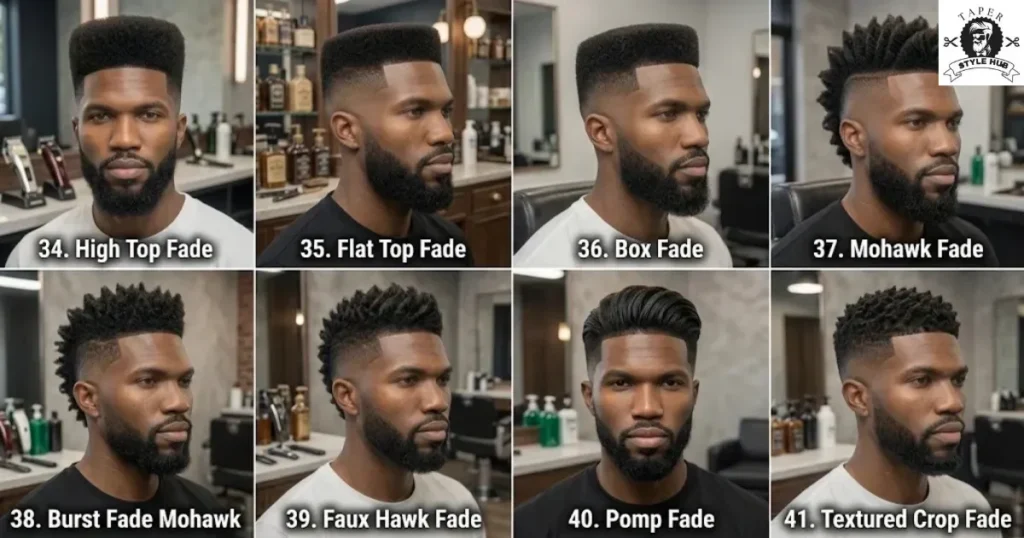
Here the shape of the top matters as much as the fade. These cuts reward a skilled barber and a clear photo to work from.
“All The Types Shown Below Are Displayed In The Single Image Above☝️”
- High Top Fade: is an 80s classic that stands tall and boxy above tight sides. It is back with a modern edge. Add razor partings on the sides if you want extra individuality.
- Flat Top Fade: keeps the top level and even, which gives a structured, iconic finish on thick hair. It takes real skill to keep the top even, so choose a confident barber.
- Box Fade: squares off the top and corners for sharp, defined volume. It works best on dense, textured hair.
- Mohawk Fade: leaves a strip of longer hair through the center with short faded sides. Add a beard or a clean shave depending on your style.
- Burst Fade Mohawk: follows the natural curve of a mohawk and is one of the most popular combinations. Because the burst keeps the back fuller, it is easier to wear every day.
- Faux Hawk Fade: is the laid-back cousin of the mohawk, with a raised ridge and softer sides. It is subtler than shaved sides, which makes it feel more casual.
- Pomp Fade: brushes extra front length up and back for volume. It looks polished with short sides. Use a little product to keep the front lifted.
- Textured Crop Fade: adds movement to short hair and suits thick curls and coils. It requires almost no daily styling.
Beard and Detail Styles
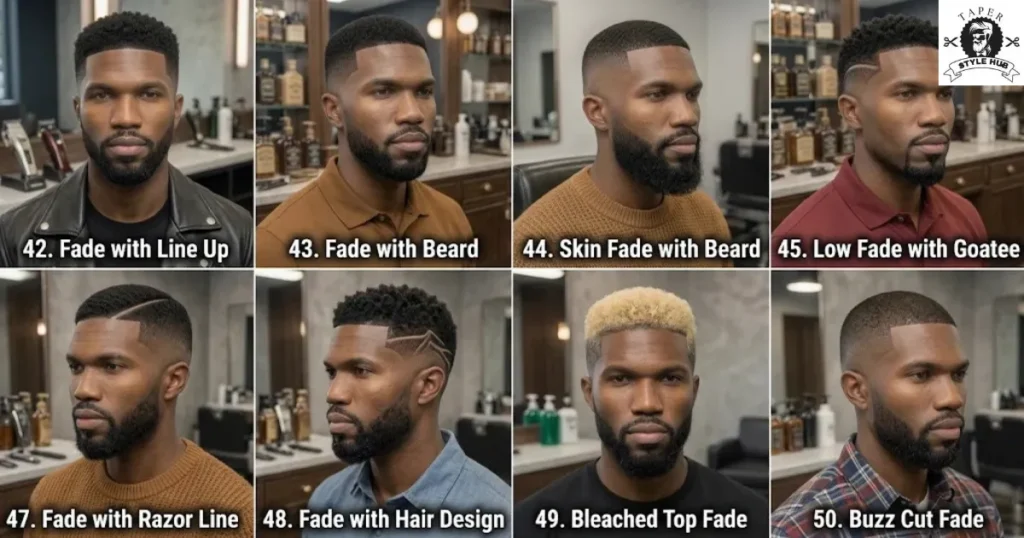
Finishing details turn a good cut into a personal one. Each of these nine styles adds a beard connection, a line, or a design on top of the fade.
“All The Types Shown Below Are Displayed In The Single Image Above☝️”
- Fade with Line Up: adds sharp edges at the hairline and temples. It is the finishing touch that makes any fade look fresh. Without it, even a perfectly blended fade can fall flat.
- Fade with Beard: blends the sides smoothly into the beard for one continuous line. Ask your barber to shape the beard and the hairline together.
- Skin Fade with Beard: connects bare sides to a sculpted beard. It gives the most contrast but needs the most upkeep. Plan on frequent visits to keep both sides crisp.
- Low Fade with Goatee: keeps the look subtle while a goatee balances the volume on top. Clean edges at the cheeks help the goatee look deliberate.
- Hard Part Fade: adds a shaved line that separates the top from the sides. It works with almost any top length or texture.
- Fade with Razor Line: adds detail without making the cut look busy. A single line is enough to personalize the cut.
- Fade with Hair Design: carves zigzags or geometric shapes into the sides. Expect touch-ups every one to two weeks. Choose a simple pattern first if you have never had shaved detailing.
- Bleached Top Fade: pairs a lightened top with faded sides for bold contrast. Take extra care of bleached hair with deep conditioning.
- Buzz Cut Fade: is the lowest-maintenance option, with an even short top and a sharp fade. It suits busy lifestyles and almost every face shape.
Black Men Fade Haircut Trends for 2026
The 2026 look blends classic technique with creative detail. Barbers are mixing tradition with personal touches, so a modern black men fade haircut rarely looks like anyone else’s.
- Curved fades: drop and burst shapes continue to gain ground because they follow the shape of the head.
- Textured tops: twists, sponge curls, and short afros pair with clean fades for contrast.
- Subtle detail work: a single razor line or hard part is preferred over busy patterns.
- Softer tapers: many men choose guarded bases over bare skin for easier upkeep.
Whatever the trend, the fundamentals stay the same. A clean blend, a sharp line up, and healthy hair on top will always look current.
How to Choose a Black Men Fade Haircut for Your Hair Type
Your curl pattern changes how a fade behaves, so match the cut to your texture. A black men fade haircut that looks perfect on 3C hair may need tweaks on 4C.
| Hair Type | Fades That Work Well | Why |
|---|---|---|
| 4A (looser coils) | Drop and burst fades | The curl definition shows clearly against the gradient |
| 4B (Z-pattern) | Mid and temple fades | Dense top stays distinct from the faded sides |
| 4C (tight coils) | Low taper and skin fades | Short afro texture creates strong contrast |
| Waves | Low or mid fades | Higher fades can cut into the wave area |
| Locs and twists | Drop and burst fades | Curved lines support the vertical look |
A black men fade haircut works on straight and wavy hair too. The main difference is that regrowth shows faster on straighter hair, so the line softens sooner.
Best Black Men Fade Haircut by Face Shape
Face shape is a guide for any black men fade haircut, not a rule. Use it as a starting point, then check photos of cuts on heads similar to yours.
| Face Shape | Best Fade | Avoid |
|---|---|---|
| Oval | Almost any fade | Nothing in particular |
| Round | High or skin fade for added height | Low fades that add fullness |
| Square | Low or taper fade to soften the jaw | Very high fades |
| Long | Low fade with volume on top | Very high fades |
| Heart | Mid fade with extra top volume | Overly tight sides |
Photos help more than rules. Compare cuts on heads with a similar profile, and always check the side and back views before you commit. A cut that flatters one head can look completely different on another.
Choosing a Black Men Fade Haircut for Your Lifestyle
Your job and routine matter as much as your hair. A black men fade haircut that needs a touch-up every ten days will frustrate you if your schedule is packed.
- Corporate roles: a low taper fade looks polished and lasts two to three weeks.
- Creative jobs: drop and burst fades with sharp lines feel expressive without going overboard.
- Athletes and gym-goers: skin fades or buzz cut fades need little daily styling.
- Frequent travelers: a taper fade holds its shape longer between cuts.
How to Ask Your Barber for a Black Men Fade Haircut
Do not figure out what you want while sitting in the chair. A clear request for your black men fade haircut saves time and prevents a cut that is too high or too short.
The Four Details to Mention
- Fade height: low, mid, or high.
- Finish: skin, taper, or something in between.
- Top length: long, medium, short, or buzzed, ideally in inches.
- Hairline shape: square, rounded, or natural.
Clipper Guard Numbers
Barbers use guards numbered from 0 to 8, and lower numbers mean shorter hair. Knowing a few of them lets you describe your black men fade haircut precisely.
| Guard | Length | Common Use |
|---|---|---|
| #0 | Near skin | Bottom of a skin fade |
| #1 | 1/8 inch | Shortest section before skin |
| #2 | 1/4 inch | Start of a low fade |
| #3 | 3/8 inch | Middle of a taper fade |
| #4 | 1/2 inch | Where the fade meets longer hair |
Also bring one or two reference photos. Choose models with a similar texture and hairline, then ask your barber what needs to change for the cut to work on you.
A Simple Barber Script
If you want a ready-made request, try this: a mid fade with a number one guard at the bottom, a short afro on top, and a clean square line up.
Adjust the words to fit your hair. The point is to name the height, the finish, the top, and the edges so nothing is left to chance.
Pairing a Black Men Fade Haircut With Facial Hair
A beard changes how a fade looks, so plan both together. A black men fade haircut can blend into the sideburns and beard, or the two can stay deliberately separate.
A low or mid fade works nicely with a full beard because the transition feels gradual. A skin fade adds an edgier look, especially with stubble or a sculpted beard.
Tell your barber which version you want before the clippers start. Also ask about cheek lines and the neckline, since those small details frame the entire face.
How to Find the Right Barber for Your Black Men Fade Haircut
The best fade in the world still depends on the person holding the clippers. A skilled barber understands Black hair, clean lines, and seamless blending.
- Check their portfolio: look at their social media or shop website to see real fades they have cut.
- Ask for recommendations: friends or colleagues with cuts you admire can point you to someone reliable.
- Look for Black hair experience: ask about their training and review a variety of their previous work.
- Judge the precision: sharp lines and a smooth blend are the real signs of quality.
- Communicate clearly: bring photos so your barber sees exactly what you mean.
Touch-Up vs Full Reset
If you are visiting between full cuts, say so. A touch-up cleans the outline and neckline without changing the sides, while a full reset restarts the blend from the beginning.
These services take different amounts of time and often cost different prices, so mentioning your goal at the start avoids confusion.
How to Maintain a Black Men Fade Haircut
A fresh fade looks great for about a week, then the blend starts to blur. Regular visits and a simple home routine keep your black men fade haircut sharp for longer.
| Fade Type | Barber Visit |
|---|---|
| Skin fade | Every 10 to 14 days |
| Mid or low fade | Every 2 to 3 weeks |
| Taper without skin | Every 3 to 4 weeks |
What You Can Do at Home
Between visits, clean up only the edges. That means the neckline, sideburns, and the hairline at your forehead. Leave the blend itself to your barber, because the wrong guard creates visible steps.
Moisture and Night Care
Black hair tends to be dry, so moisturize the longer top section every day with a leave-in conditioner or a natural oil like jojoba, argan, or castor oil.
Wear a durag, satin bonnet, or silk pillowcase at night. They reduce friction, hold in moisture, and protect waves and curls while you sleep.
Scalp and Neck Care
Very close cuts can irritate the neck and cause bumps. If that happens to you, ask for a guarded base instead of a skin finish, and see a dermatologist if the bumps keep returning.
Products and Tools for a Black Men Fade Haircut
You do not need a shelf full of products. A few well-chosen basics keep the hair on top healthy and your black men fade haircut looking crisp.
- Leave-in conditioner or curl cream: keeps curls and coils hydrated and defined.
- Natural oils: jojoba, argan, and castor oil help moisturize the hair and scalp.
- Soft-bristle or wave brush: spreads natural oils and trains waves.
- Edge control and a small trimmer: helps tidy the hairline between visits.
- Sulfate-free shampoo: cleans gently without stripping natural oils.
- Durag, satin bonnet, or silk pillowcase: protects your style while you sleep.
Buy quality over quantity, and learn your hair porosity so you know how often to hydrate. Well-moisturized hair holds its shape and looks healthier between cuts.
How to Grow Out a Black Men Fade Haircut
Changing your style takes patience. A black men fade haircut usually needs about three to six weeks to grow out, depending on how fast your hair grows and how short you went.
During that time, keep the edges clean and moisturize daily. A neat neckline and sideburns make the awkward in-between stage look intentional instead of messy.
If you want longer twists or locs, stay with a low or taper finish so the sides do not fall too far behind the top while you grow.
Black Men Fade Haircut for Special Situations
Not every head or schedule fits the standard advice. These situations come up often, and a small adjustment makes a big difference.
Receding Hairline
A high fade or temple fade can shift attention away from thinning areas and create cleaner edges. A strong beard also helps balance the overall look.
Black Boys and Teens
For younger guys, a low fade is easy to maintain between school and sports. It stays subtle enough for most dress codes while still looking freshly cut.
Summer and Hot Weather
Heat and humidity can blur a fade faster than usual. Wash regularly to remove sweat, keep the scalp moisturized, and schedule trims a little more often.
Black Men Fade Haircut Myths Worth Ignoring
Plenty of advice around fades is repeated without being true. Clearing up a few common myths will save you money and a bad haircut.
- Myth: a fade always means bare skin. Reality: shadow fades, tapers, and guarded bases keep a layer of hair.
- Myth: only short hair can be faded. Reality: the black men fade haircut works under afros, twists, locs, and braids.
- Myth: higher always looks better. Reality: the best height depends on your head shape and your plans.
- Myth: you can fix the blend yourself. Reality: home guards create steps, so only clean the edges.
Checklist Before Your Next Black Men Fade Haircut
Run through this short list before you sit in the chair. It takes two minutes and protects you from the most common disappointments.
- Decide the fade height and finish you want.
- Save one or two photos that match your texture.
- Know your preferred top length in inches.
- Decide whether the beard should blend or stay separate.
- Tell your barber about any growth plans.
- Book your next appointment before you leave.
Common Mistakes With a Black Men Fade Haircut
Most regret after a black men fade haircut comes from a handful of avoidable errors. Watch for these before your next appointment.
- Going too high too fast: a high fade is dramatic and hard to undo, so start low or mid.
- Skipping the line up: a great fade with a messy hairline still looks unfinished.
- Ignoring hair texture: copying a photo of a different curl pattern rarely works.
- Fixing the fade at home: a guard that is too short leaves steps that only a barber can fix.
- Waiting too long between cuts: the blend disappears by the third week.
- Forgetting the hair on top: a sharp fade needs healthy, moisturized hair above it.
Final Thoughts on the Black Men Fade Haircut
A great fade comes down to matching the cut to your hair, your face, and the upkeep you can realistically handle. Pick the cut that fits your life, not only the one that looks sharpest in a photo.
Treat every visit as a conversation. Your barber knows the technique, and you know your lifestyle, so the best results come when both sides share what they know.
Learn the vocabulary, bring a reference photo, and speak in guard numbers when you can. Do that, and every black men fade haircut in this guide becomes a realistic option instead of just inspiration.
FAQs About the Black Men Fade Haircut
What is the best fade for Black men?
It depends on your texture and lifestyle. A low taper is the most versatile, while a skin fade gives the sharpest contrast.
How often should I get a fade touched up?
Skin fades need a touch-up every 10 to 14 days. Low and mid fades usually last two to three weeks.
Can I get a fade with an afro?
Yes, an afro fade is one of the most popular styles. It keeps natural volume on top with clean, blended sides.
What is the difference between a fade and a taper?
A fade can blend down to bare skin. A taper keeps more hair and gives a softer, more conservative finish.
Which fade lasts the longest?
A low or mid taper holds its shape longest because it never exposes bare scalp, so regrowth is less noticeable.

I’m M Ahmad Ansari, founder and content creator at Taper Style Hub. With 3+ years of experience researching taper haircuts, hairstyles, grooming, and men’s style, I create practical, accurate, and easy-to-understand content. My goal is to provide readers with trustworthy information, useful tips, and inspiring ideas for choosing and styling the perfect taper haircut.


One Comment