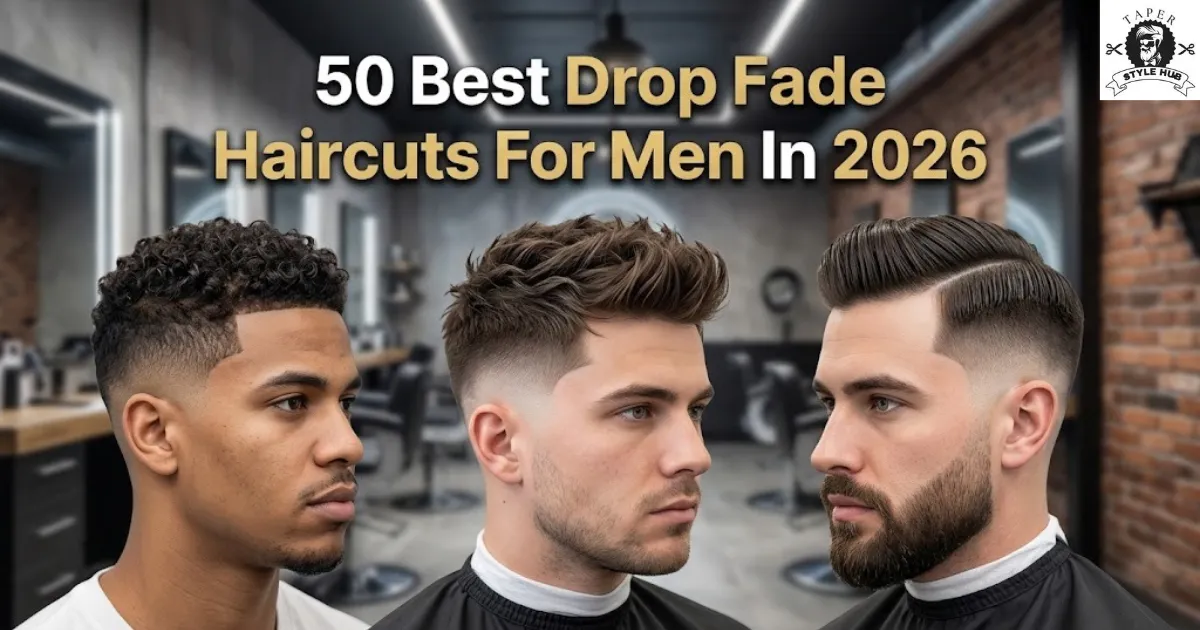
50 Best Drop Fade Haircuts For Men In 2026
A drop fade is a haircut where the fade line curves down behind the ear instead of running flat around the head. That small dip adds shape, depth, and a cleaner outline, which is why barbers and clients both love it.
This guide explains how the cut works, how to ask for it, and how to keep it fresh. You will also find 50 types sorted into clear categories, so you can pick the one that suits your hair and routine.
Whether you want a quiet office look or a bold weekend style, there is a version for you. Let’s start with the basics.
👉 Also Read: Low Drop Fade
What Is a Drop Fade and Why Do Men Keep Asking for It?
A drop fade is a variation of the classic fade haircut. The hair gets gradually shorter from the top of the head toward the neckline, but the fade line dips lower as it passes behind the ear.
Most standard fades follow a straight guideline around the head. This version follows the natural curve of the skull instead, which creates a soft arc running from the temple to the nape.
That arc leaves more hair at the crown and upper sides, so the top often looks fuller. It also helps balance the back of the head, a detail many barbers quietly appreciate.
Men also like how versatile it is. You can pair it with curls, waves, a buzz cut, a pompadour, or even a mullet, and the shape still looks intentional.
It is also easy to dress up or down. A low version with a neat side part fits a job interview, while a high version with a textured top fits a night out.
Celebrities and athletes have helped the style spread, and it now shows up in barbershops, streetwear, and offices alike. It stays trendy without feeling like a passing fad.
👉 Also Read: Mid Drop Fade
Why the Drop Fade Is Trending in 2026
Men’s grooming has moved toward cuts that look clean without constant fuss. A drop fade fits that mood because it frames the head neatly and still leaves room for personal style on top.
Social media plays a part too. Side and back photos make the curve easy to show, so a drop fade photographs well and spreads quickly through barbershop feeds and saved boards.
Barbers like it as well. The curve gives them a chance to show precision, and clients usually notice the difference the moment they see the back of their head in the mirror.
Trends change fast, but this shape follows the skull, so it ages better than many gimmicky cuts. That is why a drop fade keeps showing up year after year.
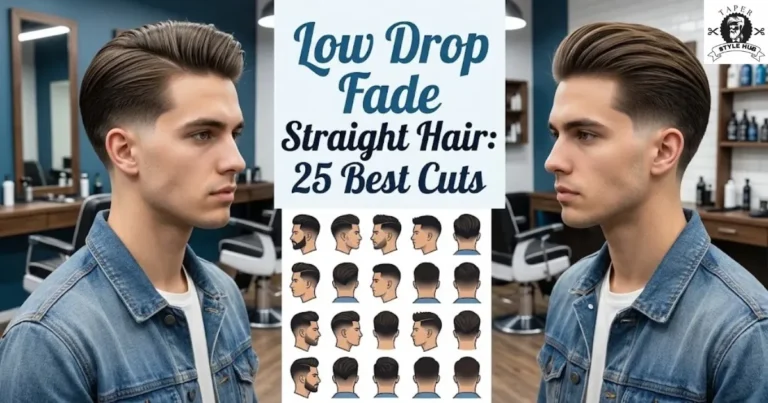
👉 Also Read: Low Drop Fade Straight Hair
How the Drop Fade Shape Works Behind the Ear
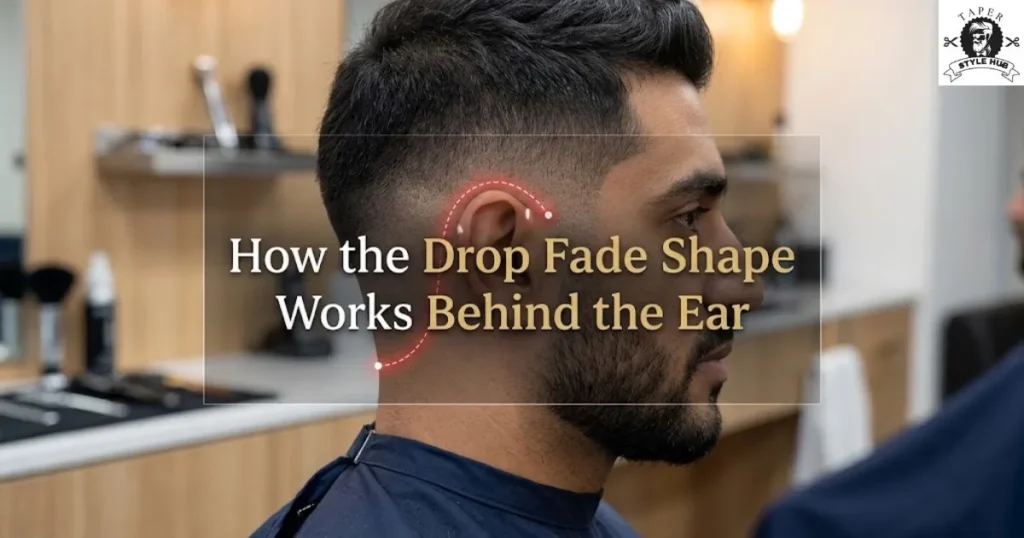
Look at a drop fade from the side and you will see an arc. The line sits higher near the temple, travels above the ear, and then slopes down toward the nape.
The drop itself is only a shape. It does not tell your barber how high the blend starts, how short the base gets, or what happens on top.
That is why a good request has four parts: shape, height, finish, and top style. Once you name all four, the barber stops guessing, and you are far less likely to leave disappointed.
👉 Also Read: Burst Fade Curly Hair
Temple, Ear, and Nape: Where the Curve Travels
The curve begins near the temple, moves around the ear, and finishes at the nape. Where it ends depends on your head shape, your hairline, and how much contrast you want.
A shallow dip looks soft and professional. A deeper dip creates a stronger outline that stands out, especially under short or tightly cut hair.
👉 Also Read: High Burst Fade
Why the Back of Your Head Matters
A flat or sharply angled back of the head can look uneven under a level fade. The curved line follows the skull more closely, which softens those angles and adds shape.
Run your hand over the back of your head before your next appointment. Tell your barber what you feel, because a flat spot or a hook at the base changes where the curve should land.
👉 Also Read: Mid Burst Fade
Skin Fade vs Shadow Fade: The Two Families Behind Every Drop Fade

Barbers often say fades come in two main families. A skin fade, also called a bald fade, starts at zero on the sides and blends upward into whatever length you keep on top.
A shadow fade starts with a little hair at the base instead of bare skin, then blends up the same way. Every other fade, including the drop, is a variation of these two.
Both families can be low, medium, or high. The drop only changes the path of the line, so you can choose a skin version or a shadow version of the same curve.
Many barbers feel the curve looks best at low to medium height. A very high version can look a little strange, because the line has less room to travel.
👉 Also Read: Low Burst Fade
Drop Fade Guard Numbers and Clipper Lengths
Guard numbers control the shortest length at the base of the fade. This table is a simple starting point, though brands vary slightly.
| Guard | Approximate Length | Typical Use |
|---|---|---|
| #0.5 | 1.5 mm | Near-skin base |
| #1 | 3 mm | Soft guarded base |
| #2 | 6 mm | Gentle shadow base |
| #3 | 10 mm | Upper part of the blend |
| #4 | 13 mm | Top of the fade |
If you are unsure, start with a #1 base. You get most of the contrast of a skin finish, and regrowth looks softer between visits.
Always tell your barber the shortest guard you want. Words like skin, taper, and shadow mean different things in different shops, but a number is clear.
👉 Also Read: Burst Fade Straight Hair
50 Types of Drop Fade Explained by Category
Fifty styles can feel overwhelming, so I grouped them into seven categories. Read the category that matches your hair first, then pick the type that fits your routine and your barber’s skill.
👉 Also Read: Taper Mullet 40 Modern Types For Men
Height-Based Types
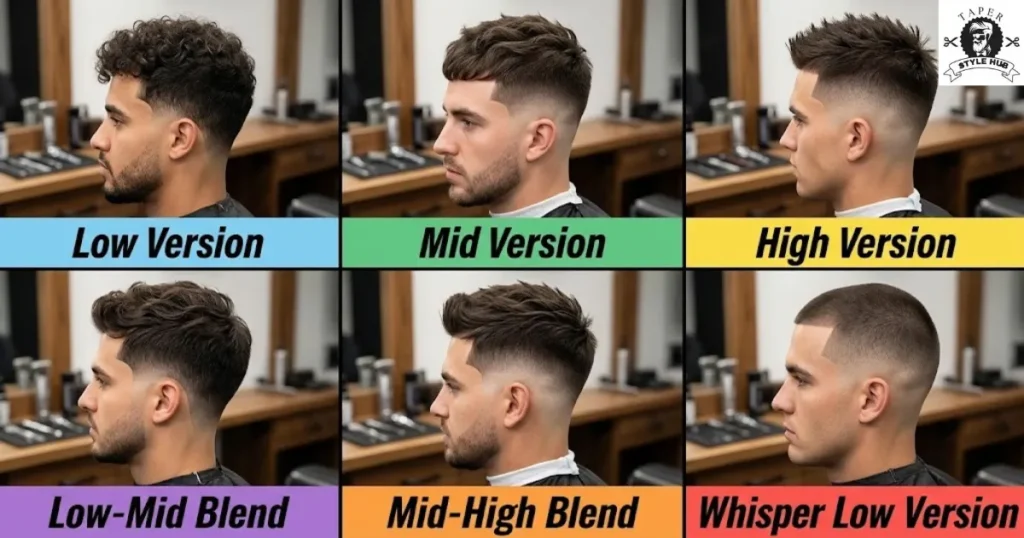
Height decides where the blend starts on the side of your head. It changes how much contrast people notice when they look at you.
“All The Types Shown Below Are Displayed In The Single Image Above☝️”
- Low Version: The blend starts just above the hairline and keeps most of the side length. It is the safest first choice and works well in conservative offices.
- Mid Version: The blend begins around the temple. It gives clear contrast without showing too much scalp, which is why it is so popular.
- High Version: The blend climbs close to the crown. It creates sharp contrast and a bold, striking look that draws attention.
- Low-Mid Blend: This sits between low and mid. Choose it when you want visible contrast but still want some weight left on the sides.
- Mid-High Blend: This shows more scalp than a mid version while keeping a soft transition, so it feels daring without going extreme.
- Whisper Low Version: A barely there fade at the hairline that adds a subtle outline. It suits men who want almost no contrast at all.
If you are choosing between heights, start with a low drop fade, then go higher at your next visit if you want more contrast. A barber can always remove more hair, but nobody can add it back.
Finish-Based Types

Finish describes how short the hair gets at the very bottom. The curve stays the same, but the mood changes completely.
“All The Types Shown Below Are Displayed In The Single Image Above☝️”
- Skin Finish: The base fades down to bare skin for the sharpest contrast. It looks amazing fresh and needs the most frequent visits.
- Zero Gap Finish: The blend runs into the skin with no visible gap line, a favorite among men who like a clean bald fade look.
- #0.5 Finish: This leaves a shadow of hair, roughly 1.5 mm. It looks close to skin from a distance but feels gentler on the scalp.
- #1 Finish: A soft guarded base around 3 mm. It hides regrowth longer and suits first-time clients who want a safe starting point.
- #2 Finish: A relaxed base with low contrast and a natural, easygoing look that fits school, work, and family events.
- Shadow Blend: The fade starts with real hair at the base, giving the soft, smoky look that shadow fades are known for.
Think about how often you can visit the barber. Closer finishes look incredible but demand more upkeep, while longer guards forgive missed appointments.
Short and Classic Top Types

Short tops make the curve easy to see, and they need very little styling. They also suit men who prefer a quick morning routine.
“All The Types Shown Below Are Displayed In The Single Image Above☝️”
- Buzz Cut: A short, even top with the curve running behind the ear. There is no hair to hide the lines, so the blend must be clean.
- Crew Cut: Short sides with a slightly longer front. It is a classic military-inspired shape with a more modern outline.
- French Crop: A short, flat fringe brushed forward over a clean curve. It looks neat and works well on straight hair.
- Caesar Cut: A short top combed forward with a straight fringe. It needs almost no styling and hides a receding hairline nicely.
- Ivy League: A slightly longer crew cut with a short side part. It is tidy, polite, and perfect for the office.
- Textured Crop: A short top broken up with scissors or a razor. It looks messy in a controlled way and holds shape easily.
- Flat Top: A level, boxy top that needs a steady hand and sharp clippers. It makes a strong retro statement.
- High and Tight: Very short sides and minimal hair on top. It is the ultimate low-maintenance choice for busy schedules.
Short tops show every detail of a drop fade, so choose a barber with clean blending skills. Ask to see photos of their buzz cuts and crops from behind before you book.
Curly, Wavy, and Coily Types

Fuller tops are where this cut really shines. The lower line holds a bigger shape on top without harsh contrast.
“All The Types Shown Below Are Displayed In The Single Image Above☝️”
- Curly Top: Curls stay full on top while the sides fade smoothly. It looks youthful and shows off natural curls.
- Afro: A rounded natural top with a clean curve behind the ear. The fade frames the shape and keeps it looking sharp.
- 360 Waves: Waves brushed in a circular pattern with clean sides and back. Daily brushing keeps the pattern defined.
- Sponge Curls: Twisted curls sit on top of tight, clean sides. A curl sponge builds definition in just a few minutes.
- Twists: Two-strand or comma twists kept neat above the curve. The fade keeps the outline crisp as the twists grow.
- Locs: Locs or dreads on top with faded sides and back. The contrast makes the locs look intentional and well kept.
- Short Coils: Tight coils cut short on top. This version is easy to wash, easy to style, and very low effort.
- Curly Perm: Bouncy permed curls over tight sides. The volume on top makes the curve look even sharper.
You must moisturize textured hair. Use a curl cream, and avoid washing every day, because dry curls lose shape and make the drop fade look less defined.
Longer Top Types

Medium and long tops need a little more time each morning. In return, they give you the most room to express personal style.
“All The Types Shown Below Are Displayed In The Single Image Above☝️”
- Pompadour: Tall, swept-back volume at the front. Plan on ten to fifteen minutes with a blow dryer and a strong pomade.
- Quiff: A lifted front that sits shorter at the back. It looks looser and more windblown than a pompadour.
- Slick Back: Longer hair brushed straight back with pomade. The fade emphasizes the clean lines of the combed hair.
- Comb Over: A longer top swept to one side with a soft blend underneath. It looks polished and suits many face shapes.
- Side Part: A hard part with a smooth comb. It gives a classic gentleman’s look that works for formal events.
- Man Bun: Hair tied up on top while the sides stay faded. The clean sides keep the bun looking tidy.
- Curtains: A middle part that falls to each side. This style pairs well with longer, straighter hair and a low curve.
- Long Flow: Long waves or straight length over tight sides. It is dramatic, and it needs regular trims to stay healthy.
Longer tops reward patience. Plan regular trims, learn to use a blow dryer, and keep a small pot of pomade or cream at home.
Bold and Creative Types

These versions add a twist, such as a different shape on top, a color change, or a shaved pattern. Bold styles work best with a barber who shows strong portfolio photos.
“All The Types Shown Below Are Displayed In The Single Image Above☝️”
- Mullet: Short sides with a longer back. The curve stops behind the ear and gives the mullet a modern, controlled look.
- Faux Hawk: The center of the top runs longer and higher. Sharp faded sides keep the shape modern instead of costume-like.
- Mohawk: A spiky strip down the center with sharply faded sides. It is a confident choice for men who like attention.
- Undercut: A dramatic disconnect between a long top and very short sides. The curve keeps the shape from looking harsh.
- Burst Hybrid: This mixes a semicircle around the ear with a downward curve at the back for a bolder outline.
- Taper Hybrid: A softer blend that keeps some length near the temples and neckline for a gentle, natural transition.
- Blonde Top: A lightened top creates strong contrast against dark faded sides. Bleached hair needs extra moisture to stay healthy.
- Shaved Design: A thin shaved line or pattern above the ear. Ask to see rear photos of your barber’s work first.
Bold choices look best when the basics are right. Perfect blending and a symmetrical curve matter far more than any color or design.
Beard, Age, and Hair Density Types

Life stage, facial hair, and hair density all change which version works best. A few small tweaks make the cut feel made for you.
“All The Types Shown Below Are Displayed In The Single Image Above☝️”
- Beard Blend: The faded sides flow into the beard so the two look like one shape. Tell your barber how you wear your beard.
- Teen Style: A choppy, messy fringe with a mid curve. It is popular with teens and easy to restyle each morning.
- Kids Style: A soft low curve with a guarded base and a short, easy top. Boys love how simple it is to keep neat.
- Mature Style: A neat side part with a low curve. It looks refined and keeps older men looking sharp without extra effort.
- Gray Hair Style: Short, tidy gray hair with a soft guarded base. The clean edges give silver hair a crisp frame.
- Thinning Top Style: A shorter top with a low curve keeps the head balanced and avoids drawing attention to thinning areas.
These tweaks are small, but they make a big difference. Share your age, beard, and hair density with your barber so the plan feels personal.
Quick Reference: Which Drop Fade Should You Pick?
Still unsure? Use this quick table to match your goal or hair type to a starting point, then show your barber side and rear photos.
| Your Goal or Hair | Start With |
|---|---|
| First drop fade | Low version with a #1 base |
| Office-safe look | Low version with a side part |
| Clear contrast, little scalp | Mid version with a guarded base |
| Maximum contrast | High version with a skin base |
| Curly or coily hair | Mid version with curls kept full on top |
| Waves | Low or mid version with clean sides |
| Thin or fine hair | Low version with a shorter top |
| Sensitive scalp | #0.5 or #1 base instead of skin |
Pick one style from the table and one backup. That gives your barber a plan B if your hair refuses to cooperate on the day.
How to Choose the Right Drop Fade for Your Hair Type
Hair texture and density matter as much as the shape of your head. The same curve can look very different on straight, wavy, curly, or fine hair.
Straight Hair
Straight hair shows every line, so the fade looks crisp and polished. Because the strands lie flat, the top can look limp, so ask for some texture or a little extra length.
Wavy Hair
Wavy hair adds natural movement to the top, which balances the clean sides nicely. A mid-length top with light layers lets the waves sit without puffing out.
Curly and Coily Hair
Curls and coils need enough length on top for the shape to frame them. Curly hair also shrinks as it dries, so many barbers cut it dry to see the true length.
Fine or Thinning Hair
Thin hair can look flat under a heavy fade. A shorter top with a guarded base keeps the head looking fuller, and a low curve avoids too much scalp contrast.
Best Face Shapes for a Drop Fade
No face shape rules out this cut. The top style usually does more for balance than the fade itself, so think about the whole shape of your head.
| Face Shape | Good Starting Point |
|---|---|
| Oval | Almost any height, since oval faces suit most styles |
| Round | Mid height with extra volume on top |
| Square | Mid height with soft texture to balance the jaw |
| Heart-shaped | Low to mid height with a textured fringe |
| Long or oblong | Low height with less lift on top |
| Diamond | Low to mid height with some length on top |
Treat the table as a starting point, not a rule. A barber can see your hairline, crown, and cowlick in person and adjust the curve to match.
Drop Fade for Work, School, and Special Occasions
The same curve can fit very different settings. What changes is the height, the finish, and how much contrast you ask for.
Office and Interviews
Choose a low drop fade with a #1 or #2 base and a neat side part or short crop. Low contrast and tidy edges keep the focus on you, not your haircut.
School and Teen Life
Teens often like a mid drop fade with a textured top. Check the school dress code before choosing shaved lines or bleached color, since some schools have strict rules.
Weddings, Parties, and Nights Out
Special events call for a sharper finish. A skin drop fade, a clean line-up, and a slick back or pompadour look great in photos and last through a long evening.
Sports and Active Lifestyles
Athletes often prefer short tops with a guarded base. Sweat, helmets, and daily washing are easier to handle when the hair needs almost no styling.
How to Ask Your Barber for a Drop Fade
Clear communication gets you the haircut you imagined. Walking in with a simple plan saves time and prevents awkward surprises halfway through the cut.
- Bring a clear reference photo, because the curve lives on the sides and back.
- Name the fade height: low, mid, or high. Point to the spot where the blend should start.
- Say the shortest guard you want, such as skin, #0.5, or #1.
- Describe the top, including length, texture, and whether it blends into the fade.
- Mention the neckline, line-up, and any beard connection.
Here is a sample request: “Mid height, #1 at the bottom, let the line drop behind my ear, and keep two inches of texture on top.” That covers everything.
Before you leave, ask your barber to show you the back with two mirrors. Small fixes are easy while you are still in the chair.
Drop Fade With a Beard, Line-Up, and Neckline
Details around the edges can make or break the final look. Talk through them before the clippers start, because each one changes how the curve reads from the side.
A line-up cleans the hairline and temples with a trimmer. It makes a drop fade look sharper, but it also grows out fast, so expect to refresh it every week or two.
For beards, you can blend the sideburns into the beard or leave a small gap with a crisp edge. Bring a photo of the beard shape you like.
The neckline can be natural, rounded, or squared. A natural neckline grows out softly, while a squared one looks very clean on day one and rough by week three.
How a Barber Cuts a Drop Fade Step by Step
Knowing the process helps you spot problems early. Most barbers follow a sequence like this one, though every shop adds its own habits.
- The barber checks your hair type, growth direction, and head shape.
- They mark where the blend should start on the side.
- They clip the base with your shortest guard.
- They draw a guideline that curves down behind the ear toward the nape.
- They blend upward with longer guards, using small flicking motions.
- They cut the top and blend it into the fade.
- They finish the neckline, sideburns, and edges with a trimmer.
A final check with a hand mirror shows whether both curves match. A drop that sits higher on one side is easy to miss in the front mirror.
Drop Fade vs Burst Fade, Low Fade, and Taper
These names get mixed up because they describe different things. Some describe a shape, some a height, and some a finish.
| Style | Line Shape | Best For |
|---|---|---|
| Drop fade | Curves down behind the ear | A contoured, rounded outline |
| Burst fade | Semicircle around the ear | Curls, mullets, and messy tops |
| Low fade | Starts low and runs level | A subtle, office-friendly look |
| Mid fade | Starts at mid height and runs level | Balanced, even contrast |
| Taper | Shortens mostly at the neck and sideburns | A soft, conservative finish |
A burst fade makes a semicircle around the ear and leaves the back longer, while a drop fade keeps curving toward the nape.
A mid fade keeps the line even across the sides, so the contrast looks balanced and tidy. A drop fade dips behind the ear, which gives a more dramatic outline.
A low fade describes height, not shape, so one haircut can be both. If you want the curve, say it out loud and mention the height separately.
How to Style a Drop Fade at Home
Styling tips here are simple once you know the order. The fade itself stays sharp between visits, so most of your effort goes into the hair above it.
- Start with clean hair, washed and towel-dried until slightly damp.
- Apply a pre-styler such as sea salt spray or mousse for volume and grip.
- Blow-dry in the direction you want, guiding the hair with a comb or your fingers.
- Rub a small amount of product between your palms and work it through the top.
- Check both sides in the mirror and adjust any loose strands.
Less is more with product. Too much wax or gel makes the top look heavy and can hide the clean edges of the fade.
Drop Fade Styling Time and Difficulty
Different tops need different amounts of effort. This table gives a rough idea of daily time and skill so you can match the drop fade to your mornings.
| Top Style | Daily Time | Difficulty |
|---|---|---|
| Buzz cut | Under 2 minutes | Very easy |
| Textured crop | 3 to 5 minutes | Easy |
| Curly top | 5 to 10 minutes | Moderate |
| Slick back | 5 to 8 minutes | Moderate |
| Pompadour | 10 to 15 minutes | Advanced |
| Long flow | 10 to 15 minutes | Moderate |
Be honest about how much time you will really spend. A style that needs fifteen minutes feels fun on day one and tiring by week three.
Best Hair Products for a Drop Fade
The right product depends on your hair type and the finish you want. Keep the formula light so the fade stays visible.
- Texture Clay: Gives a matte finish and firm control. Good for crops, quiffs, and messy tops.
- Sea Salt Spray: Adds grit and volume before blow-drying for a relaxed, lived-in look.
- Texture Powder: Lifts flat roots and absorbs shine without leaving the hair heavy.
- Pomade: Delivers shine and hold for slick backs, side parts, and comb overs.
- Styling Cream: Gives light, flexible hold and tames frizz on wavy or curly tops.
- Molding Paste: Builds medium hold with a matte finish for textured styles.
- Curl Cream: Defines curls and keeps them soft instead of crunchy.
- Argan Oil: Adds shine and moisture to dry hair and keeps the scalp comfortable.
- Clarifying Shampoo: Removes buildup so products do not weigh the hair down.
- Hydrating Conditioner: Restores moisture and keeps hair soft and manageable.
How to Maintain a Drop Fade Between Barber Visits
Hair grows about half an inch each month, so the cleanest lines fade within a few weeks. The shorter your base, the sooner regrowth shows.
| Base Finish | Typical Visit Schedule |
|---|---|
| Skin base | Every 1 to 2 weeks |
| #0.5 or #1 base | Every 2 to 3 weeks |
| #2 shadow base | Every 3 to 4 weeks |
| Neckline taper only | Every 4 to 6 weeks |
Between visits, brush or comb daily to keep the direction neat, and use light product on the top. Wash your hair a few times a week to keep the scalp healthy.
Leave the fade itself to your barber. Home touch-ups usually come out uneven, and fixing them takes longer than waiting for your next appointment.
If a skin base irritates your scalp or causes razor bumps, ask for a #0.5 or #1 base instead. See a doctor if bumps keep returning or become painful.
How to Grow Out a Drop Fade Gracefully
Sometimes you want to grow the top while keeping the sides tidy. A drop fade makes that easier, because the clean sides frame longer hair and hide the awkward stages.
Keep trimming the top every four to six weeks while it grows, so the ends stay healthy. Ask your barber to blend the length gradually instead of cutting it short.
Use a light cream or sea salt spray during the awkward phase. These products add shape and keep the top from looking flat while it grows.
When you decide to let the sides grow too, move to a low curve with a longer base. That keeps the transition smooth instead of sudden.
Drop Fade Cost, Tipping, and Booking Tips
Pricing varies by city, shop, and barber, so ask before you sit down. Fades often cost more than scissor cuts because they take longer and need careful blending.
Line-ups, beard trims, and shaved designs usually cost extra. A tip of 15 to 20 percent is common in many places, though local habits differ.
Book the same barber each time if you can. A barber who knows your head shape and hairline will repeat the curve more accurately.
Who Should Think Twice About a Drop Fade?
A drop fade works for most men, but it is not perfect for everyone. Knowing the limits helps you avoid a haircut you regret.
If you hate frequent barber visits, choose a #1 or #2 base and a low curve. These finishes stay presentable for weeks instead of days.
If you have a prominent scar, mole, or sensitive skin near the sides, tell your barber early. They can adjust the guard or avoid shaving that area.
And if you want a perfectly level, uniform look, a regular fade might suit you better. The curve is the whole point here, so choose it only if you like it.
Common Drop Fade Mistakes to Avoid
Most disappointing haircuts come from a few predictable mistakes. Avoid these, and your next appointment will go much smoother.
- Asking for “a drop fade” without naming the height, shortest guard, and top style.
- Bringing only a front-facing photo, since the curve lives on the sides and back.
- Pushing the height higher in the middle of the cut. A line taken too high cannot come back that visit.
- Using too much product, which hides the fade and makes the top look greasy.
- Skipping regular trims and letting the lines grow out completely.
- Choosing a very high version when you really want a soft, professional look.
Common Drop Fade Myths Barbers Hear Every Week
A few myths keep men away from this cut. Here are the most common ones, along with what barbers actually see in the chair.
Myth: A Drop Fade Has to Be Bald on the Sides
Not true. The base can be skin, #0.5, #1, or longer. The curve stays the same, so you can choose the finish that suits your scalp and schedule.
Myth: It Only Works for Short Hair
Also false. Long tops, curls, waves, and even a mullet pair well with the curve. The clean sides simply frame whatever length you keep above.
Myth: It Is Too Hard for Barbers to Cut
It takes planning, since both sides must match. Experienced barbers handle it routinely, and the steps are not mysterious once you know them.
Final Thoughts on the Drop Fade
The drop fade works because it respects the natural shape of your head. It adds depth without shouting, and it pairs with almost any top, from crops and curls to pompadours and mullets.
Pick a category from this guide, save a few side and rear photos, and tell your barber the height, finish, and top style. With regular trims and light styling, the cut stays sharp for weeks.
If you remember one thing, remember this: clear details beat clever names.
Photos, guard numbers, and a quick word about your routine give any barber what they need, and they turn a simple idea into a haircut you feel genuinely proud of every time you visit.
Drop Fade FAQs: Quick Answers
What is a drop fade haircut?
It is a fade where the line curves down behind the ear instead of running level, creating a rounded, contoured outline around the head.
How often should I trim a drop fade?
Most men visit every two to three weeks. A skin finish may need a trim every one to two weeks to stay crisp.
Which face shape suits a drop fade?
Oval, round, and square faces all work well. The top style usually does more for balance than the fade itself.
Is a drop fade high maintenance?
It needs regular trims to stay sharp, but daily routine is simple: a little product and a quick comb.
What should I tell my barber?
Name the height, the shortest guard, and the top style, then show side and rear photos so the curve is clear.

I’m M Ahmad Ansari, founder and content creator at Taper Style Hub. With 3+ years of experience researching taper haircuts, hairstyles, grooming, and men’s style, I create practical, accurate, and easy-to-understand content. My goal is to provide readers with trustworthy information, useful tips, and inspiring ideas for choosing and styling the perfect taper haircut.

3 Comments