
30 Low Drop Fade Looks Men Keep Asking For
A low drop fade is the haircut people notice without knowing its name. The fade starts low above the ear, then curves behind it toward the nape. From the front it looks calm, but from the side it looks sculpted.
This guide covers how the cut works, how it differs from similar fades, and 30 of the best styles sorted into clear categories. You will also get a barber script, styling advice, and an upkeep plan that fits real life.
👉 Also Read: Mid Drop Fade
What Is a Low Drop Fade and Why Is It So Popular?
A low drop fade keeps the blend low on the sides and lets the fade line fall behind the ear instead of running level around the head. The result is a rounded outline that follows your skull.
It works on straight, wavy, curly and coily hair, and it pairs with almost any top. That flexibility, plus a clean look in the office and at the gym, explains why barbers keep recommending it.
The name also hides a common trap. Neither word tells the barber how short the bottom should go or what to leave on top, so those details need to be said out loud.
👉 Also Read: Low Drop Fade Straight Hair
Why Is It Called a Drop Fade?
It is called a drop fade because the fade line drops lower behind the ears. The barber follows the contour of the head rather than holding one height all the way around.
That downward arc is what separates this cut from a standard fade. You see it most clearly from the side and the back, where the line bends toward the neckline.
👉 Also Read: Burst Fade Curly Hair
Low Drop Fade Quick Facts
| Feature | Details |
|---|---|
| Starting point | Just above the ear and sideburn |
| Line path | Curves down behind the ear toward the nape |
| Faded area | Lower sides and back only |
| Base length | Skin, shadow, or a guard of your choice |
| Top | Any length, texture, or style |
| Typical rebooking | Every two to four weeks |
What Do Low and Drop Mean in a Low Drop Fade?
The word low describes where the blend begins. In a low fade only the bottom part of the sides sits inside the fade zone, so the upper sides keep their length and weight.
The word drop describes the path. The line sits higher near the sideburn, dips as it passes the ear, and follows the skull down to the nape.
Because the curve lives behind the ear, a front mirror hides most of it. Ask for a hand mirror and check the side and rear views before you approve the finish.
👉 Also Read: High Burst Fade
Skin, Shadow or Taper: Choosing the Finish for Your Low Drop Fade

The drop is the curve. The finish is a separate choice, and it changes how bold the haircut looks. You can keep the same shape and still go softer or sharper at the bottom.
| Finish | How It Looks | Best For | Upkeep |
|---|---|---|---|
| Skin | Blends down to bare skin | Maximum contrast and bold looks | Trim every 10 to 14 days |
| Shadow | Blends to short stubble, not skin | Offices and a softer finish | Trim every 2 to 3 weeks |
| Number 1 guard | Short visible hair, about 3 mm | Fine hair and sensitive skin | Trim every 3 to 4 weeks |
| Taper | Gradual blend with longer hair at the bottom | Natural looks and low upkeep | Trim every 3 to 5 weeks |
If you are unsure, start with a shadow finish. A barber can always go shorter next visit, but nobody can bring hair back the same day.
👉 Also Read: Mid Burst Fade
Low Drop Fade vs Similar Haircuts
Compare these cuts on three points: where the blend starts, which path the line follows, and how much hair comes off the sides. The names overlap, so a quick table helps.
👉 Also Read: Low Burst Fade
| Haircut | Blend Starts | Line Path | Amount Removed |
|---|---|---|---|
| Low drop fade | Just above the ear | Curves behind the ear | Lower sides and back |
| Low fade | Just above the ear | Level around the head | Lower sides and back |
| Low taper | Sideburns and nape | Follows the hairline | Mostly the edges |
| Mid drop fade | Around the temple | Curves behind the ear | About half the sides |
| Low burst fade | Around the ear | Semicircle around the ear | Area around the ear |
Low Drop Fade vs Low Fade
From the front, the two look almost identical. A low fade holds a level line, while this cut bends downward behind the ear. Tell your barber whether you want a slight or a pronounced curve.
👉 Also Read: Burst Fade Straight Hair
Low Drop Fade vs Low Taper
A taper shortens hair mainly at the sideburns and neckline, so the sides keep more length. A drop fade removes more hair over a wider area. Describe the result you want instead of trusting the label.
👉 Also Read: Burst Fade Design
Low Drop Fade vs Mid Drop Fade
Both follow the same curve, but the mid version starts higher. It removes more weight and shows more scalp. If you are torn, start low, because a barber can raise the line but never lower it.
👉 Also Read: Taper Mullet 40 Modern Types For Men
Low Drop Fade vs Burst Fade
A burst fade curves in a semicircle around the ear and often leaves more length at the back. A drop fade keeps falling toward the neckline. A rear-view photo settles which shape you want.
👉 Also Read: Burst Fade Mullet Curly Hair
Low Drop Fade vs Skin Fade, Shadow Fade and Taper Fade

These labels describe different things, which is why they confuse so many clients. Drop describes the shape of the line, while skin and shadow describe how short the bottom gets.
A taper fade describes how gradually the length changes. You can combine them freely, for example a low drop fade with a shadow finish or a low skin drop fade.
That is why naming only one word leaves gaps. Mention the shape, the height and the finish together, and the barber has everything needed to plan the cut.
👉 Also Read: Burst Fade Mullet
Who Looks Best with a Low Drop Fade?
This haircut suits most men and boys because it only reshapes the sides and back. Fit depends less on face shape and more on texture, density, growth pattern and how often you will rebook.
Hair Texture and Density
The curve adapts to every texture. What changes is how the sides blend into the top. Use the table below as a quick guide before you book.
| Hair Type | What to Expect | Barber Note |
|---|---|---|
| Straight | Clean lines, but a rough blend shows | Ask for a gradual graduation |
| Wavy | Predictable with little shrinkage | Leave enough length for the wave to show |
| Curly | Shrinks as it dries | Judge the length dry |
| Coily | Shrinks the most and holds shape well | Agree on dry length and a soft transition |
| Fine or thin | Shows scalp sooner | Choose a shadow or guard finish, not skin |
| Thick | Adds weight at the sides | The drop removes bulk behind the ear |
Face Shape and Head Shape
Round faces gain length from height on top, square faces enjoy the softer curve, and oval faces handle nearly every version. Short sides also reveal the back of your skull, so check that area in a mirror.
| Face Shape | Helpful Top Style |
|---|---|
| Oval | Almost any version, from textured crops to slick backs |
| Round | Height on top, such as a quiff or pompadour |
| Square | Softer tops that echo the curved fade |
| Oblong | Medium volume at the sides and a lower fade |
| Heart-shaped | Medium length on top, such as a fringe |
Cowlicks, Receding Hairlines and Neck Shape
Mention cowlicks and strong nape growth early, because they decide where the arc can end cleanly. A receding hairline works fine too, since a skilled barber follows your natural hairline instead of squaring it off.
Growth pattern matters as much as texture. Hair that grows in swirls at the crown or nape can fight the curve, so a barber may adjust the arc slightly to keep the blend smooth.
Why a Low Drop Fade Works in Every Situation
The same haircut can change character with the top alone. Left textured, it fits a casual weekend. Smoothed down with a comb and pomade, it reads professional in a meeting.
That versatility comes from the top styling, not the fade itself. The low curve stays tidy through gym sessions, long workdays and evenings out, so it needs no restyle between them.
It also photographs well from every angle. The curved line behind the ear gives side and rear shots a finished look that a level fade rarely delivers.
| Occasion | Suggested Look |
|---|---|
| Office | Shadow finish with a side part |
| Gym | Buzz cut or crew cut on top |
| Wedding | Slick back with medium-hold pomade |
| Night out | Textured quiff or messy top |
| School | Easy crop with a guarded finish |
30 Best Low Drop Fade Haircuts for Men
The 30 styles below share the same low, curved sides. Only the top and the finishing details change, so pick the top first and then confirm the fade leaves enough weight to support it.
To keep things easy to scan, the styles are grouped into six categories. Each group solves a different need, from low-effort classics to bold statement cuts.
Clean and Classic Low Drop Fade Haircuts

These short, sharp versions need very little styling and suit nearly every face shape. They are the safest first picks if you have never asked for this cut.
“All The Types Shown Below Are Displayed In The Single Image Above☝️”
1. Classic Short Top
The original version keeps the top short with light texture while the fade curves low behind the ear. A pea-sized amount of matte clay is all you need in the morning.
2. Skin Finish
Here the bottom blends all the way to bare skin, which gives the sharpest contrast of any version. It looks crisp, but plan a touch-up every two weeks.
3. Crew Cut
A short military crew cut sits on top, around an inch long, with the curved fade below. It is clean, masculine and perfect for active routines.
4. Buzz Cut
A uniform buzz on top meets a precise curved fade at the sides. The drop adds shape so the buzz never looks flat. It needs almost no styling at all.
5. Beard Blend
The sideburns melt straight into a full beard with no harsh line between them. It looks planned and polished, especially on men with even beard growth.
Sharp Detail Low Drop Fade Pairings

These styles add a crisp detail to the cut, such as a part or a line-up. Choose one when you want the haircut to look more intentional.
“All The Types Shown Below Are Displayed In The Single Image Above☝️”
6. Hard Part
A shaved part line cuts through the top and draws the eye upward. The low sides stay neat. It works well on straight and wavy hair.
7. Line-Up
The hairline and temples are cut into crisp straight lines. Ask for it to follow your natural hairline, because a line pushed too far back looks obvious as it grows in.
8. Side Part
A timeless side part sits on top with the curved fade below. It is the grown-up version of the cut and suits strict workplaces and formal events.
9. Comb Over
A longer top is swept to one side, and the curved fade gives this classic a modern edge. Keep three or four inches on top so it combs smoothly.
10. Slick Back
The top is combed straight back while the sides stay tight. Apply pomade to damp hair, comb it back, and use a blow dryer for extra volume.
Textured Low Drop Fade Haircuts
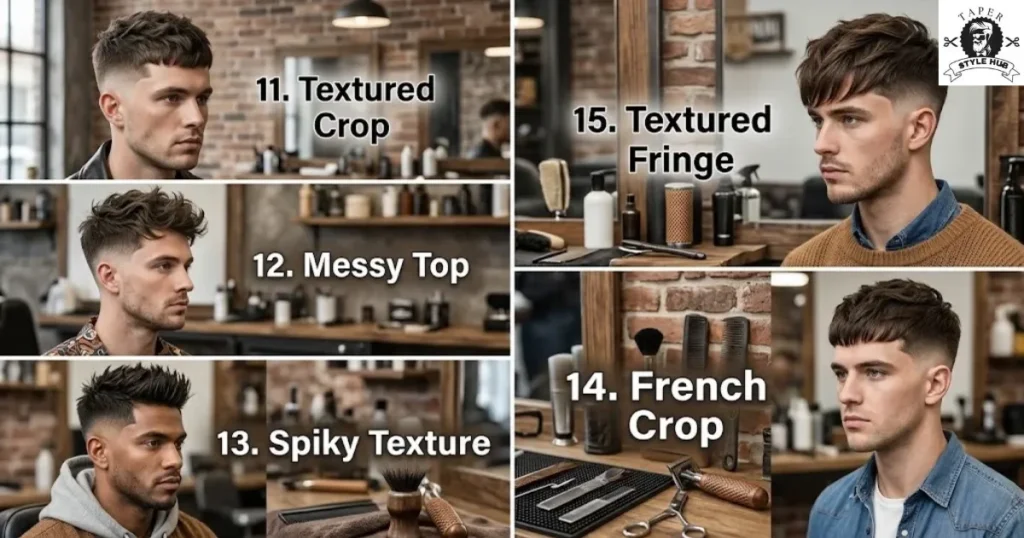
Texture is what makes this cut look modern. The soft curve below balances the rough, tousled movement on top, and this is the most popular group right now.
“All The Types Shown Below Are Displayed In The Single Image Above☝️”
11. Textured Crop
A short, choppy crop adds fullness and hides thin spots. Work sea salt spray into damp hair, scrunch it with your fingers, and let it air dry.
12. Messy Top
A deliberately messy top sits over tidy sides, and the contrast is the whole point. Twist small sections of matte clay through dry hair and do not overthink it.
13. Spiky Texture
Short spikes add height, which helps round faces look longer. Pull small sections upward with strong clay and keep the spikes short and even.
14. French Crop
A blunt fringe sits across the forehead above clean sides. It is simple, sharp and very current, and it also covers a high forehead nicely.
15. Textured Fringe
This is a softer cousin of the French crop. The fringe is broken up with texture instead of cut blunt, and it should sit above the eyebrows.
Curly, Coily and Wavy Low Drop Fade Haircuts
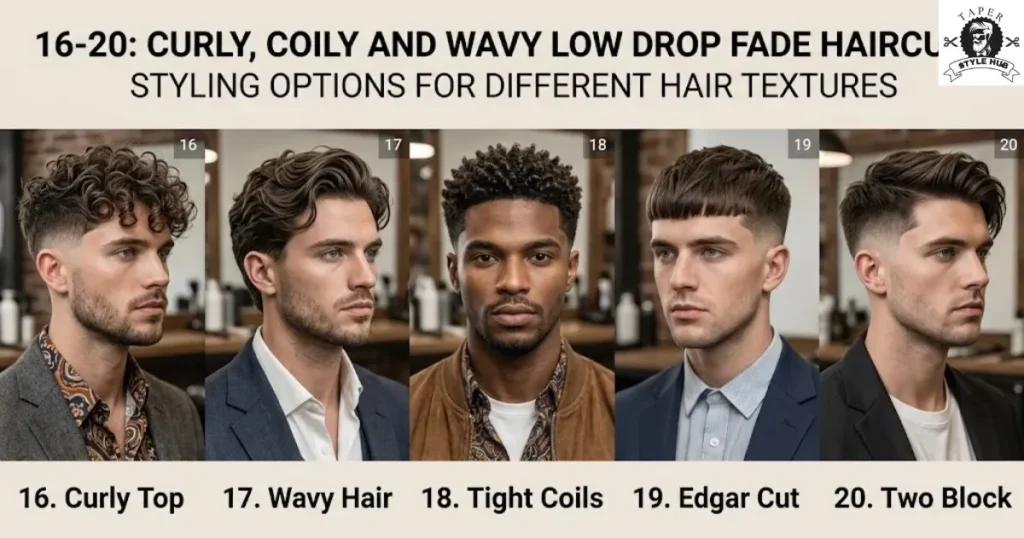
The curve follows the natural shape of the head, so it keeps the sides tight while curls get all the attention. These styles work for every curl type.
“All The Types Shown Below Are Displayed In The Single Image Above☝️”
16. Curly Top
Natural curls stay long on top while the fade frames them from below. Apply curl cream to damp hair, scrunch gently, and let it dry without touching.
17. Wavy Hair
Beachy waves on top and a low curved fade below give a relaxed but groomed look. Keep about three inches of wave and mist with sea salt spray.
18. Tight Coils
Short tight coils on top look crisp against the curved fade. Moisturize with a light oil and define the pattern with a sponge brush.
19. Edgar Cut
The Edgar pairs a straight, blunt fringe with a sharp line-up. Paired with a low curved fade, it looks bold and unmistakable on straight, thick hair.
20. Two Block
A longer top sits over shorter faded sides. The soft curve blends the disconnect more gently than a harsh undercut would, which suits straight, thick hair.
Bold Statement Low Drop Fade Haircuts

These are the high-impact versions, with big height, strong shapes and sharp lines. They take more styling time, and they also earn the most compliments.
“All The Types Shown Below Are Displayed In The Single Image Above☝️”
21. Quiff
A voluminous quiff sweeps up and back over tight sides. Leave three to four inches on top, then blow-dry upward and lock it in with medium-hold pomade.
22. Pompadour
The classic pomp gets real height in front while the curved fade gives it a modern base. Thick hair with natural volume holds this shape best.
23. Faux Hawk
A longer strip rises down the middle with faded sides. It is edgy without going full mohawk, and strong clay pulls the top toward the center.
24. Mohawk Strip
A narrow mohawk strip with low faded sides feels daring but wearable. The soft curve takes the harshness off the edges, though it suits weekends more than offices.
25. Mullet
Short on top and long at the back, the mullet flows naturally into the curve behind the ear. Texturize the top with clay and let the back fall freely.
Long Tops and Smart Finishes

Not every version is short on top. These styles keep real length above while the curve handles the sides, and the last two are built for specific hair types.
“All The Types Shown Below Are Displayed In The Single Image Above☝️”
26. Long Top Flow
A longer top is swept back in a relaxed flow with the sides faded low. Blow-dry it back with a brush and add a little cream to control flyaways.
27. Undercut Top
A longer, disconnected top sits over faded sides. The low curve blends that disconnect more softly. Slick the top back or to the side with pomade.
28. Hair Design
A shaved line or pattern carved into the fade turns the curve into a canvas. Designs grow out fast, so book a trim every two weeks to keep lines crisp.
29. Thick Hair Version
For dense hair, the barber thins the top so it does not puff out over the fade. Matte clay controls volume better than heavy pomades that add bulk.
30. Fine and Thin Hair Version
For fine or thinning hair, ask for a number one or two guard instead of skin and keep the top short with texture. Shorter tops always look thicker.
Low Drop Fade with Long Hair on Top

A low curve keeps the sides neat without costing you length on top. That makes it a smart choice for men who want a tidy look while growing their hair out.
“All The Types Shown Below Are Displayed In The Single Image Above☝️”
Man Bun
Longer hair tied back looks cleaner when the sides and nape are faded. You need enough length to gather it, so allow several months of growth.
Dreads and Locs
The fade cleans the lower sides and the area around the ears while the locs stay long. The barber should work around your existing pattern and avoid removing too much from the sides.
Waves and Blowouts
A blowout adds height and volume on top, while brushed waves rely on regular care. The low placement keeps more hair on the sides, which suits wave patterns better than a high fade.
How to Ask Your Barber for a Low Drop Fade
Saying the name alone leaves several decisions to guesswork. Settle five specifications before the clippers come out, and bring side and rear photos so the barber sees the curve.
- Fade height: say the blend should start just above the ear and stay low.
- Drop depth: choose a subtle or pronounced arc, and show it in a rear photo.
- Shortest length: name skin, shadow, or a guard number for the base.
- Top length: give inches judged dry, and say whether it blends or stays disconnected.
- Neckline and edges: pick a squared, rounded or tapered neckline and decide on a line-up.
Here is a simple script you can read from your phone: low drop fade with a number one guard at the base, a gentle arc behind the ear, three inches on top, and a tapered neckline.
Avoid vague phrases such as clean me up or do whatever you think. Those leave the curve to chance, and your barber cannot guess the depth you imagined.
How to Find a Barber Who Understands the Curve
The curve takes real skill, so the barber matters more than the product or the photo. Use this short checklist before you commit to a new shop.
- Check their portfolio or Instagram for side and rear photos of curved fades.
- Read recent reviews that mention blending, precision and listening.
- Book a first appointment with modest expectations, since a consultation cut reveals a lot.
- Notice whether they ask questions before picking up the clippers.
- Once you find a good one, tip well and book ahead.
Choosing the Right Reference Photo
Bring a side view and a rear view, because the curve is hard to read from the front. Two or three photos from different angles work best.
Choose real haircuts on hair similar to yours. A cut on thick straight hair will not look the same on fine or curly hair, and generated images can show blends real hair cannot produce.
How a Barber Builds the Curve
A good cut starts with the curve, not the blend. The barber marks the arc above the ear, steps back, and checks that both sides match before any graduation begins.
Then each zone steps up with passes that follow the arc. Above the line, more hair stays than in a standard fade, and scissor-over-comb work blends it into the top.
Speak up after the first pass. Height and symmetry are set early, and an uneven arc cannot be blended away later.
Tools Behind a Clean Low Drop Fade
Most barbers mark the arc with the edge of a clipper or a detail trimmer. They then work through guards, starting with the shortest length at the bottom and stepping up along the curve.
A flat-top comb helps the barber lift hair evenly, while shears and thinning scissors soften the transition into the top. Finally, a razor or trimmer cleans the neckline and sideburns.
Ask what base length the barber’s version of shadow or zero leaves. Shops use those words differently, and a quick question prevents surprises.
Neckline and Hairline Options for a Low Drop Fade
The neckline is the last thing people see and the first thing that grows out badly. Pick it deliberately, because it changes how the curve finishes at the back.
| Neckline | How It Looks | Best For |
|---|---|---|
| Blocked | Straight across the nape | Sharp, bold looks with a skin finish |
| Rounded | Soft curve across the nape | Most heads and a relaxed feel |
| Tapered | Gradual fade into the natural hairline | Natural growth and low upkeep |
| V-shape | Point in the center of the nape | Short hair and a defined back |
Tapered necklines grow out most gracefully, so they suit anyone who rebooks every three or four weeks. Blocked and V-shaped versions look sharpest but lose their crispness faster.
How to Style a Low Drop Fade at Home
The fade needs almost no daily effort. Your routine depends on the top, so match the product to your hair type and start with less than you think you need.
| Hair Type | Best Product | Tip |
|---|---|---|
| Straight | Matte clay or paste | Use a pea-sized amount on dry hair |
| Wavy | Sea salt spray | Scrunch into damp hair and air dry |
| Curly | Curl cream | Apply to damp hair and avoid touching it |
| Coily | Light oil and moisturizer | Keep it hydrated to prevent frizz |
| Fine or thin | Volumizing powder | Avoid heavy pomades that flatten hair |
| Thick | Strong-hold clay | Work through small sections |
For volume, blow-dry the top upward with your fingers. For a sleek finish, comb pomade through damp hair. A little product goes a long way, because you can add more but never take it out.
Low Drop Fade with a Beard
This combination is one of the most requested pairings. The barber blends the sideburns into the beard so the curve behind the ear connects cleanly to the facial hair.
With stubble, keep the cheek line defined so it reads intentional. If you are clean-shaven, the fade stands alone, so keep the neckline crisp and the sideburns precise.
A full beard looks best when the barber matches the guard steps, so mention beard length before the low drop fade is blended.
Low Drop Fade for Black Men
Coils, waves and short natural hair all work well here. The low placement leaves room for natural volume on top while cleaning the area around the ears and neckline.
Add a line-up for a sharper front edge, or keep the natural hairline for a softer finish. Brush waves regularly and keep the hair moisturized for definition.
Low Drop Fade for Boys and Teens
Boys can wear this cut too, and a guarded finish is the safest choice for young skin. Keep the top easy to style so it survives school mornings and sports practice.
Ask the barber for a natural neckline and skip the line-up at first. Simple shapes grow out gracefully between visits.
How to Maintain a Low Drop Fade
A fresh fade looks sharp because the contrast between lengths is clean. As hair grows, that contrast softens, and the curve behind the ear is the first thing to blur.
| Base Finish | Looks Sharpest For | Typical Rebooking |
|---|---|---|
| Skin | About 3 to 5 days | Every 10 to 14 days |
| Shadow | About 1 week | Every 2 to 3 weeks |
| Number 1 guard | 1 to 2 weeks | Every 3 to 4 weeks |
| Taper | 2 to 3 weeks | Every 3 to 5 weeks |
Between visits, tidy the neckline and sideburns with a cordless trimmer. Leave the arc itself alone, because re-cutting the fade at home usually ruins the symmetry.
Book your next appointment before you leave the chair. A standing slot every three weeks keeps the cut looking fresh without any guesswork.
Daily Hair Care Habits for a Low Drop Fade
Healthy hair makes every cut look better. Wash according to your texture, condition curly and coily hair regularly, and avoid piling on product that builds up by midday.
Apply styling product to damp hair rather than dry, because it spreads more evenly. Sleep on a smooth pillowcase if your waves or curls frizz overnight.
Scalp Care and Skin Comfort
A close fade shows your scalp, so dryness and flakes become visible. Use a gentle scalp shampoo, avoid very hot water, and moisturize lightly after washing.
Very short hair can curl back into the skin and cause razor bumps, especially on coarse or curly hair. A shadow or guarded finish is the simple fix. See a dermatologist if bumps keep returning.
Seasonal Tweaks for Your Low Drop Fade
In summer, go slightly shorter on top for breathability, and a skin finish feels cooler. In winter, let the top grow longer, because the curve keeps the shape structured even with extra length.
Autumn suits a medium top that handles cooler weather, while spring is a good moment to try a new variation you considered over winter.
Growing Out a Low Drop Fade
Growing out a fade is the phase most men dread. Keep the neckline tidy every two to three weeks, and let the top and sides grow evenly instead of cutting only the sides.
Expect eight to twelve weeks to transition fully. Around week six, book a shape-up that blends you into a longer style rather than a full re-cut.
Does Age Matter?
Not in the way most men think. The cut works from the late teens through the fifties and beyond, and only the best top style changes as hair density shifts.
Men with thinning crowns benefit from longer tops that create volume. Grey or salt-and-pepper hair looks especially sharp, because the contrast against the faded sides photographs well.
Whatever your age, the low drop fade gives you structure without trying too hard, and you can adjust the top whenever your hair or taste changes.
Troubleshooting a Bad Low Drop Fade
Even good barbers have off days. Most problems are fixable, and knowing the right response saves you from panicking in the chair or at home.
Uneven Curve
If one side sits lower, give it about a week for the blend to soften. Then return and ask your barber to redraw the line on both sides.
Fade Too High
Nothing brings hair back, so simply wait it out and bring a clear photo next time. Point to the exact spot where the blend should stop.
Irritated Neckline
Apply a fragrance-free aftershave balm right after the cut and avoid touching the area. Mild redness usually settles within a couple of days.
Top Too Short
It grows. Two or three weeks usually restores enough length to restyle, and a little texture product hides the difference while you wait.
Common Low Drop Fade Mistakes to Avoid
Most bad results come from vague placement or length removed before the shape was agreed. Watch for these seven problems.
- Asking for a regular fade, which gets you a level line instead of a curve.
- Showing only a front photo, when the drop lives behind the ear.
- Dropping the curve too low, so it reads like a taper.
- Not dropping it enough, so it becomes a plain low fade.
- Letting the blend creep up until the cut stops being low.
- Waiting more than four weeks between trims.
- Using heavy product that flattens the top and hides texture.
Common Myths About the Low Drop Fade
A few wrong ideas keep people from asking for this cut, or from getting the version they actually want. Here are the three most common ones.
Myth: It Always Means Skin
The word drop describes the curve, not the length. A shadow or guarded base keeps the same shape with softer contrast.
Myth: It Only Suits Short Hair
Long tops, curls, locs and buns all work above a low curve. The fade only reshapes the sides and back.
Myth: It Is the Same as a Low Fade
The two start at the same height, but only one bends behind the ear. That small difference changes the whole silhouette.
How Much Does a Low Drop Fade Cost?
In most barbershops the price sits somewhere between 25 and 45 dollars, while premium city shops can charge more. The curve takes extra skill, so some shops add a small fee.
Extras such as a line-up, beard trim or hair design usually add a few dollars each. Pay for an experienced barber, because one bad fade takes weeks to grow out.
Quick Guide: Which Low Drop Fade Should You Choose?
Use this table as a shortcut, then fine-tune the details with your barber.
| Your Goal | Best Choice |
|---|---|
| Maximum sharpness | Skin finish with a hard part or line-up |
| Low maintenance | Taper finish with a short crop |
| Professional setting | Shadow finish with a side part |
| Thick hair control | Thinned top with matte clay |
| Fine hair fullness | Number two guard with a textured top |
| Curl definition | Longer curly top with a soft transition |
| Bold statement | Quiff, pompadour or faux hawk |
Final Thoughts on the Low Drop Fade
A low drop fade is simple once you split it into parts: a low start above the ear, a curved path behind it, and a base length you choose. Everything else is a separate decision.
Pick your finish, save side and rear photos, and share a clear brief with your barber. Check the arc in a mirror before blending starts, and your cut will stay crisp between visits.
Whether you choose a crisp skin finish or a soft taper, the low drop fade rewards a little preparation. Walk in with photos, name your specifications, and leave with a cut that matches the picture in your head.
Frequently Asked Questions About the Low Drop Fade
What Is the Difference Between a Low Fade and a Low Drop Fade?
A low fade holds a level line around the head, while a low drop fade curves downward behind the ear toward the neckline.
How Often Should I Trim a Low Drop Fade?
Every two to three weeks keeps the blend sharp. Choose shorter gaps for a skin finish and longer gaps for a taper.
Does a Low Drop Fade Work on Curly Hair?
Yes, it suits curls and coils well. Keep enough length on top and agree on the dry length with your barber.
Can I Get a Low Drop Fade Without Showing Skin?
Yes. Ask for a shadow or guarded finish, and the curve stays the same with softer contrast.
Is a Low Drop Fade Good for Work?
Yes. The low contrast makes it one of the most professional fades, especially with a side part or slick back.

I’m M Ahmad Ansari, founder and content creator at Taper Style Hub. With 3+ years of experience researching taper haircuts, hairstyles, grooming, and men’s style, I create practical, accurate, and easy-to-understand content. My goal is to provide readers with trustworthy information, useful tips, and inspiring ideas for choosing and styling the perfect taper haircut.


4 Comments