Low Taper Fade Buzz Cut: 27 Best Styles
A low taper fade buzz cut gives you short, even hair on top and a soft blend around the ears and neckline. It looks sharp without asking for much time, which is exactly why so many men keep asking their barbers for it.
This guide walks through 27 styles, the right clipper guard numbers, face shape and hair type advice, and a barber script you can read out loud. You will also find styling steps, upkeep tips, comparisons and common mistakes to avoid.
👉 Also Read: Taper Fade Black Male
What Is a Low Taper Fade Buzz Cut?
It is a buzz cut with a low taper on the sides and back. The top is clipped to one short length, usually with a #2, #3 or #4 guard. The hair then shortens gradually just above the ears and around the nape.
Because the taper stays low, most of the side hair remains in place. You get a clean frame around the head without the stark contrast of a high fade. That balance is what makes the cut feel polished instead of extreme.
Key features of this haircut include:
- Short, even hair on top
- A low taper around the ears and sideburns
- A clean, blended neckline
- A gradual transition instead of a hard line
- Minimal daily styling
- Flexible guard lengths from #1 to #5
The exact result depends on hair density, texture, head shape and hairline. A good barber adjusts the guard and the taper to suit all four.
👉 Also Read: Low Taper Buzz Cut
Why the Low Taper Fade Buzz Cut Is Trending in 2026
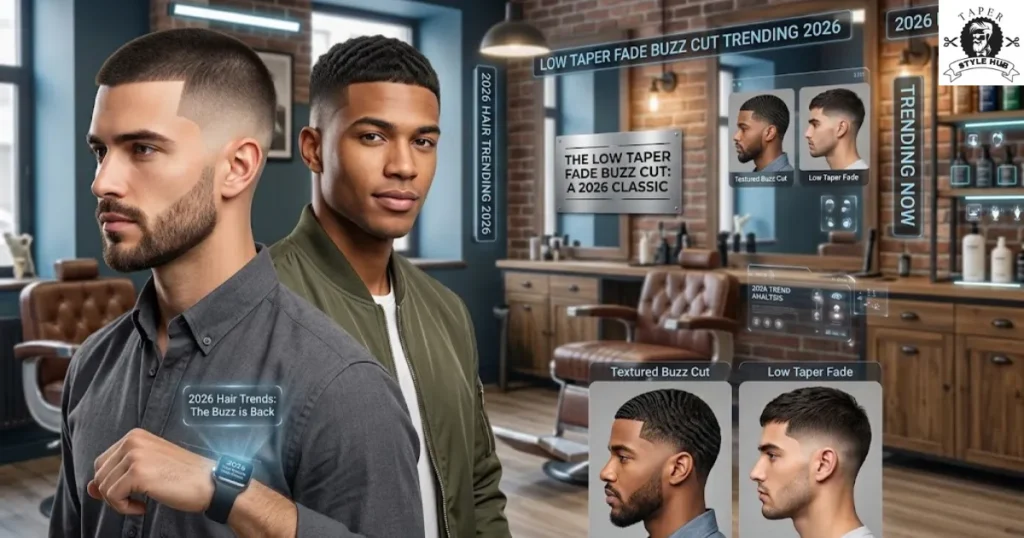
Men want sharp hair that does not eat up the morning. This cut delivers that, and barbershop reels on TikTok and Instagram have pushed it into the mainstream. People see a fresh before and after, and they want the same result.
Barbers also say many clients now ask for lower fades because they grow out more gracefully. Nobody wants patchy edges after five days. A low taper stays presentable for two to three weeks.
The look fits the gym, the office and a night out. That versatility, combined with almost zero styling effort, explains why the low taper fade buzz cut keeps climbing.
Short hair also photographs well, which helps in the age of constant profile photos. A clean low taper fade buzz cut frames the face without competing with clothes or backgrounds.
👉 Also Read: Low Taper Fade Black Men
Who Should Choose This Haircut
This cut suits most men, but some groups get more from it than others. Students, athletes and busy professionals usually see the biggest payoff because the upkeep is so light.
- Busy professionals who want a tidy look with no morning routine
- Athletes who sweat often and prefer lightweight hair
- Men with thinning hair who want less contrast between thick and thin areas
- First-time buzz cut wearers, since the low taper is forgiving
- Teens and students who need a school-friendly style
If you plan to grow your hair out later, the low taper also makes the transition easier. The sides blend into longer lengths without an awkward stage.
If you are still unsure, ask the barber for a #3 version first. A low taper fade buzz cut can always be taken shorter at the next visit.
👉 Also Read: Low Taper Mullet
What Is a Buzz Cut?
A buzz cut is hair clipped to one short length all over the head. Barbers describe the length with guard numbers, where a lower number means shorter hair. The name comes from the buzzing sound of electric clippers.
On its own, a uniform buzz can look flat on some head shapes. That is why many men ask for a taper or fade on the sides.
👉 Also Read: Blonde Low Taper Fade
What Is a Low Taper Fade?
A taper is a gradual shortening of hair around the sideburns, ears and neckline. A fade goes further and usually reaches skin level. Many barbershops use the two words almost interchangeably.
The word “low” tells the barber where the change starts. A low taper begins near the ear and nape, so the cut keeps weight on the sides and looks subtle.
👉 Also Read: Low Taper Fade Fluffy Hair
Low Taper vs Mid Taper vs High Taper
Fade height changes the whole mood of the haircut. A low taper sits at the ear, a mid taper rises toward the temple area, and a high taper climbs toward the crown.
Higher fades add contrast but demand more frequent visits. Lower ones are softer and more forgiving.
👉 Also Read: Low Taper Buzz
Benefits of a Low Taper Fade Buzz Cut
The benefits go well beyond convenience. Here is what most men notice after the first month:
- Low effort: no blow drying and no product routine
- Clean neckline: the nape stays tidy even in week three
- Flexible: works with straight, wavy, curly, coily, thick and fine hair
- Beard friendly: the taper blends smoothly into facial hair
- Cool and light: ideal for warm weather and workouts
- Budget friendly: fewer products and shorter chair time
- Professional: suitable for interviews and conservative offices
A typical appointment takes 15 to 20 minutes, and the shape holds for two to three weeks.
27 Low Taper Fade Buzz Cut Styles Explained by Category
Instead of one long list, the 27 styles below are grouped into seven categories. Each group shares a common idea, such as fade finish, top length or hair texture, so you can jump to the one that fits you.
All of them share the same base: a short top and a low taper. Small changes in guard size, hairline and finish make each version look different.
Classic and Everyday Styles
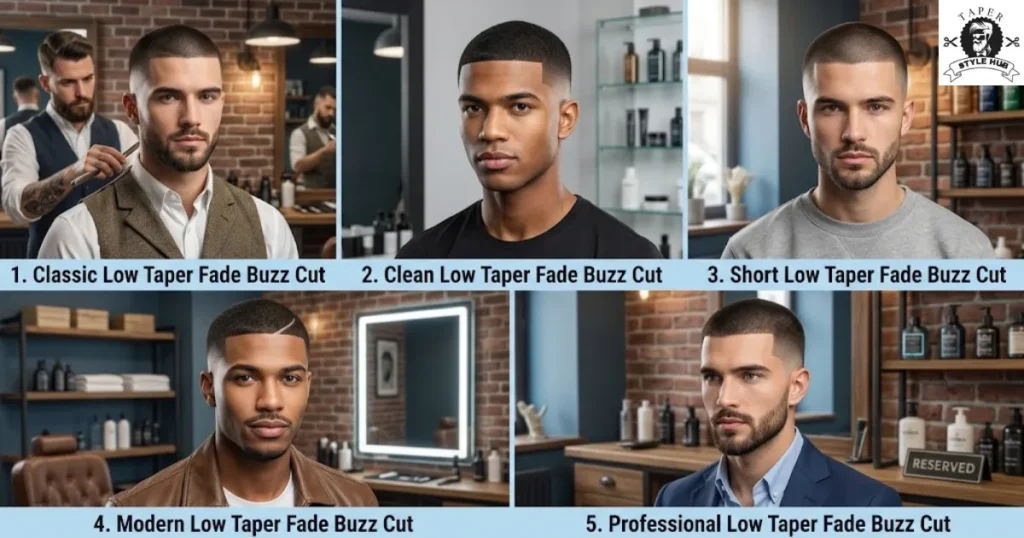
These five versions are the safest starting points. They keep the shape simple, work in nearly every setting, and need very little explanation at the barbershop.
“All The Types Shown Below Are Displayed In The Single Image Above☝️”
1. Classic Low Taper Fade Buzz Cut
The original version uses a #2 or #3 guard on top with a soft taper around the ears and neck. The natural hairline stays untouched. It is the easiest cut to describe to any barber.
Best for: first-timers and anyone who wants a reliable everyday look. Maintenance: a trim every 2 to 3 weeks.
2. Clean Low Taper Fade Buzz Cut
This version has no designs or harsh lines. One guard covers the top, the taper blends smoothly and the neckline looks natural. It reads as neat, simple and freshly cut.
Best for: men who prefer understated grooming. Maintenance: a quick neckline cleanup every 2 weeks.
3. Short Low Taper Fade Buzz Cut
A #1 or #1.5 guard on top gives an extra close finish while the taper stays low. It is almost maintenance free and grows out evenly. Check your head shape first, since very short hair shows scars and crown patterns.
Best for: hot climates and very busy schedules. Maintenance: light, with a touch up every 3 weeks.
4. Modern Low Taper Fade Buzz Cut
A #3 or #4 on top, a soft skin taper and a relaxed natural hairline give this version a current feel. It looks casual without looking careless.
Best for: younger men who want a softer take on the buzz. Maintenance: a refresh every 3 weeks keeps the taper soft.
5. Professional Low Taper Fade Buzz Cut
A #3 top, a subtle taper that finishes at short stubble and a tidy neckline make this the office option. There are no designs and no sharp contrast.
Best for: interviews, client-facing roles and conservative workplaces. Maintenance: a visit every 2 to 3 weeks keeps the edges tidy.
Fade Finish and Contrast Styles

The way the taper ends changes how bold the cut looks. These four variations adjust the contrast between the top and the sides.
“All The Types Shown Below Are Displayed In The Single Image Above☝️”
6. Skin Fade Low Taper Fade Buzz Cut
The taper drops to bare skin at its lowest point while the fade line stays low. A #2 on top looks especially crisp. The trade-off is faster regrowth, so cleanups come sooner.
Best for: men who want sharper contrast without a high fade. Maintenance: high, with a visit every 1 to 2 weeks.
7. High Contrast Low Taper Fade Buzz Cut
Pairing a #4 top with a quick drop to skin creates a bold, graphic look in a small area. Dark hair on lighter skin shows the contrast most clearly.
Best for: men who want more edge than a standard blend. Maintenance: high, so book every 10 to 14 days.
8. Buzz Cut with Temple Fade
The fade concentrates around the temples while the low taper handles the nape. It frames the face nicely and softens the hairline.
Best for: men who want definition without a dramatic drop. Maintenance: medium, with a fix every 2 weeks.
9. Buzz Cut with Drop Fade Shape
Here the fade curves down behind the ear and around the nape instead of running straight. The curve adds flow when viewed from the side and back. It looks best with a #3 or #4 top.
Best for: men who like subtle detail. Maintenance: medium, with a trim every 2 to 3 weeks.
Top Length and Texture Styles
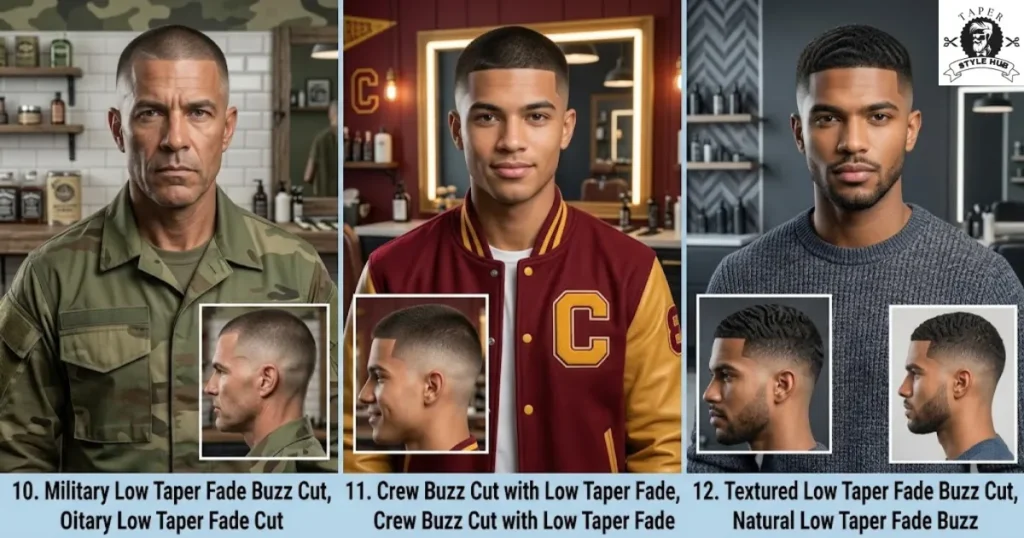
Top length shapes the whole silhouette. These three versions change how much hair stays on top and how it behaves.
“All The Types Shown Below Are Displayed In The Single Image Above☝️”
10. Military Low Taper Fade Buzz Cut
A #1 or #2 top with a close taper and a clean nape. It looks disciplined and tough, but the low taper makes it feel modern instead of regulation.
Best for: men who want a no-fuss, practical finish. Maintenance: low, since a quick re-buzz handles most regrowth.
11. Crew Buzz Cut with Low Taper Fade
This version keeps slightly more length, often a #4 or #5, with short tapered sides. It looks athletic and classic.
Best for: men who want some texture to run a hand through. Maintenance: medium, with a trim every 3 weeks.
12. Textured Low Taper Fade Buzz Cut
A #4 or #5 top with a pinch of matte paste gives a rough, lived-in finish. Light texturizing with scissors adds movement while the taper keeps the sides clean.
Best for: wavy and thick hair that needs a little personality. Maintenance: a trim every 3 weeks keeps the texture neat.
Detail and Edge Styles

Line work adds precision. These four styles lean on trimmer detail, so expect shorter gaps between barber visits.
“All The Types Shown Below Are Displayed In The Single Image Above☝️”
13. Buzz Cut with Line Up and Low Taper Fade
A line up creates crisp, straight edges along the forehead and temples. With a #2 or #3 top it makes the face look more defined. Ask for a natural line if you want to keep your original hairline.
Best for: square faces and strong hairlines. Maintenance: very high, because the line grows out within a week or two.
14. Buzz Cut with Sharp Edge Up
An edge up cleans the full hairline, including the forehead, temples and the area behind the ears. It follows your natural shape and gives a fresh-from-the-barber finish.
Best for: coarse, thick hair that holds crisp lines. Maintenance: high, with a weekly or fortnightly edge up.
15. Buzz Cut with Hard Part and Low Taper Fade
A razor shaves a thin line where a normal part would sit. It adds structure without needing a comb over. The line needs a refresh every week or two.
Best for: straight and thick hair. Maintenance: high, because the part needs frequent re-shaving.
16. Low Taper Fade Buzz Cut with Hair Design
A shaved line, small geometric shape or pattern is etched into the faded area. Keep the rest of the cut simple so the design stands out. Designs fade quickly, so plan frequent visits.
Best for: men who want to show personality. Maintenance: very high, since designs soften within a week.
Beard and Color Styles

Facial hair and hair color change how the taper reads. These two styles show how to work with each.
“All The Types Shown Below Are Displayed In The Single Image Above☝️”
17. Buzz Cut with Beard and Low Taper Fade
The taper runs from the sideburn straight into the beard, so there is no visible break. The result looks like one continuous shape from temple to jaw. Shape the beard at the cheek line.
Best for: men with a short beard or heavy stubble. Maintenance: high, because both the hair and the beard need shaping.
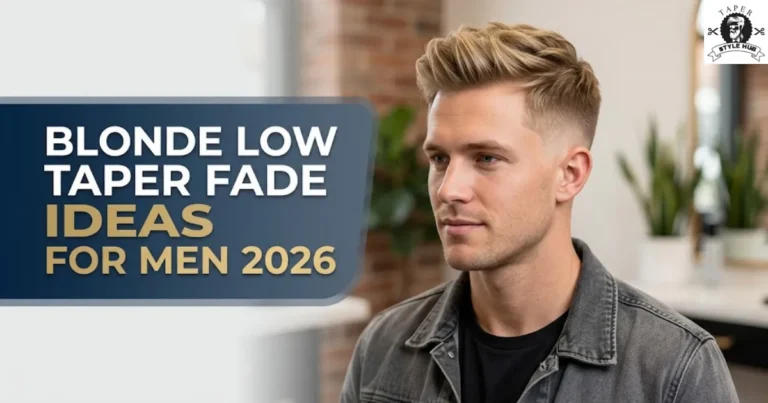
18. Blonde Low Taper Fade Buzz Cut
Light hair lowers the contrast with the scalp, so the taper looks softer. If you bleach, use a toning shampoo and keep the top at #3 or longer to protect the hair.
Best for: natural blondes and men who like a bolder color. Maintenance: medium, plus root touch ups if you color.
Hair Type Styles
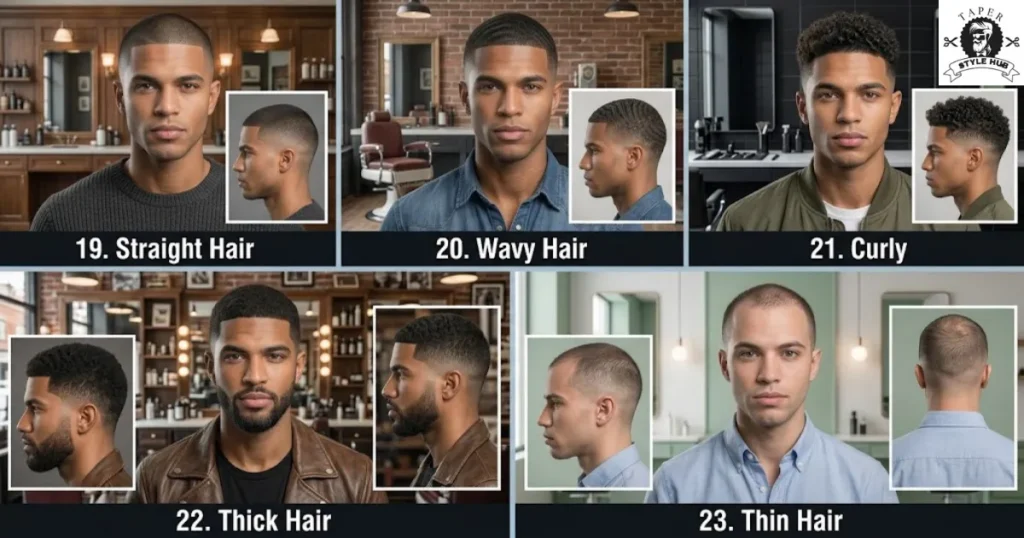
Hair texture changes how the same guard number looks. These five versions are tuned to common hair types.
“All The Types Shown Below Are Displayed In The Single Image Above☝️”
19. Straight Hair Low Taper Fade Buzz Cut
Straight hair lies flat, so the taper looks especially clean. Use a #3 or #4 and ask the barber to check for cowlicks at the crown.
Best for: men who want crisp, visible fade lines. Maintenance: low, with a haircut every 3 weeks.
20. Wavy Hair Low Taper Fade Buzz Cut
Waves stay visible even at short lengths, giving the top depth without any product. A #3 keeps the wave alive while the taper removes side bulk.
Best for: men with medium-density wavy hair. Maintenance: medium, with a trim every 3 weeks.
21. Curly Low Taper Fade Buzz Cut
Curls contract when they dry, so a #3 can look like a #2. Keep the top slightly longer and ask for a dry cut so the length you see is the length you get.
Best for: curly hair that needs controlled width. Maintenance: medium, with a trim every 2 to 3 weeks.
22. Thick Hair Low Taper Fade Buzz Cut
Thick hair can puff out within two weeks. A tight taper removes the helmet effect and keeps the head looking proportionate.
Best for: dense hair that grows quickly. Maintenance: medium, because thick hair grows quickly.
23. Thin Hair Low Taper Fade Buzz Cut
Go a little longer, around a #3 or #4, and avoid a harsh skin fade. A softer taper helps thin areas blend in, and the top looks fuller.
Best for: fine or thinning hair. Maintenance: low, with a trim every 3 weeks.
Styles for Different Textures and Age Groups
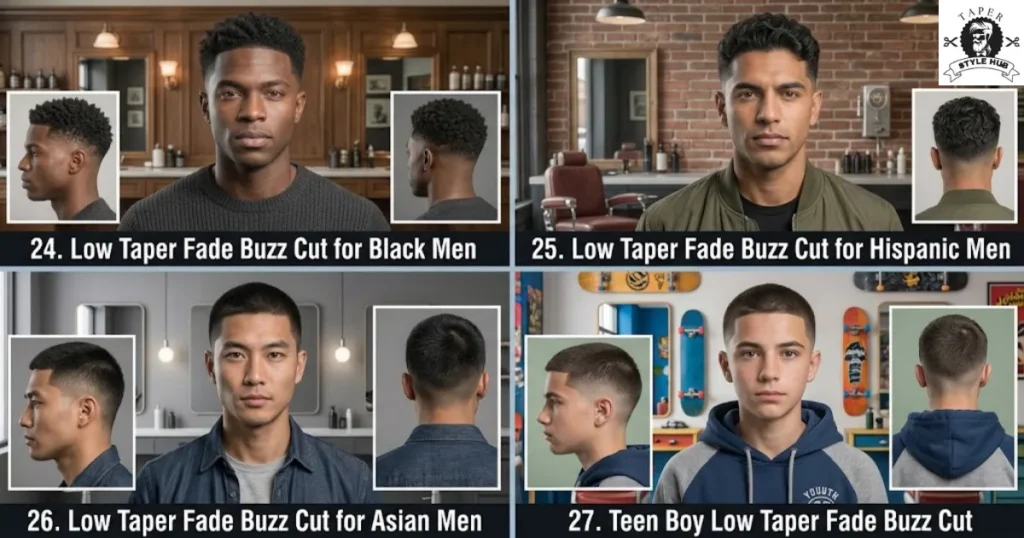
Every head of hair behaves differently. These four styles answer common requests, and the advice is based on hair texture and age rather than assumptions.
“All The Types Shown Below Are Displayed In The Single Image Above☝️”
24. Low Taper Fade Buzz Cut for Black Men
On tight curls or waves, the low taper keeps the shape neat and defined. Ask for a clipper finish instead of a close razor to lower the risk of razor bumps.
Best for: coily and wavy textures that need a clean perimeter. Maintenance: high, with a line up and fade fix every 1 to 2 weeks.
25. Low Taper Fade Buzz Cut for Hispanic Men
Dense, dark hair holds a buzz shape well. A #2 top, a low skin taper and a crisp line up give a polished look.
Best for: thick, dark hair. Maintenance: medium, with a trim every 2 weeks.
26. Low Taper Fade Buzz Cut for Asian Men
Straight, thick hair often sticks out at the sides as it grows. Keep the taper tight, use a #3 or #4 top and book trims early.
Best for: strong, straight hair. Maintenance: high, so cut every 2 weeks before the sides flare out.
27. Teen Boy Low Taper Fade Buzz Cut
A #2 or #3 top with a gentle taper is easy to maintain and usually school friendly. Check the dress code first.
Best for: students who want a neat look with no styling. Maintenance: medium, which fits a standard 3 week haircut routine.
Best Clipper Guard Numbers for a Low Taper Fade Buzz Cut
Guard numbers decide how much hair stays on top. A higher number leaves more length. Use this chart as a starting point and adjust for hair density and head shape.
| Guard | Length (inches) | Length (mm) | Typical use |
|---|---|---|---|
| #1 | 1/8 | 3 | Tight fade or very short top |
| #2 | 1/4 | 6 | Classic short buzz |
| #3 | 3/8 | 10 | Most popular top length |
| #4 | 1/2 | 13 | Longer, softer buzz |
| #5 | 5/8 | 16 | Textured top |
Exact lengths vary slightly between clipper brands. Ask the barber to test the guard on a small patch first.
On Top
Use #2 for a sharp look, #3 for balance, or #4 and #5 for texture. If you are unsure, start at #3.
For the Fade
The sides usually step from a #1 at the bottom to a #2 or #3 where they meet the top. A smaller gap between guards gives a softer blend.
Fade Height
A low taper begins near the ear and nape. Anything higher moves into mid fade territory with more contrast and more upkeep. A taller fade also grows out faster, which means more frequent barber visits.
Hairline Shape
Choose a natural hairline for a relaxed look, a rounded edge up for polish, or a squared line up for a bold finish.
Beard Blending
If you wear a beard, ask the barber to blend the taper from the sideburn into the beard line so it steps down smoothly.
Neckline Preference
A tapered neckline fades into the skin and grows out naturally. A blocked neckline looks sharp but turns untidy faster.
How to Ask Your Barber for a Low Taper Fade Buzz Cut
Barbers work with numbers and positions, not vague words like “short”. Decide four things before you sit down: the top guard, the fade type, the fade height and the edge style.
A reference photo removes most of the guesswork.
Barber Script
Read this out or show it on your phone:
- “I would like a #3 on top, all one length.”
- “Please give me a low taper on the sides and back, starting just above the ear.”
- “Keep the fade soft, not down to skin.” Say “take it down to skin” if you want a skin fade.
- “Can we start longer and go shorter if needed?”
Starting with a longer guard is the safest move, because hair cannot be put back.
What Not to Say
- “Just trim it up” gives no direction.
- “Fade it however you want” hands the decision to the barber.
- “Make it short” means something different to every barber.
Always give numbers and mention the taper height.
Step-by-Step Barber Technique
Knowing the process helps you spot good work:
- The barber clips the top with the chosen guard.
- The taper starts just above the ear with an open lever.
- The lever moves to half and then closed to build a soft graduation.
- A C-shaped motion around the ear softens the blend.
- An outliner or trimmer details the hairline and temples.
- The neckline gets light, precise strokes.
- A final check confirms both sides are symmetrical.
Best Face Shapes for a Low Taper Fade Buzz Cut
A short haircut shows the natural proportions of the face, so guard choice matters. This table gives quick pairings.
| Face shape | Best top guard | Why it works |
|---|---|---|
| Oval | #2 to #3 | Balanced proportions suit almost any version |
| Square | #2 to #3 | Close sides show off the jaw |
| Round | #3 to #4 | A little height slims the face |
| Long or oblong | #3 to #4 | Extra top length avoids stretching the face |
| Diamond | #3 | A fuller top balances wide cheekbones |
| Heart | #2 to #3 | A short top softens a wide forehead |
A line up suits square faces, while round faces do better with slightly more length on top. Oblong faces should avoid extremely short tops.
Best Hair Types for a Low Taper Fade Buzz Cut
Hair type changes how the same guard looks. Your barber should consider density and growth direction, not only the guard number.
| Hair type | Best guard | Main benefit |
|---|---|---|
| Straight | #2 to #3 | Sharpest, cleanest fade lines |
| Wavy | #3 | Texture stays visible |
| Curly | #3 to #4 | Keeps curls from looking patchy |
| Coily | #2 to #4 | Dense cap with defined edges |
| Thick | #1 to #3 | Taper removes side bulk |
| Fine | #3 to #4 | Looks fuller and less see-through |
Thin or receding hair works best with a longer guard and a soft taper. A high contrast skin fade can expose the scalp more than you expect.
Curly and coily textures benefit from dry cutting, which shows the true length before the hair is clipped.
Thinning Hair and Receding Hairlines
Men with thinning hair often worry that a short cut will expose the scalp. In practice, a #3 or #4 reduces the contrast between thick and thin areas. A low taper fade buzz cut keeps the sides tidy so the top draws less attention.
Avoid a very high contrast skin fade, which can make a thinning area stand out. A soft taper and a natural hairline are usually the safest choices.
Low Taper Fade Buzz Cut Pros and Cons
| Pros | Cons |
|---|---|
| Very low maintenance | Needs a trim every two to three weeks |
| Neat in almost every setting | Little room to hide scars or head shape flaws |
| Grows out gracefully | Scalp can sunburn without protection |
| Easy to explain to any barber | Skin fade versions need frequent touch ups |
| Works for most face shapes and hair types | Blending needs a skilled barber |
Overall the pros of a low taper fade buzz cut outweigh the cons for most men, as long as you plan for regular trims and sun protection.
How to Style a Low Taper Fade Buzz Cut
There is not much to style on a low taper fade buzz cut. A few small steps keep it looking intentional.
Best Styling Products
- Lightweight moisturizer: keeps the scalp from looking dry
- Matte clay or paste: adds texture to a #4 or #5 top
- Matte cream: keeps straight hair lying flat
- Beard oil: softens the sideburn and beard blend
- Sunscreen (SPF 30 or higher): protects the exposed scalp
Step-by-Step Styling Routine
- Wash with a gentle shampoo and rinse well.
- Pat the head dry with a towel.
- Rub a pea-sized amount of matte paste between your palms.
- Run it through the top against the growth direction, then smooth it forward.
- Apply sunscreen before going outside.
Skip heavy gels and greasy pomades. They flatten the cut and show too much scalp.
How to Maintain a Low Taper Fade Buzz Cut
Hair grows about half an inch a month, so the taper loses its blend first. Plan a barber visit every two to three weeks to keep the edges crisp.
| Task | How often |
|---|---|
| Barber visit (standard taper) | Every 2 to 3 weeks |
| Barber visit (skin taper or line up) | Every 1 to 2 weeks |
| Wash hair | 2 to 3 times a week |
| Neckline cleanup at home | Between visits |
| Scalp moisturizer | After washing or when dry |
Scalp Care and Sun Protection
Short hair exposes more scalp to sun, cold and dryness. Moisturize after washing and wear sunscreen or a hat in strong sun.
Handling Razor Bumps and Cowlicks
Razor bumps are more common on tight curls, so ask for clippers instead of a razor on the neckline. Cowlicks at the crown can stick up on short guards, so mention them to your barber.
A small trimmer at home helps with neckline and sideburn cleanups between visits.
Low Taper Fade Buzz Cut vs Other Haircuts
People often confuse similar cuts. This table sums up the differences before the details.
| Feature | Buzz cut | Low taper fade buzz cut | Skin fade buzz | Crew cut |
|---|---|---|---|---|
| Sides | Same as top | Gradual low taper | Fade to bare skin | Short, tapered |
| Contrast | None | Low | High | Low to medium |
| Upkeep | Lowest | Medium | Highest | Medium |
| Top | Even | Even | Even | Slightly longer |
Versus a Regular Buzz Cut
A plain buzz uses one length everywhere, so it has no taper. It is the lowest upkeep option but can look flat. A low taper cleans up the neck and ears for little extra effort.
Versus a Skin Fade Buzz Cut
A skin fade reaches bare skin and often sits higher. It looks bold but grows out fast. A low taper is gentler and lasts longer between cuts.
Versus a Crew Cut
A crew cut leaves more length at the front and on top with tapered sides. The buzz version keeps the top even and shorter.
Low Taper Fade Buzz Cut for Different Settings
One reason this cut stays popular is how easily it moves between settings. A few small tweaks to the guard and the edges let you adapt it without changing the base shape.
Office and Interviews
Choose a #3 top, a soft taper and a natural hairline. Skip designs and extreme contrast so the cut looks tidy and quietly confident. A fresh cleanup the day before an interview helps the neckline look crisp.
Gym and Sports
A #1 or #2 top dries fast and fits under caps and helmets. Sweat does not weigh anything down, and there is nothing to restyle after a workout. The low taper keeps the ears and nape clean.
School and College
A #2 or #3 with a gentle taper meets most dress codes. Check the school rules before asking for hard parts or designs. Parents usually like how easy it is to keep up.
Weddings and Formal Events
Book a visit two or three days before the event so the edges look sharp but not raw. A light line up and a beard blend add polish. Finish with a little moisturizer so the scalp does not look dry in photos.
Hot and Humid Weather
Short hair keeps you cool, but the scalp needs sunscreen. Wear a hat during long outdoor days and moisturize after showering. The low taper keeps the nape tidy even when you sweat.
What to Expect During Your Barber Appointment
Knowing the flow of a low taper fade buzz cut appointment makes it less stressful. Most visits follow the same simple order, and the whole thing takes about 15 to 20 minutes.
The Consultation
The barber asks about the top guard, fade height and hairline. This is the moment to show your reference photo and read your script. Confirm the taper starts low before the clippers touch your head.
The Cut
The barber usually clips the top first, then builds the taper from the bottom up. Expect clipper work around the ears and trimmer work on the hairline. A good barber checks symmetry from the front and the back.
The Finish
After the cut, the barber brushes off loose hair and may apply a light finishing product. Check both sides in the mirror and speak up if the taper looks higher than agreed. Small fixes are easy while you are still in the chair.
Choosing the Right Barber
Not every barber blends equally well, and a low taper needs a steady hand. Look at recent photos of their work before booking, especially close ups of the sides and neckline.
Signs of a skilled barber include:
- Smooth blends with no visible lines or steps
- Even symmetry on both sides of the head
- Clean, natural necklines
- Willingness to start longer and go shorter
- Questions about your lifestyle and hair type
If a barber ignores your reference photo or pushes the fade higher than you asked, consider finding someone else. A barber who listens will deliver a better low taper fade buzz cut every time.
Tools for Keeping the Look at Home
You can handle the top and the neckline at home, but the blend is best left to a barber. A few reliable tools make cleanups between visits much easier.
- Clippers with a full guard set from #1 to #5
- A small trimmer or outliner for the neckline and sideburns
- A handheld mirror to check the back of the head
- A soft brush to clear loose hair
- Scalp moisturizer and sunscreen
If you cut your own top, start with a longer guard than you think you need. Move against the direction of growth, check often and work in slow passes. Leave the taper around the ears to a professional.
How the Taper Grows Out Week by Week
Understanding the grow-out timeline helps you decide when to book your low taper fade buzz cut. Here is what most men see as the weeks pass.
| Week | What you will notice |
|---|---|
| Week 1 | Edges are crisp and the neckline is clean |
| Week 2 | The taper still looks sharp, with slight fuzz at the nape |
| Week 3 | The blend softens and the neckline starts to look fuzzy |
| Week 4 | The taper loses its shape and the sides look fuller |
| Week 6 | The cut reads as a medium length buzz with no clear taper |
These timings shift with growth speed and hair density. If you like a very crisp edge, book earlier. If you prefer a soft, lived-in look, stretching to four weeks is fine.
Myths About This Haircut
A few persistent myths keep some men from trying this cut. Here is what barbers say about each one.
Myth: It Only Suits Square Jaws
A square jaw shows off the sharp edges, but the cut adapts to other shapes too. Longer tops and softer tapers help round and long faces. A low taper fade buzz cut is more flexible than most people assume.
Myth: It Makes Thinning Hair Worse
Cutting hair short does not change how fast it thins. A #3 or #4 simply makes thin areas less noticeable by reducing contrast. Many men find a low taper fade buzz cut easier to live with than longer styles.
Myth: It Needs Constant Styling
The opposite is true. The cut was designed to need almost nothing, apart from a little moisturizer and the occasional cleanup. Most mornings take less than a minute.
Myth: A Taper and a Fade Are Completely Different
In everyday barbershop talk, the terms overlap heavily. A taper is usually more subtle, while a fade can reach bare skin. When you order a low taper fade buzz cut, describing the finish matters more than the word you use.
Quick Checklist Before You Book
A little preparation saves you from a haircut you did not want. Run through this list before you sit in the chair.
- Save a reference photo of the exact cut you like
- Decide on your top guard, starting with #3 if unsure
- Choose between a soft taper and a skin finish
- Pick a natural hairline or a sharper line up
- Check your schedule so you can return every 2 to 3 weeks
- Pack sunscreen or a hat for the first few days
With these details settled, your low taper fade buzz cut is far more likely to match what you pictured.
Celebrity Inspiration
Bring a photo to your barber, but remember that hair texture and head shape change how a cut looks. These public figures have been photographed with short, tapered or buzzed styles:
- Michael B. Jordan: an actor often shown with a short fade and neat beard
- David Beckham: a former footballer who has worn closely cropped hair at times
- Idris Elba: an actor often seen with very short hair and a trimmed beard
- Zayn Malik: a singer who has tried short cuts with sharp temple fades
- Drake: a rapper often photographed with a crisp line up and smooth taper
Use them as a reference for shape, not as a promise of identical results.
Common Mistakes to Avoid With a Low Taper Fade Buzz Cut
A short haircut leaves less room to hide mistakes. These are the ones barbers see most:
- Going too short on the first try: start one guard longer
- Letting the fade creep too high: say “keep it low” and point to the spot
- Skipping a reference photo: words mean different things to different barbers
- Forgetting sunscreen: a fresh buzz leaves the scalp exposed
- Waiting too long between cuts: after four weeks the blend loses its shape
- Ignoring scalp dryness: flaking shows quickly on short hair
Final Thoughts on the Low Taper Fade Buzz Cut
The low taper fade buzz cut gives you structure, speed and flexibility in one haircut. It suits professionals, athletes, students and anyone who wants neat hair without a long routine.
Pick your top guard, choose a fade height, bring a photo and use the barber script above.
Whether you choose the classic version or a bolder variation, the low taper fade buzz cut rewards a little planning. Choose the right guard, find a barber you trust and keep the edges fresh. Which of the 27 styles will you try first?
Frequently Asked Questions About the Low Taper Fade Buzz Cut
What guard number is best for a low taper fade buzz cut?
A #3 on top is the most popular choice, and a #2 gives a sharper look. Start with #3 if you are unsure.
How often should I get a trim?
Every two to three weeks keeps the edges crisp. Four weeks is possible, but the blend will soften.
Is a low taper the same as a low fade?
They are close, and many barbers use the words interchangeably. A taper is slightly more subtle, while a fade can reach skin.
Which face shapes suit this cut?
Oval, square, round and oblong faces all work with small changes to guard size and fade height.
How long does it take to grow out?
Hair grows about half an inch a month, so expect a medium length in two to three months.

I’m M Ahmad Ansari, founder and content creator at Taper Style Hub. With 3+ years of experience researching taper haircuts, hairstyles, grooming, and men’s style, I create practical, accurate, and easy-to-understand content. My goal is to provide readers with trustworthy information, useful tips, and inspiring ideas for choosing and styling the perfect taper haircut.


5 Comments