
Low Taper Fluffy Fringe: 15 Best Ideas
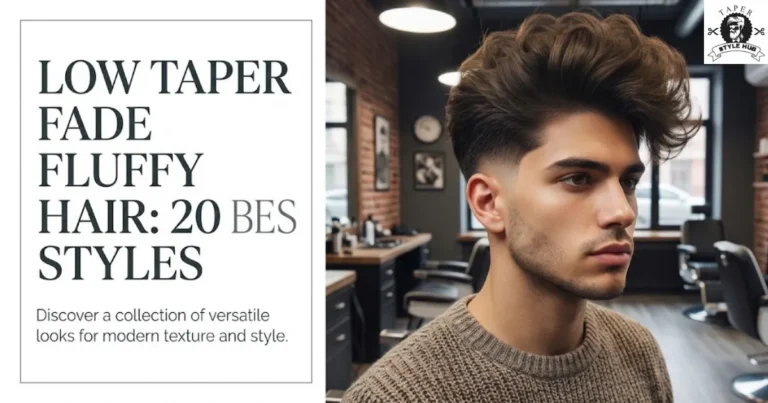
A low taper fluffy fringe is a men’s haircut that pairs short, softly blended sides with a full, airy top falling over the forehead. It looks clean at the edges and relaxed on top. That balance explains why barbers hear this request so often.
Most guys want a cut that looks sharp without a long morning routine. This one delivers. The taper keeps the outline tidy, while the fluffy fringe adds soft volume that moves naturally and never looks stiff or overstyled.
It also works on almost every hair type, from straight and fine to wavy, thick, and curly. This guide covers 15 styles grouped by category, barber scripts, styling steps, product picks, maintenance advice, and quick answers to common questions.
👉 Also Read: Messy Fringe Low Taper
What Is a Low Taper Fluffy Fringe Haircut?
A low taper fluffy fringe combines two haircut ideas that meet near the temple. The low taper shortens hair gradually around the sideburns, ears, and nape. The fluffy fringe keeps extra length at the front, cut in light layers so it lifts instead of lying flat.
Unlike a skin fade, a low taper usually leaves a soft shadow of hair even at its shortest point. The line stays close to the natural hairline and does not swoop behind the ear. That subtle finish keeps attention on the volume above.
Think of it as two haircuts working as one. The bottom half is precise and quiet, while the top half is soft, loose, and expressive. Together, they create a clean, modern men’s haircut with real personality.
👉 Also Read: Low Taper Fade Boys
The Two Parts Behind a Low Taper Fluffy Fringe
Every good version depends on getting both parts right. If the taper starts too high or the top is cut too short, the entire shape changes. Here is what your barber actually works on during the appointment.
- The low taper: Sides and nape start about an inch to an inch and a half above the ear, then shorten gradually toward the neckline.
- The fluffy fringe: The top stays around 3 to 5 inches long, with internal layers that remove weight without losing visible length.
- The blend: The barber joins both zones with scissor over comb or clipper over comb, so no harsh lines remain.
👉Also Read: Low Taper Fade Buzz Cut
Low Taper Fluffy Fringe vs Mid Taper vs High Taper
The words low, mid, and high tell you where the taper begins. That single detail controls how much contrast appears between the sides and the fluffy top. Choose carefully, because it changes the whole mood of the haircut.
| Feature | Low Taper | Mid Taper | High Taper |
|---|---|---|---|
| Starting point | Just above the ear | Around the temple | Near the crown |
| Contrast with the top | Soft and subtle | Clear and defined | Sharp and bold |
| Grow-out | Graceful and gradual | Shows sooner | Shows fastest |
| Typical refresh | Every 3 to 4 weeks | Every 2 to 3 weeks | Every 2 weeks |
| Best vibe | Polished and relaxed | Modern and bold | Dramatic and graphic |
A low taper fluffy fringe works best because the fade stays quiet and lets the volume do the talking. A high taper beside the same fluffy top would compete for attention instead of supporting it.
👉 Also Read: Taper Fade Black Male
Why the Low Taper Fluffy Fringe Is Trending in 2026
Men want haircuts that look styled but never stiff, and this cut fits that demand. It works at school, in the office, and on weekends without changing anything about the shape. That flexibility keeps it near the top of every haircut ideas search.
Short video platforms also pushed the look forward. Barbers can show a clear before and after in seconds, and viewers instantly see how the soft taper frames the airy top. Here is why men keep choosing it:
- It stays versatile, looking right with a shirt, a suit, or a hoodie.
- The subtle taper suits workplaces with stricter grooming rules.
- The fluffy top creates the look of density for fine hair.
- It grows out gracefully, so a late appointment never ruins the shape.
- Styling takes only five to ten minutes with light products.
👉 Also Read: Low Taper Buzz Cut
How Tapers and Fluffy Fringes Became Popular
Tapered cuts come from classic barbering, where barbers used scissor over comb to shorten hair gradually toward the neckline. The method gave gentlemen’s cuts a neat, tidy outline, and it stayed popular for decades.
Fades later moved into mainstream style through barbershop culture, where clippers made smoother blends possible. Short, forward fringes also have a long history, from the Caesar cut to the textured crops of the 2010s.
Soft, voluminous tops arrived with the wave of relaxed, natural styling that followed. Men moved away from stiff gel and toward airy movement, and the fluffy fringe became the natural partner for a gentle taper.
In 2026, the trend leans even softer. Gentler tapers, longer tops, and lighter products define the look, which is why this haircut feels current without feeling like a passing fad.
👉 Also Read: Low Taper Fade Black Men
Low Taper vs Skin Fade vs Drop Fade
People often confuse these three, but they leave very different results on the sides. Knowing the difference helps you ask for the correct finish and avoid surprises in the chair.
| Fade Type | Shortest Length | Shape | Maintenance |
|---|---|---|---|
| Low taper | Soft shadow of hair | Straight, close to the hairline | Every 3 to 4 weeks |
| Skin fade | Down to bare skin | Gradual with high contrast | Every 2 weeks |
| Drop fade | Varies by barber | Curves down behind the ear | Every 2 to 3 weeks |
A low taper keeps the most hair and grows out the softest. That is why it pairs so well with fluffy tops. Skin fades look sharper but add upkeep, while drop fades add a curved shape for bolder looks.
Fluffy Fringe vs Textured Fringe vs Curtain Fringe
These three fringes get mixed up constantly, and the difference matters when you talk to your barber. Each one uses a different cutting method and creates a different finish above the same tapered sides.
| Fringe Type | Cutting Style | Finish | Best Hair |
|---|---|---|---|
| Fluffy fringe | Soft internal layers | Airy and full | Straight, wavy, fine |
| Textured fringe | Point cutting with choppy ends | Separated and dry | Straight, thick |
| Curtain fringe | Center part with long layers | Loose and framing | Straight, wavy |
A fluffy fringe prioritizes volume and softness, while a textured fringe prioritizes separation and grit. Curtain fringes focus on the part and the fall. Many barbers blend two of these approaches in one haircut.
If you want maximum lift, ask for fluffy. If you want a defined, piecey finish, ask for textured. If you want a face-framing look, ask for curtains. Bring a photo to confirm the exact result.
Who Should Get a Low Taper Fluffy Fringe?
This cut suits most men, but some groups benefit more than others. The soft taper and airy top solve different problems for different hair types and lifestyles.
- Men with fine or thin hair who want the look of extra density.
- Men with a high forehead who want a softer hairline.
- Students and teens who need a neat, dress-code-friendly cut.
- Professionals who want a modern look that stays office safe.
- Men with wavy or curly hair who want controlled, natural volume.
It is less suitable for a very receding hairline or heavy thinning at the front, because a fringe cannot cover hair that is not there. In that case, ask your barber about a shorter, more textured crop.
15 Best Low Taper Fluffy Fringe Styles by Category
Instead of one long, confusing list, these 15 styles sit inside four categories. Pick the category that matches your top priority first. Then choose the specific style inside it that fits your hair type, routine, and face shape.
Low Taper Fluffy Fringe Styles by Fringe Length

Length decides how much styling time you need and how much movement the fringe can show. Short versions suit busy mornings, medium versions suit most people, and long versions reward anyone who enjoys styling.
“All The Types Shown Below Are Displayed In The Single Image Above☝️”
1. Short Low Taper Fluffy Fringe
The fringe stops just above the eyebrows, so styling takes about two minutes. This version suits fine and straight hair that needs a light, lifted finish. A pinch of volumizing powder at the roots is usually enough.
Best for: Busy mornings, fine hair, and warm weather.
2. Medium Low Taper Fluffy Fringe
The fringe reaches the eyebrows or slightly below, with roughly 3 to 4 inches on top. It is the best all-rounder because you can push it forward, sweep it sideways, or lift it upward whenever you like.
Best for: Most hair types and men who like switching styles.
3. Long Low Taper Fluffy Fringe
The fringe reaches the eyes or beyond, so it needs regular styling and a light cream to control frizz. The low taper keeps the sides tight, which stops the extra length from looking heavy or overgrown.
Best for: Wavy or thick hair and guys who enjoy daily styling.
Low Taper Fluffy Fringe Styles by Hair Type

Your natural texture decides how much volume you get without effort. Matching the style to your hair type saves product, time, and frustration. These five versions work with what your hair already wants to do.
“All The Types Shown Below Are Displayed In The Single Image Above☝️”
4. Low Taper Fluffy Fringe for Straight Hair
Straight hair falls flat without help, so the barber adds light layers and you add lift at the roots. Blow-dry upward with your fingers, then finish with a root-lifting spray. The result looks clean, smooth, and airy.
Best for: Pin-straight to slightly thick straight hair.
5. Wavy Low Taper Fluffy Fringe
Waves already break into soft pieces, which makes this the easiest version to wear. Apply a light mousse or sea salt spray to damp hair and let it dry. Use your fingers, never a brush.
Best for: Naturally wavy hair and a low-effort routine.
6. Curly Low Taper Fluffy Fringe
Curls bring natural bounce, so the cut focuses on shape instead of lift. The taper stops the sides from puffing out and keeps attention on the curls. Curl cream and a gentle scrunch define the pattern.
Best for: Loose curls to coily textures with a shape-first cut.
7. Thick Hair Low Taper Fluffy Fringe
Thick hair carries volume easily, but bulk can make the fringe look heavy. Ask for thinning shears or internal layering to remove weight. A small amount of matte clay controls the shape without flattening the top.
Best for: Dense or coarse hair that needs weight removed.
8. Fine Hair Low Taper Fluffy Fringe
Fine hair goes flat quickly, so build volume from the roots instead of relying on length alone. Blow-dry upside down first, then set the shape with a light-hold spray. Keep the fringe slightly shorter for the fullest effect.
Best for: Thin or fine strands that need the look of density.
Low Taper Fluffy Fringe Styles by Finish
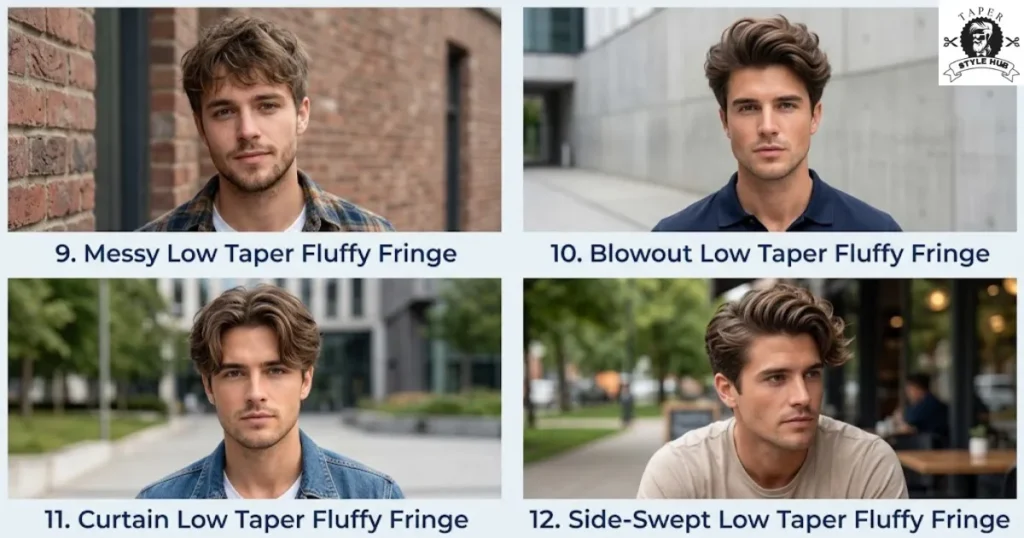
The finish controls the mood. Messy versions feel casual, blowouts feel bold, and parted versions feel polished. The haircut underneath stays the same, so you can switch finishes whenever you like.
“All The Types Shown Below Are Displayed In The Single Image Above☝️”
9. Messy Low Taper Fluffy Fringe
This is the “just woke up like this” look, except it takes a few minutes of product and a clean taper to look intentional. Scrunch texture paste through dry hair and avoid overworking it.
Best for: Casual everyday wear and men who skip combs.
10. Blowout Low Taper Fluffy Fringe
The top is dried upward and forward with a round brush, section by section, for maximum height. The low taper stops the shape from tipping into “too much.” Ask for roughly 3 to 4 inches on top.
Best for: Bold looks, parties, and thick to medium hair.
11. Curtain Low Taper Fluffy Fringe
A middle part splits the fringe into two soft curtains that frame the face. It opens the forehead and balances oval or oblong faces well. Blow-dry each side outward from the center using a light spray.
Best for: Oval or oblong faces and straight to wavy hair.
12. Side-Swept Low Taper Fluffy Fringe
A side part sweeps the fringe across the forehead while volume sits behind it. The look works in meetings as easily as on weekends. Comb the part in while the hair is slightly damp, then lift with your fingers.
Best for: Office days, interviews, and dressier weekends.
Low Taper Fluffy Fringe Styles by Look and Occasion
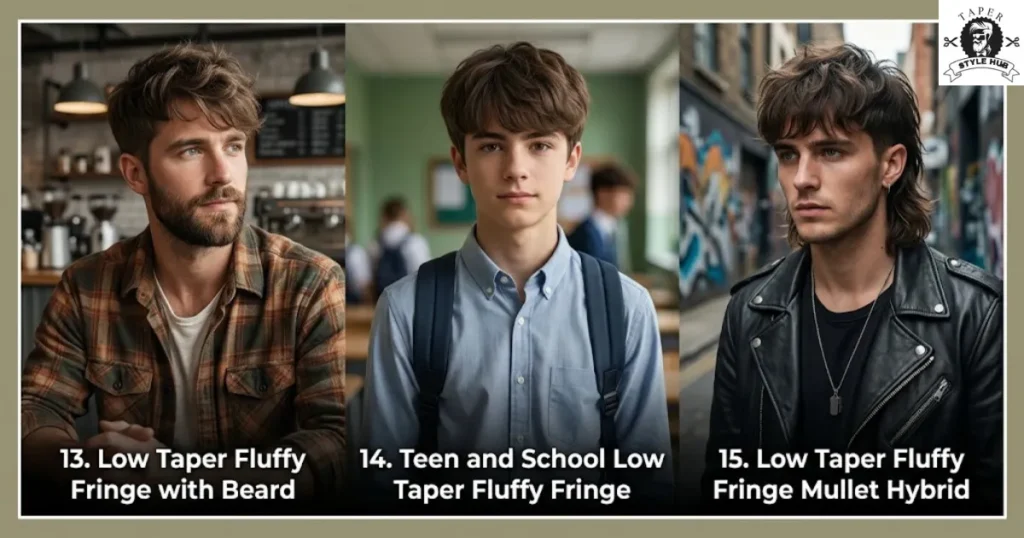
Some versions are built for a specific setting or style goal. These last three styles suit men who want the haircut to match a particular lifestyle, whether that means a beard, a school week, or a bolder statement.
“All The Types Shown Below Are Displayed In The Single Image Above☝️”
13. Low Taper Fluffy Fringe with Beard
A beard adds maturity fast, and the taper becomes the bridge connecting both. Blend the sideburns into the beard in one pass, and keep the fringe shorter than the facial hair so the balance feels deliberate.
Best for: Men with short to medium beards and strong jawlines.
14. Teen and School Low Taper Fluffy Fringe
This version is tidy enough for strict dress codes yet relaxed enough to feel current. The top stays soft and full without daily effort. A five-minute blow-dry with light mousse is all it needs.
Best for: Students aged roughly 13 to 20 with dress codes.
15. Low Taper Fluffy Fringe Mullet Hybrid
A modern, softer mullet influence adds length at the back while the fluffy fringe stays up front. The low taper cleans up the sides so the back length looks planned. Ask for layers, not a blunt edge.
Best for: Men who want a statement cut with modern softness.
How to Pick the Right Style for You
With 15 low taper fluffy fringe styles to choose from, picking one can feel overwhelming. A simple three-step process narrows the list quickly and helps you walk into the shop with confidence.
- Start with your hair type, since texture decides how much volume you get naturally.
- Check your face shape, then match the fringe length and finish to it.
- Consider your routine, and choose a shorter version if mornings are tight.
Once you have a shortlist of two or three styles, save photos of each. Your barber can then suggest which one suits your hair density and growth pattern best.
Barber Techniques Behind the Soft, Airy Look

Great results start with technique, not just length. Knowing a few barber terms helps you understand what is happening in the chair and lets you ask for the right method.
Internal Layering and Thinning Shears
Internal layering removes weight from the inside of the hair without shortening the visible length. Thinning shears do similar work on thick hair. Together, they create lift and movement, which makes the fringe look fluffy instead of heavy.
Scissor Over Comb and Clipper Over Comb
These blending methods create the gradual taper. The barber lifts hair with a comb and trims the ends with scissors or clippers. Slow, controlled passes avoid visible lines between guard lengths.
Half Guards and Lever Play
Barbers use the clipper lever to adjust blade closeness mid-pass. This softens the transition between guard numbers. If a taper looks stepped instead of smooth, the blending pass was probably skipped.
Wet Versus Dry Cutting
Wet hair looks longer than it dries, especially if your hair is wavy or curly. Ask your barber to check the length once the hair is dry. That small step prevents an accidentally short top.
How to Ask Your Barber for a Low Taper Fluffy Fringe
Walking in and saying the name of the haircut is a good start, but barbers work from specifics like fade height, guard numbers, and top length. Clear details prevent the wrong fade.
Here is a short script you can read straight from your phone:
“I would like a low taper starting about an inch above my ear, blended down to the neckline. Keep the top around 4 inches with internal layers, so it stays light and fluffy. No skin fade, please.”
Break that request into four details your barber needs to hear:
- Fade start point: Say an inch to an inch and a half above the ear, not just “low.”
- Top length: Give a number in inches instead of saying “kind of long.”
- Texture, not weight: Ask for internal layering or thinning shears if your hair is thick.
- Finish line: Request a soft blend at the neckline instead of a hard shaved edge.
Bring reference photos from the front, side, and back. Two people can use the same words and mean completely different lengths. Photos remove that guesswork and protect your fluffy top from being cut too short.
Questions to Ask Your Barber Before the First Cut
A quick conversation before the clippers start protects the result. These questions show the barber you care about detail, and the answers reveal how they plan to cut.
- Will you layer the top with scissors or thinning shears?
- How long will the top look once it dries?
- Where exactly will the taper start above my ear?
- How should I style this at home each morning?
A good barber answers clearly and adjusts the plan to your hair. If the answers feel vague, consider a second opinion before committing to the cut.
Hair Type and Face Shape Guide for a Low Taper Fluffy Fringe
Not every version flatters every head. Hair texture controls the volume you get, while face shape decides which fringe length and finish look best. Use these two tables as a quick reference before your appointment.
Best Match by Hair Type
| Hair Type | How It Behaves | Key Product |
|---|---|---|
| Straight | Falls flat and needs lift at the roots | Root-lifting spray |
| Wavy | Naturally airy and works with the taper | Sea salt spray |
| Thick | Holds volume but can look heavy | Matte clay |
| Fine | Needs extra lift and goes flat by midday | Volumizing mousse |
| Curly | Naturally full and needs shape, not lift | Curl cream |
Best Match by Face Shape
| Face Shape | Best Fringe | Styling Tip |
|---|---|---|
| Oval | Almost any length | Try any style in this guide |
| Round | Medium with height | Lift the top and keep the sides tight |
| Square | Soft, textured fringe | Messy volume softens strong angles |
| Heart | Fuller, brow-length fringe | Cover part of a wide forehead |
| Diamond | Mid to long fringe | Add width at the forehead |
| Oblong | Short to medium, full | Avoid too much height on top |
Not sure which category fits you? Tell your barber your hair type and face shape together. That combination, not the haircut name alone, helps them choose the right fringe length and taper height.
How to Style a Low Taper Fluffy Fringe Step by Step
The cut does half the work, but styling decides whether the volume actually shows. Once you learn the order, the full routine takes about five to ten minutes and gives the same result every morning.
- Towel dry until damp: Squeeze out excess water until the hair is damp, not dripping. Soaking hair will not hold volume.
- Apply a root product: Work a small amount of root-lifting spray or volumizing mousse into the roots, not the ends.
- Blow-dry upward and forward: Lift at the roots with your fingers or a round brush, and dry in sections for even height.
- Diffuse wavy or curly hair: Use low heat so the natural pattern stays together instead of being blown straight.
- Add a finishing product: When the hair is about 90 percent dry, use a pea-sized amount of cream, paste, or clay.
- Tousle with your fingers: Never comb it flat, because a comb removes the texture you just built.
What to Avoid When Styling
Skip heavy gels and waxes. They give hold, but they weigh the top down and kill the airy effect. If you need extra hold, layer a light spray over a lightweight cream instead of reaching for something heavier.
Best Products for a Low Taper Fluffy Fringe
One or two good products beat a bathroom shelf full of random ones. Choose light, matte formulas that add grip without weight, and match each product to your hair type.
- Sea salt spray: Adds grit and separation to wavy and medium hair.
- Volumizing mousse: Builds lift at the roots for fine and straight hair.
- Matte clay: Controls thick hair without shine or stiffness.
- Texturizing powder: Gives dry grip and instant volume to flat hair.
- Curl cream: Defines waves and curls without crunch.
- Light-hold finishing spray: Sets the shape without weighing down the fringe.
Pea-sized amounts are enough. You can always add more, but you cannot remove product without washing your hair again.
Hair Health Tips for Long-Lasting Fluffy Volume
Volume depends on healthy hair as much as on products. Dry, damaged strands collapse quickly, while hydrated, clean hair holds lift for hours. A few simple habits make a visible difference.
Scalp Care and Washing
A balanced scalp produces balanced oil. Washing two to three times a week keeps the roots light without stripping natural moisture. Overwashing makes hair frizzy, while underwashing makes it greasy and flat.
Heat Protection and Drying
Heat styling builds volume but also dries hair out. Use a heat protectant before blow-drying and keep the dryer on medium or low. Finish with a short burst of cool air to lock the shape in place.
Diet, Hydration, and Trims
Protein, iron, and plenty of water support strong hair growth. Regular trims remove split ends that weigh hair down. Healthy ends sit lighter and lift easier, which keeps the fringe looking full.
How to Maintain a Low Taper Fluffy Fringe
The fluffy top grows out gracefully, but the taper loses its sharpness first because the hair there is shortest. Expect the sides to need attention before the top does.
Week-by-Week Grow-Out Timeline
- Week 1: The taper is at its sharpest, and the top has full volume and definition.
- Week 2: The fade softens around the ears. The cut still looks intentional, though contrast drops slightly.
- Week 3: The taper blends into a softer shape, and most barbers recommend rebooking now.
- Week 4 and beyond: The taper loses shape, and the extra length pulls volume down.
Daily and Weekly Care Habits
- Wash two to three times a week with a gentle volumizing shampoo.
- Use a lightweight conditioner only, since heavy formulas flatten the fringe.
- Clean out product buildup with a clarifying shampoo every week or two.
- Tidy the neckline with a trimmer between visits, but leave the taper to your barber.
- Comb gently once a day, then style with your fingers.
Book a barber visit every three to four weeks to keep the taper clean. If you like crisp lines, go every two to three weeks. The fringe itself can wait six to eight weeks between layer refreshes.
Styling in Different Seasons and Climates
Weather changes how fluffy hair behaves. Humidity adds frizz and extra puff, while dry winter air can flatten the top or create static. Adjusting your routine by season keeps the style consistent all year.
Hot and Humid Weather
Use a light anti-frizz cream and avoid heavy products that melt under heat. A bit of texturizing powder absorbs oil at the roots. Shorter fringes also feel cooler in summer.
Cold and Dry Weather
Switch to a richer leave-in cream and condition the ends more often. Hats cause flat spots, so let your hair dry fully before wearing one. A quick finger tousle brings the volume back.
Low Taper Fluffy Fringe Cost Guide
A low taper fluffy fringe is not automatically more expensive than a standard fade, but blending takes skill and time. Prices vary by shop tier and city, so treat these ranges as rough estimates.
| Barber Tier | Typical Price | What You Usually Get |
|---|---|---|
| Budget walk-in shop | $15 to $25 | Fade and a basic top trim |
| Neighborhood barbershop | $25 to $45 | Fade, shaping, and light styling |
| Premium grooming lounge | $45 to $75 | Fade, layering, consultation, and styling |
| Master barber or salon | $75 and up | Precision layering, wash, and finish |
Spend your money on a barber with strong fade reviews. A rough blend on the sides is far more noticeable than a slightly uneven top.
Common Low Taper Fluffy Fringe Mistakes to Avoid
Small errors can turn a great cut into a flat one. Watch for these common problems before and after your appointment:
- Cutting the top while the hair is soaking wet, which hides the real length.
- Skipping root products, so the volume collapses by midday.
- Using heavy wax or gel that weighs the fringe down.
- Stretching appointments past four weeks and losing the taper shape.
- Accepting “just a little off” without agreeing on a length first.
Most of these mistakes come down to communication and consistency. Agree on clear numbers with your barber, keep your daily routine simple, and rebook right on time. Small, repeatable habits protect the shape far better than expensive products or occasional heavy styling sessions before big events.
Quick Glossary of Barber and Styling Terms
Barbershop language can sound confusing at first. This short glossary explains the terms used throughout this guide, so you can follow along and speak confidently during your next appointment.
- Taper: A gradual shortening of hair from the top down toward the sideburns and neckline.
- Fade: A blend that shortens hair more dramatically, sometimes down to bare skin.
- Fringe: The front section of hair that falls toward the forehead.
- Internal layering: Cutting shorter pieces underneath to remove weight and create lift.
- Point cutting: Snipping into the ends at an angle to create soft, broken edges.
- Thinning shears: Special scissors that remove bulk without shortening visible length.
- Nape: The back of the neck, where the taper usually ends.
- Diffuser: A dryer attachment that spreads airflow to protect waves and curls.
- Root lift: Volume created at the scalp using sprays, mousse, or blow-drying.
- Guard number: The clipper attachment size that sets the cutting length.
Final Thoughts on the Low Taper Fluffy Fringe
The low taper fluffy fringe works because it balances order with softness. Clean sides keep the outline sharp, while the airy top adds movement and personality. With 15 styles to choose from, almost every hair type and face shape has a match.
Pick one style, save a few photos, and use the barber script from this guide. Add light products, style with your fingers, and book regular trims. That simple routine keeps your low taper fluffy fringe looking fresh all year.
FAQs About Low Taper Fluffy Fringe
What is a low taper fluffy fringe?
It is a haircut with short sides that taper gently near the ears and neck, paired with a soft, layered fringe on top.
How often should I trim a low taper fluffy fringe?
Every three to four weeks keeps the taper clean. The fringe itself can wait six to eight weeks between layer refreshes.
Does a low taper fluffy fringe work on fine hair?
Yes. The taper removes side bulk, so the top looks fuller. Volumizing mousse at the roots helps carry the lift all day.
Is a low taper fluffy fringe suitable for school or office?
Yes. The low taper keeps the sides polished, and the top can be styled neater for formal days.
What should I tell my barber to get a low taper fluffy fringe?
Ask for a taper starting an inch above the ear, about 4 inches of layered top, and a soft neckline blend. Bring photos.

I’m M Ahmad Ansari, founder and content creator at Taper Style Hub. With 3+ years of experience researching taper haircuts, hairstyles, grooming, and men’s style, I create practical, accurate, and easy-to-understand content. My goal is to provide readers with trustworthy information, useful tips, and inspiring ideas for choosing and styling the perfect taper haircut.


6 Comments