
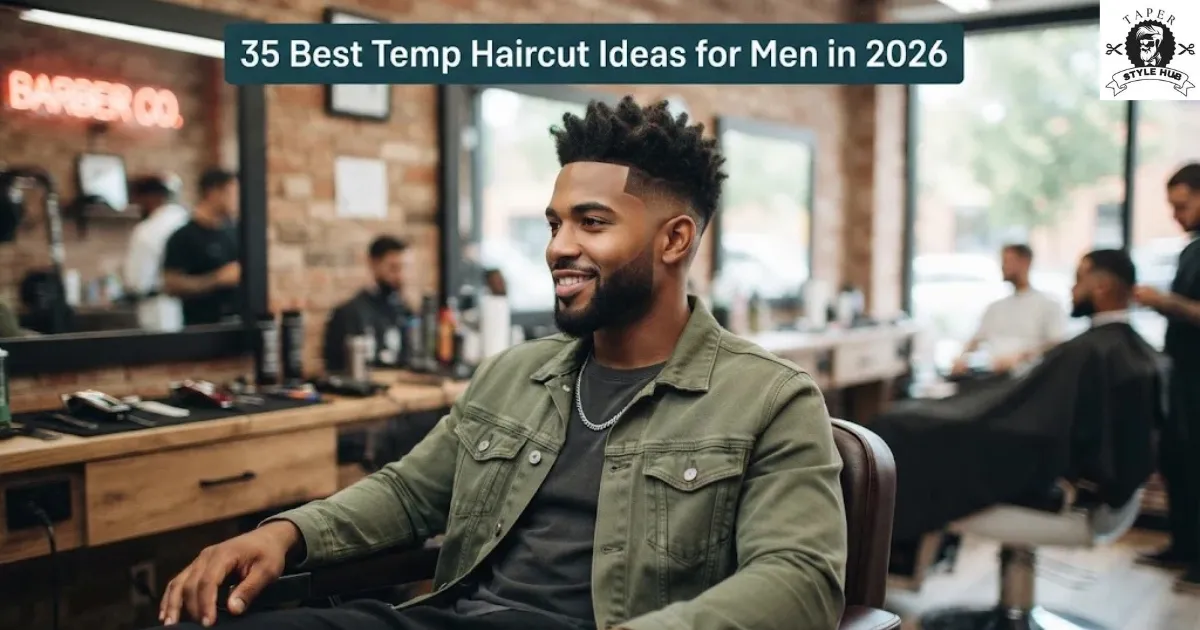
35 Best Temp Haircut Ideas for Men in 2026
A temp haircut is one of those cuts that looks sharp the second you leave the barbershop. The fade sits only at the temples and front sideburns, so the rest of your hair keeps its length, volume, and personality.
This guide covers 35 temp haircut styles for every hair type, from short curls to long locs. You will also learn what to tell your barber, how to style the cut, and how to keep it fresh between visits.
Whether you wear curls, waves, locs, or a clean crop, there is a version that fits your hair, your face, and your schedule. Let’s start with the basics, then move on to the styles.
👉 Also Read: Wolf Cut Men Short
What Is a Temp Haircut?
A temp haircut, short for temple fade, blends the hair at your temples and front sideburns from very short into your existing length. The top, back, and most of the sides stay long, so the face gets a clean frame.
The name causes some confusion, because barbers also say temple fade, temp fade, and Brooklyn fade. They all point to the same idea. What changes from shop to shop is whether the nape and a line-up come with it.
The cut grew out of Black barbershops and became a 90s favorite. Today the temp haircut works on straight, wavy, curly, and coily hair, which is why barbers hear the request more than almost any other detail.
👉 Also Read: Undercut Fade
Where a Temp Haircut Starts and Stops
The fade begins at the temple corner, where the front hairline meets the sideburn. It runs back toward the top of the ear and stops once the blend reaches your natural side length. The zone is usually only a few centimeters wide.
Because the area is so small, line quality matters more than anything else. A temp haircut with a smooth gradient and matching corners looks expensive. One with a visible line at the top of the blend looks cut instead of graduated.
👉 Also Read: Duck Tail Hair
Temp Haircut vs Taper Fade vs Full Fade
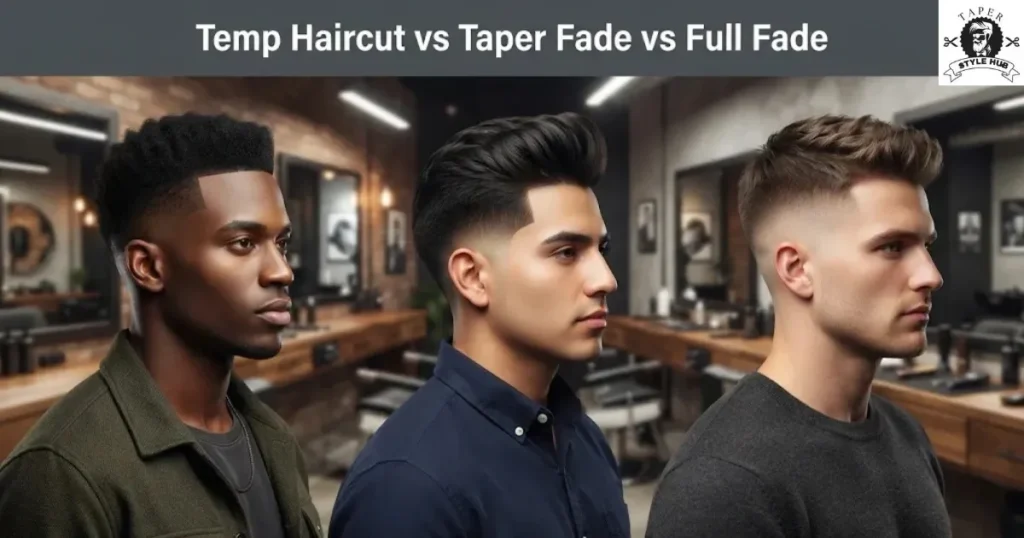
People mix these cuts up all the time, but placement separates them. A temp haircut stays at the front corners. A taper works the sideburns and neckline, and a full fade wraps around the whole head.
| Cut | Treatment Area | Main Visible Change |
|---|---|---|
| Temp haircut | Temples and front sideburns | Small blend at the front corners |
| Taper fade | Sideburns and neckline | Shorter edges with fuller sides |
| Full fade | Sides and back all around | Broad gradient across the head |
| Line-up | Hairline edge | Crisp outline, no length change |
You can combine them. Many men pair a temp haircut with a line-up for a crisp frame, and some barbers lay a temp fade on top of a skin fade so the front gets extra definition.
👉 Also Read: Medium Quiff Haircut
How to Choose a Temp Haircut for Your Face Shape
Face shape is a styling guide, not a rule. A good barber adjusts the height and the width of the temple blend to suit your features. These pairings give you a solid starting point.
- Round faces: a mid or high temp haircut adds height and makes the face look longer.
- Oval faces: almost every version works, so a classic low temp fade is the safe pick.
- Square faces: a mid blend with a textured top softens a strong jawline.
- Heart-shaped faces: a low blend with some side volume balances a wider forehead.
- Oblong faces: keep the top shorter and the blend low, so you do not stretch the face.
👉 Also Read: Military Fade
35 Temp Haircut Ideas Grouped by Category
Here are 35 temp haircut styles grouped into six categories. Each style comes with a short note on what it looks like and who it suits, so you can pick one fast and show it to your barber.
Height and Finish Temp Haircut Styles
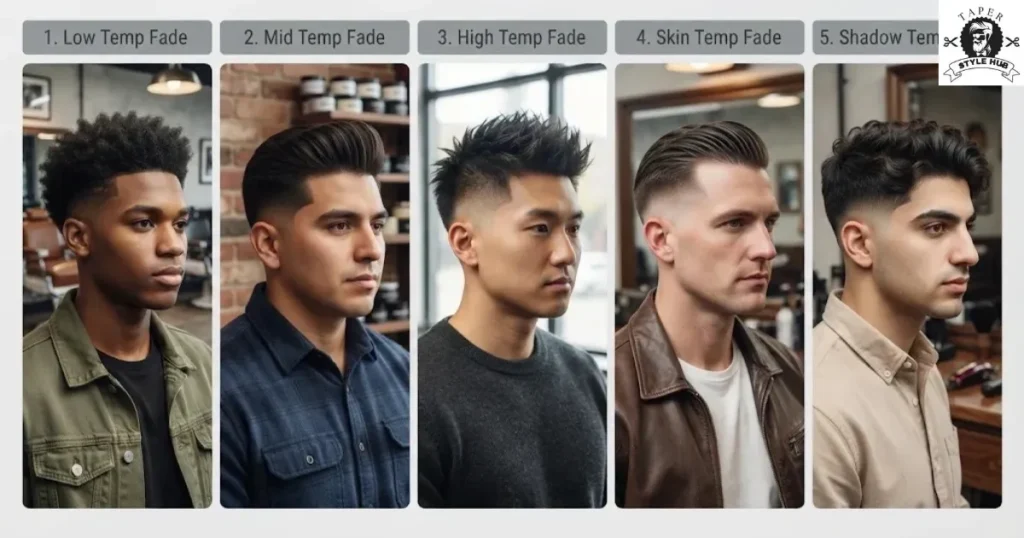
These styles change how high the blend climbs and how short it gets. Pick the height first, because it decides how bold the whole cut looks.
“All The Types Shown Below Are Displayed In The Single Image Above☝️”
1. Low Temp Fade
The low temp fade keeps the blend tight to the temple and sideburn. It is the most subtle version, so it grows out gently and feels safe for a first appointment with a new barber. Most clients start here.
Ask for a low temp haircut with a soft edge and a natural hairline. Style the top with matte clay for texture. It suits oval and heart-shaped faces, and it passes in any office.
2. Mid Temp Fade,
The mid temp fade carries the blend higher up the side for more contrast. It balances boldness and polish, which is why many men picture this height by default when they hear the name.
Tell your barber exactly how far up the blend should climb. A mid height flatters most face shapes and works with curls, waves, and straight tops. Finish with a light cream.
3. High Temp Fade
The high temp fade takes the blend well above the temples for strong contrast between the faded zone and the top. It exposes more scalp, so it reads bold and confident rather than quiet.
This version flatters round and square faces because it adds height. Expect to book touch-ups sooner, since a high blend shows regrowth quickly. Blow-dry the top upward for lift.
4. Skin Temp Fade
A skin temp fade goes down to bare skin at its shortest point. That zero length gives the sharpest contrast you can get, and it makes a temp haircut look crisp from every angle.
The trade-off is upkeep. Skin shows regrowth fastest, so plan a refresh every ten to fourteen days. Pair it with a short crop or a buzzed top for the cleanest finish.
5. Shadow Temp Fade
A shadow temp fade stops just short of skin and leaves a faint layer of hair. The blend looks soft and smoky instead of hard, and it hides uneven growth at the corners better than a bare finish.
It grows out gently, so you can stretch it to three weeks. It also suits sensitive skin and conservative workplaces. Ask for a number one guard at the lowest point instead of skin.
6. Drop Temp Fade
The drop temp fade curves down behind the ear instead of running straight back. That curve follows the shape of the head, so the cut feels contoured and a little more dramatic than a flat line.
It works especially well with voluminous curls or a textured top, because the curved edge adds movement. Show your barber a photo so the drop sits where you want it.
Temp Haircut Styles for Curly and Coily Hair
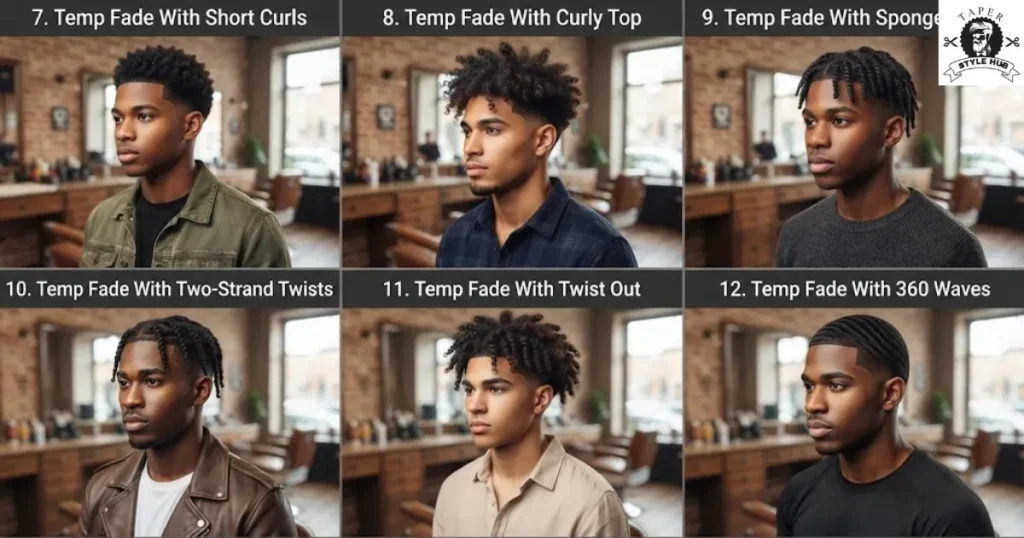
Curls and coils love a temp fade. The tight blend at the temples frames the texture and makes the top look fuller, because the sides keep their natural volume.
“All The Types Shown Below Are Displayed In The Single Image Above☝️”
7. Temp Fade With Short Curls
Tight short curls on top with faded temples make a clean, low-effort combination. The contrast between the crisp corners and the soft texture makes every curl stand out more. It is a favorite for men who want a polished look with minimal daily work.
Keep the curls about an inch long and ask for a clean temple blend. Apply curl cream to damp hair, scrunch gently, and let it air-dry for definition without crunch.
8. Temp Fade With Curly Top
Longer defined curls flowing on top look intentional when the temples are faded. The tight sides keep all the attention on the curls, so the style feels bold without looking messy or overgrown.
Leave three to four inches on top and ask for a clean temp haircut at the sides. Use leave-in conditioner first, then curl cream, and pick the roots lightly for volume.
9. Temp Fade With Sponge Twists
A twist sponge creates tight, even coils on top in a few minutes. The temp fade frames those coils with a sharp border, which gives short coily hair texture and shape at once.
Ask your barber to leave enough length on top for twisting. Dampen the hair, add a little curl cream, and twist in small circles. Refresh the look every few days.
10. Temp Fade With Two-Strand Twists
Neat two-strand twists on top with faded temples work as a protective style and a sharp haircut at the same time. The twists usually last one to two weeks with careful handling.
This look suits medium-length natural hair. Sleep in a satin durag to keep the twists neat, and refresh the scalp with a light oil. Book a temple touch-up when the corners soften.
11. Temp Fade With Twist Out
A twist out gives big, defined texture on top, and the temp fade carves a clean shape around it. The bigger the twist out, the stronger the contrast against the tight temples.
Undo the twists in the morning, fluff the roots, and add a little sheen spray for healthy shine. Ask for a tight temp haircut so the faded corners stay visible under the volume.
12. Temp Fade With 360 Waves
Deep, glossy 360 waves crowned by a temp fade are a barbershop classic. The line-up makes the wave pattern look even sharper, and the faded temples draw the eye straight to the ripple above.
Waves need consistency. Brush daily, wear a durag at night, and use a light wave pomade. Ask for brush-length hair on top and a clean line-up so the pattern stays the star.
Natural and Protective Temp Haircut Styles
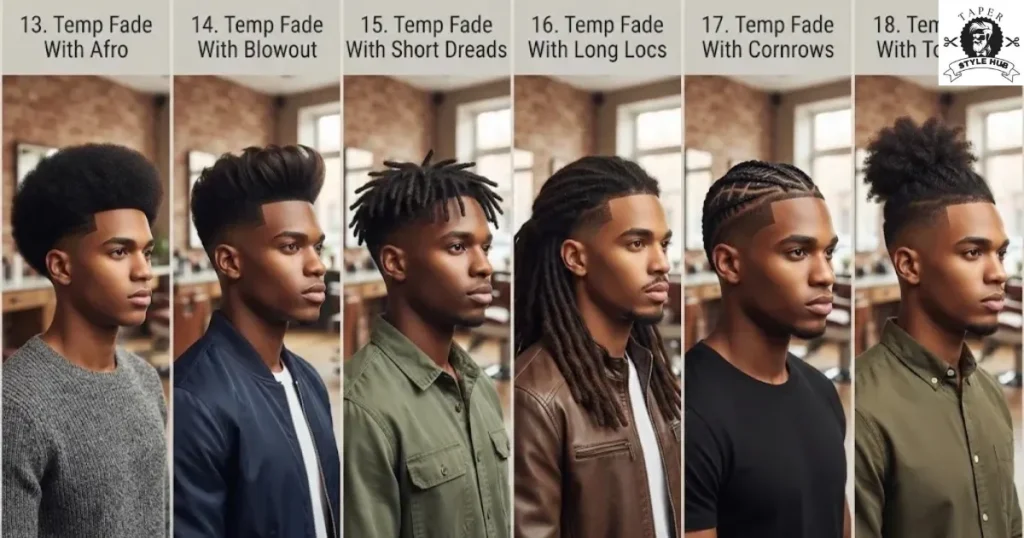
Longer natural styles pair beautifully with faded temples. The blend keeps big hair looking groomed and intentional, and it works whether your hair is loose, twisted, braided, or tied back.
“All The Types Shown Below Are Displayed In The Single Image Above☝️”
13. Temp Fade With Afro
A full, rounded afro with faded temples looks sculpted and neat. The fade shapes the outline, so the afro stays fresh between trims and holds a clean perimeter even as it grows. It is one of the earliest versions of the look.
Ask your barber to shape the afro round, fade the temples, and keep the line-up crisp. Pick the hair out daily for shape, and use a moisturizing cream to fight dryness.
14. Temp Fade With Blowout
A tall, blown-out top with faded temples brings big volume together with sharp edges. It is a real head-turner on thick hair with natural lift, and the fade stops the volume from looking shapeless.
Leave the top long and full, then blow-dry upward with a pick. A volumizing mousse locks in the height. The temp haircut at the sides keeps the whole shape tidy.
15. Temp Fade With Short Dreads
Short locs on top with faded temples look clean, modern, and easy to maintain. The fade keeps the early growing phase looking sharp, when short dreads often stick out in every direction. It is a smart option for anyone starting a loc journey.
Ask your barber to fade the temples and leave the locs alone. Retwist the roots every few weeks, and keep the faded skin moisturized with a light oil.
16. Temp Fade With Long Locs
Long locs pulled back or up look structured when the temples are faded. The fade adds shape to flowing hair, and it works whether you wear the locs down, tied back, or in a bun.
Keep the request simple: fade the temples and clean up the hairline. Tie the locs back to show off the blend, and use a scalp refresher spray to keep everything fresh.
17. Temp Fade With Cornrows
Neat cornrows on top flowing into faded temples create striking lines. The braids and the fade give you a protective style that still looks razor sharp, and it usually lasts two to four weeks.
Leave enough length on top for braiding, and wrap your hair at night to protect the pattern. Keep the faded edges clean with a trimmer, and book a touch-up when the corners fuzz.
18. Temp Fade With Top Knot
Pulling the top into a knot or bun while the temples stay faded gives you street style with sharp grooming. It is a favorite among creative types who have medium to long hair on top.
Ask your barber to fade the temples tight and keep all the length on top. Gather the hair into a knot, secure it, and use a little styling cream to tame flyaways.
Short and Sharp Temp Haircut Styles
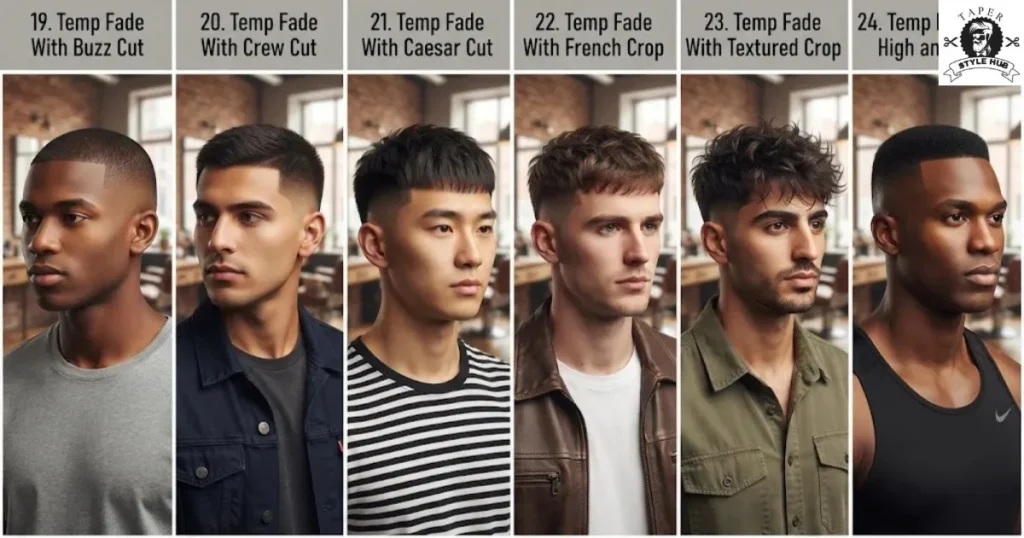
Short on top and sharp at the temples, these cuts suit men who want to look groomed with almost no daily effort. They also grow out evenly, which makes them easy to maintain.
“All The Types Shown Below Are Displayed In The Single Image Above☝️”
19. Temp Fade With Buzz Cut
One even length on top with faded temples is the simplest temp haircut you can get. It needs no styling, which makes it ideal for hot weather, gym routines, and busy mornings.
Ask for a number three on top and a fade down to skin at the temples. Wash, dry, and go. The whole style takes seconds. A line-up between cuts keeps the edges crisp.
20. Temp Fade With Crew Cut
The classic crew cut gets an upgrade here. Hair stays short on top and slightly longer in front, while the temples fade clean. It is a timeless, all-American look that works for every age.
Ask for a short, neat top with faded temples. A dab of matte product adds texture, but the cut looks good worn natural, too. It suits straight and wavy hair best.
21. Temp Fade With Caesar Cut
The Caesar cut brings a short, straight fringe across the forehead, and faded temples give it a modern finish. The fringe visually shortens a larger forehead, which makes the style practical as well as sharp.
Brush the fringe forward while the hair is damp, and use a light cream to hold it. Ask your barber for a straight fringe, faded temples, and a crisp line-up.
22. Temp Fade With French Crop
The French crop is the Caesar’s textured cousin. The fringe looks choppy and effortless, and the temples stay razor clean. It is a European favorite that keeps trending on straight and wavy hair.
Work texture powder or matte clay into dry hair, and mess it up on purpose. A temp haircut keeps the crop looking neat instead of sloppy, even on a busy day.
23. Temp Fade With Textured Crop
A messy, piecey crop on top with sharp faded temples looks like controlled chaos. Shaggy tops get a tidy frame this way. The texture hides cowlicks and adds movement, which makes the style perfect for thick, straight hair.
Spray sea salt onto damp hair, then add matte clay and scrunch for extra texture. Ask for lots of texture on top and a clean fade at the temples to balance it.
24. Temp Fade With High and Tight
This military-inspired cut keeps the sides very short and blends them into the temple fade, with a slightly longer strip on top. It is a favorite among athletes and servicemen who want zero fuss.
Ask for a short top and a temple fade that steps down to skin. The cut takes care of itself, so no styling is needed. Visit your barber every two to three weeks.
Bold Temp Haircut Styles That Stand Out
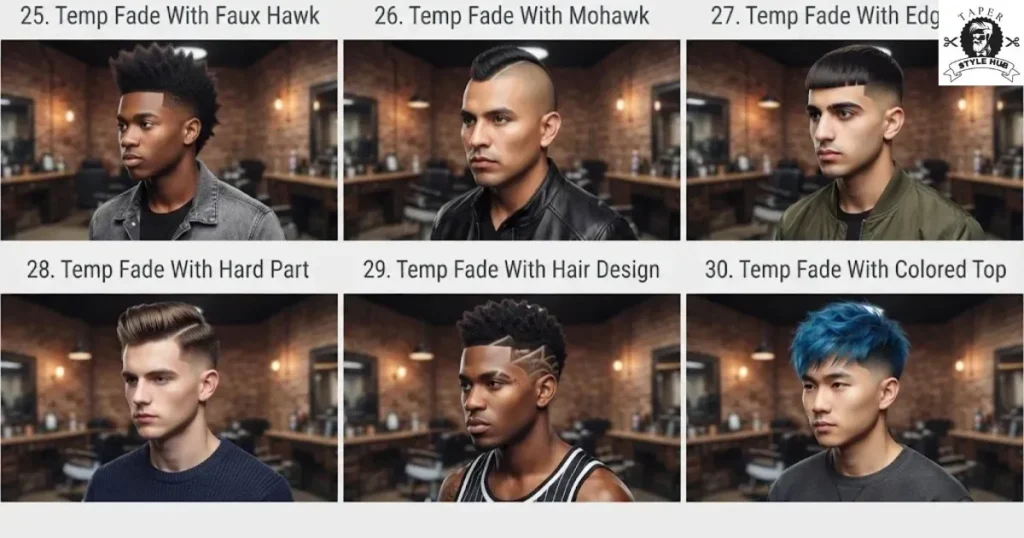
Ready to stand out? These looks use the temp fade as a launchpad for more edge, more attitude, and more compliments. Each one needs a confident barber and a clear photo.
“All The Types Shown Below Are Displayed In The Single Image Above☝️”
25. Temp Fade With Faux Hawk
The center strip stands tall while the temples fade away. You get the edge of a mohawk without the commitment, which makes it surprisingly wearable with the right outfit and a confident attitude.
Ask your barber to keep the middle strip long and fade the temples tight. Push strong-hold wax or gel upward from the sides, and the higher you go, the bolder the shape.
26. Temp Fade With Mohawk
A true narrow mohawk with temp-faded temples looks dramatic, because the fade makes the strip stand out even more. It is not for the shy, and that is exactly the point of the style.
Ask for a narrow strip on top and a fade down to skin at the temples. High-hold product is a must, so spike it up and own the look.
27. Temp Fade With Edgar Cut
The viral Edgar cut pairs a blunt, straight fringe and a sharp bowl line with faded temples. It is huge with younger guys right now, and it looks best on thick, straight hair.
Ask for a blunt fringe line, faded temples, and sharp edges. A flat iron gives the fringe its razor-straight finish, and a light serum fights frizz through the day.
28. Temp Fade With Hard Part
A shaved part line carved into the side with a temp fade below it is precision on top of precision. The hard part adds instant polish to any top, so sharp dressers love it.
Ask your barber to carve the part line first and fade the temples second. Comb the top away from the part, and a medium-shine pomade will define the line all day.
29. Temp Fade With Hair Design
Artistic lines, curves, or patterns carved into the faded zone turn your head into a canvas. A temp haircut with a design is pure self-expression, and it suits men who want a cut that nobody else has.
Designs last about one to two weeks before they grow out. Ask for two curved lines at the temple, keep the fade clean around them, and book weekly edge-ups to preserve the details.
30. Temp Fade With Colored Top
A bleached or dyed top, whether blonde, platinum, or a bold color, looks even louder against faded temples. The fade makes the color pop, and bleach shows best against darker skin and tight sides.
Get the fade done first, then plan the color. Trendsetters will enjoy the attention it gets. Purple shampoo keeps blonde bright, and a weekly deep conditioner helps, because bleached hair gets dry fast.
Polished Temp Haircut Styles for Work
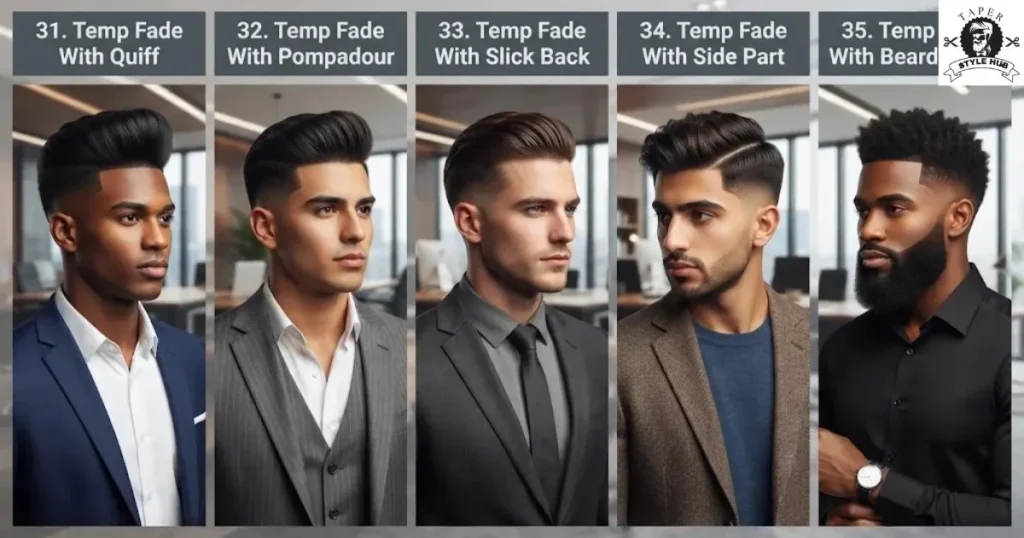
A temp haircut can look boardroom-ready, too. These classic tops stay refined while the faded temples add a modern edge, which makes them ideal for offices, interviews, and weddings.
“All The Types Shown Below Are Displayed In The Single Image Above☝️”
31. Temp Fade With Quiff
A voluminous quiff swept up and back with clean faded temples is a modern classic. It works for dates and big meetings alike, and it looks best on medium-length straight or wavy hair.
Leave about four inches on top, then blow-dry upward with a round brush. Lock in the lift with a medium-hold matte clay, and keep the temples tidy with regular touch-ups.
32. Temp Fade With Pompadour
The iconic pompadour gets a modern twist with big volume on top and a sharp fade at the temples. It is a timeless look that suits thick hair with natural lift, and it never really leaves style.
Ask for length on top for the pomp and faded temples at the sides. Blow-dry back and up, then finish with a classic pomade that offers medium shine and firm hold.
33. Temp Fade With Slick Back
The top combed straight back looks sleek and controlled, and faded temples add pure confidence. It is a power look for the office that works best on straight or wavy hair of medium length.
Keep the top long enough to slick back and fade the temples cleanly. Apply pomade to damp hair and comb straight back, because a little shine goes a long way.
34. Temp Fade With Side Part
A clean side part with a temp fade is the gentleman’s cut with a modern edge. It suits professional settings and almost every face shape, and it never looks like you tried too hard.
Ask your barber to define the part, keep the top neat, and fade the temples. Part damp hair with a comb, and use a light pomade to keep it polished without stiffness.
35. Temp Fade With Beard Blend
The temp fade flows straight into a shaped beard for one seamless blend from temple to jaw. A temp haircut does not blend into facial hair by default, so you need to ask your barber for it.
Tell your barber to fade the sideburns into the beard and shape the beard too. Beard oil keeps the blend soft, and brushing the beard downward helps it connect smoothly.
Is a Brooklyn Fade the Same as a Temp Haircut?
Mostly yes, but the names overlap loosely. Some barbers use Brooklyn fade for the temple blend alone, while others mean a longer shape with a sharper line-up and a faded nape.
The safest move is to describe the result you want instead of relying on the label. A temp haircut request with a photo and a clear height leaves nothing to chance.
Who Should Get a Temp Haircut?
A temp haircut suits anyone who wants cleaner temples without losing much side length. It works on every hair type, and it is a smaller change than a full fade, which makes it a friendly first step.
Skip it if your sides puff out as they grow. A temple-only blend removes no bulk, so it cannot slim the sides. In that case, a taper or full fade is the better fit.
Temp Haircut for Black, White, and Asian Men
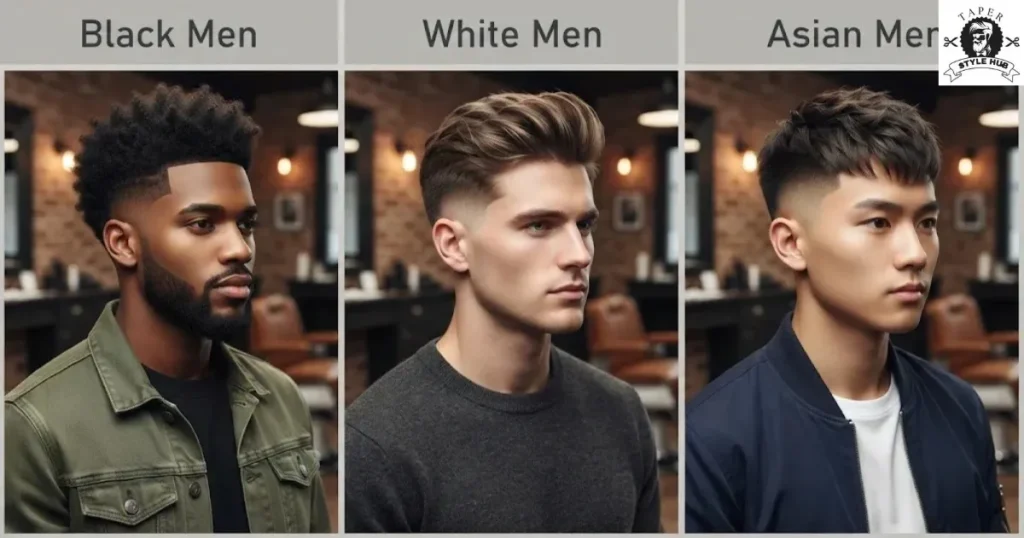
Black Men
Tight curls, waves, and afro textures hold the fade beautifully, and the cut grew out of Black barbershops. A crisp line-up and a clean temple blend make waves and short curls look deliberate.
White Men
Straight and wavy hair takes a razor-clean temple line well. Pair it with a textured crop, a quiff, or a side part, and a shadow finish keeps the blend soft against lighter skin.
Asian Men
Thick, straight hair suits a temp haircut with a Caesar cut, a French crop, or a textured top. The faded temples add shape and tidy the sides without taking away needed bulk on top.
How to Choose the Right Temp Haircut
Start with your lifestyle, not your mirror. A cut that looks perfect on day one but needs a barber visit every week will not suit everyone, so be honest about how much upkeep you want.
If You Want Low Maintenance
Choose a shadow finish with a low blend and a short top. It grows out softly, needs fewer touch-ups, and still gives you cleaner temples than a plain trim.
If You Want a Bold Look
Choose a high blend with a skin finish and a sharp line-up. Add a design or a colored top if you like attention, and plan on regular visits to keep it crisp.
If You Want a Professional Look
Choose a low or mid shadow blend with a side part, a quiff, or a short crop. The cut reads clean and modern, and it passes in any workplace.
How to Ask Your Barber for a Temp Haircut
Saying temp haircut alone leaves placement, finish, and neckline up to your barber’s imagination. Bring front and side photos, and confirm these five details before the clippers start.
- Areas: temples and sideburns only, or the nape as well.
- Height: low, mid, or high, matched to your reference photo.
- Finish: skin or shadow at the shortest point.
- Edges: a sharp line-up, a tapered edge, or a natural hairline.
- Length to keep: how much stays on top and behind the ear.
If you are unsure, start with a shadow finish and a natural edge. A temple cut back too far takes weeks to recover, while hair that is still there can always come off later.
Here is a sample request you can adapt: low temp fade, skin at the shortest point, soft front edge, nape left natural, and no length taken off the top.
How a Barber Creates a Temp Haircut
A barber marks the temple zone, cuts its lowest point shortest, and blends upward into the surrounding length. Most of the skill lies in matching both temples and hiding the top of the transition.
- Agree on the boundaries and the sharpness of the edges.
- Set the shortest point at the lower temple with a trimmer or a very short guard.
- Step up through longer guards, using the taper lever to fine-tune between them.
- Blend the upper edge with an upward rocking motion so no line remains.
- Compare both sides for symmetry, then add a line-up if you asked for one.
Guard numbers are reference points, not fixed settings, because lever range differs between clippers. A good barber works by eye while shaping any temp haircut, checking each side in the mirror before moving on.
How to Style a Temp Haircut
The fade itself needs almost no product, so all the styling happens on top. Match the product to your hair type, and keep heavy oils and waxes off the freshly faded skin, where they can clog pores.
Best Products for Each Hair Type
- Curly and coily tops: curl cream on damp hair for definition without crunch.
- Straight and textured tops: matte clay for grip and a natural finish.
- Wavy or slicked styles: a light pomade for shine and control.
- Volume and lift: texture powder or sea salt spray on damp roots.
- Dry or bleached hair: argan oil on the lengths, never on the faded skin.
Blow-dry the top with your fingers to set direction, then finish with the product. A temp haircut looks best when the top has clear shape and the temples stay clean and product-free.
Temp Haircut Maintenance and Touch-Up Schedule
A temp haircut grows out fast, because the shortest hair shows regrowth first. How often you need a refresh depends on how short the fade starts and how sharp you like it.
| Finish | Touch-Up Timing | What to Expect |
|---|---|---|
| Skin temp fade | Every 10 to 14 days | Shows stubble within a week |
| Shadow temp fade | Every 3 to 4 weeks | Grows out softly and gently |
| Line-up only | Every 1 to 2 weeks | Restores the crisp edge |
| Full cut | Every 3 to 4 weeks | Resets length and gradient |
Book a line-up around day ten to fourteen, when the corners begin to soften. Book a full cut once the gradient has disappeared or your length has grown past what you like.
At-Home Care Between Visits
Keep the area clean with a gentle cleanser and leave the edges to your barber. Rubbing product into freshly edged temples can irritate the skin, and a razor at home can overshoot into hair that should stay.
Temp Haircut for Different Hair Types
Straight and Wavy Hair
On straight hair the fade shows clearly, especially on a short cut. On longer straight hair, the surrounding length hides most of the blend, so the top styling becomes the bigger choice.
Thick, Curly, and Coily Hair
Tight textures hold their length evenly, so a temp haircut looks crisp and deliberate. Because the sides keep their volume, the faded corners frame the top instead of shrinking it.
Fine and Thin Hair
Fine hair benefits from a shadow finish, because a bare skin blend can look patchy where growth is sparse. Keep the top short and textured to create the illusion of fullness.
Temp Haircut for Thinning Hair and Receding Hairlines
Thinning hair does not rule out a temp haircut. You just need the right version, and a low or shadow blend usually works best because it hides thin spots around the temples instead of exposing them.
Avoid high-contrast skin blends if the hairline is receding, because the sharp edge draws attention to the thin areas. Ask for a natural finish and a curved line, since it grows out more forgivingly than a straight one.
Tell your barber about uneven growth or thin corners before the cut, so the shape can be planned around them. Softer is smarter here.
Over time, a receding hairline can change where the temple blend looks best. A good barber adapts the shape to the hairline instead of fighting it, so check in as your hair and hairline change.
How Much Does a Temp Haircut Cost?
At most barbershops, a temp haircut costs about the same as a regular men’s cut. Expect to pay a standard price for your area, since the fade is part of the haircut instead of a separate service.
Precision work can add a little extra. Skin finishes, sharp line-ups, and carved designs take more time, and many shops charge a small upcharge. Line-up-only visits between cuts usually cost much less.
Prices also vary by city and by the barber’s experience. It helps to ask about pricing before you sit down, especially if you want a design, a beard blend, or a razor line-up as part of the visit.
Can You Cut a Temp Haircut at Home?
Honestly, probably not well. The temples need perfect symmetry, and you cannot see both sides at once, which makes this one of the hardest cuts to do on yourself.
What you can do at home is maintain it. Clean up the neckline with a trimmer and leave the blending to a professional.
Home trimmers used in a mirror tend to push the corners back a little more each time. A temp haircut is worth paying a professional for.
Common Temp Haircut Mistakes to Avoid
Most mistakes come from vague requests or over-correction. A few small habits will protect your hairline and keep the cut looking sharp.
Asking by Name Only
Saying the name without a height leaves the result to guesswork. Always say low, mid, or high, and show a photo so the placement matches what you pictured.
Going Too High Too Soon
A high blend is dramatic and slow to grow out. If you are unsure, start lower, because a temple pushed back too far takes much longer to return.
Skipping the Blend
Visible guard lines look unfinished. The smooth gradient is the whole point of a temp haircut, so check both sides in the mirror before the barber takes the edge.
Razor Bumps and Sensitive Skin After a Temp Haircut
Very close cuts can cause razor bumps, especially on coarse or curly hair. If you are prone to them, ask for a shadow finish or a softer edge instead of a bare skin blend.
Bumps form when shaved hairs curl back into the skin. Avoid pulling the skin taut, never pluck a hair inside a bump, and see a dermatologist if they keep returning after you change your routine.
Temp Haircut Trends to Watch in 2026
Natural finishes are replacing harsh bare lines. More men are asking for a temp haircut with a shadow blend and a soft edge, because it looks modern and forgives the awkward days between barber visits.
Texture is also back. Messy crops, curly tops, and blown-out volume sit on top of tight temples, and bold details such as hard parts and carved designs add personality without a full fade.
Temp Haircut Barber Terms Glossary
Knowing a few barber terms helps you ask for the exact cut you want. These are the words you will hear most often in the chair.
- Line-up: a crisp trimmer edge along the hairline that does not change length.
- Taper: a gradual shortening along the sideburns and neckline.
- Shadow finish: a fade that stops just short of bare skin.
- Skin finish: a fade that goes down to bare skin.
- Nape: the area at the back of the neck below the hairline.
- Guard: the clipper attachment that sets cutting length.
- Shape-up: another name for a line-up or edge-up.
Why the Temp Fade Works So Well
The temple is where hairlines recede first and where growth turns irregular. Tidying that small area changes how polished the whole haircut looks, even when everything else stays the same.
It also keeps your options open. Because the sides and back keep their length, you can switch from a crop to curls to locs without redoing the fade, and you never commit to a full fade.
Finally, it frames the eyes. A sharp, even temple line draws attention upward and softens the transition between the sideburn and facial hair, where hair is often patchy and sparse.
How to Prepare for Your Appointment
A little preparation makes the visit smoother. Wash your hair beforehand, check in a mirror whether both temples grow the same way, and note any thin or uneven corners to mention at the start.
Save two or three reference photos from the front and side. Photos matter more than words, because labels like temp fade, temple fade, and Brooklyn fade vary from shop to shop.
Arrive with clean, dry hair and leave the top uncut if you only want the temples done. Most barbers will happily do a temples-only appointment, and it usually takes much less time than a full cut.
How Long Does a Temp Fade Take to Grow Out?
Most temp fades soften within two to three weeks and grow out completely in about six to eight. A shadow finish grows out gently, while a skin finish shows regrowth within about a week.
If you want to switch to a different cut later, the grow-out phase is easy. The sides keep their length, so only the temples need time to catch up, and a tidy line-up keeps the in-between weeks looking intentional.
Temp Fade Dos and Don’ts
Do This
- Bring front and side reference photos.
- Name the height, finish, and edges.
- Book regular line-ups between cuts.
- Keep heavy products off the faded skin.
Avoid This
- Do not trim your own temples in the mirror.
- Do not rush to a high blend on your first visit.
- Do not skip moisturizer on freshly edged skin.
- Do not ignore uneven growth; mention it first.
Essential Tools for Keeping Temples Sharp
A few simple tools help you stretch the time between barber visits. None of them replace a professional blend, but they keep the edges tidy and the cut looking fresh.
- A small trimmer for cleaning the neckline and sideburns.
- A soft brush to remove loose hair after a touch-up.
- A gentle cleanser for the temples and faded zone.
- A light moisturizer to calm freshly edged skin.
- A satin cap or silk pillowcase to protect texture overnight.
Quick Styling Routine for Busy Mornings
Five-Minute Morning Routine
- Dampen the top with water or a light spray.
- Blow-dry the top with your fingers to set direction.
- Warm a small amount of product between your palms.
- Work it through from the roots to the ends.
- Check the temples and wipe away any stray product.
This routine works for almost every top, from crops to curls. The faded temples do the heavy lifting, so you only need to shape the length and let the clean corners finish the look.
Weekend Refresh
Once a week, wash with a gentle shampoo, condition the length, and moisturize the faded zone. A quick brush-through spreads natural oils, and it keeps the skin around the temples calm and healthy.
Night Care
Protect your texture overnight with a satin cap or a silk pillowcase. It reduces frizz, keeps curls and waves defined, and helps the style survive until the next morning without a full restyle.
Final Thoughts on the Temp Haircut
A temp fade is a small, precise detail that makes a big difference. It sharpens the frame around your face, keeps your length where you want it, and works with curls, waves, locs, crops, and beards.
Pick the style that fits your hair and your life, bring a photo, and use the right words from this guide. Start conservative if you are unsure, and enjoy one of the cleanest haircuts in the shop.
Temp Haircut FAQs
What does a temp fade stand for?
Temp is short for temple. The fade blends the hair at the temples and front sideburns from very short into your existing length, while the top and back stay long.
What is the difference between a temp fade and a taper?
A temp fade focuses on the temples and front corners. A taper shortens the sideburns and neckline over a larger area for a softer overall blend.
How often should I get a touch-up?
Most men refresh every two to three weeks. Skin finishes need touch-ups about every ten to fourteen days, while shadow finishes can stretch to three or four weeks.
Does a temp fade work on curly hair?
Yes, it is one of the best pairings. The tight temples make curly and coily tops look fuller, and the sides keep their natural volume.
Does a temp fade work with a receding hairline?
Yes, with a low or shadow blend and a natural, curved edge. Avoid high-contrast skin finishes, because they draw attention to thin areas.

I’m M Ahmad Ansari, founder and content creator at Taper Style Hub. With 3+ years of experience researching taper haircuts, hairstyles, grooming, and men’s style, I create practical, accurate, and easy-to-understand content. My goal is to provide readers with trustworthy information, useful tips, and inspiring ideas for choosing and styling the perfect taper haircut.


3 Comments