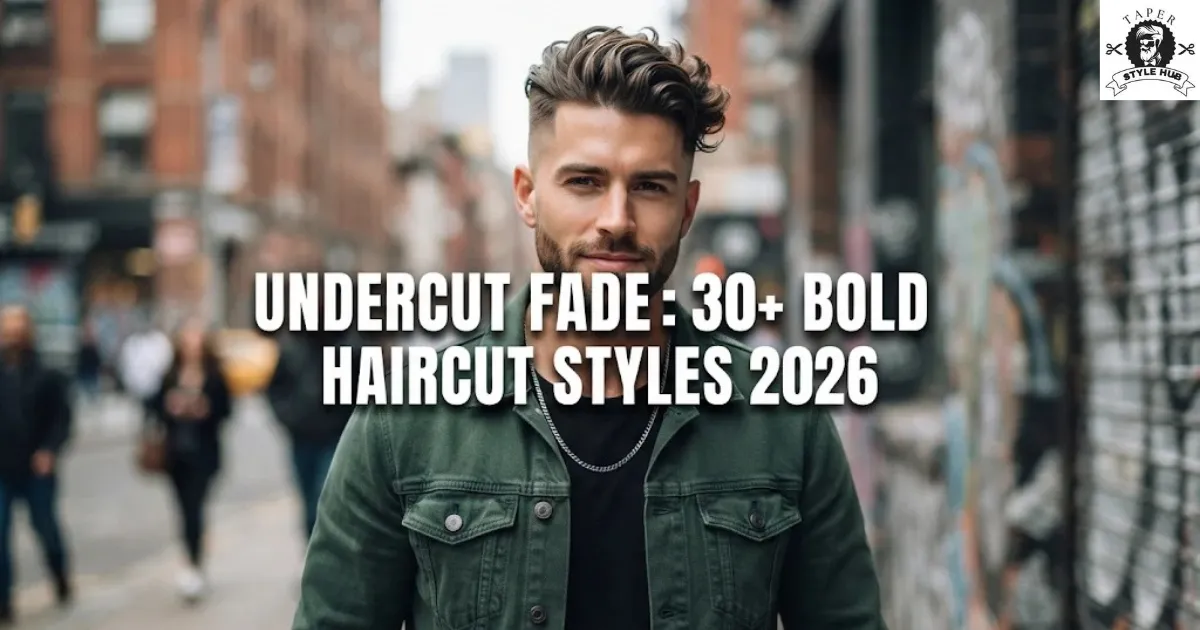
Undercut Fade: 30+ Bold Haircut Styles 2026
An undercut fade pairs a longer, textured top with sides that shrink gradually from short stubble to bare skin. The result is sharp, high-contrast and polished. This guide covers 35 styles, barber scripts and upkeep tips.
Whether you work in an office or spend weekends outdoors, there is a version that fits your hair type, face shape and schedule. We will cover every fade height, top style and texture.
👉 Also Read: Duck Tail Hair
Your Complete Guide to the Undercut Fade Haircut for Men
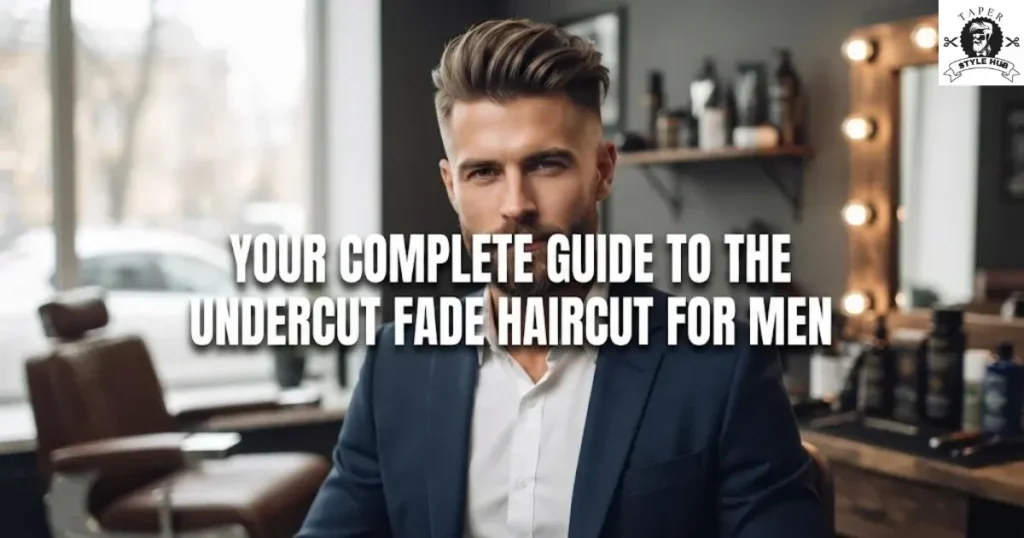
Use this guide as a roadmap. It explains the basics, compares nearby cuts, groups every style into clear categories and finishes with practical advice for the barber chair and your bathroom mirror.
👉 Also Read: Medium Quiff Haircut
What Is an Undercut Fade Haircut?
An undercut fade is a hybrid men’s haircut. It keeps the long top and the visible step of a classic undercut, then softens the clipped sides with a gradual fade. You get contrast on top and smooth blending below.
👉 Also Read: Military Fade
The Undercut Side of the Haircut
The undercut shortens the sides and back to a single clipper length, usually a number 1 to 3 guard, while the top stays two to six inches long. Nothing blends the two sections together.
👉 Also Read: Crew Cut Haircut
The Fade Side of the Haircut
A fade replaces that single length with a gradient. The clippers move through several guard lengths, so hair shortens little by little until it reaches skin or near skin at the neckline and around the ears.
👉 Also Read: Crew Cut No Fade
How the Two Techniques Work Together
Barbers keep the disconnected step under the top, then fade the clipped section from a number 2 down to skin. The line stays visible, yet the sides look softer, cleaner and far more modern than a flat clip.
Why the Undercut Fade Is Trending in 2026
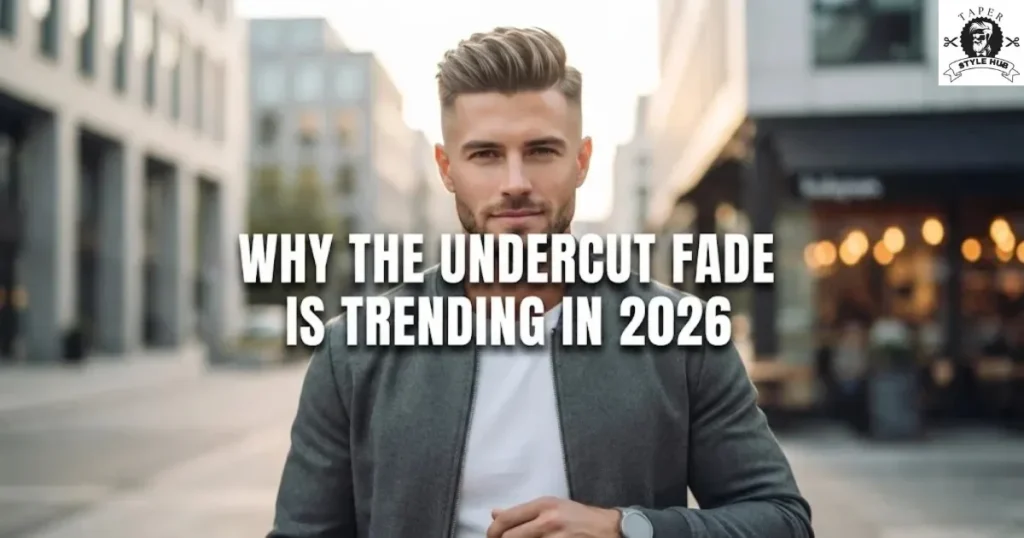
Men want haircuts that look sharp without a long morning routine. The undercut fade delivers that balance, because the short sides need no styling and the top can be finished in a few minutes.
Barbers also like its flexibility. The same base cut works with a slick back, a quiff, curls or a textured crop, so one consultation can lead to many different looks.
Public figures such as David Beckham and Cristiano Ronaldo have helped popularize short sides with longer tops, and social media keeps those looks in front of barbers and clients every day.
Works With Every Hair Type
Straight, wavy, curly and coily hair can all carry this cut. Thick hair loses bulk at the sides, while fine hair gains the illusion of density on top because the short sides frame it.
Modern, Versatile and Easy to Maintain
The cut dresses up with a suit and dresses down with streetwear. Maintenance mostly means short visits for the sides, which is far easier than managing a full head of length.
Social Media and Barber Culture
Short video platforms have turned the fade into a visual sport. Barbers post slow transitions and before-and-after clips, and clients arrive at the chair with saved photos instead of vague descriptions.
That visibility raises standards. Clients now expect smoother blends, sharper lines and a top that matches their texture, which pushes barbers to refine their technique every season.
A Short History of the Undercut Fade Haircut
The undercut dates back to the early twentieth century, when short sides and a longer top were a practical choice for working men. It faded from fashion, then returned with force in the 2010s.
Television dramas set in the 1920s, such as Peaky Blinders, pushed the sharp, disconnected shape back into barbershops. Barbers then borrowed fade techniques to soften the sides for modern tastes.
That mix produced today’s undercut fade. It keeps the vintage outline but replaces the harsh clip with a smooth gradient, which is why the cut feels both classic and current.
Undercut Fade vs Fade vs Taper: Key Differences
Barbers use the word undercut loosely, so clear language saves you from a bad surprise. This quick comparison shows how a classic undercut, an undercut fade and a regular fade differ.
| Feature | Classic Undercut | Undercut Fade | Regular Fade |
|---|---|---|---|
| Sides | One length, number 1 to 3 | Graduated from number 2 to skin | Graduated from scissor length to skin |
| Join with top | Visible step | Visible step | Fully blended |
| Top length | 3 to 6 inches | 3 to 5 inches | Buzz to 4 inches |
| Side visits | Every 3 to 4 weeks | Every 2 to 3 weeks | Every 2 to 4 weeks |
| Grow-out | Sides puff out | Fade blurs first | Shape holds longer |
Undercut vs Fade
An undercut leaves a hard step between the top and sides. A fade blends the sides into the top with no visible line. Choose the undercut for contrast and the fade for smoothness.
Fade vs Taper
A fade can reach bare skin, which creates a bold, dramatic finish. A taper keeps a little hair at the neckline and sideburns, so it looks softer and grows out more gently.
When to Choose Each
If you like bold, attention-grabbing contrast, pick the undercut. If you want a smooth finish that works with many outfits, pick the fade. If you want both, the undercut fade is the obvious middle ground.
Best Fade Height Styles for an Undercut Fade
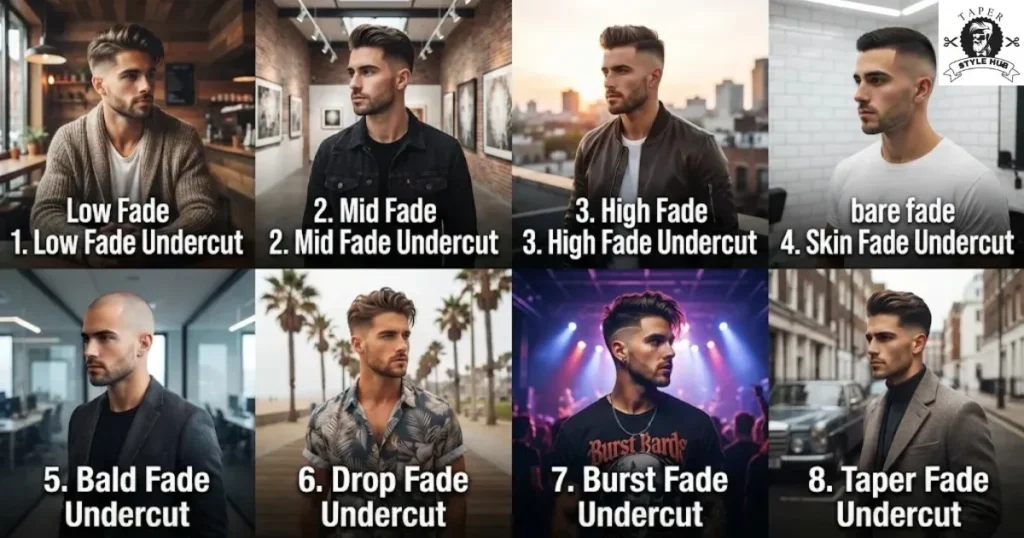
Fade height decides how much contrast you see. These eight versions change where the blend starts and how it finishes, so pick the one that matches your face shape and comfort with bold looks.
“All The Types Shown Below Are Displayed In The Single Image Above☝️”
1. Low Fade Undercut
The low undercut fade starts the blend just above the ear and keeps the sides subtle. It reads as clean and conservative, which makes it a safe first step into this style.
Pair it with a side part or a textured quiff. Fine hair and round faces usually look best here, because the low blend adds length instead of width.
2. Mid Fade Undercut
The mid fade undercut begins around the temple and shows more shape than a low blend. It is the most adaptable height, working across many hair textures and face shapes.
Style the top into a full pomp or a loose texture with matte clay. If you are unsure which height to request, start here.
3. High Fade Undercut
A high undercut fade starts well above the temples and creates the strongest contrast with the top. It highlights the jawline and cheekbones, giving the head a sculpted outline.
Square and angular faces carry it well. Comb the top up for volume or slick it back for a sleeker, more formal finish.
4. Skin Fade Undercut
The skin fade undercut takes the bottom of the sides down to bare skin. That razor-clean finish removes the shadow coarse hair leaves behind, even at a number 1.
It looks sharp but shows regrowth fastest. Book a touch-up every two weeks and keep three to four inches on top to balance the weight.
5. Bald Fade Undercut
The bald fade undercut drops to the skin early and blends upward quickly. The look is bold, no-nonsense and focused entirely on the hair left on top.
It suits most face shapes and dresses up or down easily. Warm climates and active lifestyles make it especially practical.
6. Drop Fade Undercut
The drop fade undercut curves lower behind the ear and follows the natural shape of the skull toward the nape. That curve adds an interesting dimension from the side and back.
It pairs with textured crops, slick backs and pompadours. Gray at the temples blends away neatly when the fade drops to skin.
7. Burst Fade Undercut
A burst fade undercut creates a rounded, semicircle blend around the ear, leaving more length at the back. The shape is edgy, playful and popular with younger clients.
It looks best with a mohawk-style top or a curly, textured crown. Ask for the burst to fade into the nape instead of stopping abruptly.
8. Taper Fade Undercut
The taper fade undercut shortens the sideburns and neckline only, keeping the sides softer and more natural. It feels gentle, so it suits conservative workplaces.
Ask for a number 2 on the sides with a tapered neckline. It grows out neatly, which makes it ideal for busy schedules.
Disconnected and Short Undercut Fade Styles
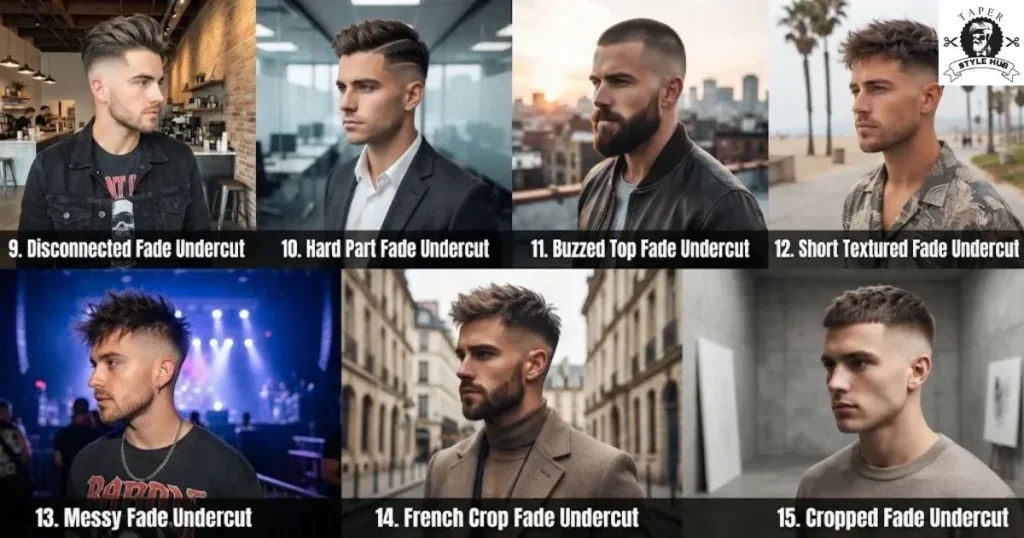
These styles lean on the step between top and sides. Short tops stay tidy with little effort, while disconnected versions show off the contrast and demand a little more attention.
“All The Types Shown Below Are Displayed In The Single Image Above☝️”
9. Disconnected Fade Undercut
The disconnected undercut fade leaves a clear gap between the long top and the short sides, with no blending across the join. Barbers fade only the clipped section underneath that step.
From pompadours to messy textures, the top can go anywhere. It looks its best for about two weeks before the sides need attention.
10. Hard Part Fade Undercut
A hard part fade undercut adds a razored line where the hair parts. That crisp line draws the eye to the top and frames the face with sharp definition.
Dark hair shows the line most clearly, while lighter hair softens it faster. Expect to refresh the part every one to two weeks.
11. Buzzed Top Fade Undercut
The buzzed top fade undercut clips the top with a number 4 guard and fades the sides lower. The contrast is faint, so the cut looks tidy without any styling effort.
Oval and square faces handle it best. It is the lowest-effort option: no product, no comb, only regular trims.
12. Short Textured Fade Undercut
A short textured fade undercut keeps two to three inches on top and point-cuts the ends so they break into separate pieces. The faded sides stay quiet underneath.
A pea-sized amount of matte paste worked from back to front is enough. Straight and slightly wavy hair give the best results.
13. Messy Fade Undercut
The messy fade undercut relies on rough-dried, finger-twisted texture on top. Because the sides are faded cleanly, the disorder looks planned instead of overdue for a haircut.
Use a little matte clay and avoid brushing. Wavy hair gives the most natural movement for this relaxed style.
14. French Crop Fade Undercut
A French crop fade undercut pairs a short, blunt fringe with faded sides. The top sits around two inches, and the fringe is cut straight across above the eyebrows.
Thick, straight hair is the ideal candidate. The fade removes side bulk, so the crop sits flat and neat.
15. Cropped Fade Undercut
The cropped fade undercut keeps the whole top short and textured while the sides fade to skin. As you remove hair from the head, you are free to add it to the face.
Cropped tops are popular, and the fade makes them look bolder. Pair the cut with a trimmed beard for balance.
Classic Styled Undercut Fade Haircuts
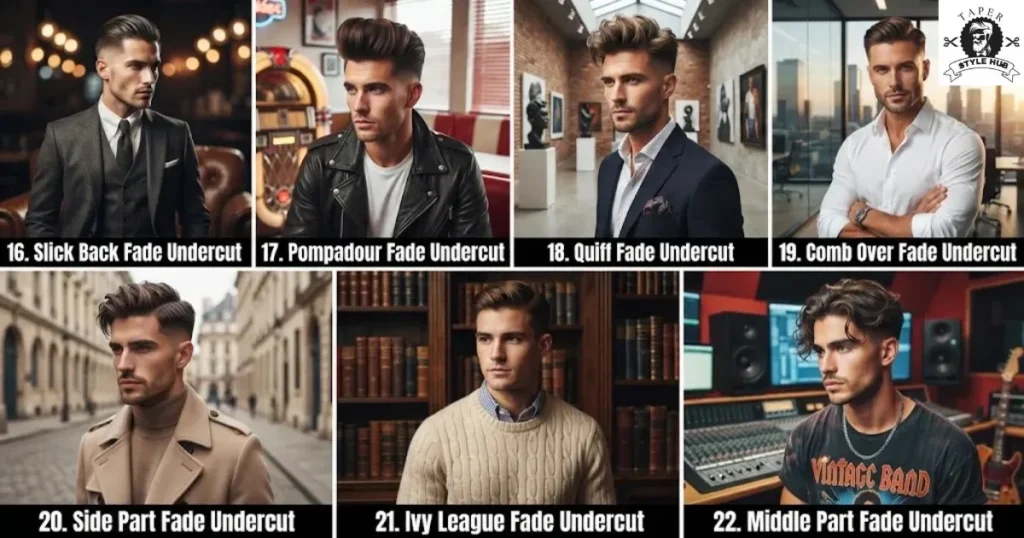
Slick backs, pompadours and quiffs made the undercut famous. These styles need four to six inches on top and a few minutes of styling each morning.
“All The Types Shown Below Are Displayed In The Single Image Above☝️”
16. Slick Back Fade Undercut
The slick back undercut fade combs four to five inches of hair straight back over sides that fade from mid height to near skin. The finish looks classy, defined and confident.
Blow-dry with a vent brush, then comb in a shine pomade. It works equally well at the office and at weekend events.
17. Pompadour Fade Undercut
A pompadour undercut fade lifts the front into height and fades the sides below it. The graduated top, longer at the front and shorter at the crown, rolls up and back.
Build the shape with a blow-dryer and round brush, then lock it in with a firm pomade. Short sides provide the contrast the style needs.
18. Quiff Fade Undercut
The quiff fade undercut sweeps the front up and back but stays fuller on the sides than a pompadour. It feels lighter, more casual and easier to restyle.
A little teasing and texture powder add volume. Switch between a polished finish and a tousled one depending on the occasion.
19. Comb Over Fade Undercut
A comb over fade undercut blends a deep side part with sharply faded sides. The timeless shape feels contemporary because the skin fade underneath sharpens every edge.
Round faces benefit most, since the diagonal sweep breaks up width. Keep the sides slimmer than the top for balance.
20. Side Part Fade Undercut
The side part fade undercut is the office-friendly choice. A neat part, a short comb-over and a low fade give a polished look that grows out quietly.
Use a light cream and comb the top to one side. Plan a side clean-up around week three, when the sides begin to puff.
21. Ivy League Fade Undercut
An Ivy League fade undercut softens the preppy, classic cut with faded sides. The smart shape feels less formal, yet remains tidy enough for work.
Keep the top a little longer than a crew cut and part it lightly. Short sides mean styling takes almost no time.
22. Middle Part Fade Undercut
The middle part fade undercut splits the top evenly and lets it fall to both sides. It has become a modern favorite and pairs well with a low or mid blend.
Curl the ends with a round brush and a hair dryer for volume. A light styling product keeps the shape in place.
Undercut Fade Styles by Hair Type and Texture
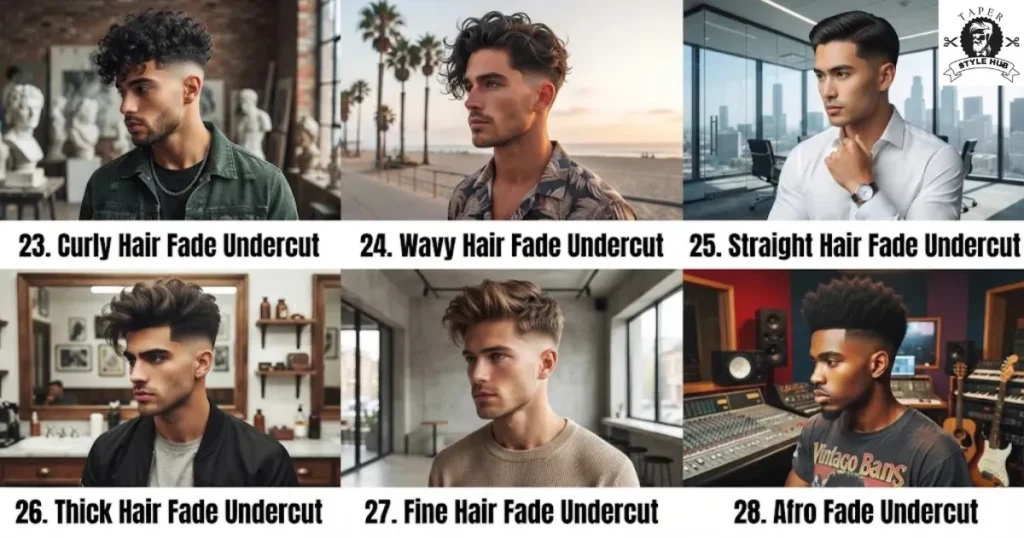
Hair texture changes how a cut behaves between visits. These six versions show how the same fade undercut adapts to curls, waves, straight strands and everything between.
“All The Types Shown Below Are Displayed In The Single Image Above☝️”
23. Curly Hair Fade Undercut
A curly hair undercut fade removes bulk from the sides and leaves the curls to take center stage. The clean contrast highlights curl shape and prevents a triangular outline.
Judge the top length with the curls dry, because they can shrink by half. A curl cream cuts frizz and adds definition.
24. Wavy Hair Fade Undercut
The wavy hair fade undercut gives natural movement a frame. Waves add dynamic motion on top, and the shorter faded sides make that texture look deliberate.
Finish with sea salt spray and air-dry or diffuse. The result stays relaxed, sophisticated and low effort.
25. Straight Hair Fade Undercut
Straight hair holds a clean line better than any other texture, so a disconnected fade undercut looks intentional rather than messy. The blend reads smoothly with nothing fighting it.
Without product, the top can look flat. Add texture powder at the roots or a matte paste to build lift.
26. Thick Hair Fade Undercut
Thick hair carries a fade undercut with ease. The fade strips weight from the sides, while the full top keeps its volume and presence.
A high or skin blend works well because heavy hair hides nothing. Regular trims stop the sides from ballooning outward.
27. Fine Hair Fade Undercut
Fine hair benefits from a lighter touch. A low or mid taper fade undercut makes the top look thicker by comparison and avoids a harsh gap against thin strands.
Keep the top at three to four inches and blow-dry it upward. Volumizing powder at the roots helps prevent collapse.
28. Afro Fade Undercut
An afro fade undercut lets natural volume command attention on top. A bald or skin fade on the sides creates a crisp, structured contrast.
A sharp line-up keeps the hairline clean between visits. Sponge twists or a shaped top add even more definition.
Statement and Long Hair Undercut Fade Styles
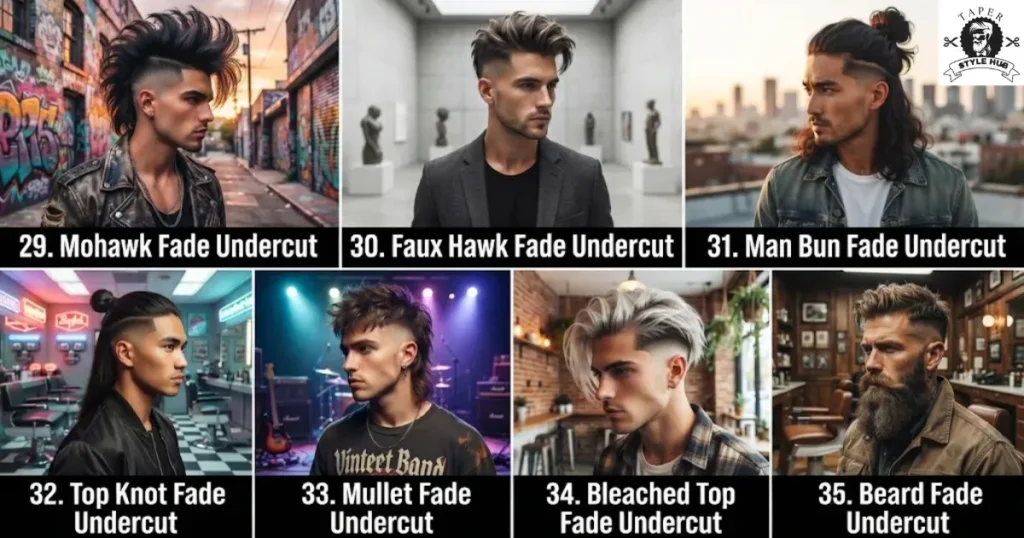
These cuts push further. Some keep serious length for tying up, while others add color, shaved details or bolder shapes. Each one needs a barber you trust.
“All The Types Shown Below Are Displayed In The Single Image Above☝️”
29. Mohawk Fade Undercut
The mohawk undercut fade pairs sharply faded sides with a raised central strip. It blends a traditional punk spirit with a modern, cleaner finish.
It adapts to many textures and works well on younger clients. Style the strip upward with strong clay or paste.
30. Faux Hawk Fade Undercut
A faux hawk fade undercut keeps some hair at the sides, though not much. The fade makes the central crest stand out without the commitment of a full mohawk.
Pair it with a mid or high fade and a connected beard. The result is rugged, yet still smooth.
31. Man Bun Fade Undercut
The man bun fade undercut ties longer top hair into a bun while the sides stay faded and fresh. It combines casual cool with a polished, put-together look.
It suits meetings and nights out alike. Your hair also becomes easier to manage than a full head of length.
32. Top Knot Fade Undercut
A top knot fade undercut clips everything below the parietal ridge short and ties eight to ten inches of top hair at the crown. It avoids bulky sides.
Let the hair down and it covers the faded sides completely. Thick, voluminous hair works best.
33. Mullet Fade Undercut
The mullet fade undercut brings back a retro favorite. The sides fade to skin, the top is spiked or kept at one length, and the back stays longer.
It looks professional enough for work and relaxed enough for weekends. Barbers say mullets are making a serious comeback.
34. Bleached Top Fade Undercut
A bleached top fade undercut adds color contrast to shape contrast. Lightened ends over a dark, faded base make texture and movement far easier to see.
Bright pink or blue over a dark base is another option. Color needs extra care, so use a moisturizing conditioner.
35. Beard Fade Undercut
A beard undercut fade blends the faded sides directly into your facial hair. The sharpness of the fade connects to the beard and makes the whole look feel intentional.
A bushy beard will not look unkempt next to short sides. Trim the beard weekly to keep the transition crisp.
Celebrity-Inspired Undercut Fade Looks
Public figures often set the trend that clients bring to the barber. These examples show how one basic cut can look very different depending on the top and the fade height.
David Beckham and the Classic Slick
David Beckham has worn many versions of the cut over the years. His slicked, side-swept looks show how a longer top and tidy sides can fit both the pitch and the red carpet.
Cristiano Ronaldo and the Sleek Fade
Cristiano Ronaldo is known for sharp, faded sides and a carefully styled top. His neat finish proves that a fade can look clean enough for sport and polished enough for photos.
Zayn Malik and the Textured Quiff
Zayn Malik has often paired faded sides with a lifted, textured top. The look keeps edge in the shape while the clean sides keep the overall finish refined.
Brad Pitt and the Vintage Undercut
Brad Pitt wore a slicked-back undercut for the film Fury, a vintage shape built on short sides and a heavy comb-back top. Add a soft fade and the same outline feels modern.
Undercut Fade Color Ideas for Extra Contrast
Color makes the step between the top and sides even easier to see. You can keep it subtle with natural tones or go bold with a statement shade.
Natural Tones and Subtle Highlights
Soft caramel or sun-lightened ends add depth to wavy and curly tops without a dramatic change. They also grow out gracefully, so you can wait longer between salon visits.
Bleached and Bright Tops
Bleached blonde, silver, pink or blue tops create maximum contrast over dark faded sides. Expect extra upkeep, because lightened hair needs moisture, gentle shampoo and regular toning.
How to Choose the Right Undercut Fade for Your Face Shape
Face shape decides where the clipped line sits and how much height the top needs. Short sides make the head look narrower, so ask whether you need more height or more width.
| Face Shape | Best Undercut Fade | Top Length | Avoid |
|---|---|---|---|
| Oval | Almost any version | 2 to 6 inches | Heavy fringes that hide the forehead |
| Round | High fade with quiff or comb over | 4 to 5 inches, styled up | Flat, forward crops |
| Square | Textured or buzzed top | Half an inch to 3 inches | Tall pompadours |
| Oblong | Low fade with fringe | 3 to 4 inches, worn forward | High fades with extra height |
| Heart | Side-swept or fringe | 3 to 4 inches | High skin fades |
| Diamond | Taper with loose side sweep | 3 to 5 inches | Slick backs that expose the forehead |
Oval and Square Faces
Oval faces can wear almost any version because the proportions already balance. Square faces suit textured tops with a mid or high blend, which softens a strong jaw without hiding it.
Round and Long Faces
Round faces benefit from height on top, so a quiff or pompadour adds length instead of width. Long faces need the opposite: keep the top lower and choose a low or mid blend.
Which Undercut Fade Should You Choose? Quick Picks
Still undecided after 35 options? These quick picks match common goals with the best starting point.
- Lowest maintenance: buzzed top or taper style.
- Office friendly: side part with a low fade.
- Maximum contrast: skin blend with a disconnected step.
- Curly hair: mid blend with a defined curly top.
- Fine hair: low taper with a textured, lifted top.
- Long hair lovers: man bun or top knot with a mid blend.
How Long Should Your Hair Be for an Undercut Fade?
You need at least two inches on top for the step to show clearly. Slick backs and pompadours need four to six inches, while buzzed tops can stay under an inch.
If your top is too short today, ask the barber to fade the sides now and let the top grow. Curly hair needs extra length because curls shrink when dry.
Wearing an Undercut Fade at Work, the Gym and Formal Events
A good haircut should fit your life, not fight it. The same cut can look conservative or edgy depending on the fade height, the part and the finish on top.
Professional Looks
Office settings reward a low or taper blend with a neat side part. Keep the top short enough to comb, and avoid razored lines that can read as too bold.
Edgy Weekend Looks
Weekends call for higher contrast. Try a skin blend, a burst shape or a messy textured top, then switch back to a tidier finish on Monday.
Gym and Hot Weather
Short faded sides stay cool and dry quickly after a workout. Tie longer tops back with a band, or choose a cropped top so sweat never disrupts the shape.
Haircut Numbers and Guard Lengths for an Undercut Fade
Guard numbers are the language of the clipper. Knowing them helps you describe the sides exactly, so your barber does not have to guess how short you want the blend to finish.
| Guard Number | Length in Inches | Length in Millimeters | Typical Use |
|---|---|---|---|
| Number 1 | 1/8 inch | 3 mm | Short sides and the base of a fade |
| Number 2 | 1/4 inch | 6 mm | Classic undercut sides |
| Number 3 | 3/8 inch | 10 mm | Softer sides and upper blends |
| Number 4 | 1/2 inch | 13 mm | Buzzed tops and gentle gradients |
Most fades start with no guard at the bottom and climb through these numbers toward the step. Always confirm the starting number, because it decides how bold the finish looks.
What to Tell Your Barber for an Undercut Fade
Most bad haircuts begin with a vague request. Bring a front photo and a side photo, then name three things: the guard number, the fade height and the top length in inches.
Use these scripts as a starting point:
- Short version: number 1 on the sides, no blending, and two to three inches on top, point-cut for texture.
- Disconnected version: number 2 on the sides, four inches on top, and a razored hard part.
- Undercut fade: keep the step, then fade the sides from a number 2 to skin at mid height, with three to four inches on top.
- Slick back version: number 2 sides, five to six inches on top, cut so it combs straight back.
Ask your barber to check your crown before cutting. A strong cowlick can push a long top upward at the step, and moving the line half an inch lower often solves it.
How to Style an Undercut Fade Every Day
Essential Tools and Products
A quality trimmer, a sturdy comb, a hair dryer and the right product handle most styles. Choose matte clay for texture, pomade for shine and curl cream for curls.
Quick Everyday Routines
Towel-dry the hair, apply a dime-sized amount while slightly damp, then style with a comb or fingers. Brush it back for neat days and rough it up for casual ones.
Texture and Volume Tips
Add volume at the roots by blow-drying upward, then set the shape with a light spray. Finish with a small amount of product through the ends so the top keeps its movement all day.
Products Matched to Hair Texture
The right product depends on texture and finish. Use this table as a quick shopping guide before your next visit.
| Product | Hold | Finish | Best For |
|---|---|---|---|
| Matte clay | Strong | Dry, textured | Thick and straight hair |
| Matte paste | Medium | Natural | Short textured tops |
| Shine pomade | Medium to strong | Glossy | Slick backs and pompadours |
| Curl cream | Light | Soft, defined | Curly and wavy hair |
| Sea salt spray | Light | Beachy | Wavy and messy styles |
| Texture powder | Light | Matte, lifted | Fine hair and roots |
How to Get the Best Undercut Fade at the Barbershop
A great result starts with a short consultation. Spend two minutes explaining your lifestyle and styling habits before the clippers come out.
Choose the Right Barber
Look at a barber’s recent fades on social media. Clean blending, sharp lines and consistent results across different hair types are the signs of real skill.
Check the Mirror Before You Leave
Ask to see the back and sides in a hand mirror. Confirm the blend, the neckline and the top length while the barber can still adjust them.
Undercut Fade Maintenance and Trim Schedule
A faded undercut looks its best for about two weeks, then the blend starts to blur. Plan visits before the shape fully grows out, because a quick touch-up is cheaper than a rebuild.
| Task | How Often | Notes |
|---|---|---|
| Sides and fade | Every 2 to 3 weeks | Every 2 weeks for skin |
| Top trim | Every 6 to 8 weeks | Ask for texture |
| Neckline at home | Weekly | Trimmer only |
| Daily styling | Every morning | Pea-sized product |
Avoid re-cutting the fade line yourself. A slightly wrong guard length breaks the blend your barber built, and it is harder to repair than a fresh cut.
Weekly habits help. Trim the neckline with a small trimmer, brush the top daily and avoid heavy product buildup that can dull the contrast between the top and sides.
Growing Out the Cut
A faded version grows out more gracefully than a hard disconnected line. Around week four the blend softens, so ask your barber to taper the sides and let the top continue growing.
Scalp and Hair Care for an Undercut Fade
Short sides expose more skin, so scalp health matters. Healthy skin also makes the fade look cleaner and keeps the top full of life.
Skin and Sun Protection
Faded sides show more scalp, which burns easily in summer. Apply sunscreen to exposed skin and wear a hat during long hours outdoors.
Washing and Conditioning
Wash two to three times a week with a gentle shampoo, then condition the top. Overwashing strips natural oil and leaves the faded areas looking dry.
Common Mistakes to Avoid With an Undercut Fade
Even a skilled barber cannot rescue a poorly planned cut. Avoid these common errors to protect your shape and your time.
- Skipping reference photos, which leaves the fade height open to guesswork.
- Choosing a skin blend when you can only visit every four weeks.
- Leaving the top too short to style, which wastes the contrast.
- Over-washing and drying the scalp, which causes flaking along the fade.
- Using heavy pomade on fine hair, which flattens the top.
- Cutting the line yourself between appointments.
Who Should Think Twice About an Undercut Fade
This cut puts the outline of your head on show, so a few situations call for another style.
- Thinning on top: short sides make sparse hair look thinner, so choose a low taper.
- A strong double crown or cowlick, which can split a long top.
- Scars or bumps on the sides, which a number 1 clip reveals.
- No time for barber visits every three weeks.
- Strict workplaces: choose a low fade with a neat side part.
If any of these points describe you, a blended fade or a short crop keeps the contrast gentler. You can still enjoy the cut with a lower line and a shorter top.
Final Thoughts on the Undercut Fade
The best undercut fade comes down to three choices: how short the sides go, where the blend starts, and how much top you are happy to style each morning.
Save a side-view photo, share clear numbers with your barber and book your first touch-up before leaving the chair. A sharp cut is only half the work; consistency does the rest.
With 35 undercut fade styles to choose from, you can always find a version that matches your hair, your face and your routine. Start with a mid blend if you are unsure, then adjust after a few weeks.
FAQs About the Undercut Fade
What Is an Undercut Fade?
An undercut fade combines an undercut’s long top and visible step with fading sides. The result is high contrast with softer, cleaner blending below.
How Often Should You Touch Up an Undercut Fade?
Most men need the sides refreshed every two to three weeks. The top usually needs trimming every six to eight weeks.
Does an Undercut Fade Work on Thin Hair?
It works on fine hair of normal density. If your top is thinning, choose a low taper and keep the top shorter.
Can You Get an Undercut Fade With Curly Hair?
Yes, and curls often suit it better than straight hair. Short faded sides stop the cut from growing wide.
Is the Undercut Fade Still in Style?
Yes. Shorter, more textured versions are the most requested now, while the slick back remains right for formal settings.

I’m M Ahmad Ansari, founder and content creator at Taper Style Hub. With 3+ years of experience researching taper haircuts, hairstyles, grooming, and men’s style, I create practical, accurate, and easy-to-understand content. My goal is to provide readers with trustworthy information, useful tips, and inspiring ideas for choosing and styling the perfect taper haircut.
4 Comments